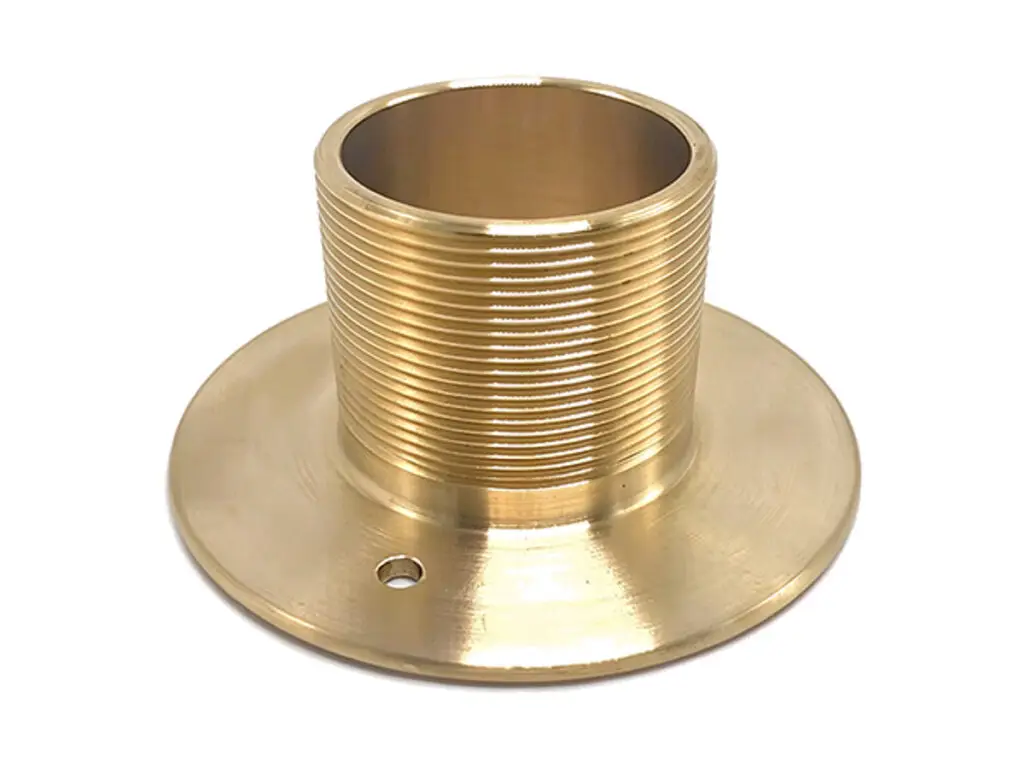


CNC Turned Brass Threaded Flange Bushing
Threaded flange bushings turned from C36000 brass, with a rolled M10 to M60 thread to class 6g, a H7 bore concentric to the thread within 0.02 mm and a flange face square to 0.03 mm. Spanner flats are milled to ±0.05 mm across.
- Thread Rolled, Class 6g
- Bore H7 Concentric to Thread
- Flange Face Square 0.03 mm
- Flats Milled for a Spanner
*Send the mating female thread and the tube that passes through the bore. A bushing threaded 6g into a worn 6H port will bottom on the flange before the thread is tight, and the seal then depends on the flange face alone.
Threaded Flange Bushing Overview
A flange bushing does three things: it adapts a thread, it provides a seating face and it centres a bore. All three come from one set-up, or the flange sits at an angle and the joint weeps on one side.
The part is turned from bar, the thread is rolled, the bore is drilled and reamed from the same axis, then the flats are milled and the flange face is skimmed square before plating.
C36000 Free-Cutting Brass
C36000 rolls a clean thread and reams to a H7 bore without tearing, which is why it is the standard for adaptor bushings. It also takes nickel plating well for wet installations.
CW617N or DZR Brass
CW617N is used where the bushing is brazed into a copper manifold, and DZR brass for potable water where dezincification would otherwise take the thread out in a few years.
Above 1 MPa the brass bushing is replaced by a steel or stainless one; at 60 mm diameter a brass flange will deform before the thread strips, which is the safer failure but still a failure.
Threaded Flange Bushing Specifications
Turning data for brass bushings, with the thread, bore and flange values that decide whether the joint seals square.
| Specification | Machining Data | Specification | Machining Data |
|---|---|---|---|
| Product | Threaded Flange Bushing / Brass Reducer | Machining Process | CNC Turning, Thread Rolling, Milling |
| Material | C36000 Free-Cutting Brass | Envelope | M10 – M60, Flange Ø 20 – 90 mm |
| External Thread | M10 – M60, Class 6g, Rolled | Internal Bore | Ø 6 – 45 mm, H7 |
| Thread to Bore | Concentric Within 0.02 mm | Flange Face | Square to Thread 0.03 mm |
| Flange Thickness | 2 – 8 mm | Flange Diameter | ±0.1 mm |
| Spanner Flats | Across Flats ±0.05 mm | Overall Length | 15 – 70 mm |
| Surface Finish | Ra 1.6 µm Bore, Ra 3.2 µm Flange | Pressure Rating | 1.0 MPa on Brass Body |
| Customization | Left Hand Thread, O-Ring Groove, Cross Holes, Nickel Plating | Lead Time | 4 – 6 Days Sample, 10 – 14 Days Batch |
| Inspection | Thread Ring Gauge, Bore Air Gauge, Flange Squareness, Visual | Packing | Thread Caps, VCI Paper, Boxed |
Key Features of Our Brass Bushings
Thread rolled before boring, flange skimmed square, flats milled after plating decision.
Thread Rolled Before Boring
Rolling the thread first and boring afterwards keeps the bore concentric to the thread within 0.02 mm, so the tube passing through does not sit at an angle.
Flange Face Skimmed After Threading
The face is skimmed last, which makes it square to the thread within 0.03 mm and lets the bushing seat on the flange instead of on two thread flanks.
Spanner Flats Milled to ±0.05 mm
Flats are milled after the thread so the wrench load goes into the body rather than twisting the thread, and the across-flats size is held so a standard spanner fits.
Thread Gauged After Plating
Every bushing is ring gauged after nickel plating, because 5 to 8 µm on the flanks is enough to stop a bushing that ran on freely before coating.
Bushing that has to seat on its flange?
Surface Finishes for Brass Bushings
The thread is a fit, the flange is a seal face and the bore carries a tube, so plating has to stay off all three.
| Finish | Main Purpose | Finish | Main Purpose |
|---|---|---|---|
| Nickel Plating | Corrosion protection in wet lines | Clear Lacquer | Keeps the brass colour |
| Masked Threads | Threads stay at 6g after plating | Vapour Blasting | Satin finish before lacquer |
| Ultrasonic Clean | Removes cutting oil from the bore | Degrease | Before Plating |
| Laser Marking | Thread size on the flange face | Plating Build | 5 – 8 µm, Threads Masked |
| Thread Caps | Fitted After Gauging | Bore Plug | Keeps Grit Out in Transit |
| Drying | Filtered Air, No Water Marks | Passivation | Nickel Adhesion on Brass |
*Nickel plating closes a rolled 6g thread by about 10 µm on the flanks. Threads are masked with plugs and the bore is plugged too, otherwise a 20 mm tube will not pass after coating.
Put your CNC milling parts into production today
All information and uploads are secure and confidential.
Trusted for Precision CNC Machined Components
Supporting OEM projects with accurate machining, flexible production, and reliable component quality.
Trusted for Precision CNC Milling.
Machining Process for Brass Bushings
The thread is rolled before the bore is finished, so the bore stays concentric to the thread instead of following the rolled crest.
01. Port and Tube Review
Check the female thread class, the tube diameter and the flange seating face, then set the thread length and the undercut.
02. Turn and Roll the Thread
Turn the body, roll the external thread to class 6g and check it with a ring gauge before the part is transferred.
03. Bore and Ream
Drill and ream the bore to H7 from the same axis, checking concentricity with a plug gauge in the thread and a dial indicator in the bore.
04. Mill Flats and Skim the Flange
Mill the spanner flats to ±0.05 mm, then skim the flange face square to the thread within 0.03 mm.
05. Clean, Plate, Gauge
Ultrasonic clean, nickel plate with the thread and bore plugged, then ring gauge the thread and air gauge the bore.
Send the port thread and the tube drawing, and we will quote a brass bushing with the thread rolled and the flange face square to it.
Brass Flange Bushing FAQs
Rolling leaves a continuous grain at the root, which is where a brass bushing cracks when it is over-tightened. It also holds a tighter 6g class without a second finishing pass.
0.03 mm, skimmed after threading. A flange that is 0.1 mm out will seal on one side and weep on the other no matter how much tape is used.
Yes, rolled with a left hand die and marked LH on the flange so it cannot be confused with a right hand part in the stores.
It adds 5 to 8 µm per flank, so threads are plugged during plating and ring gauged afterwards. An unplugged thread will not enter a 6H port without a tap.
About 1.0 MPa in a brass body with a sealed flange. Above that the flange deforms before the thread strips, so a steel or stainless bushing is the right choice.
Yes, an internal thread from M6 to M30 is cut in the same set-up, with the bore and the external thread concentric within 0.02 mm so a nipple seats square.
Other CNC Machined Mechanical Components
Explore additional precision CNC machined components manufactured for OEM applications and customized production needs.
Precision CNC machined aluminum indexing rotary tables for automation cells.
Precision CNC machined aluminum connecting plates for robot modules and automation equipment.
Custom CNC machined aluminium drone components, including arm mounts, motor mounts and frame fittings.
Custom CNC machined aluminium robot joint actuator components with concentric threads, sealing faces and hex flats.
Custom CNC machined robot end effector flanges for tool mounting and automation.
Get high‑quality machined parts in as fast as 4 days with our expanded automated CNC milling!