

CNC Machined Aluminum Drone Components
Custom CNC machined aluminium components for drones and UAV frames, including arm mounts, motor mounts, landing gear fittings and camera brackets, machined with thin walls and lightening pockets to keep weight down without losing stiffness.
- Thin-wall machining with lightening pockets
- Material: 6061-T6 / 7075-T6 Aluminum
- Process: 3-Axis / 4-Axis / 5-Axis CNC Machining
- Typical Tolerance: ±0.01 mm
*Send the arm tube size, motor bolt pattern and target weight so wall thickness and pocket layout can be balanced.
Drone Components Overview
On a drone every gram is paid for twice: once to lift it, and again in flight time. Machined aluminium parts earn their place by being stiff enough to keep the frame rigid while removing material everywhere it does not carry load.
Typical parts are arm mounts, motor mounts, folding hinges, landing gear fittings and camera brackets. They are usually machined from 6061 or 7075 plate and block, with pockets and ribs shaped so stiffness stays in the load path.
The risks are wall deflection during machining, vibration loosening at threaded holes, and weight creeping up through over-thick sections. Pockets are roughed with support, thin walls are finished in light passes, and each part is weighed against the target.
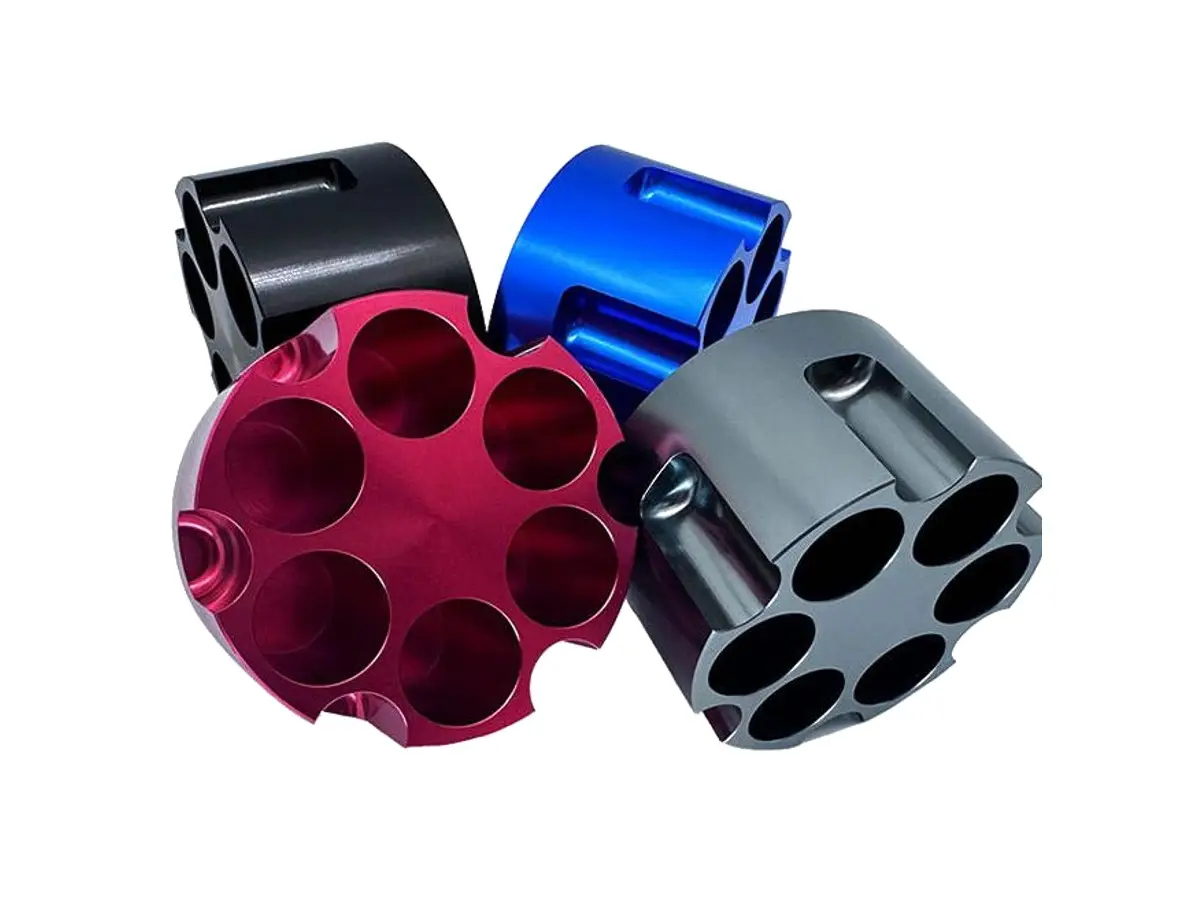
SINORISE machines drone components in small batches with black, red, blue, gold and natural anodising, and can supply matched sets for a frame so arm mounts and motor mounts share the same bolt pattern and weight.
6061 Aluminum
6061-T6 suits most mounts and brackets: it machines to thin sections cleanly, anodises to a consistent colour, and has enough fatigue resistance for a frame that sees constant vibration.
7075 Aluminum
7075-T6 is used for arm mounts and folding hinges where stiffness per gram matters most. It allows thinner sections for the same strength, but anodising colour is less uniform and the parts should be protected from galvanic contact with carbon fibre.
Where parts are supplied as a set, weight and bolt pattern are matched across the set rather than per part.
Drone Component Specifications
Machining data for UAV components, agreed to the frame geometry and the weight target.
| Specification | Machining Data | Specification | Machining Data |
|---|---|---|---|
| Product | CNC Machined Aluminum Drone Components | Pocket Machining | Roughing, Finishing, Rib and Web Cutting |
| Material | 6061-T6 / 7075-T6 Aluminum | Hole Machining | Drilling, Boring, Reaming, Tapping |
| Machining Process | CNC Milling, 3/4/5-Axis, Turning, Tapping | Surface Finish | Anodizing (Black / Red / Blue / Gold), Bead Blasting |
| Typical Tolerance | ±0.01–±0.02 mm | Minimum Wall | 0.8–1.5 mm (Depends on Depth) |
| Flatness | 0.03 mm per 100 mm | Inspection | CMM, Profile Projector, Precision Scale |
| Machined Features | Tube Clamp, Motor Bolt Pattern, Lightening Pockets, Cable Channel | Drawing Format | STEP, STP, IGES, DWG, DXF, PDF |
| Size Range | Up to 400 × 300 × 150 mm | Lead Time | 5–10 Days (Prototype), 10–18 Days (Batch) |
| Customization | Tube Diameter, Bolt Pattern, Colour, Marking, Weight Target | Packing | Foam Separated, Individually Bagged, Carton |
Key Features of Our Drone Components
These parts are judged on stiffness per gram, so the process is built around removing weight without losing the load path.
Pockets Shaped to the Load Path
Material is removed from low-stress areas and left where bending and vibration loads run, so the part gets lighter without becoming flexible.
Thin Walls Without Deflection
Pockets are roughed with support and finished in light passes, which keeps walls at the nominal thickness instead of springing thinner in the middle.
Bolt Patterns Matched Across a Set
Arm mounts, motor mounts and hinges in the same order are machined to a shared pattern, so a replacement part bolts straight onto the frame.
Weighed Before It Ships
Each part is weighed against the target and the number is recorded, so a batch does not drift heavier as tooling and programs are adjusted.
Need Lightweight Components for Your Drone Frame?
Surface Finishes for Drone Components
Finish is used for corrosion protection and for identifying arm positions, so colour is usually agreed as part of the frame design.
| Finish | Main Purpose | Finish | Main Purpose |
|---|---|---|---|
| Anodizing | Corrosion protection and colour coding for part identification | Powder Coating | Protective coating for non-critical covers and guards |
| Bead Blasting | Uniform matte texture before anodizing | Passivation | Removes machining residue before assembly |
| Hard Anodizing | Wear resistance on locating and clamping faces | As Machined | Natural machined surface where no coating is needed |
*Anodising on thin walls adds a small but measurable thickness; where a tube clamp is a close fit, the bore is sized before coating.
Put your CNC milling parts into production today
All information and uploads are secure and confidential.
Trusted for Precision CNC Machined Components
Supporting OEM projects with accurate machining, flexible production, and reliable component quality.
Trusted for Precision CNC Milling.
CNC Machining Process for Drone Components
Light parts are mostly a material-removal problem: take away weight, keep the stiffness, and do not let the walls move.
01. Drawing and Weight Review
Check tube sizes, bolt patterns, wall thickness and the target weight before programming the pockets.
02. Plate Preparation
Cut 6061 or 7075 plate to size and face it flat so the clamp bore and mounting face share a reference.
03. Roughing and Pocketing
Rough the pockets and profile in stepped passes, leaving even allowance and support for thin walls.
04. Finishing and Hole Pattern
Finish walls and faces in light cuts, then drill, ream and tap the motor and frame bolt patterns.
05. Weighing, Anodising and Packing
Weigh each part against the target, anodise to colour, then pack as a matched set where required.
Send the frame drawing with tube sizes and bolt patterns to receive a weight and machining review.
Drone Component CNC Machining FAQs
Walls of 0.8–1.5 mm are practical depending on depth and whether the wall is supported at both ends. The drawing is reviewed for pocket depth and corner radius before the wall thickness is fixed.
Yes. The existing part is weighed, and the new design is machined to that target, with each finished part weighed and recorded so the batch stays consistent.
7075 gives more stiffness per gram and is usual for arm mounts and hinges. 6061 is used where finish uniformity, cost or weldability matters more.
Yes. Arm mounts, motor mounts and hinges can be machined as a set with a shared bolt pattern, so parts are interchangeable between arms.
Yes. Anodising colour can be split within an order, and parts are packed labelled so the build sequence is clear.
Prototypes are usually 5–10 days, and small batches 10–18 days including anodising and weighing.
Other CNC Machined Mechanical Components
Explore additional precision CNC machined components manufactured for OEM applications and customized production needs.
Custom CNC machined aluminium manifold blocks for hydraulic and pneumatic circuits.
Custom CNC machined aluminium indexing disks for rotary positioning systems.
Custom CNC machined aluminum double tube clamps for motorcycle frames, bicycle builds and hydraulic lines.
Custom CNC machined aluminium mounting brackets for robots, automation and equipment mounting.
Custom CNC machined aluminium brackets for textile machinery and automation frames.
Get high‑quality machined parts in as fast as 4 days with our expanded automated CNC milling!