


Home / CNC-Machining / CNC Milling / CNC Machined Brass Multi-Port Manifold Block
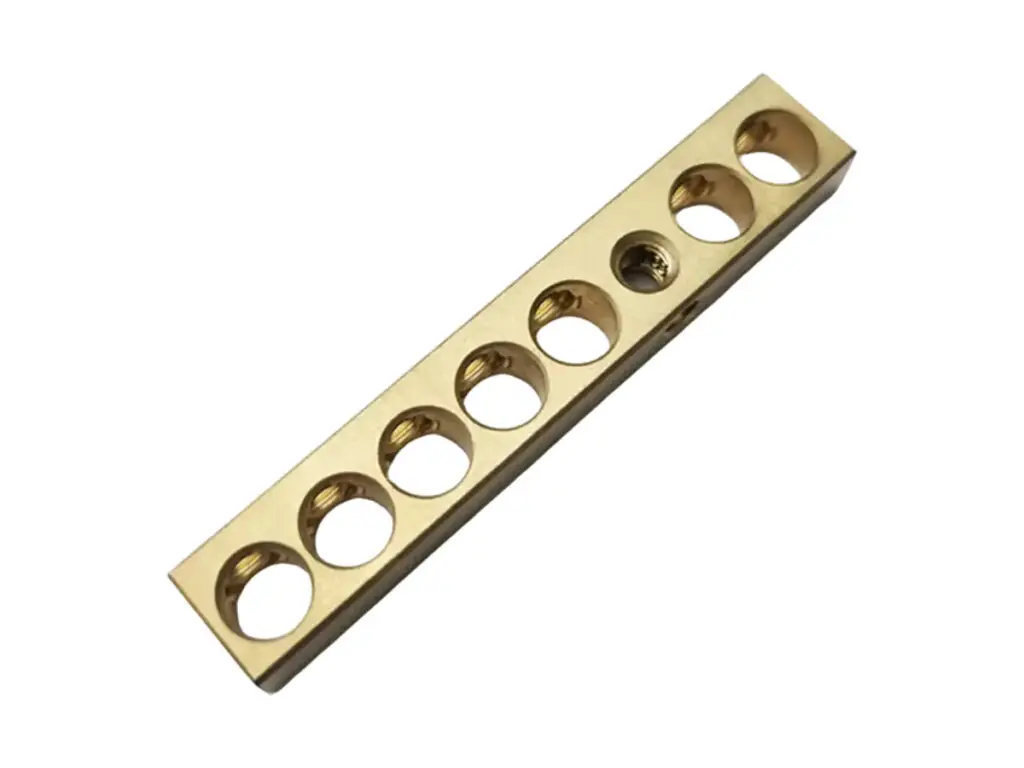
CNC machined brass multi-port manifold block with six line bored ports in a row

CNC Machined Brass Multi-Port Manifold Block

Multi-port brass manifold blocks machined from C36000, with six H8 bores line bored to 0.03 mm, a 25 mm pitch held to ±0.03 mm, Ra 0.8 µm bore finish and sealing faces flat to 0.03 mm. Every block is pressure decay tested at 0.6 MPa before plating.

*Send the spool or shaft drawing that runs through the bores. A block with six separately bored holes will be 0.05 mm out of line by the last port, and a spool will bind at one end only.

Brass Multi-Port Manifold Block Overview

A brass manifold with a row of bores is really a line-boring job: each bore has to be on the same axis as the next, or a spool that fits the first port will seize in the sixth.

The block is squared, the sealing face is machined, then all six bores are cut in one line-boring pass from a single set-up, followed by the port threads, the cross drillings and a full deburr of every intersection.

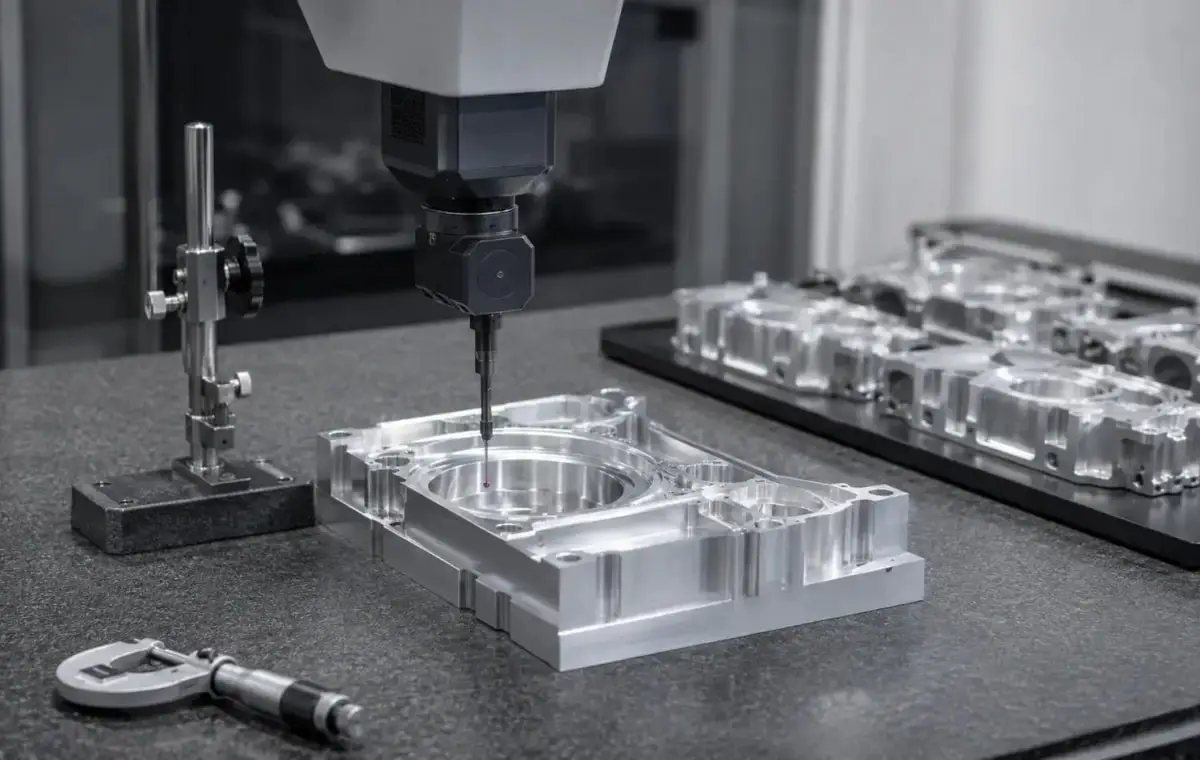
CMM inspection of a gripper jaw set, a brass manifold block and an eight-lobe flange plate
304L stainless steel round bar stock for CNC machining

C36000 Free-Cutting Brass

C36000 machines at three times the speed of aluminium and leaves a bore finish that seals without a bushing. It is the default for pneumatic and water manifolds up to 1 MPa.

304L stainless steel plate and block stock for CNC machining

CW617N or C37700 Forging Brass

CW617N is used when the block has to be brazed into a copper line, and C37700 when the block is hot forged first and only the bores and threads are machined.

Brass with more than 3 % lead machines best but is restricted in drinking water; for potable lines the block is made from DZR brass and the bore finish has to be Ra 0.4 µm to resist dezincification.

Brass Manifold Block Specifications

Line boring and milling data for brass manifolds, with the bore, pitch and leak values that decide whether the spool runs free.

SpecificationMachining DataSpecificationMachining Data
ProductBrass Multi-Port Manifold BlockMachining Process3-Axis CNC Milling, Line Boring, Tapping
MaterialC36000 Free-Cutting BrassEnvelopeUp to 240 × 60 × 60 mm
Bore DiameterØ 10 – 30 mm, H8Bore Pitch25 mm, ±0.03 mm
Bore AlignmentSix Bores in Line Within 0.03 mmBore FinishRa 0.8 µm
Port ThreadsG1/8 – G1/2, Class 6HWall Between Ports4 mm Minimum
Block Squareness0.05 mm per 100 mmSealing FaceFlat 0.03 mm
Cross DrillingØ 6 – 12 mm, Intersections DeburredPort Count4 – 10 Ports
CustomizationCross Drilling, Plugs, Mounting Flange, Nickel PlatingLead Time5 – 7 Days Sample, 12 – 16 Days Batch
InspectionBore Air Gauge, CMM Pitch, Pressure Decay, Thread GaugesPackingPort Caps, VCI Paper, Individually Boxed

Key Features of Our Brass Manifolds

Bores line bored in one pass, intersections deburred, every block tested.

Six Bores Line Bored Together

All bores are cut on one axis in a single pass, which holds the line to 0.03 mm and lets a spool or shaft pass through without a tight port at either end.

Pitch Held From One Datum

The 25 mm pitch is set from a machined end face rather than the sawn block, so a replacement manifold lines up with the pipework without re-bending.

Cross Ports Deburred by Hand

Every intersection is reached with a back-spotting tool and then hand deburred, because a brass burr at a cross port will break off and jam a valve within weeks.

Pressure Decay on Every Block

Blocks are plugged, charged to 0.6 MPa and watched for 60 s. A weeping block is stripped, re-machined and re-tested rather than plated and shipped.

Manifold where a spool has to pass through?

Surface Finishes for Brass Manifolds

Brass tarnishes within days, the threads are a fit and the bores must stay clear of plating.

FinishMain PurposeFinishMain Purpose
Nickel PlatingCorrosion protection on brass in washdownClear LacquerKeeps the brass colour indoors
Masked ThreadsThreads stay at gauge size after platingVapour BlastingSatin finish before lacquer
Ultrasonic CleanRemoves polishing compound and swarfLeak TestEvery Block, 0.6 MPa
Laser MarkingPort numbers on the top facePlating Build5 – 8 µm, Threads Masked
DegreaseBefore PlatingPort CapsFitted After Gauging
PassivationNickel Adhesion on BrassDryingFiltered Air, No Water Marks

*Nickel plating adds 5 to 8 µm and will close a G1/8 thread and a H8 bore. Ports and bores are plugged, and the block is ultrasonically cleaned before plating so the nickel does not flake at a burr.

logo

Put your CNC milling parts into production today

All information and uploads are secure and confidential.

Trusted for Precision CNC Machined Components

Supporting OEM projects with accurate machining, flexible production, and reliable component quality.

Mechanical Equipment Customer
The spool passes through all six bores without a tight spot, which never happened before.

Industrial Components Buyer
No swarf came out of the cross ports on first flush, so the deburring was done properly.

Equipment Manufacturer
The pitch matched the pipe run, and the block went in without re-bending a pipe.

OEM Customer
OEM Customer
Held pressure on the first test, so we did not lose a day re-sealing it.

Automation Industry Customer
The customized machining solution provided the dimensional accuracy required for our rotating equipment components.

Trusted for Precision CNC Milling.

Machining Process for Brass Manifolds

The six bores are line bored from one end after the block is squared, so a shaft or a spool passes through all of them without a tight spot.

01. Spool and Port Review

Check the spool diameter, the port layout and the pipe thread, then confirm that the wall between ports stays above 4 mm.

02. Square and Face the Block

Machine all faces square to 0.05 mm per 100 mm and face the sealing side as datum A for the bore line.

03. Line Bore the Ports

Bore all ports on one axis in a single line-boring pass, checking the line with a test bar before the block is unclamped.

04. Tap and Cross Drill

Tap the ports, drill the cross connections, then deburr every intersection by hand and flush the block with filtered air.

05. Test, Plate, Gauge

Pressure decay test at 0.6 MPa, ultrasonic clean, nickel plate with the ports plugged, then re-gauge every thread and bore.

Send the spool drawing and the port layout, and we will quote a brass manifold with the bores line bored on one axis.

Brass Manifold Block FAQs

0.03 mm over six ports at 25 mm pitch, bored in one pass without unclamping. Drilling and reaming each port separately gives about 0.08 mm, which is enough to bind a spool.

Brass holds a bore finish that seals without a sleeve, does not gall against a stainless spool and resists water better than anodized aluminium. The trade is weight and cost.

Yes, 5 to 8 µm of electroless or electroplated nickel, with the ports and bores plugged so the fits are unchanged. Nickel over a burr will flake, so the block is deburred first.

Every intersection is back-spotted through the port and hand finished. A brass burr left at a cross port is the most common cause of a valve sticking after a few hundred cycles.

0.6 MPa air for 60 s as standard, and 1.5 times working pressure hydrostatically on request. Blocks for potable water are also flushed and capped.

Yes, from a sample or a drawing. The pitch is taken from the end face rather than the port centres, because the end face is what locates the block in the pipe run.

Other CNC Machined Mechanical Components

Explore additional precision CNC machined components manufactured for OEM applications and customized production needs.

CNC milled aluminium robot joint adapter plates with a turned register, bolt circle to ±0.02 mm, flatness 0.02 mm and red.

Precision CNC machined steel locating flanges for robot joints.

Precision CNC machined aluminum multi hole fixture plates with a lapped grid of locating holes.

Custom CNC machined aluminum motor housings with bored bearing seats, cooling fins and mounting flanges.

Custom CNC machined aluminum hollow sleeve connectors for robot arm segments and linear modules.

Get high‑quality machined parts in as fast as 4 days with our expanded automated CNC milling!

Scroll to Top