


Home / CNC-Machining / CNC Milling / CNC Machined Aluminum Enclosure Base Plate
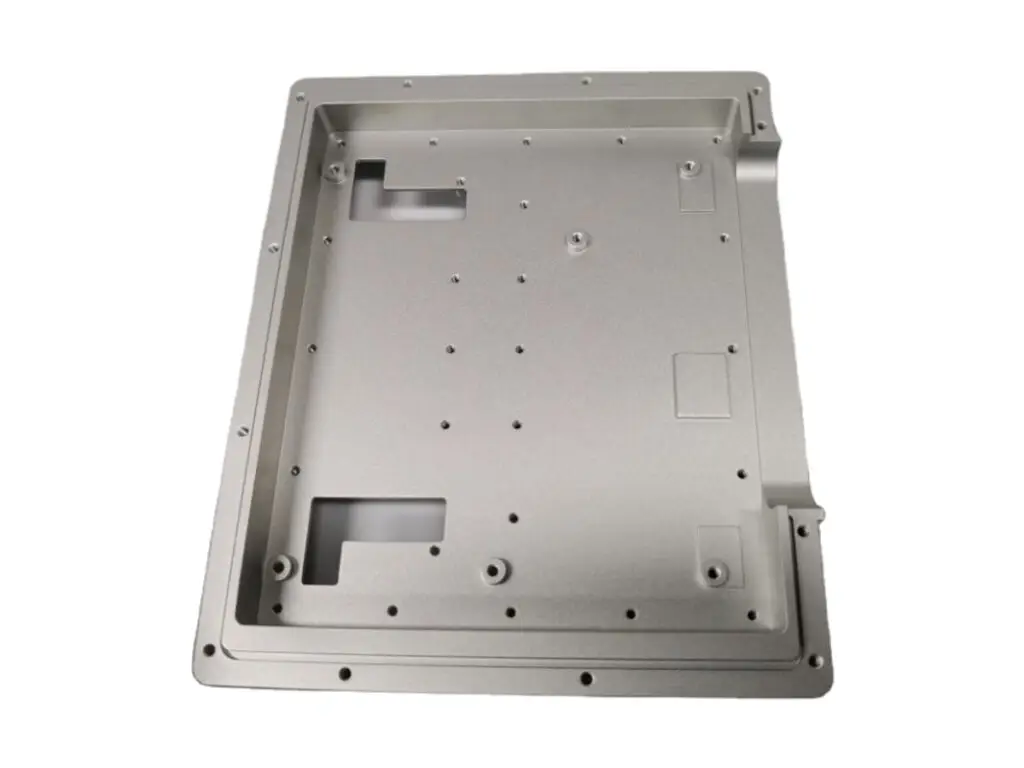
CNC machined aluminum enclosure base plate with pocketed floor and gasket land

CNC Machined Aluminum Enclosure Base Plate

Enclosure base plates milled from 6061-T6 plate, with a pocketed floor flat to 0.05 mm, a 3 mm gasket land machined in a single pass, blind standoffs held to ±0.05 mm in height and perimeter screw bosses positioned to ±0.05 mm. Edges are broken to 0.5 mm so a powder-coated lid seats without chipping.

*Send the lid and the PCB outline together. The gasket land width, the standoff height and the connector cut-outs are set by those two parts, not by the base plate drawing alone.

Enclosure Base Plate Overview

A base plate looks like a tray with holes, but it sets three things at once: how flat the electronics sit, whether the gasket seals and whether the lid closes without a gap at one corner. All three come from how the floor and the perimeter are machined.

The plate is faced on both sides first, then the floor pocket, the gasket land and the screw bosses are cut without unclamping. Perimeter walls are profiled last, because removing the wall support early lets the floor bow between the bosses.

CNC milling of a lightening hole cover plate, a pneumatic manifold block and a sensor enclosure
6061-T6 aluminium flat plate stock for CNC milling

6061-T6 Aluminium Plate

6061-T6 is used for 90 % of enclosures because it machines cleanly, anodizes to a uniform colour and keeps the floor flat after pocketing. Plate is specified rather than sheet so the floor does not oil-can when the lid is tightened.

7075-T6 aluminium billet block stock for CNC milling

5052 Sheet or 7075 Plate

5052 is chosen for thin folded enclosures where weight matters more than flatness. 7075 plate is used when the base is also a heat spreader or carries a heavy connector block and the screw bosses must not pull out.

Below 3 mm floor thickness the lid load starts to show on the floor; above 6 mm the plate is usually replaced by a casting. The crossover is set by the gasket compression, not by the alloy.

Enclosure Base Plate Specifications

Milling data for pocketed enclosure floors, with the flatness, land and boss values that decide whether the lid seals.

SpecificationMachining DataSpecificationMachining Data
ProductEnclosure Base Plate / Chassis FloorMachining Process3-Axis CNC Milling, Drilling, Tapping
Material6061-T6 Aluminium PlateEnvelopeUp to 420 × 300 × 55 mm
Floor Thickness3 – 6 mm After PocketingPocket Depth±0.10 mm, Floor Flatness 0.05 mm
Gasket LandWidth 3 mm, Flatness 0.05 mm, Ra 1.6 µmStandoff Height±0.05 mm, M3 – M6 Blind Threads
Wall Thickness2.5 – 4 mmScrew Boss Position±0.05 mm on the Perimeter
Corner RadiiR3 – R8 Internal, Matched to LidThread DepthCut 1.5 × Diameter Minimum
CustomizationCable Cut-outs, DIN Rail Slots, Earth BossLead Time4 – 6 Days Sample, 10 – 14 Days Batch
InspectionGranite Flatness, CMM Boss Pattern, Thread GaugesPackingFoam Interleaf, Stacked Face to Face, Carton

Key Features of Our Enclosure Plates

One set-up for floor, land and bosses, then the walls.

Floor, Land and Bosses in One Set-up

The pocket, the gasket land and all standoffs are cut before the part is released, so the sealing plane and the mounting plane cannot drift apart.

Gasket Land Machined Dry

The land is finished without coolant at the last pass, which stops the aluminium smearing and leaves a surface the gasket can bite into.

Blind Standoffs Depth Controlled

Standoffs are drilled to a programmed depth and checked with a depth gauge, so a PCB screw cannot bottom out and lift the board.

Walls Profiled After Pocketing

The perimeter is cut last, with the floor still supported by the parent material, which keeps the floor from bowing between screw bosses.

Base plate that has to seal against a lid?

Surface Finishes for Enclosure Plates

The inside floor is a mounting surface, the outside is a visible face, and the earth boss has to stay conductive.

FinishMain PurposeFinishMain Purpose
Type II AnodizingCorrosion protection and colour on the visible floorBead BlastingEven matte before dye, hides tool marks
Masked Earth BossKeeps the earthing point conductiveChromate ConversionConductive finish on RF and power enclosures
Laser MarkingSerial and connector labels on the inside floorPowder CoatingThick colour where the plate is not a heat path

*Anodizing adds 5 to 10 µm per surface and is an insulator. Earth bosses and connector flange faces are masked, otherwise the enclosure loses its ground path through the coating.

logo

Put your CNC milling parts into production today

All information and uploads are secure and confidential.

Trusted for Precision CNC Machined Components

Supporting OEM projects with accurate machining, flexible production, and reliable component quality.

Mechanical Equipment Customer
The gasket land sealed first time, and we did not have to re-torque the lid after the first warm-up.

Industrial Components Buyer
The standoffs were all the same height, so the board no longer rocks and the connectors line up.

Equipment Manufacturer
The floor stayed flat after anodizing, which our previous supplier never managed on a 4 mm plate.

OEM Customer
OEM Customer
Threads took the screws by hand, with no re-tapping at assembly.

Automation Industry Customer
The customized machining solution provided the dimensional accuracy required for our rotating equipment components.
Trusted for Precision CNC Milling.

Machining Process for Enclosure Plates

The floor is pocketed from the top in one set-up, so the gasket land and the screw bosses stay on the same plane as the lid it has to seal against.

01. Lid and Board Review

Check the lid drawing, the PCB outline and the connector positions against the base, and confirm the gasket land width before programming the floor.

02. Face Both Sides

Face the plate on both sides to establish thickness and a flat datum, then mark the datum corner so every later operation references the same edge.

03. Pocket the Floor

Rough the floor pocket in descending steps with a 10 mm cutter, then finish with a 6 mm cutter to leave a floor flat within 0.05 mm.

04. Cut Land, Bosses and Holes

Machine the gasket land in one continuous pass, drill and tap the blind standoffs to depth, then drill the connector cut-outs from the same datum.

05. Profile, Deburr and Check

Profile the perimeter walls, break all edges to 0.5 mm, deburr the cut-outs by hand and check flatness on granite before anodizing.

Send the lid drawing and the board outline, and we will quote a base plate with the gasket land and the standoffs on one sealing plane.

Enclosure Base Plate FAQs

0.05 mm over 300 mm on a 4 mm floor, measured on granite after the part is released. Thinner floors hold 0.08 mm because the floor moves when the clamps come off.

Yes. Standoffs are faced in the same set-up as the floor and checked with a depth micrometer, which is why a PCB does not rock on four points.

By about 10 µm on the thread flanks. Threads are cut to a pre-plate size and checked with a Go/No-Go gauge after coating, so a screw still turns by hand.

3 mm for a moulded O-ring cord and 5 mm for a flat die-cut gasket. The land is machined to the width you specify and kept flat, because a crowned land lets the gasket roll.

Yes, D-sub, M12, RJ45 and circular connector profiles are programmed from the connector datasheet, with 0.2 mm clearance on the flange so the gasket can compress.

420 × 300 × 55 mm from one plate. Larger enclosures are machined as a frame plus a floor plate, dowelled and screwed, which keeps the floor flat but adds a joint.

Other CNC Machined Mechanical Components

Explore additional precision CNC machined components manufactured for OEM applications and customized production needs.

Five-axis milled aluminium curved sensor brackets with swept mounting pads, blended fillets and 0.03 mm pad flatness for robot.

Precision CNC machined aluminum robot joint housings for arm segments and joint modules.

Precision CNC machined aluminum robot joint housing flanges.

Custom CNC machined aluminum intake manifolds for automotive and motorsport builds.

Custom CNC machined stainless steel multi jaw clamping plates for lathe, grinder and wheel hub fixtures.

Get high‑quality machined parts in as fast as 4 days with our expanded automated CNC milling!

Scroll to Top