
Quick Answer
5-axis CNC machining is an advanced manufacturing process that moves a cutting tool along five axes simultaneously. It enables production of highly complex parts in aerospace, medical, and automotive industries with superior precision, fewer setups, and efficient surface finishing.
Key Takeaways
- 5-axis CNC machining minimizes setup time and improves part accuracy.
- Capable of machining contoured surfaces, undercuts, and multi-face components in one operation.
- Supports diverse materials such as aluminum, titanium, stainless steel, and composites.
- Widely used in aerospace, automotive, medical devices, and high-precision engineering.
- Limitations include higher machine costs, advanced CAM programming, and longer initial setup.
Introduction
5-axis CNC machining is a sophisticated process in modern manufacturing, offering enhanced flexibility and precision compared to conventional 3-axis machining. By controlling the cutting tool along X, Y, Z, A, and B axes, manufacturers can produce complex geometries in a single setup, reducing error accumulation and material waste.
Definition and Working Principle
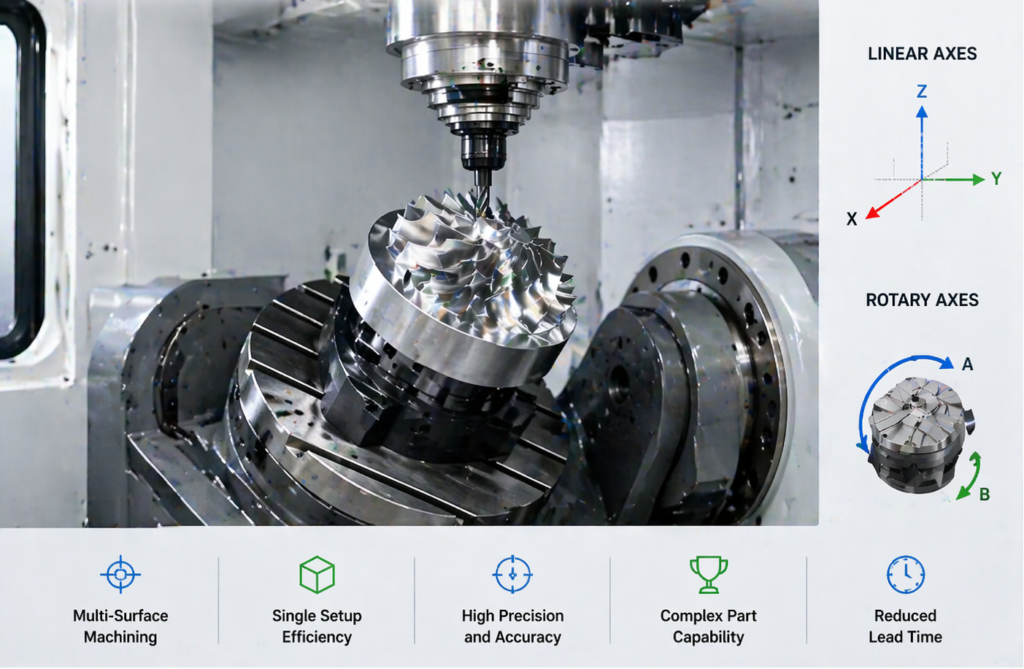
What is 5-axis CNC Machining?
- A process where a cutting tool moves in five simultaneous axes, allowing complex, multi-surface parts to be machined without multiple setups.
- Improves efficiency and maintains tight tolerances across intricate geometries.
- Applications: aerospace brackets, turbine blades, medical implants, automotive molds.
How it Works
- Linear axes (X, Y, Z): Standard Cartesian movements for positioning.
- Rotational axes (A and B): Allow tool tilting and rotation for angled cuts and deep cavities.
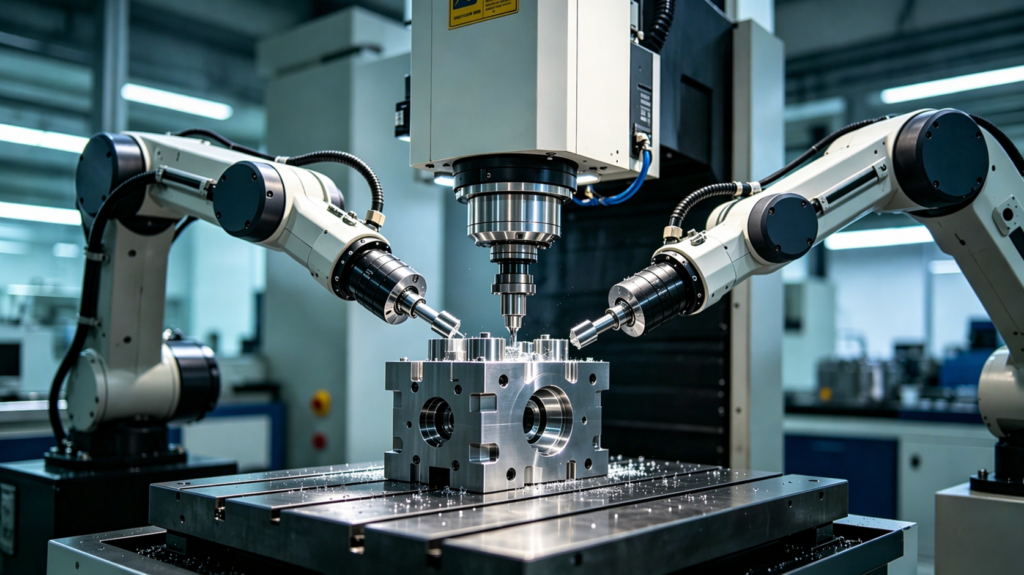
CAM software generates optimized toolpaths to prevent collisions and reduce cycle time.
Key Features of 5-Axis CNC Machining
| Feature | Description | Keywords |
| High Precision | Tolerances up to ±0.01mm even on curved surfaces | high precision cnc machining, tight tolerance cnc |
| Single-Setup Capability | Machining complex geometries without repositioning | cnc setup optimization, 5 axis machining efficiency |
| Complex Geometry | Handles deep cavities, contoured surfaces, undercuts | multi-surface cnc machining, complex part cnc |
| Superior Surface Finish | Minimizes manual polishing | cnc finishing, smooth surface machining |
| Material Flexibility | Aluminum, titanium, stainless steel, composites | 5 axis cnc materials, multi-material cnc machining |
Types of 5 Axis CNC Machines
Table-Top 5 Axis CNC Machines
- Compact, suitable for small parts or prototyping.
- Lower cost, easier programming, suitable for laboratories or small workshops.
Gantry 5 Axis CNC Machines
- Large working area for heavy components; commonly used in aerospace or automotive sectors.
- Supports high-volume and multi-material machining efficiently.
Articulated 5 Axis CNC Machines
- Tilting spindle combined with rotary table allows complex tool paths for intricate geometries.
- Ideal for medical implants, aerospace blades, and molds.
Common Materials Machined
Metals
- Aluminum (AL6061, AL7075): Lightweight, widely used in aerospace and automotive industries.
- Stainless Steel (SUS304, SUS316): Corrosion-resistant, used in medical devices, food, and aerospace.
- Titanium: High strength-to-weight ratio, ideal for aerospace and biomedical implants.
Non-Metals
- Engineering plastics: PEEK, PTFE for lightweight precision components.
- Composites: Carbon fiber and fiberglass for high-strength automotive and aerospace parts.
Applications of 5 Axis CNC Machining
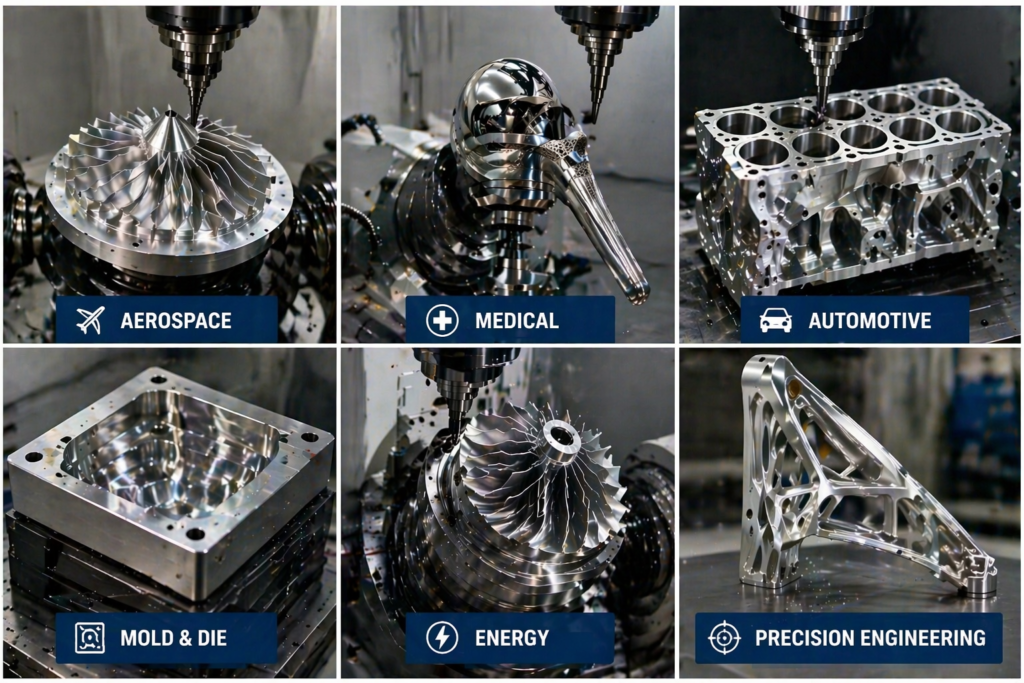
Aerospace Industry
- Machining turbine blades, engine brackets, fuselage components.
- Single-setup precision reduces cumulative error and improves aerodynamic efficiency.
Medical Industry
- Surgical instruments, orthopedic implants, dental prosthetics.
- Smooth surface finishes and tight tolerances ensure biocompatibility and safety.
Automotive & Robotics
- Engine components, molds, robotic arms, and complex fixtures.
- Reduces setup time, improves repeatability, and maintains high precision.
Precision Engineering
- Optical components, high-performance instrumentation, scientific equipment.
- Critical for industries demanding ultra-precise machining and minimal error.
Advantages of 5 Axis CNC Machining
| Advantage | Description | Keywords |
| Reduced Setup Time | Fewer setups, faster production | cnc setup optimization, 5 axis efficiency |
| High Accuracy | Minimal error accumulation | high precision cnc machining |
| Complex Part Machining | Handles contoured surfaces, undercuts | complex geometry cnc, multi-axis machining |
| Superior Surface Finish | Smooth finish, reduced post-processing | cnc finishing, smooth surface machining |
| Material Versatility | Advanced alloys, composites | 5 axis cnc materials, multi-material cnc |
Limitations of 5 Axis CNC Machining
Higher Equipment Cost
One of the most significant limitations of 5-axis CNC machining is the initial equipment investment, which is substantially higher than that of traditional 3-axis machines.
- Maintenance costs are also higher due to the complexity of moving components, such as rotary tables and tilting spindles.
- Training operators and engineers on 5-axis systems adds to the operational expenditure.
- This high cost can make 5-axis machining less feasible for small-scale manufacturers or low-volume production, where the return on investment may take longer to realize.
Advanced Programming Required
5-axis CNC machines demand advanced CAM programming skills. Unlike 3-axis machining, toolpaths for 5-axis operations must account for rotational axes and multi-directional approaches, increasing the complexity of programming.
- Skilled CAM programmers are required to generate precise toolpaths that minimize collision risks and optimize cutting efficiency.
- Simulation software is often necessary to visualize machining sequences, detect potential collisions, and verify tool clearance before production.
- Errors in programming can lead to costly scrap parts, machine crashes, or excessive tool wear.
- The learning curve for operators and programmers is longer, requiring specialized training and experience to manage complex jobs.
Summary
5-axis CNC machining is a cornerstone technology for industries that demand high-precision, multi-surface, and complex components, such as aerospace, medical, automotive, and precision engineering.
While equipment costs, programming complexity, and setup times are higher than traditional 3-axis machining, the benefits of 5-axis machining outweigh these challenges for high-value and complex parts:
- Enhanced Accuracy: Multi-axis movement reduces cumulative errors, maintaining tight tolerances and precise geometries.
- Reduced Setup and Rework: Single-setup machining minimizes part handling, lowers scrap rates, and accelerates production cycles.
- Surface Finish Quality: Multi-axis approaches provide smoother finishes and reduce the need for manual post-processing.
- Material Flexibility: Capable of machining advanced alloys like AL7075, titanium, and stainless steel, as well as composite materials for lightweight structures.
By combining careful machine selection, appropriate material choice, optimized toolpaths, and precise fixture design, manufacturers can fully leverage 5-axis CNC machining to maximize ROI, improve throughput, and produce high-quality, complex components consistently.