
Quick Answer
Choosing between 3-axis CNC machining and 5-axis CNC machining depends on part geometry, precision requirements, and production volume. 5-axis CNC machining reduces setups, enhances accuracy for complex surfaces, and minimizes rework costs, while 3-axis machining remains cost-effective for simpler parts and low-volume production.
Key Takeaways
- 3-axis machining is best for simple geometries and small batch runs.
- 5-axis machining offers high precision, single-setup machining, and reduced scrap rates.
- Material, tolerance, and part volume are critical factors influencing cost and process choice.
- Optimized workflows, DFM, toolpath simulation, and surface finishing significantly reduce production time and improve part quality.
- Industries like aerospace, medical, automotive, and robotics increasingly adopt multi-axis CNC machining for precision-critical components.
Introduction
5-axis CNC machining has become a cornerstone in advanced manufacturing. By enabling multi-directional tool access, it allows the production of complex, high-precision parts efficiently. Choosing between 3-axis and 5-axis CNC machining impacts not only cost but also part quality, surface finish, and production cycle time. This article examines these differences, provides real-world applications, and guides engineers and manufacturers in selecting the right process based on part complexity, material, and production volume.
Understanding 3-Axis CNC Machining
Definition and Capabilities
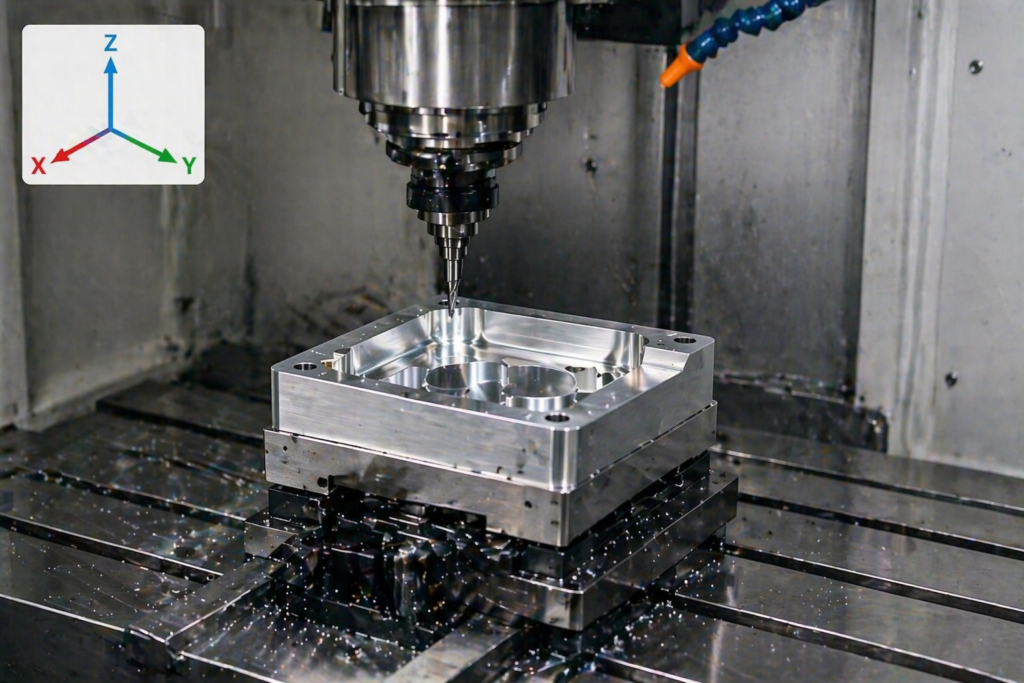
3-axis CNC machining moves the cutting tool along the X, Y, and Z axes. It is suitable for flat surfaces, straight slots, and cylindrical components.
- Applications: simple brackets, plates, housings, and basic automotive or aerospace parts.
- Material options: aluminum series 6061/7075, stainless steel 304, and mild carbon steel.
- Tooling considerations: standard end mills, drills, and taps.
Advantages
| Advantage | Description |
| Cost-effective | Lower machine and tooling costs. |
| Simpler programming | Easier G-code generation; reduced CAM complexity. |
| Fast setup for simple parts | Efficient for repeated simple geometries. |
| Easier maintenance | Less complex machine components, lower downtime. |
Limitations
- Requires multiple setups for multi-surface parts.
- Cannot efficiently reach deep cavities, undercuts, or complex contours.
- Lower surface finish quality for intricate features.
- Higher cumulative positioning errors due to repeated repositioning.
Understanding 5-Axis CNC Machining
Definition and Capabilities
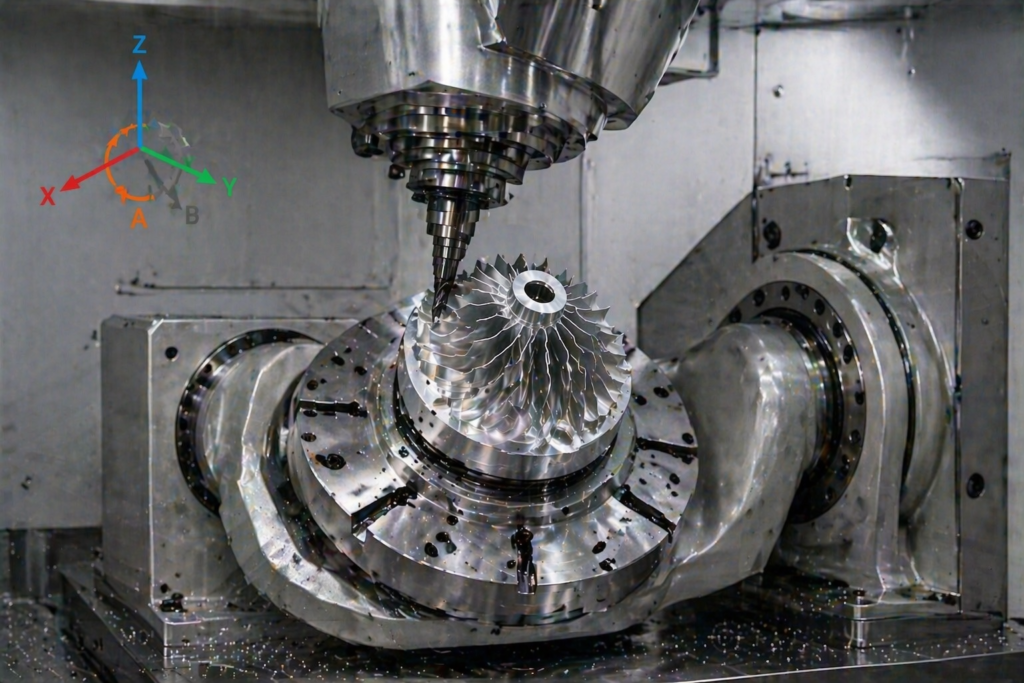
5-axis CNC machining adds two rotational axes (A and B) to the standard X, Y, Z movement. This allows single-setup machining of complex geometries.
- Applications: aerospace brackets, turbine blades, medical implants, automotive molds.
- Material options: aerospace-grade aluminum (AL2024, AL7075), titanium, stainless steel (SUS316), and exotic alloys.
- Tooling considerations: specialized end mills, ball-nose cutters, and high-speed tools.
Advantages
| Advantage | Description |
| Reduced setups | Single-setup machining minimizes error accumulation and cycle time. |
| High precision | Achieves ±0.01mm tolerance on multi-surface parts. |
| Complex geometry | Capable of machining undercuts, deep cavities, and curved surfaces. |
| Lower rework | Fewer setups and precise tool paths reduce scrap. |
| Material versatility | Can handle high-strength alloys and composite materials efficiently. |
Limitations
- Higher capital and maintenance costs.
- Requires advanced CAM programming and operator expertise.
- Longer initial setup and programming time.
Key Comparison: 3-Axis vs 5-Axis
| Feature | 3-Axis | 5-Axis |
| Setup count | Multiple | Usually single |
| Part complexity | Simple | Complex surfaces and contours |
| Accuracy | Moderate | High (±0.01mm) |
| Cost | Lower upfront | Higher upfront, but lower total cost for complex parts |
| Rework | High | Minimal |
| Material flexibility | Standard metals | Advanced alloys and composites |
Case Study Example
Aerospace bracket with curved surfaces:
- 3-axis machining requires multiple setups, increasing labor, risk of alignment error, and total cycle time.
- 5-axis machining completes in a single setup, maintains high precision, and reduces scrap, making it more cost-efficient for high-value materials.
Cost Considerations
Equipment and Operational Costs
- 3-axis machines: $50K–$150K; lower programming and maintenance requirements.
- 5-axis machines: $200K–$500K; higher programming expertise and maintenance cost.
- Tooling and consumables: 5-axis machining may use specialized high-speed or carbide tools.
Material and Rework Impact
- High-value materials (AL7075, titanium, SUS316) increase the cost of rework in 3-axis machining.
- 5-axis machining reduces scrap, minimizes manual handling, and ensures consistent quality for critical aerospace and medical components.
Lifecycle Cost Perspective
- Evaluate total cost including machine investment, programming, tooling, cycle time, and scrap rates.
- For complex, high-precision parts, 5-axis machining often reduces total production cost despite higher upfront investment.
Industry Applications
Aerospace Components
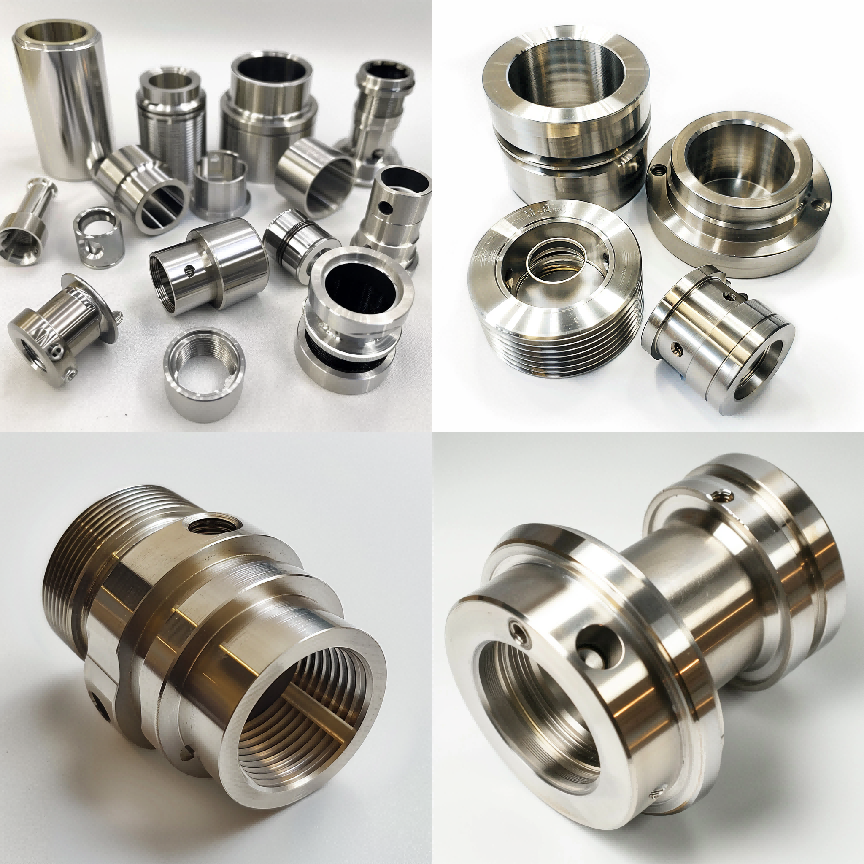
- Turbine blades, engine brackets, and airframe components benefit from single-setup 5-axis machining for aerodynamic precision and tight tolerances.
- 5-axis machining ensures minimal stress during cutting, improving part longevity.
Medical Devices
- Orthopedic implants, surgical tools, and prosthetics require smooth surfaces and tight tolerances.
- 5-axis machining minimizes micro-scratches and tool marks on critical surfaces.
Automotive & Robotics
- Engine components, molds, robotic arms, and complex fixtures benefit from reduced setup time and higher repeatability.
Workflow and Optimization Strategies
Design for Manufacturing (DFM)
- Optimize features for tool access, increase radii on internal corners, and reduce sharp angles.
- Compare single-axis vs. multi-axis tool paths to minimize tool wear and machining time.
Surface Finishing Considerations
- Post-machining treatments like anodizing, powder coating, plating, or polishing improve durability, corrosion resistance, and aesthetic appearance.
- Proper finishing ensures high-quality aerospace, automotive, and medical parts.
Sample and Production Verification
- First article inspection, 3D CMM measurement, and trial runs validate part accuracy and surface finish before full-scale production.
- Inline quality checks help reduce scrap and maintain consistency.
Advanced Tips for Professional CNC Machining
- Toolpath simulation: reduces collision risk and improves surface finish.
- Adaptive feeds & speeds: extend tool life and optimize cycle time.
- Integrated quality control: inline measurement and data logging improve process reliability.
- Multi-material machining: 5-axis enables precise machining of composite or hard alloys in a single setup.
- Industry trend: 5-axis adoption growing due to aerospace, medical, and high-performance automotive demand.
Conclusion
- 3-axis machining: cost-effective for simpler parts, small volumes, and basic prototyping.
- 5-axis machining: critical for high-precision, complex components, reducing setups and rework.
Evaluate part complexity, material, volume, tolerances, and surface finish when selecting the optimal machining process.