
Abstract
Turn-mill machining combines turning and milling in one coordinated CNC process. It is especially useful for parts that need both rotational features and milled details, such as shafts with flats, flanges with bolt holes, medical components, aerospace parts, robotic connectors, and semiconductor equipment parts. This guide explains what turn-mill machining is, when to use it, how it differs from separate CNC turning and milling, and how engineers can design better parts for high-precision production.
Quick Answer
Turn-mill machining combines CNC turning and milling in one setup when parts need round profiles plus flats, holes, slots, threads, or multi-face features with tighter accuracy and fewer transfers.
Key Takeaways
- CNC milling and turning is best for parts with both cylindrical and non-cylindrical features.
- Turn-mill machining reduces re-clamping, handling time, and datum alignment errors.
- It works well for shafts, bushings, flanges, couplings, valve parts, robotic joints, and precision housings.
- The process is valuable for small-to-medium batches, prototypes, and complex precision parts.
- Aerospace, medical, semiconductor, robotics, optical, and auto/moto parts often benefit from one-setup machining.
What Is Turn-Mill Machining?
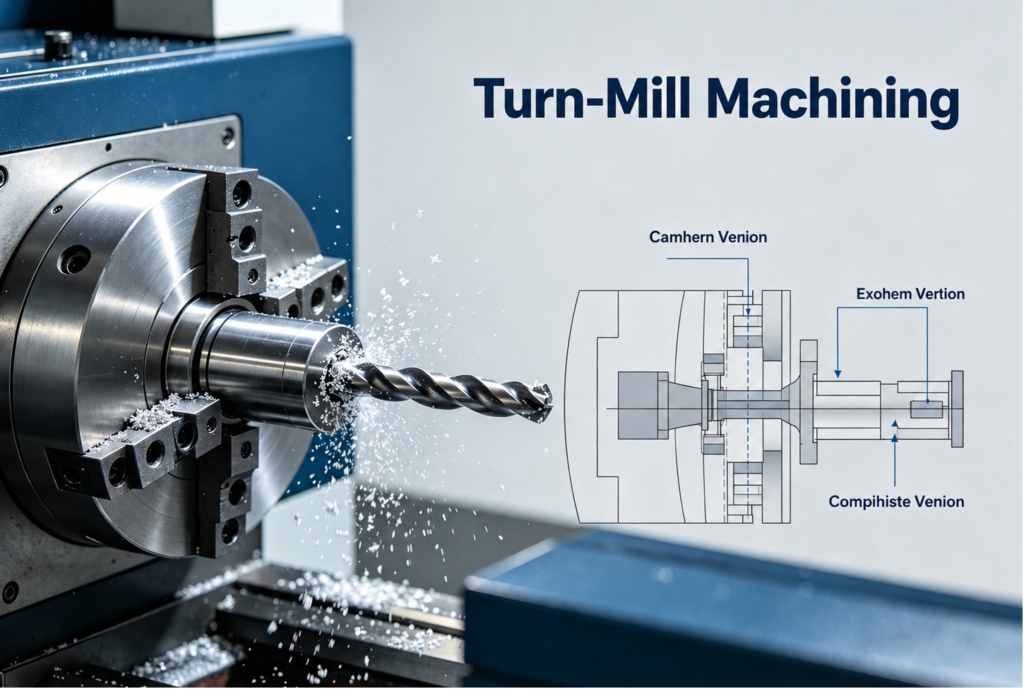
A Simple Definition
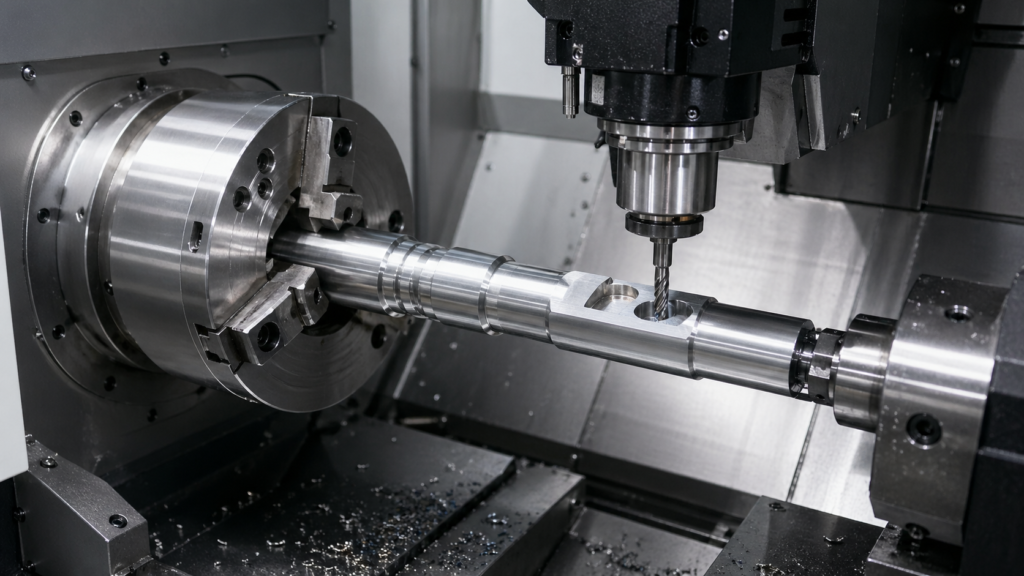
Turn-mill machining is a CNC process that combines cnc turning and cnc milling in one machine setup. In turning, the workpiece rotates while a cutting tool shapes round features such as diameters, shoulders, grooves, tapers, and threads. In milling, a rotating cutting tool removes material from a fixed or indexed workpiece to create flats, slots, pockets, holes, and multi-face details.
In a turn-mill center, these two actions are integrated. The same part can be turned, drilled, tapped, side-milled, face-milled, slotted, and sometimes machined on multiple sides without being transferred to another machine. DMG MORI describes mill-turn centers as machines that combine turning and milling in one working space, enabling complex workpieces to be completed in one cycle with fewer re-clamping steps.
How Turning and Milling Work Together
A typical cnc mill turn workflow may start with turning the outside diameter from bar stock. Then live tooling mills flats, cross holes, keyways, or slots. If the machine has a sub-spindle, the part can be transferred internally for back-side machining. This is why turn-mill machining is often described as “one-setup” or “complete machining.”
For engineers and buyers, the value is simple: fewer setups, fewer datum shifts, shorter lead time, and more consistent part quality.
CNC Milling and Turning vs Separate Operations
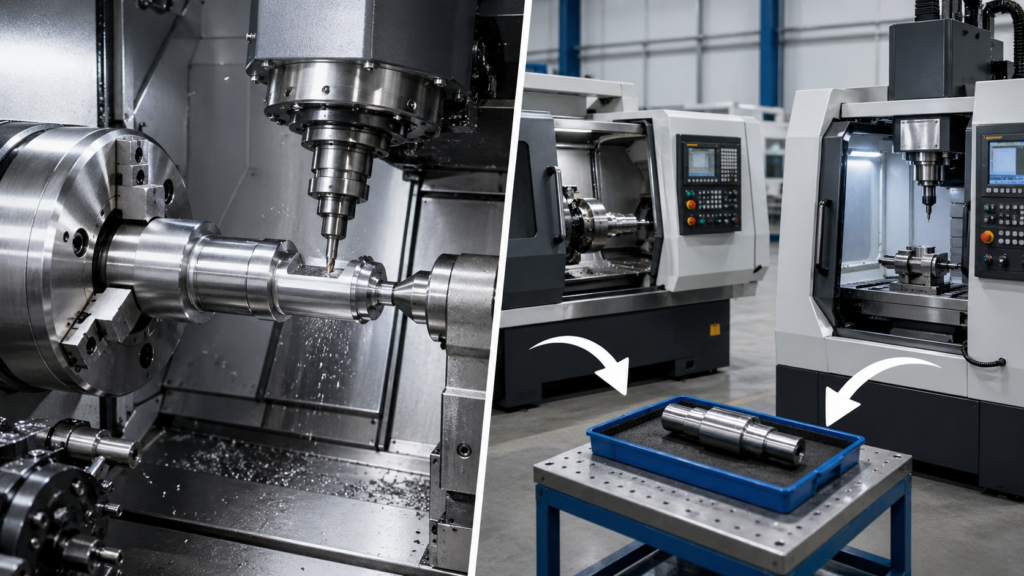
Process Comparison Table
| Manufacturing Route | Best For | Main Advantage | Main Limitation |
| CNC Turning Only | Shafts, pins, bushings, sleeves, threaded round parts | Fast and efficient for rotational geometry | Limited for flats, pockets, off-axis holes, and multi-face details |
| CNC Milling Only | Plates, housings, brackets, pockets, slots, complex surfaces | Flexible for prismatic and multi-face geometry | Less efficient for long cylindrical parts |
| Separate Turning + Milling | Parts that need both processes but have simple tolerance requirements | Flexible machine planning | More handling, re-fixturing, and accumulated tolerance risk |
| cnc milling and turning / Turn-Mill | Round parts with milled features, tight alignment, multiple operations | One setup, fewer transfers, better datum control | Requires advanced programming and suitable equipment |
Why One Setup Matters
Every time a part moves from a lathe to a mill, the manufacturer must re-clamp, re-locate, and re-check the part. That can add time and increase the risk of small alignment deviations. For simple parts, this may be acceptable. For tight-tolerance components, those small deviations can affect concentricity, true position, surface finish, or assembly performance.
This is why precision cnc milling and turning services are valuable when the part has a central axis but also needs accurately located side features.
When Should You Combine Turning and Milling?
Round Parts with Milled Flats, Slots, or Holes
Use turn-mill machining when the part begins as a round, bar-fed, or cylindrical component but also needs features that turning alone cannot create efficiently.
Common examples include:
- A shaft with wrench flats
- A bushing with cross holes
- A connector with milled slots
- A flange with bolt circles
- A valve body with radial ports
- A robotic joint pin with grooves and side holes
These parts are not purely turned parts and not purely milled parts. They sit in the middle, which makes cnc turning and milling the logical process.
Tight Datum Relationships and Concentricity
Turn-mill machining is especially useful when turned and milled features must align to the same datum. For example, a cross hole may need to intersect a bore accurately, or a milled flat may need a controlled angular relationship to a turned diameter.
In separate operations, the second setup must reproduce the original datum. In turn-mill machining, more features can be completed before the datum is disturbed. This improves repeatability and reduces inspection risk.
Small-to-Medium Batch Production
For prototypes and small-to-medium batches, setup time often matters as much as cycle time. Sino Rise positions its CNC precision manufacturing around multi-process and small-to-medium batch production, which matches the buyer intent behind many turn-mill projects.
Turn-mill machining can reduce the need for multiple fixtures, multiple programs, and multiple machine queues. This is useful for buyers who need reliable lead times for engineering samples, pilot runs, or repeat low-volume production.
Complex Parts in High-Growth Industries
Turn-mill machining is increasingly relevant because industries are asking for lighter, more precise, and more integrated parts. SEMI projects strong 300mm fab equipment spending growth in 2026 and 2027, driven partly by AI chip demand and supply chain localization. Deloitte also expects semiconductor sales to reach a historic high in 2026, fueled by AI infrastructure.
For CNC suppliers, this means more demand for precision parts used in semiconductor equipment, automation systems, thermal hardware, positioning parts, and high-accuracy mechanical assemblies.
Typical Turn-Mill Feature Examples
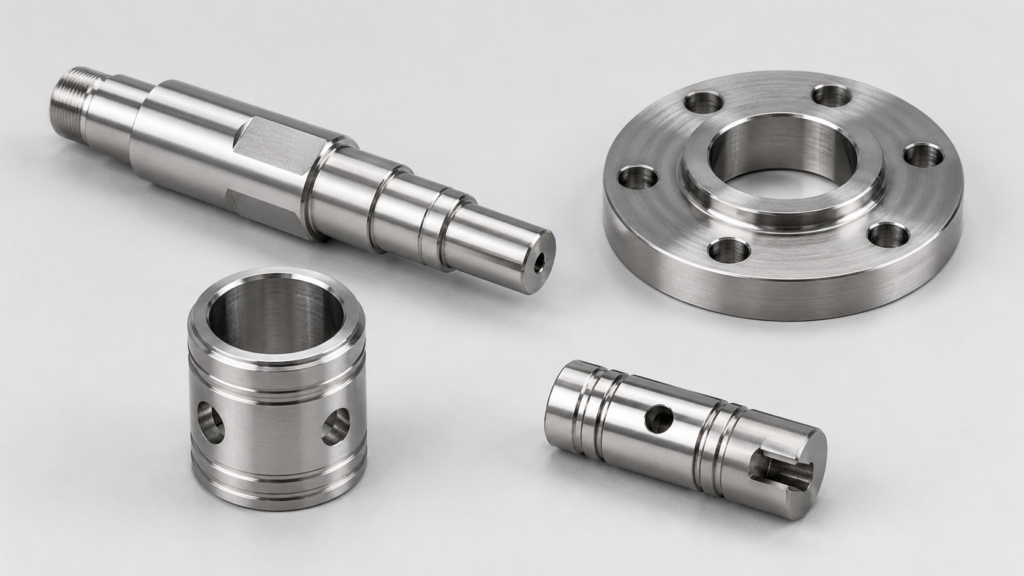
5 Feature Diagrams Engineers Can Use
Below are suggested feature diagrams that can be added to the blog as simple technical illustrations.
| Figure | Suggested Visual | Feature Type | Why Turn-Mill Helps |
| Figure 1 | Cylindrical shaft with two milled flats | Turned OD + milled wrench flats | Keeps flats aligned to shaft centerline |
| Figure 2 | Flange with OD, bore, and bolt circle | Turning + drilling/tapping | Reduces re-clamping between lathe and mill |
| Figure 3 | Valve sleeve with radial ports | Bore + cross holes | Maintains accurate hole-to-bore position |
| Figure 4 | Medical instrument handle with taper and slot | Turned taper + milled slot | Improves ergonomic and functional feature consistency |
| Figure 5 | Robotic connector pin with grooves and side hole | Grooving + drilling + milling | Supports compact multi-feature parts |
Feature-to-Process Mapping Table
| Part Feature | Turning Handles | Milling Handles | Turn-Mill Benefit |
| Outside diameter | Yes | Not ideal | Fast round shaping |
| Internal bore | Yes | Sometimes | Better concentricity |
| Threads | Yes | Yes, depending on design | Flexible internal/external threading |
| Flats | No | Yes | Adds assembly surfaces |
| Slots/keyways | No | Yes | Avoids secondary milling setup |
| Cross holes | Limited | Yes | Accurate radial features |
| Bolt circles | Limited | Yes | Efficient flange machining |
| Multi-face details | No | Yes | Supports complex precision components |
Turn-Mill Machining Process Flow
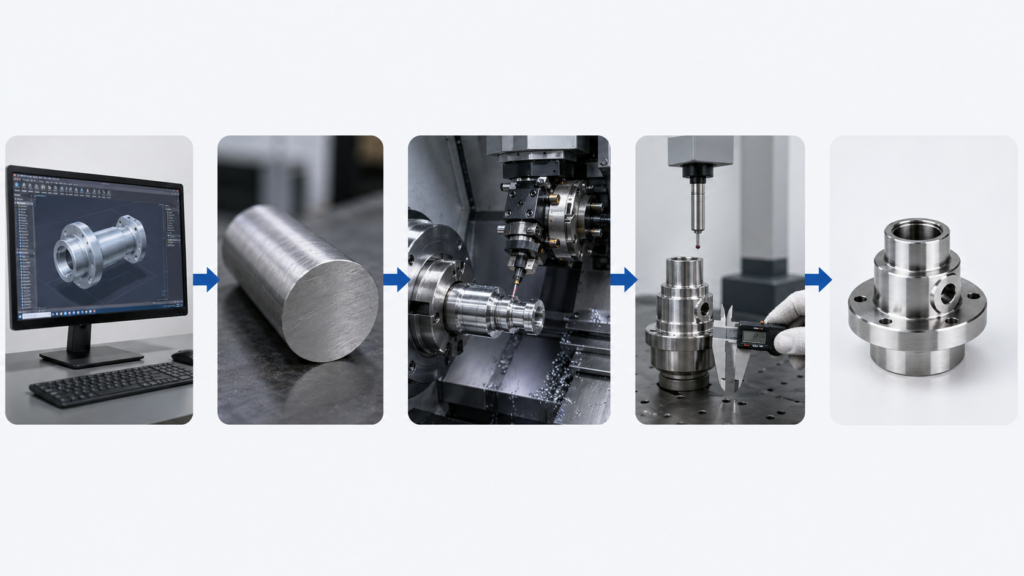
From CAD Model to Finished Part
A strong turn-mill project usually follows this workflow:
CAD Model → DFM Review → Material Selection → Turning Strategy → Milling/Live Tooling Strategy → Deburring → Surface Finishing → Inspection → Packaging
During DFM review, engineers check whether the part should be made from bar stock, billet, casting, or forging. They also review tolerances, datum structure, tool access, wall thickness, burr risks, and surface finish requirements.
For high precision cnc machining, the most important question is not only “Can the machine cut this?” but also “Can the process hold the datum structure repeatedly?”
Inspection and Surface Finishing
After machining, parts may require dimensional inspection, roughness checks, thread gauges, concentricity checks, or CMM reports. Depending on the application, surface finishing services may include anodizing, passivation, polishing, plating, sandblasting, or other metal surface treatments.
For medical, aerospace, optical, and semiconductor-related parts, surface condition can be as important as dimensional accuracy. Burrs, tool marks, contamination, or inconsistent finishes can affect sealing, motion, cleanliness, or assembly reliability.
Materials and Industry Applications
Aerospace and Low-Altitude Aircraft Components
Aerospace and low-altitude aircraft components often require lightweight metals, tight tolerances, and strong reliability. China’s low-altitude economy is being developed as a strategic emerging field connected to aerospace, smart manufacturing, new energy, and AI, with UAV and eVTOL applications highlighted as major technical drivers.
Turn-mill machining fits components such as aluminum structural connectors, shaft-like actuator parts, titanium fastener components, landing mechanism parts, sensor housings, and lightweight precision fittings.
Medical, Semiconductor, Robotics, Optical, and Auto Parts
Medical parts often need tight dimensional control, smooth surfaces, and biocompatible materials such as stainless steel or titanium. Turn-mill machining can support surgical instruments, implant-related components, handles, sleeves, and miniature mechanical parts.
Semiconductor equipment parts require precision, cleanliness, stable materials, and repeatable assembly interfaces. With AI-driven chip demand increasing investment in advanced fab equipment, precision-machined parts for semiconductor systems are likely to remain important.
Robotics and automation parts often include shafts, couplings, joints, sensor mounts, grippers, and compact motion components.
How to Decide Between Turn-Mill and Separate CNC Operations?
Decision Table
| Design Question | Choose Turn-Mill If… | Separate Operations May Work If… |
| Is the part mostly round? | Yes, but it also has milled features | It is only a simple turned shaft |
| Are side holes or slots required? | Yes, especially with tight position tolerance | Features are loose-tolerance or non-critical |
| Are datums hard to re-create? | Yes | No, datum transfer is simple |
| Is lead time important? | Yes, fewer setups can help | Machine availability favors separate routing |
| Is batch size small or medium? | Yes, setup reduction matters | Very high volume may justify dedicated fixtures |
| Is part geometry complex? | Yes, especially multi-face parts | Geometry is simple and process risk is low |
Design Tips for Better Results
To make cnc milling turning more efficient, design teams should:
- Define primary and secondary datums clearly.
- Avoid unnecessary ultra-tight tolerances on non-critical features.
- Provide surface finish requirements only where functional.
- Add reasonable tool radii in internal corners.
- Confirm whether cross holes, slots, or flats need angular positioning.
- Discuss burr-sensitive edges early.
- Specify material grade, heat treatment, and finishing requirements clearly.
- Share expected annual volume so the supplier can optimize the process route.
Good communication between the buyer and the CNC supplier can reduce quotation uncertainty and prevent redesign after machining review.
People Also Ask About Turn-Mill Machining
Is Turn-Mill the Same as CNC Milling and Turning?
Not exactly. cnc milling and turning can refer broadly to using both processes, either on separate machines or in one integrated workflow. Turn-mill machining usually means both turning and milling are completed on one CNC turn-mill center, often in one setup.
Is Turn-Mill More Expensive?
The hourly machine rate can be higher because turn-mill centers are more advanced. However, the total part cost may be lower when the process reduces fixtures, labor, transfer time, inspection risk, and scrap. For complex parts, total cost matters more than machine-hour cost alone.
What Parts Are Best for Turn-Mill Machining?
The best candidates are parts with a cylindrical base plus milled details. Examples include shafts with flats, bushings with cross holes, flanges with bolt patterns, threaded connectors, valve bodies, robotic joints, medical tools, optical mounts, and semiconductor equipment components.
What Materials Can Be Used?
Common cnc machining materials include aluminum, stainless steel, brass, copper, titanium, engineering plastics, and specialty alloys. Material choice depends on strength, weight, corrosion resistance, machinability, thermal stability, and surface finish requirements.
When Should I Avoid Turn-Mill Machining?
Avoid turn-mill machining when the part is very simple, has no critical relationship between turned and milled features, or can be produced faster on a dedicated lathe or mill. The best process is the one that meets tolerance, cost, lead time, and volume requirements with the least risk.
Conclusion
Turn-mill machining is not just a combination of two CNC processes. It is a smarter manufacturing strategy for parts that need round geometry, milled details, tight datum control, and efficient production. When a part requires both turning and milling, the decision should not be based only on machine availability. It should be based on geometry, tolerance stack-up, re-clamping risk, lead time, and total production cost.
For industries such as aerospace, medical devices, semiconductor equipment, robotics, optical instruments, and auto/moto parts, precision cnc milling and turning services can help produce complex components with fewer setups and more consistent results. For engineers, buyers, and product developers, the key question is simple: if your part loses accuracy or efficiency every time it moves between machines, it may be time to combine turning and milling.