
Abstract
CNC milling and CNC turning are two core subtractive manufacturing processes used to produce precision metal and plastic parts. The main difference is how material is removed: milling uses rotating cutting tools to shape a fixed or indexed workpiece, while turning rotates the workpiece against a cutting tool to create cylindrical features. For many modern parts, especially in aerospace, medical, semiconductor, robotics, optical, and automotive applications, cnc milling and turning may be combined to improve accuracy, reduce setups, and produce complex geometries more efficiently.
Quick Answer
CNC milling uses rotating tools to cut fixed workpieces; CNC turning rotates the workpiece to create round parts. Combine both for complex precision components with mixed features.
Key Takeaways
- CNC milling and turning are both CNC machining methods, but they serve different part geometries.
- CNC milling is best for flats, pockets, slots, holes, contours, and multi-face features.
- CNC turning is best for shafts, pins, bushings, rings, threads, grooves, and concentric round parts.
- CNC turning and milling should be combined when one part needs both round and prismatic features.
- Materials include aluminum, stainless steel, titanium, brass, copper, engineering plastics, and specialty alloys.
- For new manufacturing websites, this topic works well as a pillar page because it explains definitions, processes, applications, pros, limits, and decision rules.
CNC milling and CNC turning are subtractive manufacturing processes. Both use computer numerical control to guide cutting tools, remove material, and create finished parts from metal or plastic stock. The key difference is what rotates during cutting.
In CNC milling, the cutting tool rotates. In CNC turning, the workpiece rotates. Mastercam explains this distinction clearly: milling removes material with a rotating tool, while turning uses a rotating workpiece and a cutting tool moving into it.
CNC Milling Definition
CNC milling is a machining process where rotating cutting tools remove material from a fixed or controlled workpiece. The machine may move along three, four, or five axes depending on part complexity. Milling is used to create flat surfaces, pockets, slots, holes, contours, angled faces, and complex 3D shapes.
Because of its flexibility, precision cnc milling is commonly used for housings, brackets, plates, molds, fixtures, robotic components, optical parts, and aerospace structures.
CNC Turning Definition
CNC turning is a machining process where the workpiece rotates on a spindle while a cutting tool removes material from its surface. It is ideal for round, symmetrical, and concentric features.
Common turned parts include shafts, pins, bushings, sleeves, rings, nozzles, threaded connectors, spacers, and valve components. CNC turning is often faster and more efficient than milling when the part is mainly cylindrical.
How CNC Milling and Turning Work?
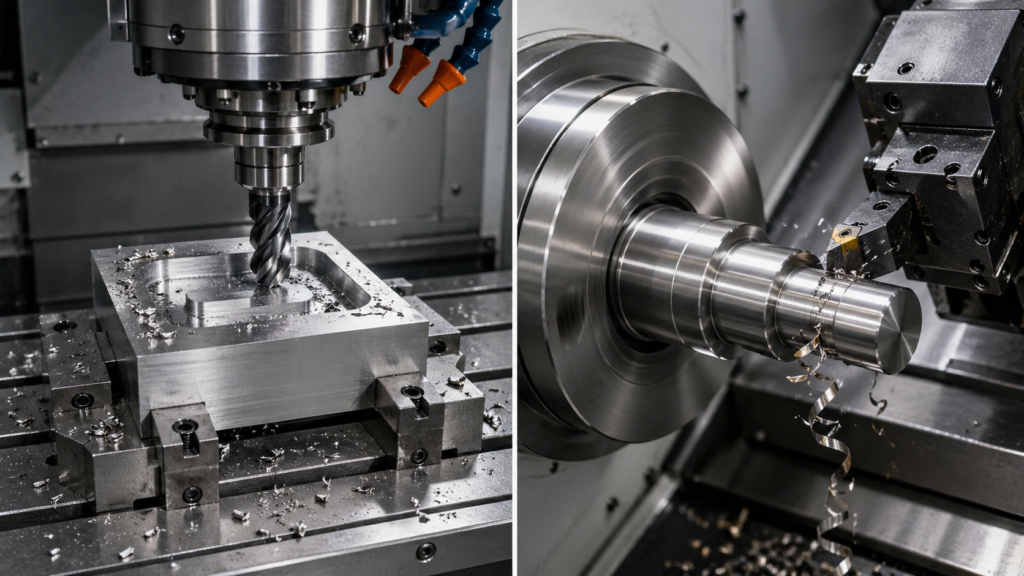
How CNC Milling Works
The cnc milling process usually starts with a CAD model. The model is converted into CAM toolpaths, and the machine follows programmed movements to cut the workpiece.
A typical milling workflow includes:
- CAD model review
- Material and fixture selection
- Toolpath programming
- Roughing operation
- Semi-finishing
- Finishing
- Deburring and inspection
- Surface finishing if required
Milling can use end mills, face mills, drills, taps, reamers, ball-nose cutters, and chamfer tools. The process is highly flexible, especially for parts with non-round geometry.
How CNC Turning Works?
The cnc turning process also begins with a CAD model and machining program. The raw material is usually bar stock, tube stock, or a pre-cut blank. The spindle rotates the workpiece while tools cut the outside diameter, inside diameter, grooves, tapers, threads, and shoulders.
A typical turning workflow includes:
- Load bar stock or blank
- Face the end surface
- Turn outside diameter
- Bore or drill internal features
- Cut grooves, tapers, or threads
- Part off the finished component
- Inspect diameter, length, roundness, and surface finish
Turning is especially efficient for high-repeatability cylindrical parts.
Key Differences Between CNC Milling and Turning
Movement, Shape, Tooling, and Feature Comparison
The easiest way to understand cnc milling turning differences is to compare motion and geometry. Milling is tool-rotation focused. Turning is workpiece-rotation focused.
Milling creates more flexible shapes. Turning creates round features more efficiently.
Quick Comparison Table
| Category | CNC Milling | CNC Turning |
| Main motion | Cutting tool rotates | Workpiece rotates |
| Best for | Flats, slots, pockets, holes, contours | Shafts, bushings, rings, threads, grooves |
| Workpiece shape | Block, plate, casting, billet, irregular part | Bar, rod, tube, round blank |
| Tool type | Multi-point rotating tools | Single-point or turret-mounted tools |
| Feature strength | Non-round and multi-face geometry | Cylindrical and concentric geometry |
| Common machines | 3-axis, 4-axis, 5-axis machining centers | CNC lathes, turning centers, Swiss lathes |
| Best production fit | Complex geometries and prototypes | Round parts and repeat production |
Main Types of CNC Milling and CNC Turning
Common CNC Milling Types
Common milling types include:
- 3-axis CNC milling: Best for simple pockets, holes, surfaces, and standard prismatic parts.
- 4-axis CNC milling: Adds rotation for angled features and multi-side machining.
- 5-axis CNC milling: Used for complex surfaces, aerospace parts, medical parts, and high-precision components.
- Vertical CNC milling: Common for general-purpose machining.
- Horizontal CNC milling: Useful for heavier parts, chip evacuation, and production efficiency.
These types support a wide range of cnc machining milling requirements, from simple prototypes to complex precision parts.
Common CNC Turning Types
Common turning types include:
- 2-axis CNC turning: Standard turning for round parts.
- CNC turning center: Supports multiple tools and higher automation.
- Swiss turning: Best for small, slender, high-precision components.
- Live-tool turning: Adds milling, drilling, and tapping operations on a turning machine.
- Turn-mill machining: Combines turning and milling in one setup.
Sino Rise describes CNC Turning-Milling as a process that combines rotating workpiece turning with rotating-tool milling, allowing outer diameters, inner holes, threads, flats, slots, drilling, and tapping to be completed in one setup.
Typical Part Features and Visual Examples
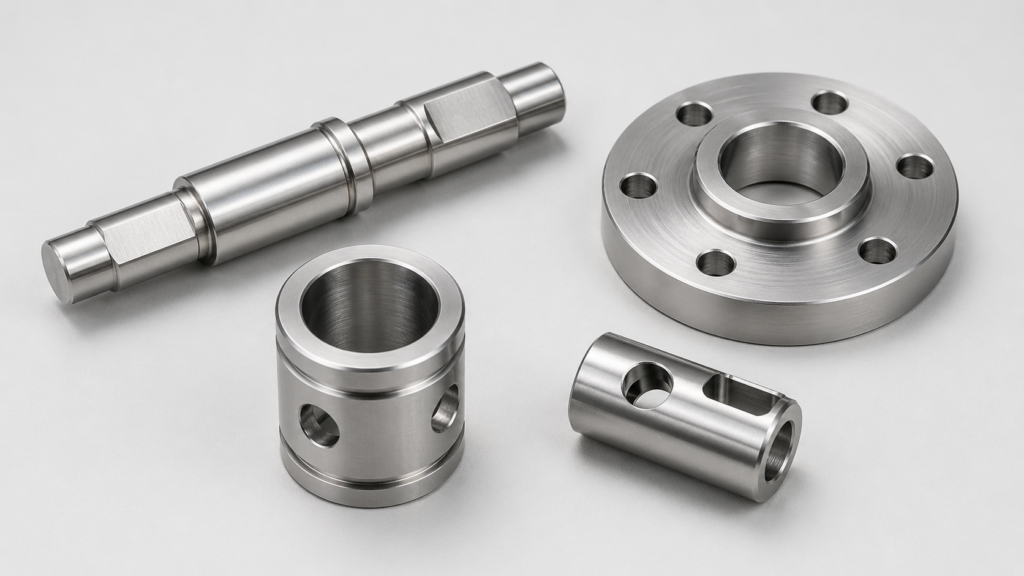
5 Feature Diagram Ideas
For this blog, adding 3–5 feature diagrams can make the explanation more convincing. Suggested visuals:
| Figure | Visual Concept | Best Process | Why It Matters |
| Figure 1 | Rectangular bracket with pockets and holes | CNC milling | Shows flat surfaces, pockets, and hole patterns |
| Figure 2 | Cylindrical shaft with steps and thread | CNC turning | Shows diameter control, grooves, and external threads |
| Figure 3 | Round flange with bolt circle | Milling + turning | Shows a part that needs both OD turning and hole milling |
| Figure 4 | Bushing with cross holes | Turn-mill | Shows radial holes aligned to a cylindrical bore |
| Figure 5 | Robotic connector with round and flat features | CNC mill-turn | Shows mixed geometry in one precision component |
Feature-to-Process Mapping Table
| Part Feature | CNC Milling | CNC Turning | Combined Process |
| Flat surface | Excellent | Limited | Useful if on round part |
| Excellent | Not suitable | Possible with live tooling | |
| Slot | Excellent | Limited | Useful for shafts with keyways |
| Outside diameter | Possible but inefficient | Excellent | Best for round base geometry |
| Internal bore | Possible | Excellent | Good for bore plus milled features |
| Thread | Possible | Excellent | Depends on location and design |
| Cross hole | Excellent | Limited | Ideal for turn-mill |
| Multi-face geometry | Excellent | Limited | Best with 4-axis, 5-axis, or turn-mill |
Common CNC Machining Materials
Metals for Milling and Turning
Common cnc machining materials include:
| Material | Milling Suitability | Turning Suitability | Common Uses |
| Aluminum | Excellent | Excellent | Aerospace parts, housings, brackets, heat sinks |
| Stainless steel | Good | Good | Medical parts, shafts, valves, food equipment |
| Titanium | Good with proper tooling | Good with proper tooling | Aerospace, medical implants, high-strength parts |
| Brass | Excellent | Excellent | Fittings, bushings, electrical parts |
| Copper | Good but soft | Good but soft | Electrical and thermal components |
| Alloy steel | Good | Excellent | Shafts, gears, mechanical parts |
Plastics and Specialty Materials
Engineering plastics such as POM, PEEK, PTFE, ABS, nylon, and polycarbonate can also be machined. Plastics are often selected for insulation, weight reduction, chemical resistance, or low-friction performance.
Sino Rise states that its CNC Turning-Milling services support common metals such as aluminum alloys, stainless steel, titanium alloys, alloy steel, carbon steel, and engineering plastics.
Applications of CNC Milling and Turning
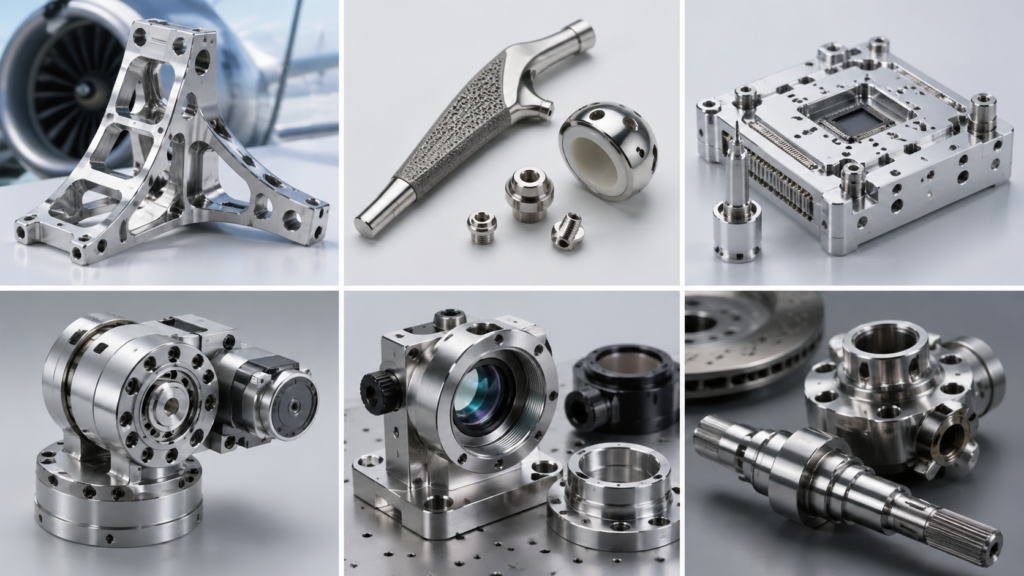
Aerospace, Medical, Semiconductor, Robotics, Optical, and Auto Parts
Precision cnc milling and turning services are used across industries where part accuracy, repeatability, and material performance matter.
Common applications include:
| Industry | CNC Milling Examples | CNC Turning Examples |
| Aerospace | Brackets, housings, structural parts | Pins, bushings, actuator shafts |
| Medical | Surgical tools, device housings | Sleeves, implant-related parts, instrument handles |
| Semiconductor | Fixtures, chambers, precision plates | Nozzles, spacers, alignment parts |
| Robotics | End-effectors, mounts, joint blocks | Pins, shafts, couplings |
| Optical instruments | Lens mounts, precision frames | Rings, threaded optical holders |
| Auto & moto | Engine brackets, custom parts | Axles, spacers, bushings |
Sino Rise positions its manufacturing services for low-altitude aircraft components, medical industry components, semiconductor parts, robotic components, optical instrument components, and auto & moto parts.
Why Industry Demand Is Growing
Industry demand is growing because modern parts are becoming smaller, lighter, more integrated, and more precise. Semiconductor equipment demand is especially strong: SEMI reported that worldwide 300mm fab equipment spending is expected to increase 18% to $133 billion in 2026 and 14% to $151 billion in 2027, driven by AI chip demand, data centers, edge devices, and regional supply chain investment.
Advantages and Limitations
CNC Milling Advantages and Limits
Advantages of CNC milling:
- Handles complex 2D and 3D geometries
- Suitable for prototypes and production
- Supports many metals and plastics
- Creates holes, pockets, slots, contours, and surfaces
- Works well with 3-axis, 4-axis, and 5-axis machining
Limitations of CNC milling:
- Less efficient for long cylindrical parts
- Deep cavities may require special tooling
- Internal sharp corners are difficult because tools are round
- More setups may be needed for multi-side parts without advanced equipment
CNC Turning Advantages and Limits
Advantages of CNC turning:
- Very efficient for round parts
- Excellent concentricity for cylindrical features
- Good surface finish on diameters
- Cost-effective for shafts, pins, bushings, and threaded parts
- Suitable for bar-fed production
Limitations of CNC turning:
- Not ideal for flat, box-like, or irregular parts
- Limited for pockets, side holes, and multi-face features unless live tooling is used
- Complex non-round features may require milling or turn-mill machining
How to Choose Between CNC Milling and Turning
Decision Table for Engineers and Buyers
| Question | Choose CNC Milling If… | Choose CNC Turning If… |
| What is the basic shape? | Block, plate, housing, bracket | Shaft, pin, bushing, ring |
| Are flat surfaces important? | Yes | Not the main feature |
| Are round diameters important? | Secondary | Primary |
| Are pockets or slots needed? | Yes | Only with live tooling |
| Is concentricity critical? | Sometimes | Yes |
| Is the part mostly symmetrical? | No | Yes |
| Does it need both round and milled features? | Use milling plus turning or turn-mill | Use live tooling or turn-mill |
When to Combine Both Processes
Combine cnc turning and milling when the part has both cylindrical and non-cylindrical features. Examples include:
- A shaft with milled flats
- A bushing with cross holes
- A flange with a turned OD and drilled bolt circle
- A valve component with ports and threads
- A robotic connector with round, flat, and slotted features
- A medical instrument component with a turned handle and milled groove
A combined cnc mill turn process can reduce re-clamping, improve datum control, shorten lead time, and reduce alignment errors. Mastercam notes that mill-turn machining helps when parts would otherwise need to move between a lathe and a mill, because each transfer adds time, re-fixturing, and potential error.
People Also Ask About CNC Milling and Turning
Is CNC Milling Better Than CNC Turning?
No. CNC milling is not universally better than CNC turning. It depends on part geometry. Milling is better for complex shapes, flat faces, pockets, and slots. Turning is better for round, concentric, and cylindrical parts.
Which Is More Accurate, Milling or Turning?
Both can be highly accurate when the machine, tooling, material, and process control are suitable. Turning often provides excellent concentricity for round parts, while milling is better for accurate multi-face geometry. For mixed-feature parts, high precision milling and turning can provide better overall datum control.
Can One Part Require Both CNC Milling and Turning?
Yes. Many precision parts require both. A part may need a turned outside diameter, an internal bore, milled flats, drilled holes, tapped threads, and side slots. In that case, cnc milling and turning or turn-mill machining can be more efficient than using separate machines.
Is CNC Turning Cheaper Than CNC Milling?
For simple round parts, CNC turning is often more cost-efficient because the cutting process is continuous and well suited to cylindrical geometry. For non-round parts, milling is usually more appropriate. The lowest-cost process is the one that matches the part design with the fewest setups and lowest risk.
What Should I Prepare Before Requesting a Quote?
Prepare a 3D CAD file, 2D drawing, material grade, tolerance requirements, surface finish requirements, quantity, application, and delivery expectations. Sino Rise’s quote workflow asks users to upload drawings, define part name and quantity, material requirements, delivery time, and contact information.
Conclusion
CNC milling and CNC turning are both essential precision machining processes, but they are designed for different geometries. CNC milling uses rotating tools to create flats, holes, pockets, slots, and complex surfaces. CNC turning rotates the workpiece to create shafts, bushings, rings, grooves, threads, and other round features.
The simplest decision rule is this: choose milling for complex non-round features, choose turning for round and concentric features, and combine both when the same part needs cylindrical accuracy plus milled details.