
Abstract
Automotive and motorcycle parts are not only judged by shape. Buyers care about strength, weight, assembly fit, surface finish, heat resistance, corrosion resistance, lead time, and repeatable quality. With electric vehicles, lightweight structures, high-performance motorcycles, and automated production increasing demand for precision components, automotive cnc machining has become an important manufacturing method for prototypes, replacement parts, performance upgrades, and small-to-medium batch production.
This guide explains common CNC part types, key industry requirements, recommended materials, machining processes, surface treatments, inspection methods, and common risks for automotive and motorcycle applications.
What Are CNC Parts for Automotive and Motorcycle Applications?
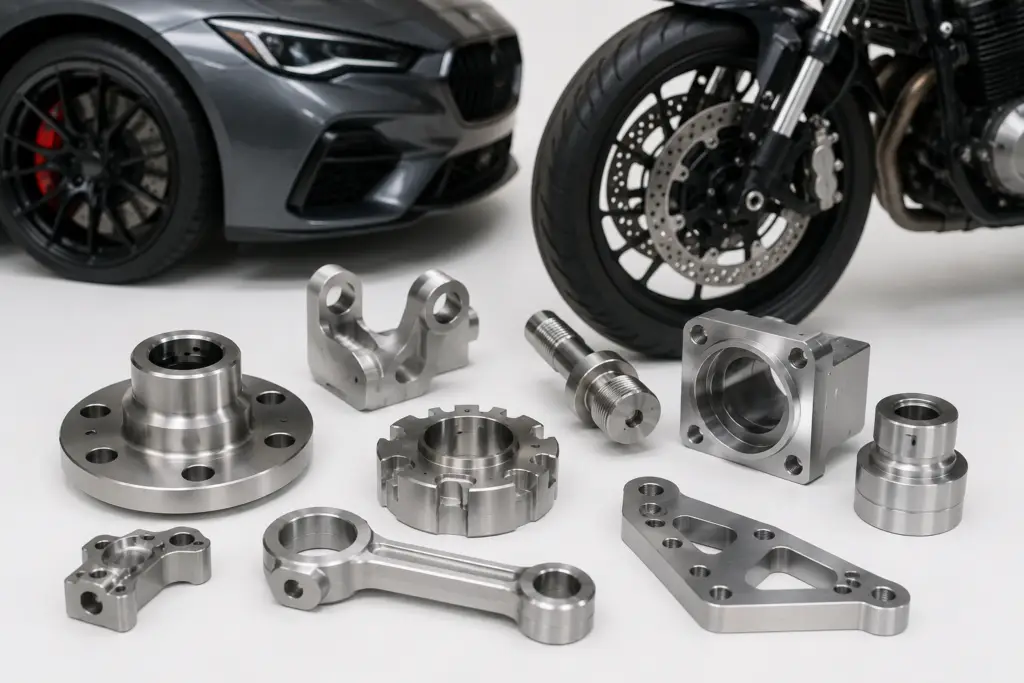
Automotive CNC machining refers to using computer-controlled milling, turning, drilling, tapping, boring, and finishing processes to manufacture custom parts for cars, motorcycles, electric vehicles, racing systems, aftermarket products, and vehicle development projects.
These parts may be used for prototyping, performance tuning, functional testing, low-volume production, repair, or custom assembly. CNC machining is especially useful when parts need accurate geometry, stable dimensions, short lead times, or materials that are stronger than 3D-printed plastics.
Typical CNC Part Categories in Auto and Moto Projects
| Part Category | Examples | Main Requirement |
| Structural parts | Brackets, mounts, supports, clamps | Strength, flatness, hole accuracy |
| Powertrain-related parts | Housings, adapters, shafts, spacers | Fit, heat resistance, concentricity |
| Motorcycle performance parts | Foot pegs, levers, triple clamps, axle blocks | Strength, appearance, durability |
| EV and battery-related parts | Cooling plates, busbar supports, connectors | Thermal control, insulation, precision |
| Interior and exterior parts | Knobs, decorative covers, trim pieces | Appearance, texture, finish consistency |
| Testing and prototype parts | Fixtures, jigs, trial components | Speed, flexibility, repeatability |
What Do Automotive and Motorcycle Buyers Care About Most?
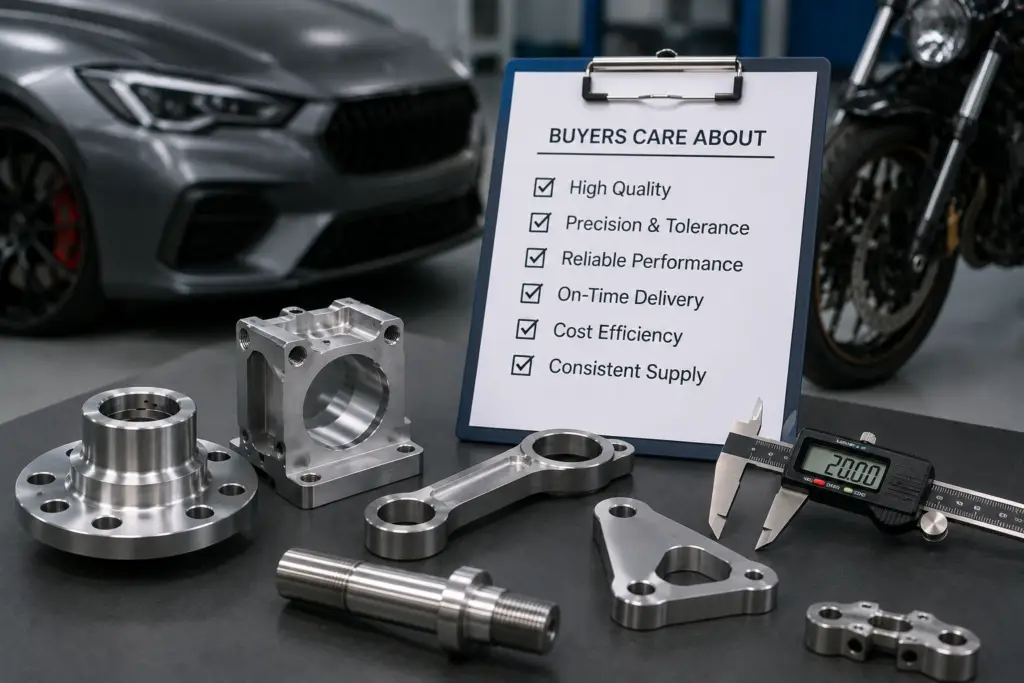
In automotive precision machining, buyers usually care about more than price. A low-cost part is not useful if it cannot assemble correctly, fails under vibration, corrodes too quickly, or looks inconsistent on visible motorcycle components.
For automotive and motorcycle applications, the most important requirements are usually dimensional accuracy, repeatability, strength, weight, heat resistance, corrosion protection, surface quality, and stable delivery.
Key Performance Indicators for CNC Vehicle Parts
| Requirement | Why It Matters |
| Dimensional accuracy | Ensures correct assembly with mating parts |
| Repeatability | Keeps batches consistent from prototype to production |
| Strength and fatigue resistance | Helps parts survive load, vibration, and repeated use |
| Lightweight design | Important for EVs, motorcycles, drones, and performance vehicles |
| Surface durability | Protects against corrosion, scratches, and wear |
| Heat resistance | Critical near engines, brakes, exhaust systems, or batteries |
| Thread quality | Prevents assembly failure and rework |
| Lead time | Supports fast vehicle development and aftermarket launches |
Common CNC Machined Automotive and Motorcycle Parts
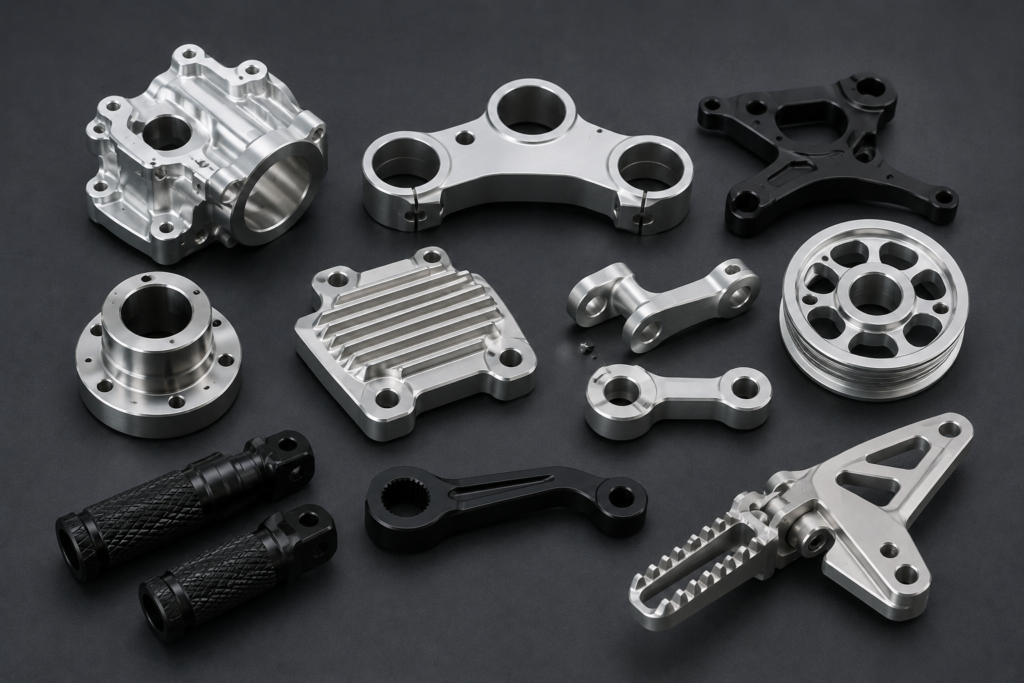
Automotive parts machining covers many different components, from hidden structural parts to visible performance parts. The part type strongly affects material, machining method, finish, and inspection plan.
Functional, Structural, Appearance, and Performance Parts
| Application | Common CNC Parts | Common Concerns |
| Automotive prototypes | Housings, adapters, brackets, test fixtures | Fast iteration, drawing updates, tolerance control |
| EV systems | Battery cooling parts, connector housings, sensor brackets | Thermal stability, insulation, corrosion control |
| Motorcycle upgrades | Levers, clamps, risers, foot pegs, axle blocks | Strength, anodized finish, visible surface quality |
| Engine and drivetrain | Spacers, shafts, sleeves, bushings, covers | Concentricity, wear resistance, heat resistance |
| Suspension and chassis | Mounts, linkages, brackets, plates | Load capacity, fatigue, hole position accuracy |
| Interior/exterior trim | Knobs, bezels, decorative covers | Appearance, texture, color consistency |
Recommended Materials for Automotive Machined Parts
Material choice should start from the part’s function. A lightweight motorcycle lever, a stainless sensor bracket, and a high-wear shaft may all need different materials.
| Material | Best For | Key Advantage |
| Aluminum 6061 | Brackets, housings, fixtures, motorcycle parts | Lightweight, machinable, cost-effective |
| Aluminum 7075 | High-strength performance parts | High strength-to-weight ratio |
| Stainless Steel 304/316 | Corrosion-resistant brackets, shafts, hardware | Strength and corrosion resistance |
| Carbon Steel / Alloy Steel | Shafts, pins, bushings, load-bearing parts | Strength and wear resistance |
| Brass | Electrical fittings, bushings, decorative parts | Machinability and appearance |
| Copper | EV connectors, heat-transfer parts | Conductivity and thermal performance |
| Titanium | Premium lightweight performance parts | Strength, corrosion resistance, low weight |
| POM / Nylon / PEEK | Bushings, insulators, wear pads | Low friction, insulation, lightweight |
Material Selection by Priority
| Priority | Recommended Material Direction |
| Lightweight structure | Aluminum 6061 / 7075 |
| High strength in compact space | Steel, 7075 aluminum, titanium |
| Corrosion resistance | Stainless steel, anodized aluminum |
| Electrical conductivity | Copper, brass |
| Heat transfer | Aluminum, copper |
| Wear resistance | Steel, stainless steel, engineered plastics |
| Premium motorcycle appearance | Anodized aluminum, polished stainless steel |
Recommended CNC Processes for Auto and Moto Parts
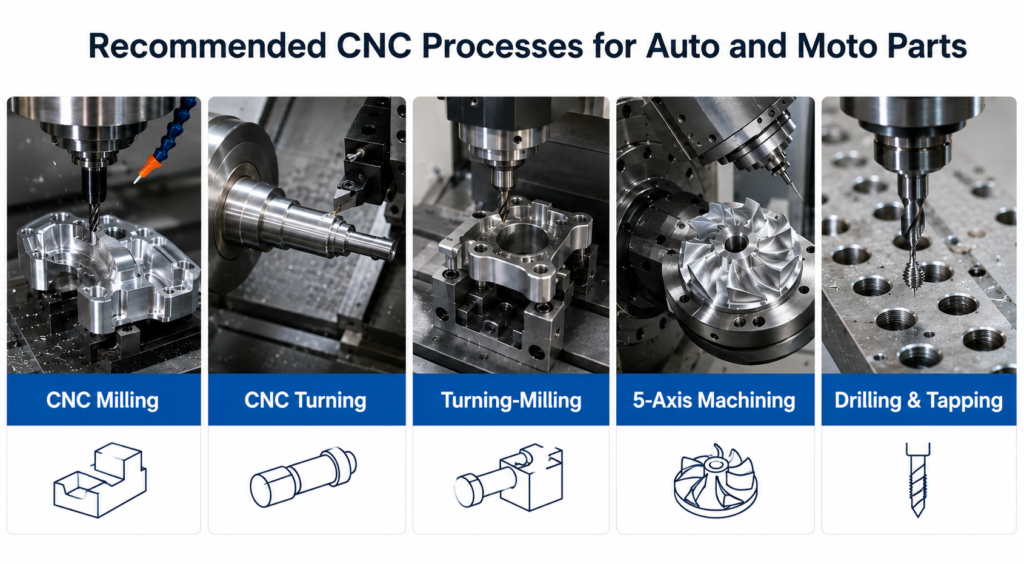
Different vehicle parts need different machining processes. Choosing the right process reduces cost, improves quality, and shortens lead time.
| CNC Process | Suitable Parts | Why It Fits |
| CNC milling | Brackets, plates, housings, clamps | Good for pockets, slots, holes, flat surfaces |
| CNC turning | Shafts, spacers, bushings, sleeves | Good for round and concentric parts |
| CNC milling and turning | Complex round parts with side features | Reduces setups and improves alignment |
| 5 axis cnc machining | Complex brackets, curved surfaces, angled features | Improves access and reduces multiple setups |
| Wire EDM | Thin slots, hard metals, precise profiles | Good for tight internal geometry |
| Sheet metal + CNC | Covers, panels, lightweight structures | Efficient for formed vehicle parts |
Process Selection Example
| Part Type | Recommended Process |
| Motorcycle handlebar clamp | CNC milling or 5-axis machining |
| Axle spacer | CNC turning |
| Sensor bracket | CNC milling |
| Brake-related adapter | CNC milling + precision inspection |
| Threaded sleeve | CNC turning |
| Complex EV housing | CNC milling or 5-axis machining |
Recommended Surface Treatments for Vehicle CNC Parts
Surface finish is important in automotive and motorcycle applications because parts face moisture, road contaminants, vibration, heat, handling, and visible appearance requirements.
| Surface Treatment | Suitable Material | Common Use |
| Anodizing | Aluminum | Motorcycle parts, brackets, housings, colored components |
| Hard anodizing | Aluminum | Wear-resistant and functional surfaces |
| Sandblasting | Aluminum, stainless steel | Uniform matte texture |
| Polishing | Aluminum, stainless steel, brass | Decorative or low-friction surfaces |
| Passivation | Stainless steel | Corrosion resistance and surface cleanliness |
| Zinc / nickel plating | Steel, brass | Corrosion resistance and appearance |
| Black oxide | Steel | Dark finish and mild corrosion protection |
| Powder coating | Aluminum, steel | Durable color and protection |
Finish Selection by Application
| Application Need | Suggested Finish |
| Visible motorcycle component | Sandblast + anodizing |
| Outdoor bracket | Anodizing, plating, or powder coating |
| Stainless hardware | Passivation or polishing |
| Wear surface | Hard anodizing or suitable material upgrade |
| Decorative metal part | Polishing, brushing, or plating |
| Road-salt environment | Stronger corrosion-resistant finish |
Recommended Inspection Methods for Automotive CNC Parts
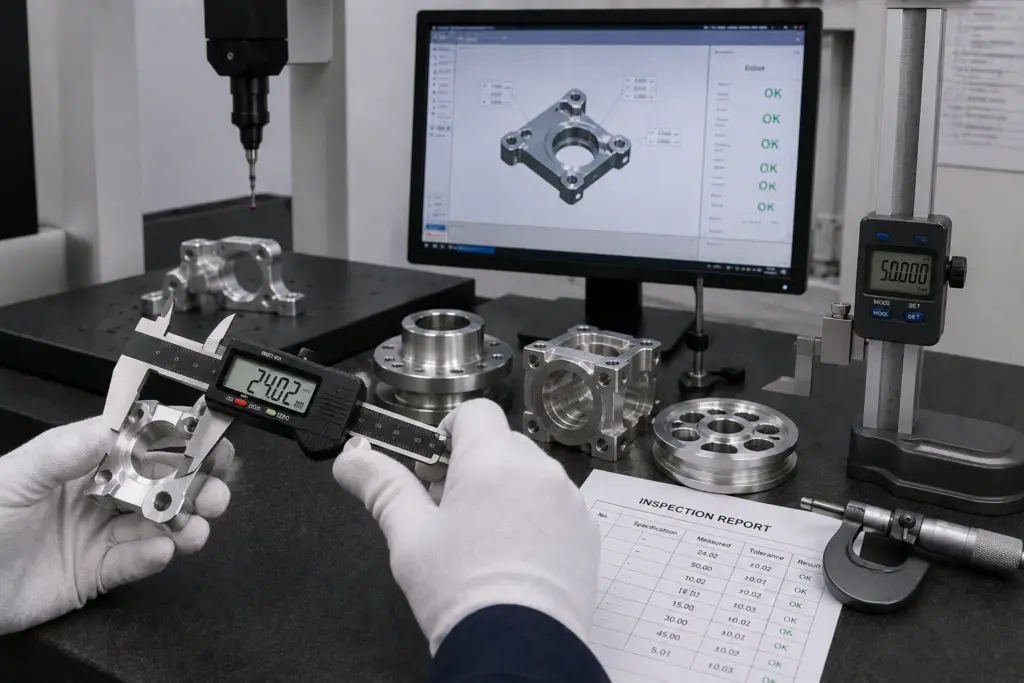
For precision CNC machining, inspection should match the function of the part. Not every dimension needs expensive measurement, but critical dimensions must be controlled.
| Inspection Method | What It Checks |
| Calipers and micrometers | Basic sizes, thicknesses, and diameters |
| Height gauge | Hole positions, step heights, flatness reference checks |
| CMM inspection | Critical 3D geometry and tight tolerances |
| Thread gauges | Internal and external thread quality |
| Surface roughness tester | Functional sliding or sealing surfaces |
| Visual inspection | Scratches, dents, anodizing, color, burrs |
| Fit check | Assembly with mating part or fixture |
| Material certificate | Confirms grade when required |
Critical Features to Inspect
For automotive and motorcycle CNC parts, inspection should focus on mounting holes, threads, bearing seats, shaft diameters, flatness, concentricity, perpendicularity, surface roughness, burrs, and coating thickness.
Common Problems and Risk Points in Automotive Parts Machining
Automotive and motorcycle parts often fail due to small details. A bracket may look correct but fail assembly because of hole position. A motorcycle part may be strong enough but rejected because the anodized surface has visible color variation.
| Risk Point | Possible Result | Prevention |
| Wrong material | Weakness, corrosion, or excessive weight | Confirm use environment and load |
| Unclear tolerances | Assembly mismatch | Provide 2D drawing with critical dimensions |
| Poor thread quality | Assembly failure | Use thread gauges and proper tool control |
| Burrs on edges | Safety and assembly problems | Define deburring standard |
| Coating buildup | Tight holes or threads become unusable | Plan masking or machining allowance |
| Thin-wall deformation | Size instability | Review geometry and clamping early |
| Surface color variation | Cosmetic rejection | Define acceptable finish standard |
| Vibration load ignored | Fatigue failure | Consider material and geometry together |
How to Reduce Machining and Assembly Risk
The best way to reduce risk is to review material, tolerance, surface finish, and application environment before production. For visible motorcycle components, appearance standards should be defined early. For functional automotive parts, mounting accuracy, strength, corrosion resistance, and inspection points should be prioritized.
How Sino-V-Rise Supports Auto and Motorcycle CNC Parts?
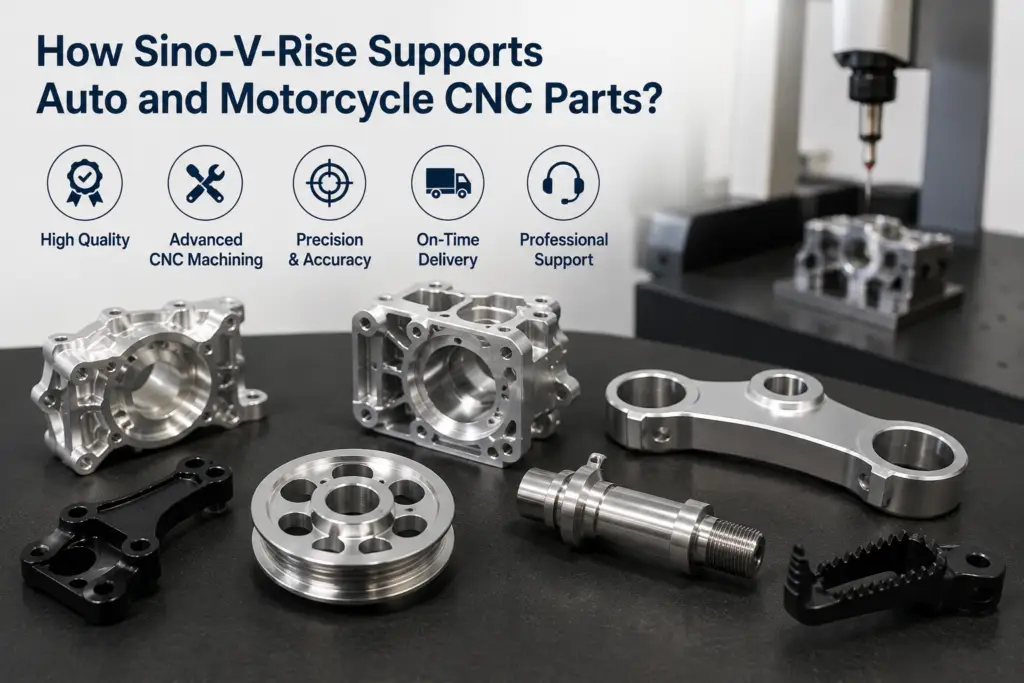
Sino-V-Rise is positioned as a global CNC precision parts partner for multi-process, small-to-medium batch production. The uploaded company profile states that its business covers 100+ countries and 100+ industries, and its strategic focus includes automotive and motorcycle parts. It also highlights 40+ precision machining equipment and inspection equipment such as 2.5D measuring instruments, digital height gauges, and CMM systems.
Sino-V-Rise’s service scope includes CNC machining, CNC milling, CNC turning, turning-milling, wire cutting, 5-axis CNC machining, laser cutting, sheet metal, and related manufacturing processes. This makes it suitable for buyers who need both prototype iteration and small-to-medium batch automotive machined parts or custom machined motorcycle parts.
RFQ Checklist for Faster Quoting and Better DFM Review
| RFQ Information | Why It Helps |
| 3D CAD file | Confirms geometry and machining process |
| 2D drawing | Defines tolerances, threads, finish, and inspection points |
| Material requirement | Helps verify strength, weight, and corrosion needs |
| Application environment | Identifies heat, vibration, road salt, or outdoor exposure |
| Quantity | Supports prototype or batch production planning |
| Surface treatment | Confirms anodizing, plating, polishing, passivation, or coating |
| Critical dimensions | Helps plan CMM or gauge inspection |
| Assembly relationship | Reduces fit and tolerance stack-up issues |
FAQ About CNC Parts for Automotive and Motorcycle Applications
What are CNC parts used for in automotive applications?
CNC parts are used for brackets, housings, adapters, shafts, spacers, fixtures, EV components, sensor mounts, engine-related parts, chassis parts, and prototype vehicle components.
What are common CNC machined motorcycle parts?
Common CNC-machined motorcycle parts include levers, clamps, risers, axle blocks, foot pegs, spacers, brackets, covers, bushings, and performance upgrade parts.
Which material is best for automotive CNC parts?
There is no single best material. Aluminum is good for lightweight parts, stainless steel is good for corrosion resistance, steel is good for strength and wear, copper is good for conductivity, and engineering plastics are useful for insulation or low-friction parts.
Is CNC machining suitable for motorcycle performance parts?
Yes. CNC machining is suitable for motorcycle performance parts because it can produce accurate geometry, strong materials, high-quality surfaces, and small-batch custom designs.
Which surface finish is best for motorcycle CNC parts?
Anodizing is common for aluminum motorcycle parts because it provides color, corrosion resistance, and a durable surface. Polishing, sandblasting, plating, and powder coating may also be used depending on material and appearance requirements.
What should be inspected on automotive CNC parts?
Important inspection points include hole position, threads, flatness, concentricity, shaft diameter, bearing seats, surface roughness, burrs, coating thickness, and fit with mating parts.
Can Sino-V-Rise support prototype and small-batch automotive CNC parts?
Yes. Sino-V-Rise supports custom CNC machining from prototype to small and medium-batch production, with multi-process machining and inspection support for automotive and motorcycle applications.
Conclusion
Automotive CNC machining is valuable because vehicle and motorcycle parts must meet practical requirements: strength, fit, weight, corrosion resistance, appearance, repeatability, and delivery stability. The right CNC solution depends on the part type, material, machining process, surface treatment, and inspection plan.
For automotive and motorcycle projects, buyers should not only ask for the lowest unit price. They should define the working environment, load, material, surface finish, assembly relationship, and inspection requirements early. This helps avoid common problems such as poor fit, thread failure, coating buildup, cosmetic rejection, or weak material selection.
For custom automotive and motorcycle CNC parts, Sino-V-Rise can support material selection, CNC milling, CNC turning, turning-milling, 5-axis machining, surface treatment coordination, and inspection planning from prototype to small and medium-batch production.