
Quick Answer
Choose aluminum for lightweight, fast-machined, cost-efficient custom parts. Choose stainless steel when strength, wear resistance, corrosion resistance, heat resistance, or long service life matters more.
Key Takeaways
- CNC machining aluminum is often faster, lighter, and more cost-efficient for prototypes and low-volume custom parts.
- Stainless steel CNC machining is better for high-strength, wear-resistant, corrosion-sensitive, or heavy-duty parts.
- Material unit price is only one cost factor. Machining time, tool wear, surface treatment, weight, and inspection also affect total cost.
- Aluminum is usually easier to machine, while stainless steel often requires slower cutting, stronger tools, and more process control.
- For custom CNC parts, the best material depends on load, environment, weight target, surface finish, tolerance, and lifecycle risk.
Abstract
Aluminum and stainless steel are two of the most common CNC machining materials for custom parts. Both can produce accurate, durable, and professional-looking components, but they behave very differently in cost, weight, machining time, surface treatment, and real-use performance.
Aluminum is usually selected when weight reduction, fast machining, good appearance, and lower total production cost are important. Stainless steel is selected when the part must handle higher loads, corrosion, heat, wear, cleaning chemicals, or long-term durability requirements. This guide compares aluminum vs stainless steel for custom CNC parts from a practical manufacturing perspective.
Aluminum vs Stainless Steel: Start with the Total Part Cost cnc machining materials

When comparing aluminum vs. stainless steel, many buyers first ask, “Which material is cheaper?” That is useful, but it is not enough.
For custom CNC parts, the total cost comes from several factors:
| Cost Factor | Why It Matters |
| Raw material price | Affects starting cost, especially for large parts |
| Machining time | Longer cycle time increases machine cost |
| Tool wear | Harder materials may require more tool changes |
| Surface treatment | Anodizing, passivation, polishing, or coating adds cost |
| Part weight | Affects shipping, handling, assembly, and product performance |
| Tolerance control | Tight tolerances may increase machining and inspection time |
| Scrap risk | Difficult materials or thin-wall designs increase production risk |
Why unit material price is not the full cost?
A stainless steel bar may not always look dramatically more expensive than aluminum by raw material price alone. But stainless steel is denser and usually slower to machine. Aluminum is much lighter, so the same part volume weighs far less.
For example, aluminum is around 2.7 g/cm³, while stainless steel is often around 7.5–8.0 g/cm³. That means a stainless steel part of the same volume can weigh almost three times more than an aluminum part. This weight difference can affect shipping cost, product performance, assembly load, and moving-system efficiency.
So the better question is not “Which material costs less per kilogram?” The better question is: “Which material gives the best total system value for this part?”
When to Choose Aluminum for Custom Parts?
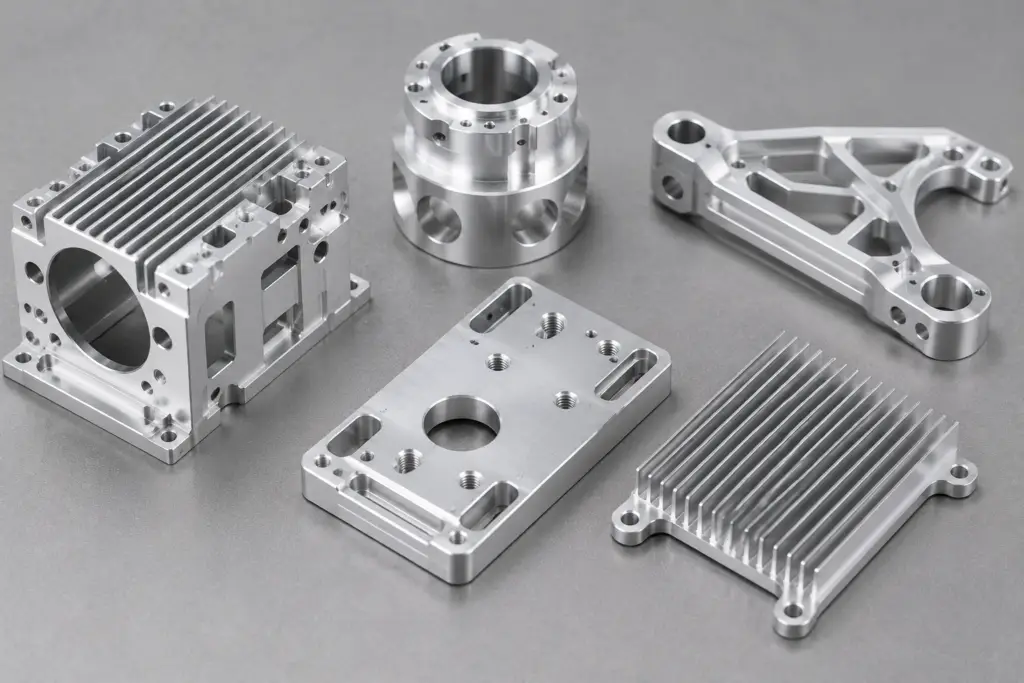
Aluminum is often the first choice for lightweight custom parts, prototypes, brackets, housings, fixtures, heat dissipation parts, drone components, optical mounts, and automation equipment.
CNC machining aluminum is popular because aluminum alloys are generally easier to cut than stainless steel. This can reduce machining time, improve production efficiency, and lower tool wear.
Common aluminum grades for CNC parts
| Aluminum Grade | Typical Use | Main Advantage |
| 6061 | General CNC parts, brackets, housings, fixtures | Balanced cost, machinability, strength, corrosion resistance |
| 7075 | High-strength lightweight parts | Higher strength and hardness |
| 5052 | Sheet metal, covers, formed parts | Good corrosion resistance and formability |
| 6082 | Structural machined parts | Good strength and machining performance |
Aluminum is often suitable when the part needs the following:
- Low weight
- Fast machining
- Good appearance
- Anodized color options
- Good thermal conductivity
- Good strength-to-weight ratio
- Lower total machining cost
For aluminum CNC machining parts, the key advantage is not only material cost. It is the combined benefit of lower weight, faster cutting, easier finishing, and flexible surface treatment.
When to Choose Stainless Steel for Custom Parts?
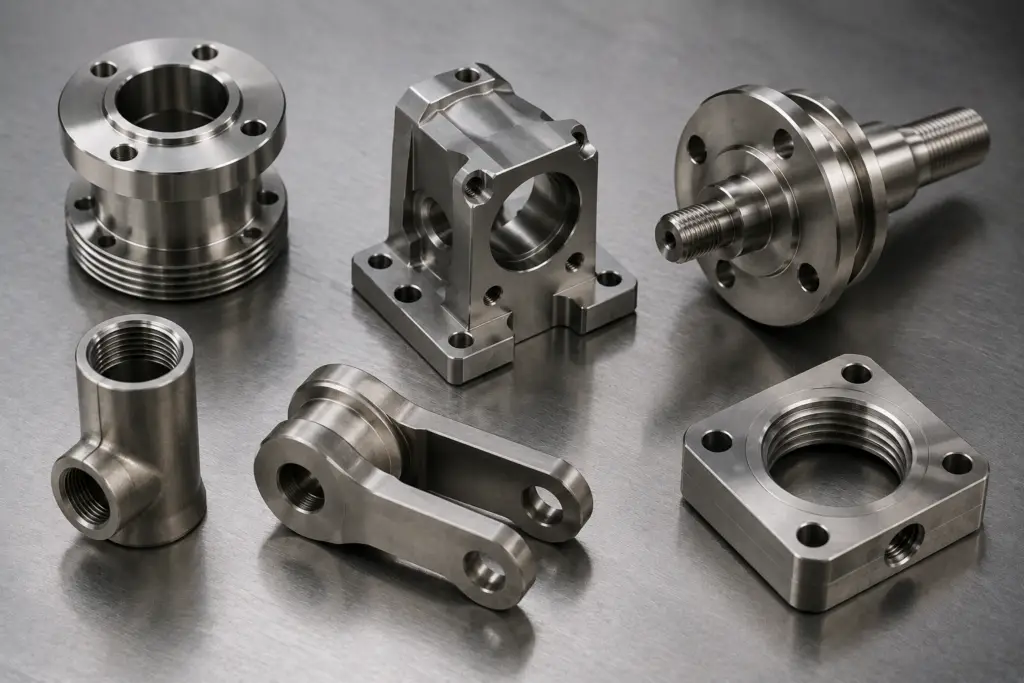
Stainless steel is selected when a part needs higher strength, better wear resistance, corrosion resistance, chemical resistance, or a clean and durable surface.
Stainless steel CNC machining is common for medical device parts, food equipment components, chemical equipment, semiconductor fixtures, shafts, pins, connectors, and precision mechanical parts.
Common stainless steel grades for CNC parts
| Stainless Steel Grade | Typical Use | Main Advantage |
| 303 | Turned parts, shafts, fittings | Better machinability |
| 304 | General stainless CNC parts | Good corrosion resistance and availability |
| 316 / 316L | Medical, marine, chemical-use parts | Better chloride and chemical resistance |
| 17-4 PH | High-strength precision parts | High strength and heat-treatable performance |
Stainless steel is often suitable when the part needs the following:
- Higher load capacity
- Better wear resistance
- Stronger corrosion resistance
- Better heat resistance
- Cleanability
- Long service life
- Better durability in harsh environments
For cnc machined stainless steel parts, the main trade-off is that machining is usually slower and more demanding than aluminum. Stainless steel can work-harden, generate heat, and increase cutting tool wear if the machining process is not well controlled.
Aluminum vs Stainless Steel Comparison Table aluminum cnc machining parts
| Factor | Aluminum | Stainless Steel |
| Weight | Much lighter | Much heavier |
| Machining speed | Usually faster | Usually slower |
| Tool wear | Lower | Higher |
| Strength | Good, especially 6061/7075 | Higher in many grades |
| Corrosion resistance | Good, improved by anodizing | Very good, especially 304/316 |
| Surface treatment | Anodizing, sandblasting, polishing, coating | Passivation, polishing, brushing, plating |
| Heat resistance | Moderate | Better |
| Cost structure | Often lower total machining cost | Higher machining cost, better durability |
| Best for | Lightweight custom parts | Strong, wear-resistant, corrosion-resistant parts |
Weight, strength, corrosion, machining, and finish comparison
| Project Priority | Better Choice |
| Reduce product weight | Aluminum |
| Reduce machining time | Aluminum |
| Lower prototype cost | Aluminum |
| High strength in small size | Stainless steel |
| Better wear resistance | Stainless steel |
| Better chemical resistance | Stainless steel |
| Color anodized appearance | Aluminum |
| Polished metal appearance | Stainless steel |
| Outdoor or marine corrosion risk | 316 stainless steel or properly treated aluminum |
| Moving parts with mass sensitivity | Aluminum |
Machining Time and Cost Differences
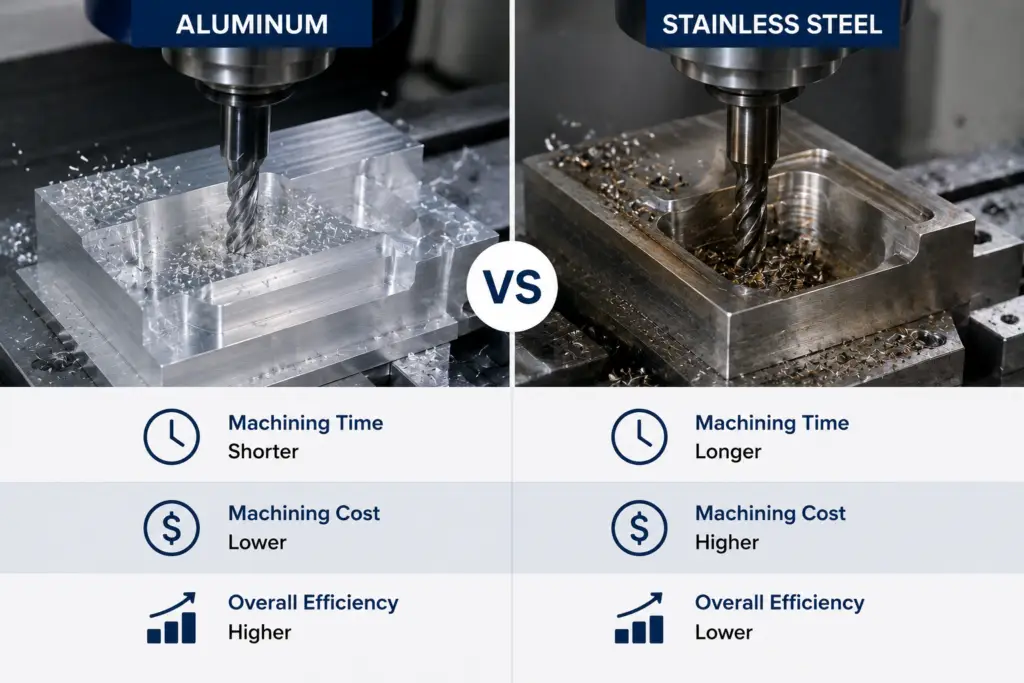
Machining time is one of the biggest hidden cost differences between aluminum and stainless steel.
Aluminum usually allows higher cutting speeds and easier chip removal. This makes it efficient for milling, drilling, pocketing, thin-wall housings, and prototypes. Stainless steel usually needs more careful feeds and speeds, stronger workholding, more coolant control, and sharper tool management.
How material hardness affects cycle time and tool wear?
| Machining Factor | Aluminum | Stainless Steel |
| Cutting speed | Higher | Lower |
| Chip evacuation | Easier | More difficult |
| Work hardening risk | Lower | Higher |
| Heat buildup | Lower | Higher |
| Tool wear | Lower | Higher |
| Burr control | Manageable | Requires more attention |
| Thin-wall machining | Good but may deform | Stronger but harder to cut |
| Thread machining | Easier | More risk of galling or tool wear |
For precision CNC machining, stainless steel can still achieve excellent accuracy, but it often needs better process planning. This is especially true for deep holes, small threads, thin walls, tight bores, and fine surface finishes.
Surface Treatment Options for Aluminum and Stainless Steel CNC Machined Components
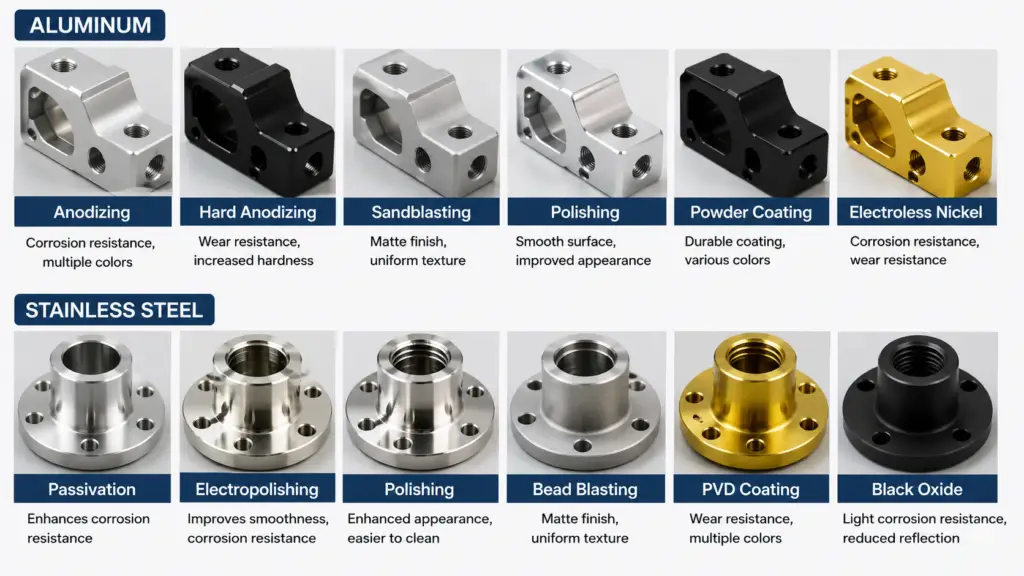
Surface treatment also changes the real cost and performance of the part.
Aluminum often uses anodizing because it improves corrosion resistance, surface hardness, and appearance. It can also provide black, clear, red, blue, or other color options. Sandblasting before anodizing can create a uniform matte surface.
Stainless steel often uses passivation, polishing, brushing, or electropolishing. These finishes improve cleanliness, corrosion resistance, or appearance without adding the same type of colored oxide layer as aluminum anodizing.
Anodizing, passivation, polishing, sandblasting, and plating
| Surface Finish | Aluminum | Stainless Steel |
| Anodizing | Very common | Not typical |
| Hard anodizing | Good for wear resistance | Not typical |
| Sandblasting | Common for matte texture | Common for matte texture |
| Polishing | Common | Very common |
| Passivation | Not typical | Common |
| Brushing | Common | Common |
| Electroplating | Possible | Possible |
| Powder coating | Possible | Possible |
Surface treatment should be decided before production. Coating thickness, masking areas, threads, holes, sealing surfaces, and cosmetic requirements can all affect machining allowances and final inspection.
Industry Selection Guide for Custom CNC Parts ——Custom Precision Parts Manufacturer
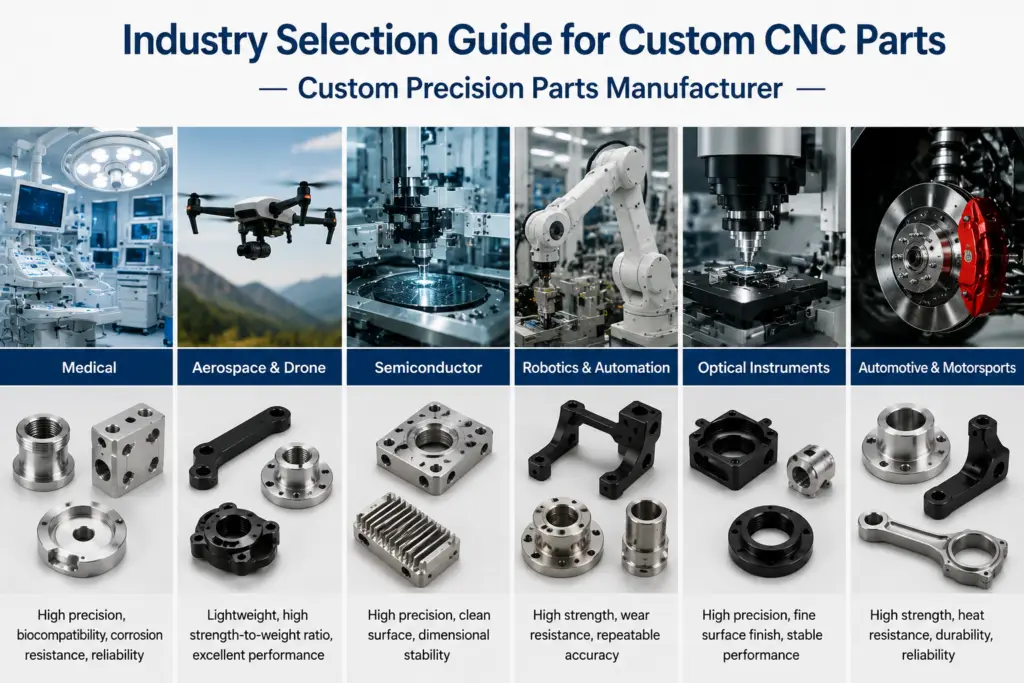
Different industries value aluminum and stainless steel differently.
Robotics and automation continue to grow, and the International Federation of Robotics reported that the global market value of industrial robot installations reached an all-time high of US$16.7 billion, with future demand driven by AI, autonomy, and new business fields. This supports the need for lightweight, precise, durable, and application-specific custom parts.
| Industry | Aluminum May Fit When… | Stainless Steel May Fit When… |
| Medical devices | Lightweight housings, fixtures, non-contact parts | Cleanability, corrosion resistance, strength, or sterilization matters |
| Drone / UAV | Weight reduction is critical | Small high-strength shafts, inserts, or wear parts are needed |
| Semiconductor equipment | Lightweight brackets or covers are needed | Chemical resistance, cleanliness, or stability is required |
| Robotics | Moving arms, housings, lightweight brackets | Shafts, pins, joints, or high-load components are required |
| Optical instruments | Lightweight black anodized mounts | Polished, rigid, or corrosion-resistant precision parts are needed |
| Automotive / motorcycle | Lightweight brackets, covers, prototypes | Heat, wear, road salt, or load resistance is required |
The best material is not universal. It depends on what the part must do inside the final product.
How Sino-V-Rise Supports Aluminum and Stainless Steel CNC Parts?
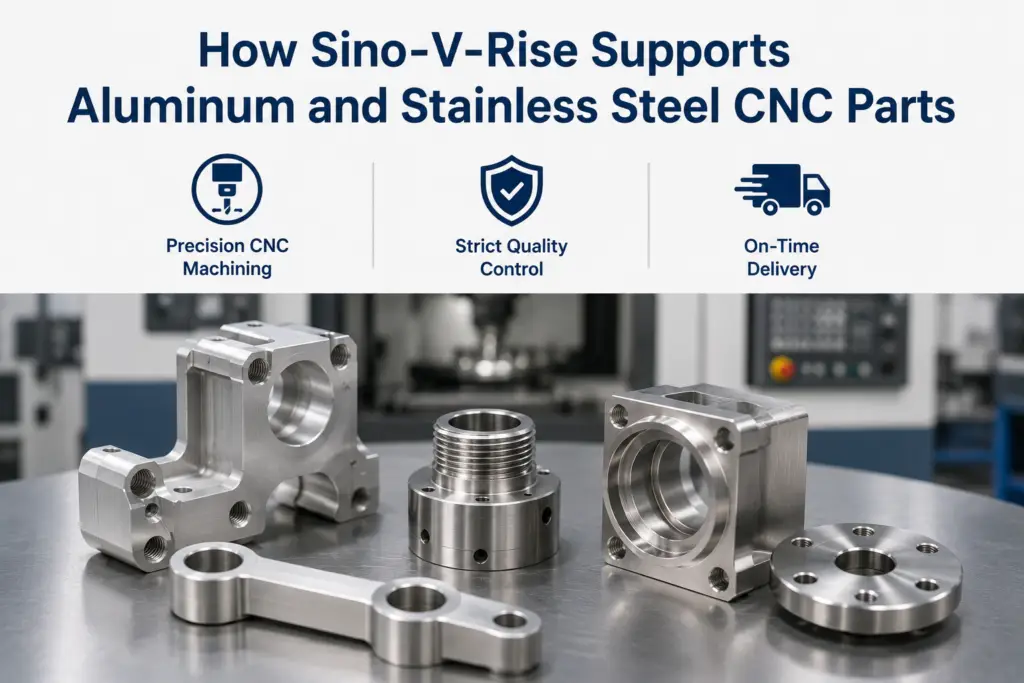
Sino-V-Rise supports custom CNC machining for prototype, small-batch, and medium-batch precision parts. For aluminum and stainless steel projects, the team can help evaluate material choice, machining process, surface finish, tolerance risks, and inspection requirements.
This is useful when buyers are comparing aluminum CNC machining parts and custom stainless steel parts, but are not sure how the material will affect total cost, lead time, surface finish, or function.
Sino-V-Rise’s CNC capabilities include CNC milling, CNC turning, turning-milling, 5-axis machining, wire cutting, laser cutting, sheet metal, and surface treatment coordination. Its website highlights engineer-reviewed quotes, 35+ surface finishes, 80+ metals and plastics, and quality assurance for custom part production.
RFQ checklist for better material selection
| RFQ Information | Why It Helps |
| 3D CAD file | Confirms geometry and machining method |
| 2D drawing | Defines tolerance, threads, surface finish, and inspection points |
| Application environment | Helps choose aluminum or stainless steel |
| Load and strength requirement | Confirms whether aluminum is enough |
| Weight target | Helps evaluate lightweight design |
| Surface treatment | Affects appearance, corrosion resistance, and dimensions |
| Quantity | Affects process planning and unit cost |
| Critical features | Helps identify machining and inspection risks |
If weight, fast delivery, and cost are the main priorities, aluminum is often the better starting point. If corrosion, strength, heat, wear, or cleaning resistance is more important, stainless steel may be the safer choice.
FAQ: Aluminum vs Stainless Steel for Custom Parts
Is aluminum cheaper than stainless steel for CNC machining?
Usually, aluminum has a lower total machining cost because it is lighter and easier to cut. However, final cost depends on part size, grade, tolerance, surface treatment, and quantity.
Is stainless steel stronger than aluminum?
In many cases, stainless steel has higher strength, hardness, and wear resistance. Aluminum can still be strong enough for many custom parts, especially when weight reduction is important.
Which material is better for lightweight custom parts?
Aluminum is usually better for lightweight custom parts because its density is much lower than stainless steel. This is important for drones, robotics, optical instruments, and portable equipment.
Which material is better for corrosion resistance?
Both can resist corrosion in suitable environments. Anodized aluminum performs well in many applications, while stainless steel, especially 304 and 316, is often better for chemical, wet, cleaning, or marine environments.
Which material is easier to machine?
Aluminum is generally easier and faster to machine. Stainless steel requires more cutting control, coolant, tool strength, and process stability.
Should I choose aluminum or stainless steel for prototypes?
For early prototypes, aluminum is often a cost-effective choice because it machines quickly and looks professional after anodizing. If the prototype must test real strength, wear, heat, or corrosion performance, stainless steel may be necessary.
Can Sino-V-Rise machine both aluminum and stainless steel parts?
Yes. Sino-V-Rise supports custom CNC machining for aluminum, stainless steel, and many other metal and plastic materials, with multiple machining and surface finishing options for prototype and small-to-medium batch production.
Conclusion
Aluminum and stainless steel are both reliable cnc machining materials, but they solve different problems.
Choose aluminum when your custom part needs low weight, fast machining, lower total cost, good appearance, or anodized surface treatment. Choose stainless steel when your part needs higher strength, better wear resistance, stronger corrosion resistance, heat resistance, cleanability, or long-term durability.
The smartest choice is not based only on raw material price. It should consider machining time, tool wear, surface treatment, part weight, shipping, assembly, operating environment, and lifecycle risk.
For custom CNC parts, sharing your CAD file, drawing, working environment, surface finish, and quantity with an experienced machining supplier helps prevent material selection mistakes before production begins.