
Abstract
Precision machining is a controlled manufacturing process used to produce accurate, repeatable, and high-quality parts from metal or plastic materials. It is widely used when components require tight tolerances, stable dimensions, clean surface finishes, and reliable assembly performance. This guide explains what precision machining is, how it works, common process types, suitable materials, industry applications, advantages, and limitations.
Quick Answer
Precision machining is a CNC-controlled manufacturing process that removes material from a workpiece to create accurate, repeatable, tight-tolerance parts for demanding industrial applications.
Key Takeaways
- Precision machining focuses on accuracy, repeatability, and process control.
- It includes CNC milling, CNC turning, turning-milling, 5-axis machining, drilling, tapping, and finishing.
- Common precision machining materials include aluminum, stainless steel, titanium, brass, copper, and engineering plastics.
- It is widely used in aerospace, medical, semiconductor, robotics, optical, automotive, and motorcycle parts.
- Its main limits are higher cost, longer setup time, and stricter inspection requirements.
What Is Precision Machining?
Precision machining is a subtractive manufacturing process that uses controlled cutting tools to remove material from a workpiece and produce parts with accurate dimensions, tight tolerances, and consistent surface quality. In most modern production environments, precision machining is performed with CNC equipment, where computer programs control tool movement, spindle speed, feed rate, cutting depth, and machining sequence.
Compared with general machining, precision CNC machining places more emphasis on process stability. The goal is not only to make one accurate part, but to make accurate parts repeatedly across prototypes, small batches, and production runs.
For Sino Rise, this topic fits directly with its custom parts manufacturing capabilities. The official website highlights ±0.005 mm precision, 35+ surface finishes, and 80+ metals and plastics, along with 17+ years of OEM/ODM experience, more than 100,000 parts manufactured, 20,000+ global customers, and service across 100+ industries.
How Does Precision Machining Work?
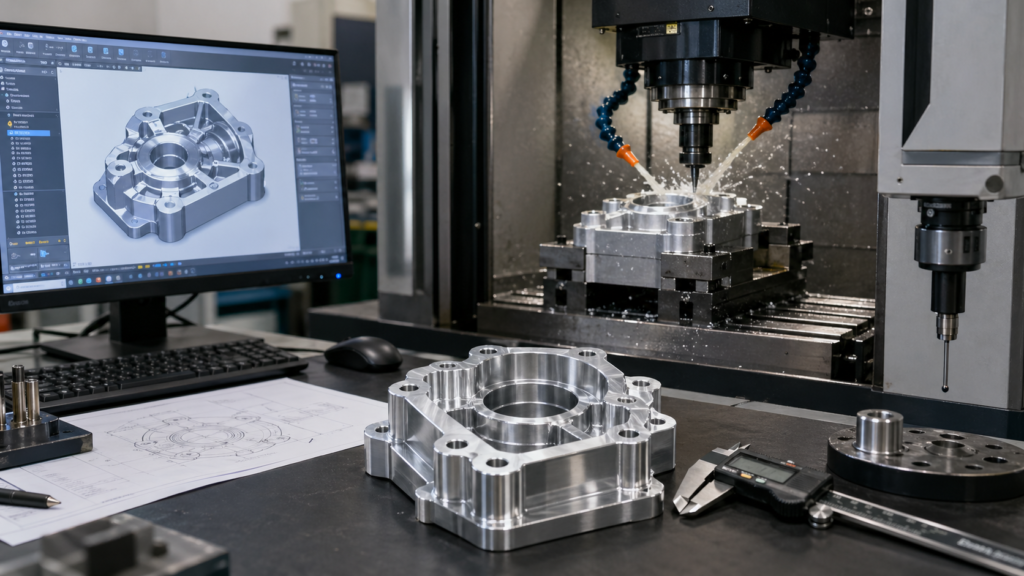
From Digital Design to Finished Part
A typical cnc precision machining workflow starts with a 3D CAD model or 2D engineering drawing. Engineers review the part geometry, material, tolerance, surface finish, and production quantity before selecting the best machining method.
| Step | Purpose |
| Drawing review | Confirm dimensions, tolerances, material, and critical features |
| DFM analysis | Improve manufacturability and reduce unnecessary cost |
| CAM programming | Generate toolpaths for CNC machines |
| Setup and fixturing | Hold the workpiece accurately and reduce movement |
| Rough machining | Remove bulk material efficiently |
| Semi-finishing | Prepare accurate stock allowance |
| Finishing | Achieve final tolerance and surface finish |
| Inspection | Verify dimensions and quality before delivery |
| Surface treatment | Add anodizing, plating, polishing, blasting, or coating if required |
In high precision CNC machining, each step affects the final result. Tool wear, machine stability, clamping pressure, heat, material stress, and inspection accuracy must all be controlled.
Why CNC Control Matters
CNC control allows the machine to follow programmed coordinates with high repeatability. This makes it suitable for complex geometries, multi-face parts, small holes, tight bores, slots, pockets, threads, and fine surface features. For buyers, the main value is consistency: the first part and the hundredth part should meet the same functional requirements.
Main Types of Precision Machining
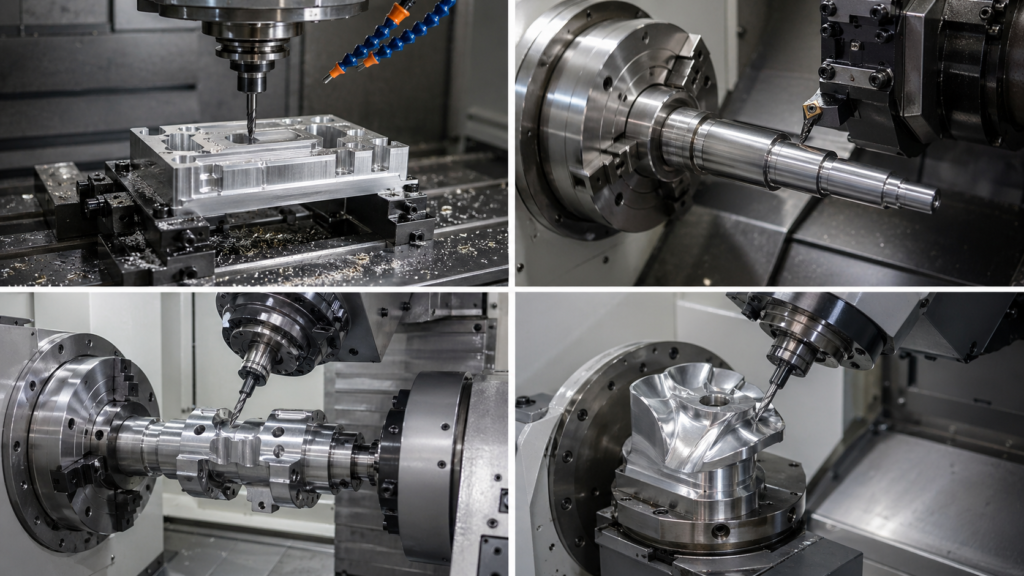
CNC Milling for Precision Machined Components
CNC milling uses rotating cutting tools to remove material from a fixed workpiece. It is suitable for flat surfaces, pockets, slots, cavities, holes, contours, and complex multi-surface parts. Precision CNC milling is often used for housings, brackets, plates, blocks, fixtures, and optical or robotic components.
CNC Turning for Round Precision Parts
CNC turning rotates the workpiece while a cutting tool shapes the outer or inner diameter. It is ideal for shafts, bushings, sleeves, pins, spacers, threaded parts, and other cylindrical features. Precision CNC turning is commonly used when concentricity, roundness, and smooth rotation matter.
CNC Turning-Milling for Complex Parts
Turning-milling combines turning and milling operations in one machine. Sino Rise describes CNC turning-milling as a process that can complete turning outer diameters, internal holes, threading, milling flats, milling slots, drilling, and tapping in one setup without transferring the workpiece between machines. This helps reduce setup changes and process errors for complex parts.
5-Axis CNC Machining for High-Precision Geometry
5-axis machining moves the cutting tool across three linear axes and two rotational axes. It is useful for curved surfaces, angled features, deep cavities, undercuts, aerospace brackets, medical parts, and complex fixtures. Sino Rise’s own 5-axis content notes that 5-axis machining can reduce setup time, improve accuracy, and support materials such as aluminum, titanium, stainless steel, and composites.
Key Features of Precision CNC Machining
| Feature | Why It Matters |
| Tight tolerance control | Helps parts fit, seal, align, or rotate correctly |
| Repeatability | Supports stable batch production |
| Surface finish control | Improves function, appearance, and post-treatment quality |
| Multi-material capability | Supports different engineering requirements |
| Complex geometry | Enables detailed features and multi-face machining |
| Inspection support | Reduces assembly and quality risk |
The core feature of precision machining is not only machine accuracy. It is the full control of design review, process planning, tooling, fixturing, machining, finishing, and inspection.
Common Precision Machining Materials
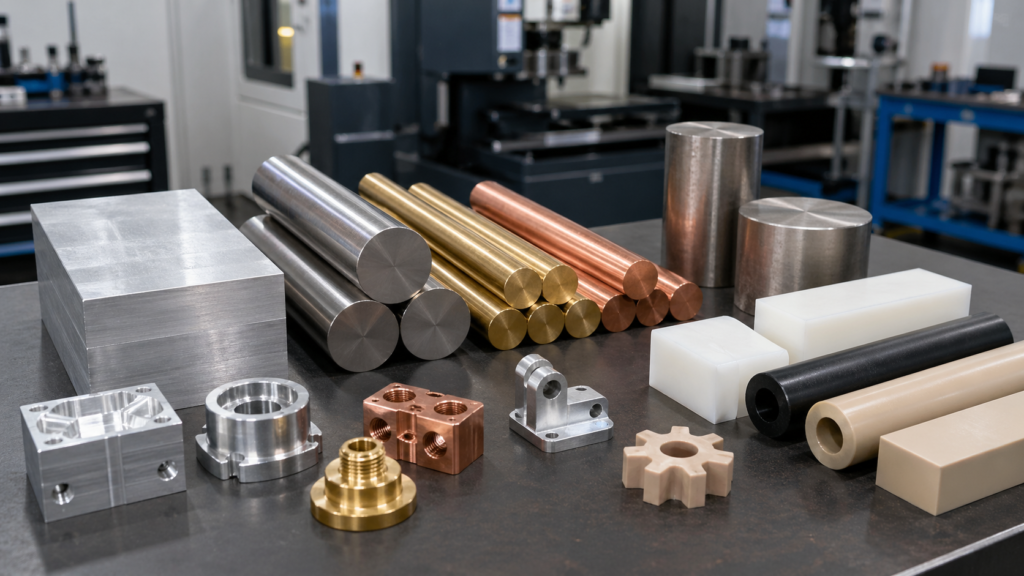
Metal Materials for Precision Machining
Common precision machining materials include:
| Material | Typical Use |
| Aluminum | Lightweight parts, housings, brackets, heat sinks, prototypes |
| Stainless steel | Medical, food, aerospace, corrosion-resistant components |
| Titanium | Aerospace, medical, lightweight high-strength parts |
| Brass | Electrical parts, fittings, bushings, decorative components |
| Copper | Conductive components, heat transfer parts |
| Carbon steel | Industrial parts, shafts, structural components |
Aluminum precision machining is especially common because aluminum is lightweight, machinable, corrosion-resistant after treatment, and suitable for both prototypes and production components.
Plastic Materials for Precision Machining
Engineering plastics such as POM, PEEK, PTFE, nylon, ABS, and PC are used for lightweight, insulating, wear-resistant, or chemical-resistant parts. Plastic precision machining requires careful control because some plastics deform under heat, clamping pressure, or tool stress.
Applications of Precision Machining
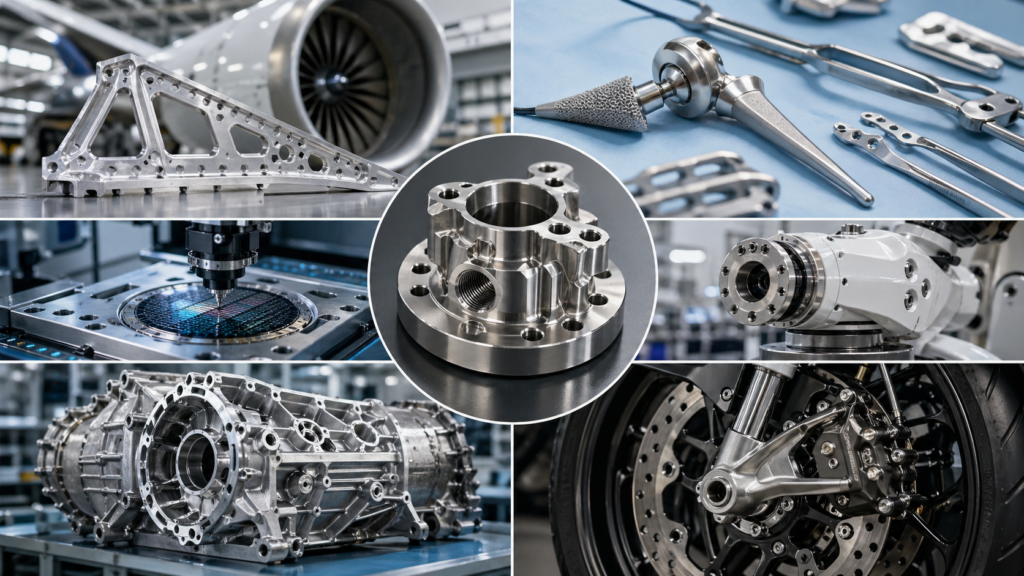
Precision Medical Machining
Precision medical machining supports surgical tools, device housings, sleeves, pins, connectors, and small functional components. For medical-related parts, surface quality, repeatability, and clean processing are especially important.
Semiconductor CNC Precision Machining
Semiconductor CNC precision machining is used for equipment components, fixtures, plates, chambers, vacuum parts, and high-cleanliness mechanical parts. This application is increasingly relevant as AI-related chip demand expands. Reuters reported that SEMI expected chipmaking equipment sales to grow about 9% to $126 billion in 2026, driven by logic and memory chips used in AI.
Robotic, Optical, Automotive and Motorcycle Parts
Robotic CNC machining supports joints, frames, mounting plates, end-effectors, and motion-related components. Optical instrument parts require accurate alignment and stable surfaces. Precision automotive machining supports EV components, sensor housings, motor parts, and performance assemblies. Sino Rise’s service navigation also lists low-altitude aircraft components, medical industry components, semiconductor parts, robotic components, optical instrument components, and auto & moto parts as industry areas.
Advantages of Precision Machining
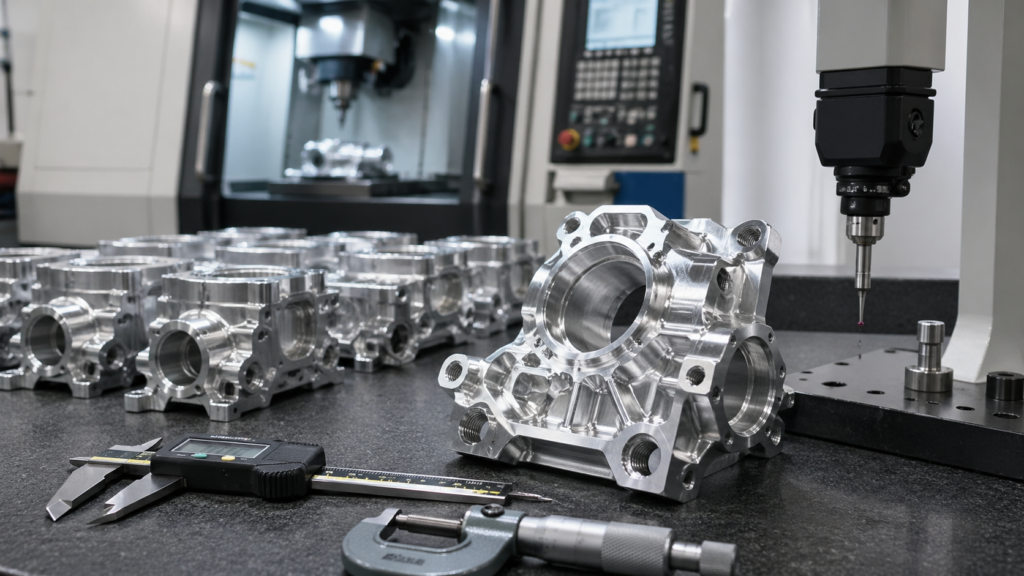
High Accuracy and Repeatability
The biggest advantage of precision machining is the ability to produce consistent parts with controlled dimensions. This reduces assembly problems and improves product reliability.
Flexible Production from Prototype to Batch
A qualified precision machining service can support prototypes, small-batch production, and larger production runs. This is useful for buyers who need fast design validation before scaling up.
Strong Material and Surface Finish Options
Precision machining supports a wide range of metals, plastics, and surface treatments. Sino Rise highlights 35+ surface finishes and 80+ metals and plastics on its website, which supports different functional and cosmetic requirements.
Limitations of Precision Machining
Higher Cost for Tight Tolerances
Tighter tolerances usually require better fixtures, more stable machines, slower finishing, more inspection, and skilled operators. This increases cost compared with standard machining.
Longer Setup and Programming Time
Complex parts may require detailed CAM programming, simulation, custom tooling, and careful setup. 5-axis parts and turn-mill parts can be efficient in production, but the initial preparation is more demanding.
Design Restrictions Still Exist
Precision machining cannot ignore basic manufacturing rules. Very thin walls, sharp internal corners, deep narrow cavities, and unnecessary tight tolerances can increase cost or reduce stability.
How to Choose a Precision Machining Service
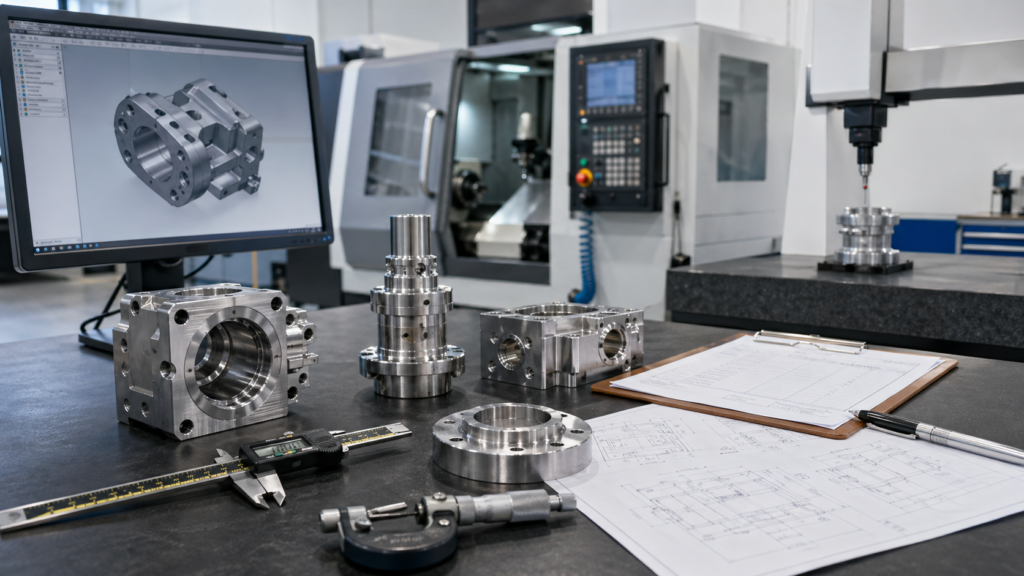
When selecting a precision CNC machining supplier, buyers should evaluate more than price.
| Selection Factor | What to Check |
| Process capability | CNC milling, turning, turn-mill, 5-axis machining |
| Material options | Metals, plastics, specialty materials |
| Tolerance capability | Whether the supplier can meet drawing requirements |
| Surface finishing | Anodizing, plating, polishing, blasting, coating |
| Inspection support | Dimensional inspection and quality control |
| Industry experience | Aerospace, medical, semiconductor, robotics, optical, automotive |
| RFQ support | Ability to review drawings and provide DFM feedback |
A good supplier should help identify which features truly need tight tolerance and which can use standard tolerance to reduce cost.
FAQ About Precision Machining
What is precision machining used for?
Precision machining is used to make accurate metal and plastic parts for aerospace, medical, semiconductor, robotics, optical, automotive, industrial equipment, and custom manufacturing applications.
Is precision machining the same as CNC machining?
Not exactly. CNC machining is the computer-controlled process. Precision machining is a higher-control approach that uses CNC equipment, strict tolerances, stable tooling, inspection, and process planning to produce accurate parts.
What materials are best for precision machining?
Common materials include aluminum, stainless steel, titanium, brass, copper, carbon steel, POM, PEEK, PTFE, nylon, ABS, and PC. The best material depends on strength, weight, corrosion resistance, heat resistance, cost, and application.
Why is precision machining expensive?
It costs more because it requires accurate equipment, skilled programming, stable fixturing, quality tooling, slower finishing, tighter inspection, and better process control.
Conclusion
Precision machining is a key manufacturing method for parts that require accuracy, repeatability, surface quality, and reliable performance. It is not limited to one machine or one process. It can include CNC milling, CNC turning, turning-milling, 5-axis machining, surface treatment, and inspection.