
Quick Answer
Choose 5 axis cnc machining when your part has multi-angle features, tight cross-face tolerances, complex surfaces, limited tool access, or high-value production risks.
Key Takeaways
- 5-axis machining is most valuable when part complexity creates accuracy, setup, or tooling risks.
- It helps reduce multiple setups, improve repeatability, and reach complex geometries more efficiently.
- It is suitable for aerospace, medical, robotics, semiconductor, optical, and high-performance automotive parts.
- Not every part needs 5-axis machining; simple plates, blocks, and basic pockets may be better suited to 3-axis CNC.
Abstract
5 axis cnc machining is not simply a more advanced version of standard milling. It is a process choice for parts where geometry, tolerance, surface quality, and setup control directly affect performance. This guide explains five clear signals that indicate when engineers and buyers should evaluate 5-axis machining for complex parts. It also includes a decision table, industry application examples, and practical RFQ guidance for working with a precision CNC machining supplier such as Sino-V-Rise.
What Is 5 Axis CNC Machining Best Used For?
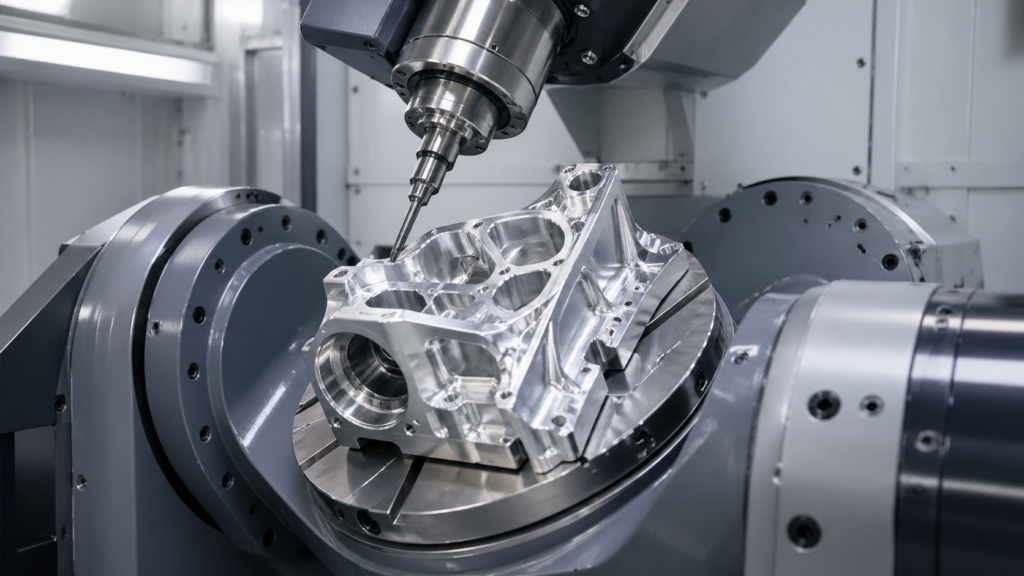
5 axis cnc machining is best used for parts that require cutting from multiple angles in one controlled process. Unlike standard 3-axis machining, which mainly moves along X, Y, and Z directions, 5-axis machining adds two rotary movements. This allows the cutting tool to reach angled faces, curved profiles, deep features, and complex surfaces with fewer setups.
For simple parts, this extra movement may not be necessary. But for complex CNC parts, 5-axis machining can reduce fixture changes, improve feature alignment, shorten production steps, and lower the risk of dimensional error.
Sino-V-Rise focuses on precision CNC machining for industries where part accuracy, repeatability, and material stability matter. Its service scope is especially relevant for complex parts used in low-altitude aircraft, medical devices, semiconductor equipment, robotics, optical instruments, and automotive or motorcycle components.
5 Signs You Should Choose 5-Axis Machining for Complex Parts
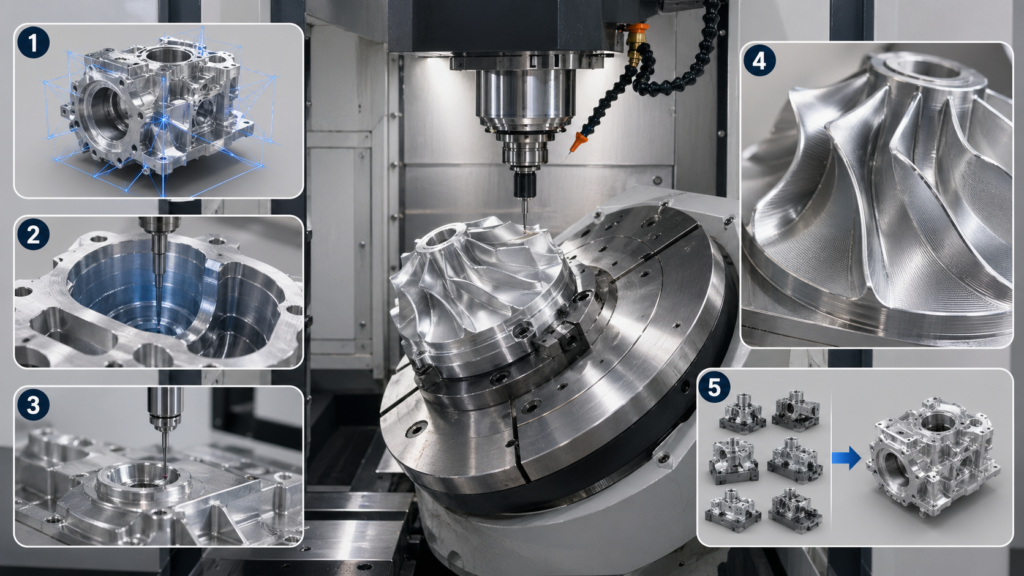
1. Your Part Has Features on Multiple Angled Faces
The first signal is multi-face geometry. If your part has holes, slots, pockets, bosses, or threaded features on different angled surfaces, 5-axis CNC machining services may be the right choice.
In 3-axis machining, the part often needs to be removed, rotated, re-clamped, and re-indicated. Every repositioning step adds potential error. For precision parts, even a small shift can affect hole alignment, flatness, perpendicularity, or assembly fit.
5-axis machining helps keep critical features in one setup. This is useful for aluminum housings, aerospace brackets, robotic joints, optical mounts, and compact equipment components where multiple surfaces must align correctly.
2. Your Design Includes Deep Cavities, Undercuts, or Curved Surfaces
The second signal is difficult tool access. If your part includes deep cavities, angled channels, internal pockets, undercuts, compound curves, or freeform surfaces, standard machining may require long tools or several fixture changes.
Long tools can create vibration, tool deflection, and inconsistent surface quality. 5-axis machining allows the tool to approach the part from a better angle, which can improve cutting stability and reduce the need for excessive tool length.
This is especially important for complex aluminum CNC machining, stainless steel CNC parts, titanium components, and precision housings where both dimensional accuracy and surface consistency are required.
3. Your Part Requires Tight Tolerances Across Different Sides
The third signal is tolerance relationship. Some parts do not only need accurate individual features; they need accurate relationships between features on different faces.
Examples include:
- Matched bores on opposite sides
- Mounting faces with strict perpendicularity
- Datum-controlled holes across angled surfaces
- Thin-wall structures that must remain stable
- Sealing faces that must align with internal channels
For high precision CNC machining, reducing the number of setups can reduce accumulated error. This is one of the strongest reasons to evaluate 5-axis machining early in the design stage.
4. Your Surface Finish Requirements Are Function-Critical
The fourth signal is surface finish sensitivity. Some parts require more than a clean machined appearance. The surface may affect airflow, sealing, sliding contact, optical alignment, assembly fit, or medical usability.
5-axis machining can help maintain better tool orientation along curved or angled surfaces. This can reduce visible tool marks, improve surface continuity, and minimize secondary polishing. Less manual finishing also helps protect critical dimensions.
This is valuable for medical CNC machining, optical CNC machining parts, aerospace CNC machining, and robotic components where surface quality directly affects function.
5. Your Material, Batch Size, or Lead Time Makes Setup Reduction Important
The fifth signal is production risk. Even if a part can technically be made by 3-axis machining, 5-axis may still be more efficient when the material is expensive, the batch size is small, or the lead time is tight.
For CNC prototype services and small batch CNC machining, setup time can be a major cost driver. If a complex part requires several fixtures, multiple inspections, and repeated handling, 5-axis machining may reduce the total process risk.
Sino-V-Rise supports prototype and small-to-medium batch CNC production, which makes this especially relevant for development-stage parts, engineering verification parts, and high-mix low-volume manufacturing.
5-Axis CNC Machining Decision Table
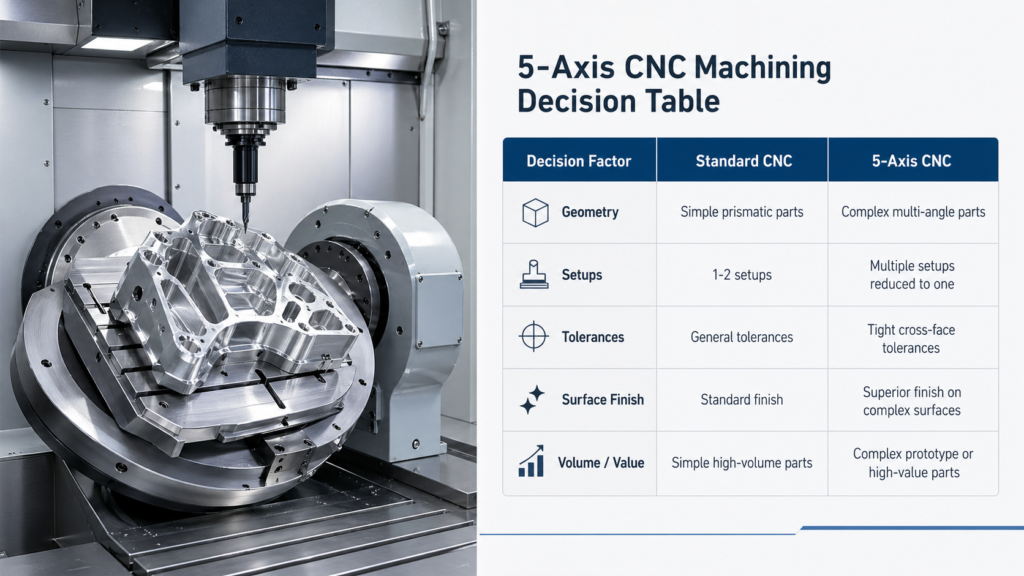
| Manufacturing Question | 3-Axis CNC May Be Enough | Consider 5 Axis CNC Machining |
| Part geometry | Flat, prismatic, simple pockets | Curved, angled, multi-face, or organic shapes |
| Tool access | Features are easy to reach from one side | Deep cavities, undercuts, or angled features |
| Setup requirement | One or two setups are enough | Multiple setups increase alignment risk |
| Tolerance demand | General machining tolerance | Tight cross-face or datum-based tolerance |
| Surface finish | Standard machined finish | Functional or cosmetic high-quality surface |
| Production type | Simple repeat part | Prototype, complex part, or small batch production |
| Material risk | Low-cost, easy-to-cut material | Aluminum alloy, stainless steel, titanium, copper alloy, or engineering plastics |
Industry Applications for 5 Axis CNC Machining
Aerospace and Low-Altitude Aircraft Components
Aerospace and low-altitude aircraft parts often require lightweight structures, high strength, accurate assembly interfaces, and stable machining quality. Typical parts may include brackets, housings, frames, impeller-like components, structural connectors, and precision aluminum parts.
For these applications, 5-axis machining helps reduce fixture changes and maintain alignment between multiple critical surfaces. It is also useful for parts with weight-reduction pockets, curved profiles, and complex mounting angles.
Sino-V-Rise’s industry experience in low-altitude aircraft components makes 5-axis CNC machining a strong fit for customers developing high-precision, lightweight mechanical parts.
Medical, Semiconductor, Robotics, Optical, and Automotive Parts
In medical device CNC machining, 5-axis is useful for complex instruments, curved surfaces, ergonomic components, and precision housings. For semiconductor CNC machining, it can support fixtures, carriers, chambers, heat-related parts, and precision mounting structures.
Robotics parts often require lightweight design, multi-angle mounting, and accurate motion-related interfaces. Optical instrument parts may need stable geometry, fine surface finish, and strict alignment. Automotive and motorcycle parts may require complex housings, performance components, and prototype verification parts.
These industries share one common need: reliable precision machining for complex parts. Sino-V-Rise can support this need through CNC milling, CNC turning, 5-axis machining, material selection, surface finishing, and quality inspection.
When 5-Axis Machining May Not Be Necessary
5-axis machining should be selected for the right reason. It may not be necessary if the part is simple, flat, or easily machined from one or two directions.
You may not need 5-axis machining when:
- The part is a simple plate or block
- All features are accessible from one side
- Tolerances are not very strict
- Surface finish is not function-critical
- Standard CNC milling can meet the design requirements
- The main goal is the lowest possible unit machining cost
The best manufacturing decision is not always the most advanced process. It is the process that balances accuracy, cost, lead time, and part risk.
How Sino-V-Rise Supports Complex 5-Axis CNC Machining Projects
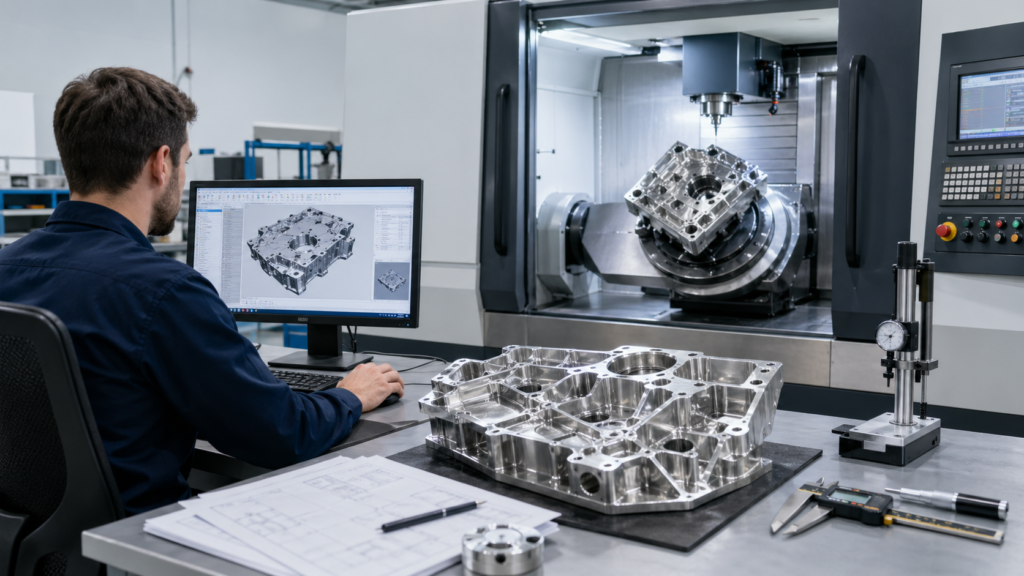
For complex parts, early manufacturing review is important. Sino-V-Rise can help evaluate whether a part should be made by 5-axis CNC machining, 3-axis milling, CNC turning, turn-mill machining, or another precision machining route.
A complete RFQ should include:
| RFQ Information | Why It Helps |
| 3D CAD file | Allows geometry and tool access evaluation |
| 2D drawing | Defines tolerances, datums, threads, and surface finish |
| Material grade | Helps select cutting strategy and machining parameters |
| Quantity | Supports prototype or small batch planning |
| Critical features | Identifies high-risk dimensions and inspection points |
| Surface treatment | Helps plan anodizing, polishing, plating, or other finishes |
| Application industry | Helps align machining strategy with part function |
Sino-V-Rise’s value is not only in machining the part, but also in helping customers choose the right process before production begins. For complex CNC machining projects, this can reduce quoting uncertainty, avoid unnecessary redesign, and improve final part reliability.
Conclusion: Use 5-Axis When Complexity Creates Manufacturing Risk
5 axis cnc machining should be considered when part complexity creates real manufacturing risk. If your part has multi-angle features, deep cavities, undercuts, curved surfaces, tight cross-face tolerances, or demanding surface finish requirements, 5-axis machining may provide better accuracy and process stability.
For simple parts, standard CNC milling may be enough. For complex parts, however, 5-axis machining can reduce setups, improve repeatability, protect critical tolerances, and support higher-quality results.
If your part matches three or more of the five signs in this guide, it is worth asking Sino-V-Rise to evaluate whether 5-axis CNC machining is the right manufacturing solution.