
Quick Answer
CNC stands for Computer Numerical Control. In machining, it means using computer-controlled tools to cut, mill, turn, drill, and finish precise metal or plastic parts.
Key Takeaways
- CNC machining is a computer-controlled manufacturing process for precise custom parts.
- The CNC machining process usually includes CAD review, programming, material cutting, machining, finishing, and inspection.
- Different industries care about different priorities: tolerance, material strength, cleanliness, surface finish, weight, or repeatability.
- CNC milling, CNC turning, 5-axis machining, and turn-mill machining should be selected based on part geometry.
- Sino-V-Rise supports precision CNC machining, materials, surface treatment, and quality inspection for complex industry parts.
Abstract
CNC stands for Computer Numerical Control, but for engineers and buyers, the real question is not only what CNC means. It is how CNC machining helps produce reliable parts for demanding industries. This guide explains the CNC machining process, common industry parts, key performance indicators, recommended materials, suitable machining methods, surface finishes, inspection options, and common risks.
What Does CNC Stand for in CNC Machining?
CNC stands for Computer Numerical Control. In machining, it refers to the digital control of physical machines through computer instructions. Manufacturing.gov describes CNC as digital automation that controls physical machines using integrated actuators, electronics, sensors, and dedicated computer systems.
In simple terms, CNC machining means a computer controls how cutting tools move, how fast they rotate, how deep they cut, and how they shape a workpiece. The goal is to produce accurate, repeatable, and functional parts from metals or plastics.
For buyers, CNC is not just a machine type. It is a manufacturing system that affects part accuracy, material choice, surface quality, inspection, cost, and delivery time.
How the CNC Machining Process Works?
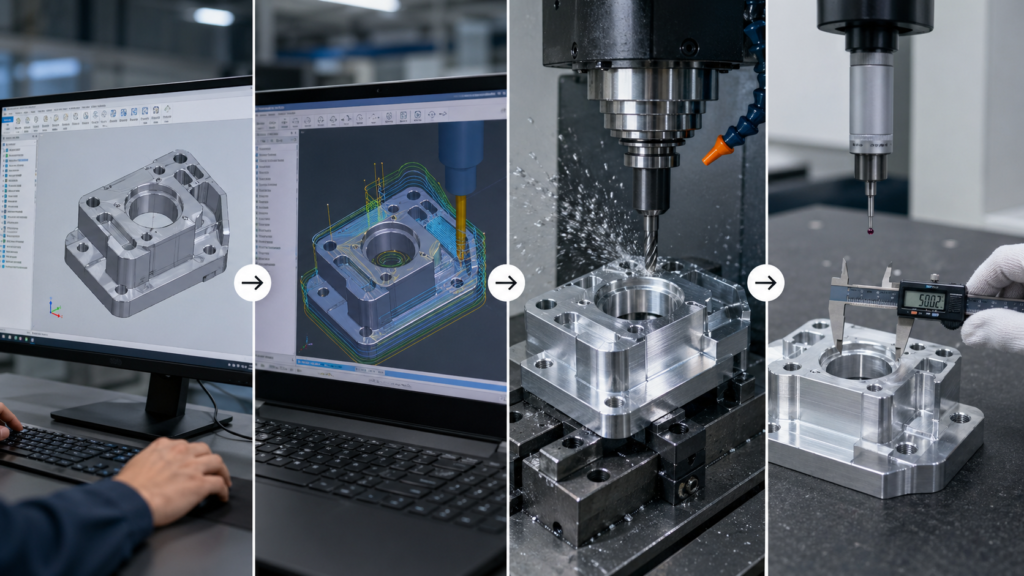
From CAD File to Finished CNC Machining Part
A typical CNC machining process includes several steps:
| Step | What Happens | Why It Matters |
| CAD review | Engineer checks the 3D model and drawing | Confirms geometry, tolerance, and manufacturability |
| Process planning | Choose milling, turning, 5-axis, or turn-mill | Matches the process to part shape |
| CAM programming | Toolpaths are created for the CNC machine | Controls cutting sequence and tool movement |
| Material preparation | Metal or plastic stock is selected and cut | Affects strength, stability, and cost |
| CNC machining | The machine cuts the part to shape | Creates the required geometry |
| Surface treatment | Anodizing, polishing, plating, blasting, or coating | Improves function or appearance |
| Inspection | Dimensions and quality are checked | Confirms part compliance before delivery |
CNC Milling, CNC Turning, 5-Axis, and Turn-Mill Machining
Different CNC machining services solve different part problems.
| CNC Process | Best For | Typical Parts |
| CNC milling | Blocks, plates, slots, pockets, multi-face geometry | Brackets, housings, frames, fixtures |
| CNC turning | Round, cylindrical, concentric parts | Shafts, bushings, pins, sleeves |
| 5-axis CNC machining | Complex angles, curved surfaces, deep features | Aerospace brackets, optical mounts, medical parts |
| Turn-mill machining | Parts needing both rotation and milling | Connectors, valve bodies, precision mechanical parts |
What Industries Care About Most in CNC Machined Parts?
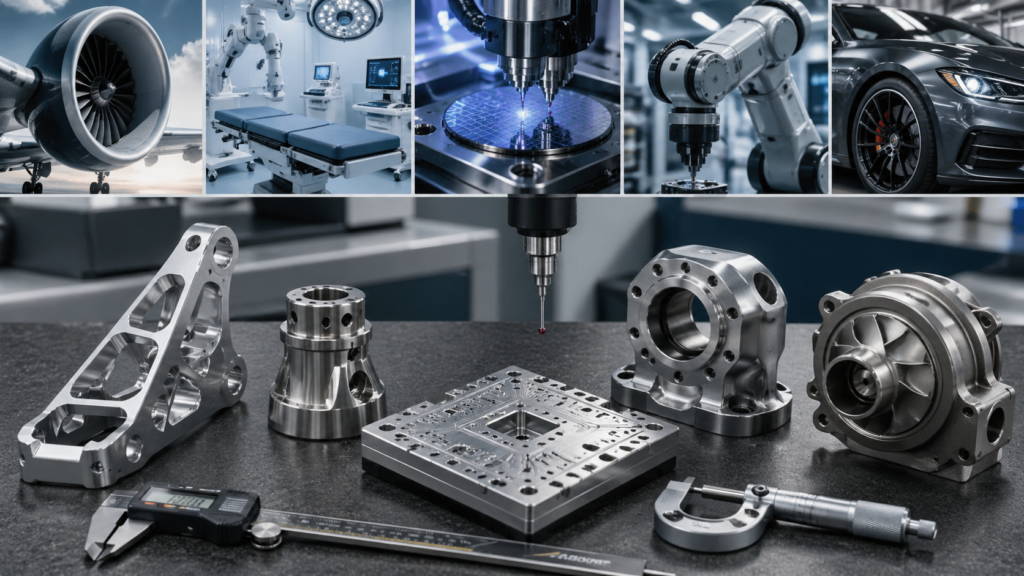
Different industries do not evaluate CNC parts in the same way. Some care most about strength. Some care about cleanliness. Others care about lightweight structure, surface finish, or dimensional stability.
Aerospace CNC Machining: Strength, Weight, and Traceability
Aerospace CNC machining often focuses on high strength, fatigue resistance, lightweight structures, and reliable assembly fit. Common CNC machining aerospace parts include brackets, frames, housings, support blocks, connectors, and precision aluminum components.
Recommended priorities:
- Tight tolerance control
- Lightweight material selection
- Stable machining process
- Complete dimensional inspection
- Reliable batch consistency
Sino-V-Rise highlights low-altitude aircraft components as an industry solution, with focus on high strength, fatigue resistance, and support for small-batch pilot runs and larger production needs.
Medical CNC Machining: Biocompatibility, Precision, and Clean Finish
Medical CNC machining requires stable dimensions, smooth surfaces, suitable materials, and strict quality control. Common parts include surgical tool components, device housings, connectors, mounting parts, and precision medical prototypes.
Recommended priorities:
- Biocompatible materials
- Burr-free edges
- Smooth and clean surfaces
- Tight tolerance repeatability
- Documented inspection
Sino-V-Rise describes medical industry components as requiring biocompatible materials, stringent precision, and full-process compliance with medical industry quality standards.
Semiconductor CNC Machining: Cleanliness, Stability, and Wear Resistance
Semiconductor CNC machining often focuses on ultra-clean parts, dimensional stability, wear resistance, and material compatibility. Common parts include fixtures, carriers, chambers, mounting plates, precision brackets, heat-related parts, and equipment components.
This market is becoming more important as AI chip demand drives semiconductor manufacturing investment. SEMI reported that worldwide 300mm fab equipment spending is expected to increase in 2026 and 2027, supported by AI chip demand, advanced nodes, and localized supply chains.
Robotics, Optical, and Automotive CNC Machining Requirements
Robotic components often need lightweight structures, accurate joints, stable transmission interfaces, and repeatable assembly. Optical instrument components require very low tolerance, surface stability, and precision alignment. Automotive and motorcycle CNC parts usually require strength, impact resistance, and repeatability under demanding conditions.
Recommended CNC Machining Materials by Industry
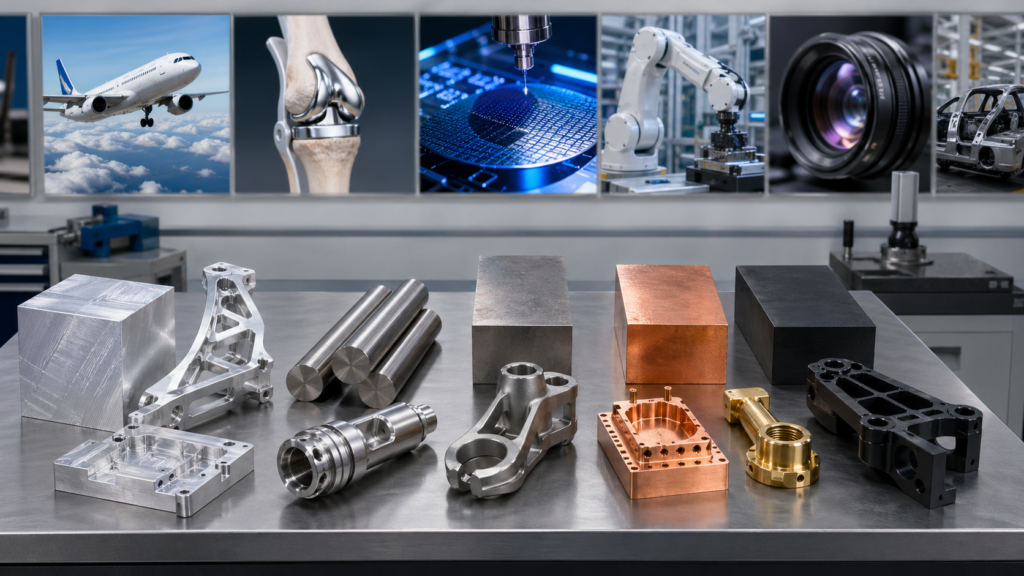
| Industry | Common CNC Machining Materials | Why They Are Used |
| Aerospace / low-altitude aircraft | Aluminum 6061, aluminum 7075, titanium, stainless steel | Lightweight, strong, corrosion-resistant |
| Medical | Stainless steel, titanium, PEEK, engineering plastics | Biocompatibility, strength, clean finish |
| Semiconductor | Aluminum, stainless steel, copper, ceramics-compatible materials | Stability, cleanliness, thermal performance |
| Robotics | Aluminum, steel, stainless steel, engineering plastics | Lightweight structure, durability, motion stability |
| Optical instruments | Aluminum, stainless steel, brass, precision plastics | Stability, fine finish, alignment accuracy |
| Automotive / motorcycle | Aluminum, steel, stainless steel, brass | Strength, wear resistance, cost control |
Recommended Surface Treatment for CNC Machining Parts
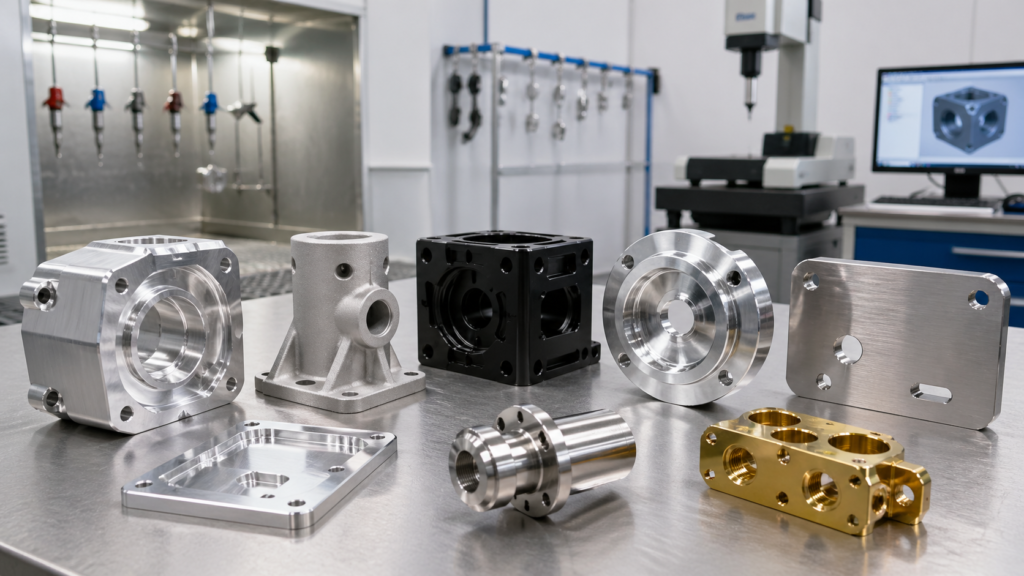
Surface treatment is not only cosmetic. It can improve corrosion resistance, wear resistance, hardness, cleanliness, friction performance, and product appearance.
| Surface Treatment | Best For | Typical Use |
| Anodizing | Aluminum CNC machining parts | Corrosion resistance, color, surface protection |
| Sandblasting | Aluminum and stainless steel parts | Matte finish, surface texture |
| Polishing | Medical, optical, and visible parts | Smooth surface, clean appearance |
| Electroplating | Steel, brass, copper, functional metal parts | Conductivity, wear resistance, corrosion protection |
| Powder coating | Structural metal parts | Durable color coating |
| Passivation | Stainless steel CNC parts | Corrosion resistance and cleanliness |
Recommended Inspection Methods for Precision CNC Machining
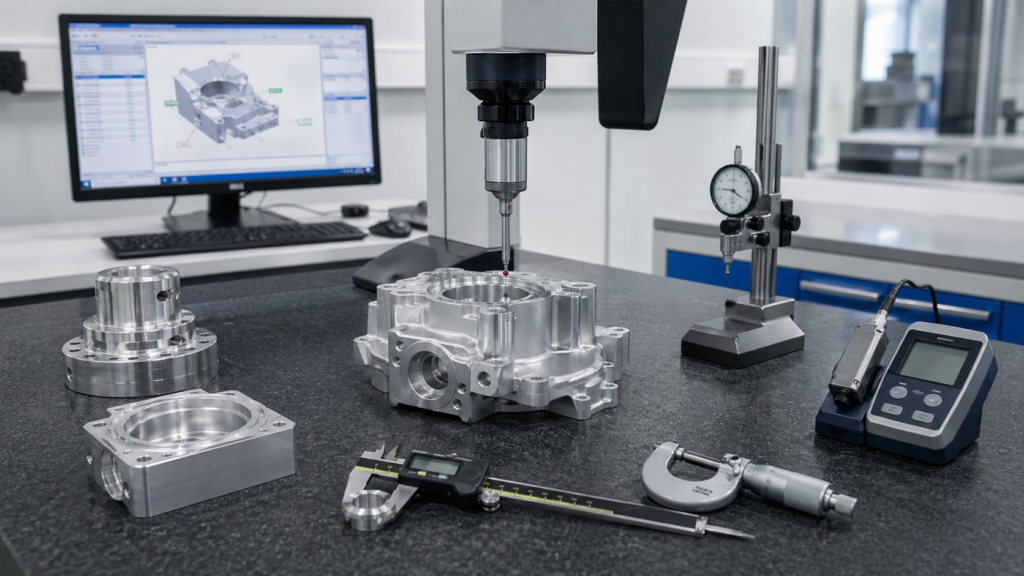
For precision CNC machining, inspection should match the risk level of the part.
| Inspection Method | Best For | Checks |
| Caliper / micrometer | General CNC machining parts | Basic dimensions |
| Height gauge | Flatness, step height, hole position | Shop-floor measurement |
| CMM inspection | High precision CNC machining | GD&T, hole position, profile, datums |
| Surface roughness tester | Sealing, optical, medical, sliding surfaces | Ra value and finish consistency |
| Thread gauge / plug gauge | Threaded holes and bores | Functional fit |
| First article inspection | New parts or new batches | Confirms process before production |
Common CNC Machining Problems and Risk Points
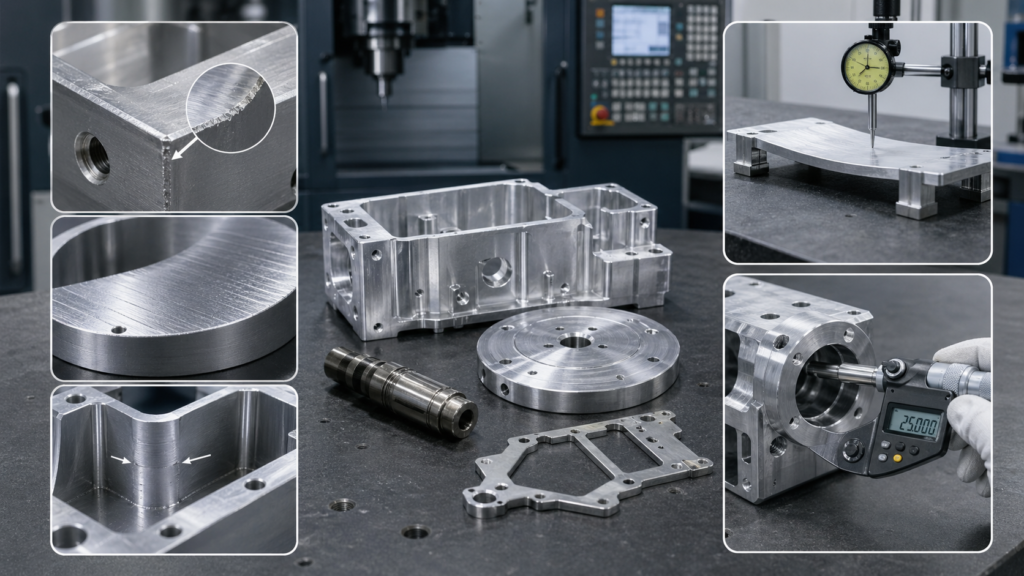
The most common CNC machining risks usually come from design, material, tolerance, or process selection.
| Risk Point | What Can Go Wrong | How to Reduce the Risk |
| Over-tight tolerance | Cost increases or parts fail inspection | Define only function-critical tolerances |
| Wrong material | Warping, poor strength, poor corrosion resistance | Match material to industry use |
| Thin walls | Vibration, deformation, poor surface finish | Adjust wall thickness or machining strategy |
| Deep pockets | Tool deflection and chatter | Use suitable tool length or 5-axis machining |
| Poor surface finish planning | Extra polishing or rejected parts | Define Ra and finish before quoting |
| Incomplete drawings | Quoting errors or production delays | Provide 3D CAD and 2D drawings |
How Sino-V-Rise Supports CNC Machining Projects
Sino-V-Rise is suitable for buyers who need custom CNC machining services from prototype to small and medium-batch production. Its website highlights ±0.005mm precision, 35+ surface finishes, 80+ metals and plastics, engineer-reviewed quoting, and flexible production support.
FAQ About CNC Machining and CNC Machining Process
What does CNC stand for in machining?
CNC stands for Computer Numerical Control. It means a computer controls the movement of machining tools to cut and shape parts accurately.
What is the CNC machining process?
The CNC machining process includes CAD review, CAM programming, material preparation, machining, surface finishing, inspection, and delivery.
What parts can be made by CNC machining?
CNC machining can produce housings, brackets, shafts, bushings, fixtures, connectors, medical parts, aerospace components, semiconductor parts, robotics components, optical parts, and automotive parts.
What materials are used in CNC machining?
Common CNC machining materials include aluminum, stainless steel, steel, brass, copper, titanium, PEEK, ABS, nylon, and other engineering plastics.
Is CNC machining good for prototypes?
Yes. CNC prototype services are useful when parts need real production materials, accurate dimensions, functional testing, and fast design verification.
When should I choose 5-axis CNC machining?
Choose 5-axis CNC machining when the part has complex angles, deep features, curved surfaces, tight cross-face tolerances, or multiple setups that may affect accuracy.
Conclusion: CNC Is About Control, Repeatability, and Part Performance
CNC stands for Computer Numerical Control, but in real manufacturing, it means much more than automated cutting. A good CNC machining process helps control dimensions, material performance, surface finish, inspection, delivery, and final part reliability.
For simple parts, standard CNC milling or CNC turning may be enough. For complex parts, 5-axis machining, turn-mill machining, precision machining, and advanced inspection may be required.
If your project involves aerospace, medical, semiconductor, robotics, optical, automotive, or motorcycle components, the best next step is to match your part requirements with the right material, process, surface treatment, and inspection plan. Sino-V-Rise can support this full workflow from drawing review to finished CNC machined parts.