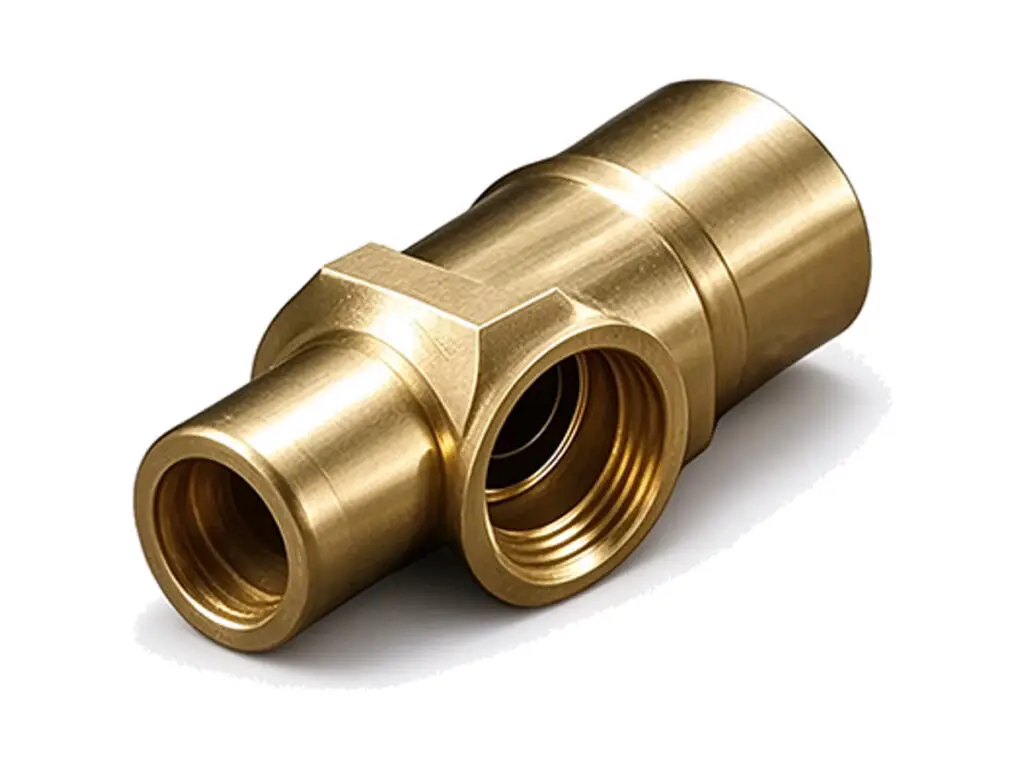



CNC Turned Brass Three Way Fitting
Three way fittings turned from C36000 brass, with G1/8 to G1/2 threads milled square to their faces within 0.1 mm, port centres at 90° ±0.2° and coplanar within 0.1 mm, a 3 mm wall at the junction and a hydrostatic test at 1.5 times working pressure.
- Three Ports on True Centres
- Threads Square to 0.1 mm
- 3 mm Wall at the Junction
- Tested at 1.5× Pressure
*Send the tube or hose connection type and the flow direction. A tee with a 5 mm passage on a 10 mm line drops the flow by half, and no amount of thread sealing fixes that.
Brass Three Way Fitting Overview
A tee splits a line in two. It has to do that without leaking at three ports, without restricting the flow at the junction, and without twisting when the fittings are tightened.
The body is turned, the branch is drilled and threaded on a cross slide, the junction is deburred through the port, and every fitting is capped and pressure tested before plating or packing.
C36000 Brass
Free-cutting brass turns and threads cleanly, seals against a bonded washer without galling, and takes nickel or tin plating evenly. It is the default for pneumatic and low-pressure hydraulic tees.
C37700 or 316 Stainless
C37700 is used for hot-forged bodies and soldered joints, and 316 stainless where the medium is aggressive or the fitting sits outdoors and dezincification would crack a brass body.
A 3 mm wall at the junction is the minimum for a G1/2 port; under that, torque on the branch pulls a crack from the drill intersection that only shows under pressure.
Three Way Fitting Specifications
Turning, cross drilling and threading data for tees, with the angle and wall values that keep a line sealed.
| Specification | Machining Data | Specification | Machining Data |
|---|---|---|---|
| Product | Three Way Fitting / Brass Tee | Machining Process | CNC Turning, Cross Drilling, Thread Milling |
| Material | C36000 Free-Cutting Brass | Envelope | Ø 18 – 45 mm Body, 45 – 90 mm Across Ports |
| Port Threads | G1/8 – G1/2 or NPT, Square to 0.1 mm | Thread Depth | ±0.3 mm |
| Passage | Ø 5 – 12 mm, Junction Deburred | Wall at the Junction | 3 mm Minimum |
| Port Centres | 90° ±0.2°, Coplanar Within 0.1 mm | Sealing Faces | Flatness 0.03 mm, Ra 1.6 µm |
| Hex Section | Across Flats ±0.10 mm | Weight | 40 – 260 g |
| Test Pressure | 1.5× Working, 5 Minutes | Coating | Nickel on Request |
| Customization | Port Angle, Thread Type, Hex Size, Barbed End, Cap | Lead Time | 5 – 7 Days Sample, 12 – 16 Days Batch |
| Inspection | Thread Gauges, Angle Check on CMM, Hydrostatic Test | Packing | Cap Plugs, Bagged, Foam Box |
Key Features of Our Brass Tees
Branch threaded on the turned axis, junction deburred, every fitting pressure tested.
Branch Drilled and Threaded on Axis
The branch is machined on a cross slide while the body is still in the collet, so its thread stays square to the turned face within 0.1 mm and the outlet seals flat.
Junction Deburred Through the Port
The intersection of the drill and the through passage is deburred with a long-reach tool, which keeps the bore full size and stops swarf from being trapped at the corner.
Hex Cut With the Threads
The hex is milled in the same set-up as the threads, so a spanner seats on all six flats and the fitting does not have to be gripped on a finished thread.
Pressure Tested Before Plating
Each fitting is capped and held at 1.5 times working pressure for five minutes; plating a leaking body only hides the fault until it is in service.
Tee that has to seal on three ports?
Finishes for Brass Fittings
Bare brass for soldering, nickel or tin where the fitting is seen or bonded.
| Finish | Main Purpose | Finish | Main Purpose |
|---|---|---|---|
| As Turned | Bare brass for soldered joints | Nickel Plating | Corrosion resistance and appearance |
| Tin Plating | Electrical bonding and low friction | Clear Lacquer | Stops tarnish in storage |
| Ultrasonic Clean | Removes cutting oil from the passage | Thread Masking | Threads stay at gauge size |
| Passivation | Removes tarnish before plating | Cap Plugs | Keeps grit out of the passage |
| Leak Test | 1.5× working pressure, 5 minutes | Anti-Tarnish Bag | Keeps brass bright for a year |
| Salt Spray | 96 h on Nickel Plated Brass | Thread Recheck | Gauge After Plating |
*Nickel plating builds inside the thread as well as outside; threads are masked or cut 0.05 mm oversize so a fitting still runs in by hand after plating.
Put your CNC milling parts into production today
All information and uploads are secure and confidential.
Trusted for Precision CNC Machined Components
Supporting OEM projects with accurate machining, flexible production, and reliable component quality.
Trusted for Precision CNC Milling.
Machining a Brass Tee
The branch port is drilled and threaded on the turned axis, so the tee sits flat on a manifold with both outlet threads square to their faces.
01. Port and Flow Review
Confirm the three port threads, the flow direction and the wall thickness, then check that the branch will not break into a thread root.
02. Turn the Body
Turn the body, face the first port and cut the through passage, holding the bar in a collet so the branch stays concentric with the spindle.
03. Cross Drill and Thread
Drill the branch on the cross slide, deburr the junction through the port, and thread mill all three ports square to their faces.
04. Cut Hex and Test
Mill the hex, break every edge, cap the ports and pressure test at 1.5× for five minutes.
05. Plate and Pack
Ultrasonically clean, plate or lacquer if specified, re-gauge the threads and pack with caps fitted and an anti-tarnish bag.
Send the three port sizes and the medium, and we will quote a tee with the branch threaded on the turned axis and every body pressure tested.
Brass Three Way Fitting FAQs
About 15 percent against a straight run when the branch passage matches the through passage. A branch one size smaller loses closer to 40 percent, which usually shows as a starved cylinder.
Yes, any angle from 45° to 90° within ±0.2°. Below 45° the drill breaks into the through passage at a shallow angle and the junction is harder to deburr cleanly.
A bonded washer on the flat face for a brass tee. PTFE tape works but strands migrate into the passage, and a taper thread in brass can split the port if it is over-tightened.
Nickel adds 5 to 8 µm, so threads are masked or cut oversize. An unmasked G1/4 thread after nickel often will not take a fitting by hand.
C36000 contains lead and is not used for potable water. For drinking water we machine C69300 or 316 stainless, both of which are lead-free.
Every body is capped and held at 1.5 times working pressure for five minutes, and a body that weeps at a thread root is scrapped rather than re-threaded.
Other CNC Machined Mechanical Components
Explore additional precision CNC machined components manufactured for OEM applications and customized production needs.
CNC turned aluminium stepped spacer bushings with parallel faces to 0.02 mm, stepped shoulder square to the bore and teal or.
CNC turned aluminium guide shafts and positioning pins with stepped diameters ground to h6, straightness 0.02 mm per 100 mm and.
316L stainless multi-port valve bodies machined from solid, port faces flat to 0.02 mm and cross-drilled galleries pressure.
Custom five-axis CNC machined stainless steel turbine stators and nozzle rings.
Precision CNC machined stainless steel gripper fingers for robot end effectors.
Get high‑quality machined parts in as fast as 4 days with our expanded automated CNC milling!