


Home / CNC-Machining / CNC 5-Axis Machining / Five-Axis CNC Machined Stainless Steel Turbine Stator
Five-Axis CNC Machined Stainless Steel Turbine Stator - CNC machined component

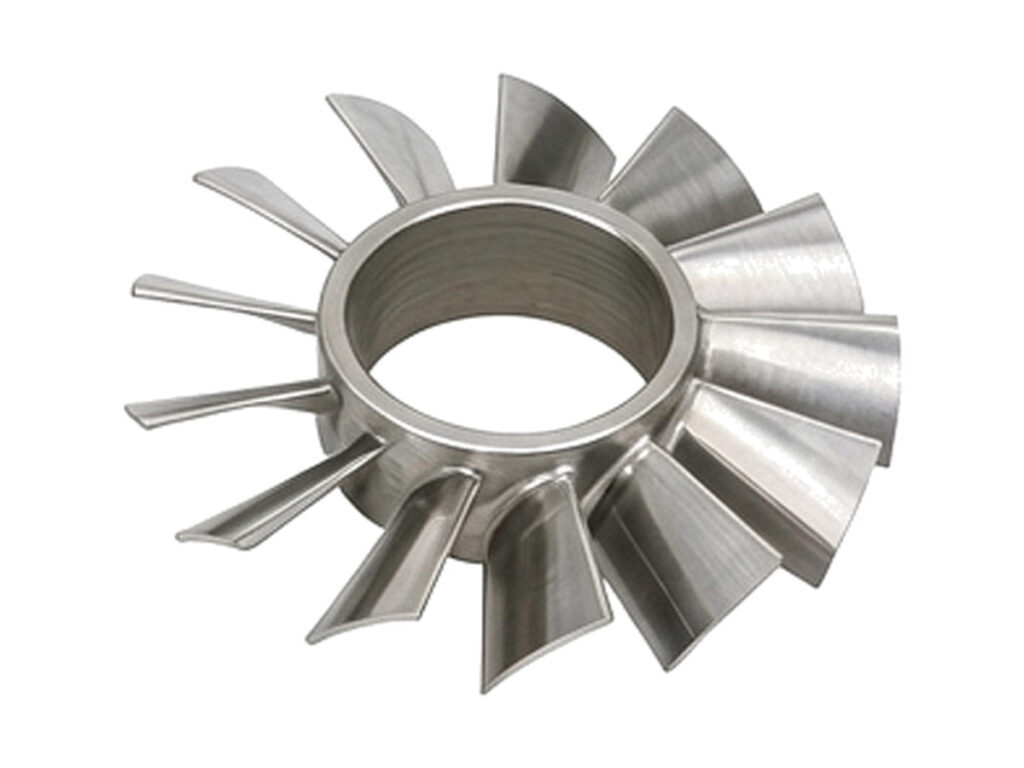
Five-Axis CNC Machined Stainless Steel Turbine Stator

Custom five-axis CNC machined stainless steel turbine stators and nozzle rings for turbochargers, expanders and flow test rigs. Vanes are cut in one continuous five-axis operation, the flow area is checked against the design value, and 17-4PH stators are heat treated and hardness tested.

*Send the design flow area and the gas conditions, because the vane angle and the throat opening are set by the flow requirement rather than by the envelope.

Stainless Turbine Stator Overview

A turbine stator turns pressure into velocity before the gas reaches the rotor. The vane angle and the throat area decide how much velocity the rotor sees, so a stator that is 2 percent off in flow area changes the whole stage.

The vane cascade is machined on five axes with the tool following the vane surface, so the throat opening is cut to the model rather than interpolated between two axes. The hub and the mounting flange are cut in the same set-up, which keeps the cascade concentric to the bore.

Five-axis milling of an aluminum wrist housing for a robot arm
304L stainless steel round bar stock for CNC machining

17-4PH / 316L Stainless

17-4PH is specified when the housing has to hold a thread or a press fit under load. After ageing it reaches roughly 1,000 MPa and still machines to a fine bore. 316L is the alternative when chloride exposure is the concern and strength is secondary.

304L stainless steel plate and block stock for CNC machining

304L Stainless Steel Bar

304L is chosen for housings and fittings that see coolant, washdown or outdoor service. It welds without carbide precipitation, machines to a fine finish on the sealing faces, and needs no coating, so a scratch does not become a corrosion point.

17-4PH H900 is the default for a hot-side stator because it holds 38-44 HRC after ageing. 316L is used on cold-flow rigs and Inconel 718 is quoted separately where exhaust temperature exceeds what 17-4PH will take.

Stainless Turbine Stator Specifications

Machining and heat treatment data for turbine stators, agreed against the flow area and the operating temperature.

SpecificationMachining DataSpecificationMachining Data
ProductTurbine Stator / Nozzle RingMachining Process5-Axis Simultaneous CNC Milling
Material17-4PH / 316L / Inconel 718 on RequestTypical Tolerance±0.03 mm on Vane Profile
Stator Diameter60 – 400 mmVane Count6 – 36 Vanes
Vane Thickness1.5 – 8 mmFlow Area Tolerance±2% of Design Area
Hub and ShroudIntegral or Split ConstructionSurface FinishRa 1.6 µm, Ra 0.8 on Flow Surfaces
Heat TreatmentH900 / H1025 on 17-4PHHardness38 – 44 HRC (17-4PH H900)
FeaturesVane Cascade, Integral Hub, Mounting Flange, Seal LandDrawing FormatSTEP, STP, IGES, X_T, DWG, DXF, PDF
CustomizationVane Angle, Count, Hub Interface, CoatingLead Time12 – 18 Days (Prototype), 22 – 32 Days (Batch)
InspectionCMM Vane Scan, Flow Area Check, Hardness TestPackingFoam Cradled, Vane Protected, Crate

Key Features of Our CNC Machined Turbine Stators

A cascade that matches the flow model, and a material that survives the temperature.

Continuous Five-Axis Vane Cutting

The vane surface is cut in one continuous five-axis pass, so the throat opening follows the model rather than being interpolated between two axes.

Flow Area Verified

The machined throat area is measured and compared with the design value, with a tolerance of ±2 percent, so the stage is not tuned by trial and error.

Integral Hub and Flange

The hub, the flange and the cascade are cut in one set-up, which keeps the vane ring concentric to the mounting bore.

Heat Treated and Tested

17-4PH stators are aged to H900 or H1025 and hardness tested, with the treatment record shipped alongside the CMM report.

Stator not making the flow the model predicted?

Surface Finishes for CNC Machined Turbine Stators

On a hot-side stator the finish affects flow and oxidation, so it is specified on the flow surfaces.

FinishMain PurposeFinishMain Purpose
As MachinedBare flow surface where temperature governs and coating is not neededPassivationRestores corrosion resistance after machining and heat treatment
Glass BeadingUniform surface before coatingThermal Barrier CoatingReduces heat transfer into the stator on hot sections
PolishingRa 0.8 flow surfaces for efficiencyMasked Seal LandsSeal faces left bare to hold tolerance

*Coating a vane changes the throat area. Where a thermal barrier is specified, the vane is machined with the coating thickness allowed for and the flow area is checked after coating.

logo

Put your CNC milling parts into production today

All information and uploads are secure and confidential.

Trusted for Precision CNC Machined Components

Supporting OEM projects with accurate machining, flexible production, and reliable component quality.

Mechanical Equipment Customer
The flow area came in on the design value, so the stage did not need a flow bench to trim.

Industrial Components Buyer
Vane surfaces were smooth enough that we skipped the hand blending we used to do on castings.

Equipment Manufacturer
Hardness after heat treatment was consistent across the batch, and the records came with each part.

OEM Customer
OEM Customer
Concentricity to the mounting bore was good, so the rotor clearance was even all round.

Automation Industry Customer
The customized machining solution provided the dimensional accuracy required for our rotating equipment components.
Trusted for Precision CNC Milling.

CNC Machining Process for Stainless Turbine Stators

The vane cascade is cut on five axes in one set-up, so the flow area matches the model rather than the drawing tolerance stack.

01. Flow and Thermal Review

Check the design flow area, the gas temperature and the vane count, then confirm the alloy and the heat treatment against the duty before programming.

02. Billet and Datum

Select the billet, face both ends and mark the datum face that the cascade and the hub bore are referenced to.

03. Five-Axis Vane Machining

Rough the vane channels, semi-finish the flanks, then finish each vane in a continuous five-axis pass. The hub and the flange are cut in the same set-up.

04. Heat Treatment and Finishing

Age 17-4PH to the specified condition, check for distortion, then finish the seal lands and passivate the part.

05. Flow Check and Inspection

Scan the vanes on a CMM, measure the throat area against the design value, hardness test, and issue the reports with the stator.

Need a stator that matches the flow model instead of the drawing tolerance? Send the flow area and gas conditions, and we will quote the cascade.

Five-Axis CNC Machined Turbine Stator FAQs

Within ±2 percent of the design area, measured on the machined throat rather than calculated from nominal dimensions. That is what lets a stage be built without flow-bench tuning.

The vane surfaces are twisted and the throat is not reachable with a three-axis approach. Five-axis cutting keeps the tool normal to the vane, so the profile and the throat both follow the model.

17-4PH H900 for most turbocharger and expander duties up to about 550 °C. 316L for cold-flow rigs, and Inconel 718 where the exhaust temperature exceeds what 17-4PH will hold.

Yes, if you send the part or a scan. The replacement is programmed from the measured vane geometry and the flow area is checked against the original before shipping.

The stator is stationary, so it is not balanced. Concentricity of the cascade to the mounting bore is checked instead, since that is what keeps the rotor clearance even.

Twelve to eighteen days for a single stator including five-axis programming, machining, heat treatment and flow checking. Small batches of five to twenty run twenty-two to thirty-two days.

Other CNC Machined Mechanical Components

Explore additional precision CNC machined components manufactured for OEM applications and customized production needs.

Custom CNC machined aluminium cavity bases for automation and electronic equipment.

Custom CNC machined aluminium brackets for textile machinery and automation frames.

Custom CNC machined steel hydraulic connectors and adapters for 350 bar systems.

CNC Machined Stainless Steel Control Valve Body

Five-Axis CNC Milled 316L Stainless Steel Mixing Impeller

Get high‑quality machined parts in as fast as 4 days with our expanded automated CNC milling!

Scroll to Top