


Home / CNC-Machining / CNC Milling / CNC Machined Stainless Steel Bearing Support Block
Stainless steel bearing support block with a bored bearing seat and a machined mounting base

CNC Machined Stainless Steel Bearing Support Block

CNC machined stainless bearing support blocks for linear shafts, lead screws and drive spindles, with the bearing seat bored to H7, seat roundness to 0.01 mm and the seat parallel to the base within 0.02 mm. Clamp flats and retaining features are cut in the same set-up as the bore.

*Send the bearing drawing, not just its bore size. Seat width, shoulder position and retaining method decide the block geometry, and a seat that is 0.5 mm deep will let the outer ring walk.

Stainless Bearing Support Block Overview

A bearing block locates a shaft in two directions at once: radially through the seat and axially through the shoulder. If the seat is parallel to the base but not square to the shaft, the bearing runs misaligned and the failure shows up as noise rather than as a dimensional error.

The block is milled from stainless, the base is faced flat, and the seat is bored with a single-point tool from the same set-up so the bore axis stays parallel to the mounting face. The shoulder is faced square to the bore, and the retaining flats or cap threads are cut before the seat is finished.

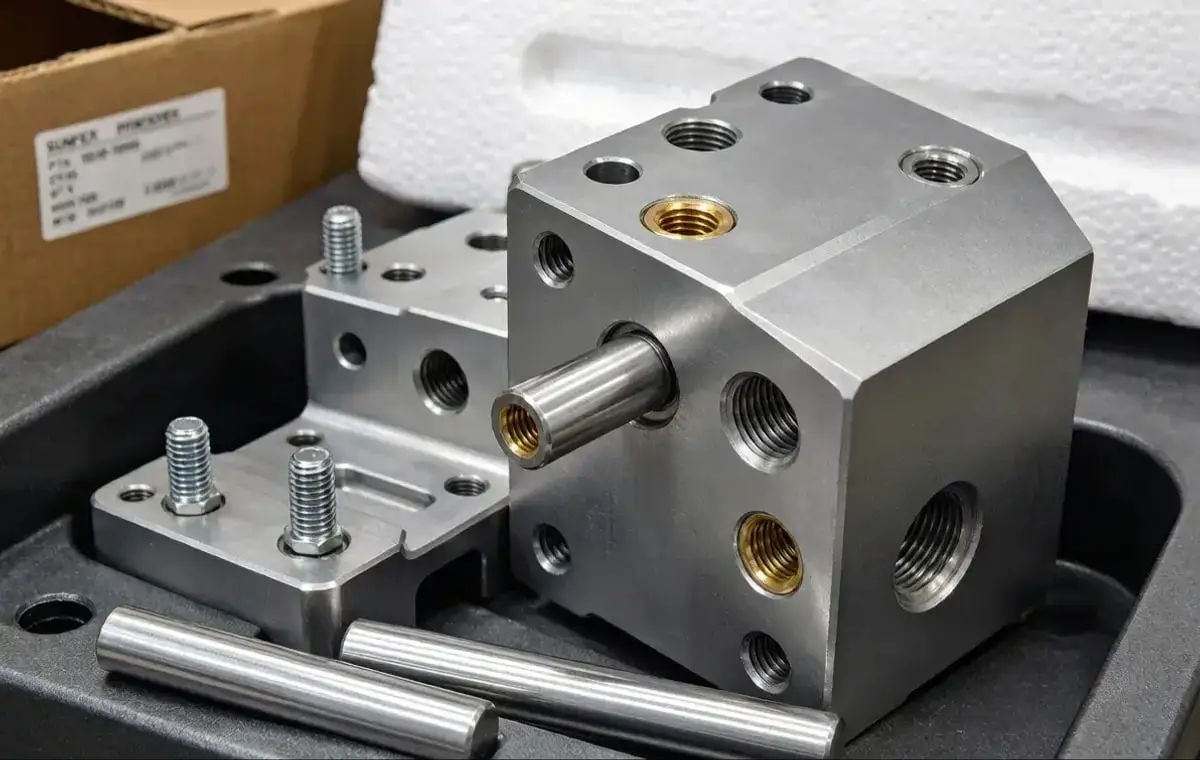
Final inspection and packing of a brass dome cap and a tapered nozzle cone
304L stainless steel round bar stock for CNC machining

304L Stainless Block

304L is used for bearing blocks in washdown and outdoor equipment, where a painted aluminium block would corrode at the mounting face. It holds a bored seat well and passivates cleanly after machining.

304L stainless steel plate and block stock for CNC machining

316L for Chloride Service

316L is specified where the block sees salt or chloride washdown, for example food lines cleaned with hypochlorite. It costs more and machines slower, but the seat does not pit under the bearing.

Both grades are non-magnetic in the annealed condition, which matters if the bearing is a magnetic encoder target; 316L is the safer choice for wet environments.

Bearing Support Block Specifications

Milling and boring data for stainless bearing blocks, with the seat, parallelism and flatness values that decide shaft alignment.

SpecificationMachining DataSpecificationMachining Data
ProductBearing Support Block / Housing BlockMachining ProcessCNC Milling, Boring, Face Milling
Material304L / 316L Stainless BlockBearing Seat ToleranceH7 (0 / +0.021 on 30 mm)
Seat Diameter10 – 80 mmSeat to Base Parallelism0.02 mm
Block Size50 × 40 × 30 mm to 200 × 150 × 120 mmSeat Roundness0.01 mm
Seat Depth10 – 60 mm, Through or BlindBore Surface FinishRa 0.8 µm
RetainingClamp Screw Flats, End Cap Thread, Circlip GrooveBase Flatness0.02 mm
Mounting2 or 4 Slots, M5 to M12Wall Around SeatMinimum 4 mm
CustomizationSeat Size, Depth, Clamp Style, Slot Pattern, MarkingLead Time8 – 10 Days (Sample), 14 – 18 Days (Batch)
InspectionBore Gauge, Parallelism on CMM, Base FlatnessPackingSeat Capped, Bagged, Foam-Lined Carton

Key Features of Our Bearing Blocks

Bored for roundness, faced for alignment, cleaned for insertion.

Seat Bored in the Base Set-Up

The bearing seat and the mounting base are machined without re-clamping, so the bore axis stays parallel to the base within 0.02 mm.

Shoulder Square to the Bore

The axial shoulder is faced square to the seat, so the outer ring seats on a face rather than on a corner and does not walk under load.

Retaining Features Cut First

Clamp flats, cap threads and circlip grooves are machined before the seat is finished, so the seat is not distorted by a later interrupted cut.

Cleaned Before Dispatch

Blocks are ultrasonically cleaned and the seat is capped, so no swarf reaches the bearing during assembly.

Need a block that keeps the shaft parallel?

Surface Finishes for Bearing Support Blocks

The bearing seat is a press fit, so it is masked or passivated only, never coated, unless the bore is sized after coating.

FinishMain PurposeFinishMain Purpose
PassivationRestores corrosion resistance on machined 304LElectropolishingBright bore for food and pharma bearing blocks
Glass Bead BlastingEven matte exterior on a visible support blockMasked PassivationKeeps the bearing seat bare for a press fit
Laser MarkingBearing size and block number on the sideUltrasonic CleaningRemoves swarf before bearing insertion

*Passivation removes about 1 µm and does not change the seat fit. Any plating or hard coating on the seat is avoided because it changes the interference and can flake under bearing load.

logo

Put your CNC milling parts into production today

All information and uploads are secure and confidential.

Trusted for Precision CNC Machined Components

Supporting OEM projects with accurate machining, flexible production, and reliable component quality.

Mechanical Equipment Customer
The bearing seat was on size, so the bearing went in with the right press fit, no shim.

Industrial Components Buyer
Base is flat, so the block sits on the frame without preload on the bearing.

Equipment Manufacturer
Seat is square to the base, so the shaft lines up with the motor without alignment work.

OEM Customer
OEM Customer
They machined the grease path through, which the last supplier left blind.

Automation Industry Customer
The customized machining solution provided the dimensional accuracy required for our rotating equipment components.

Trusted for Precision CNC Milling.

Machining Process for Bearing Support Blocks

The bearing seat is bored, not interpolated, and the base is faced in the same set-up, so the shaft runs parallel to the mounting surface.

01. Bearing and Shaft Review

Check the bearing bore, width and retaining method against the drawing, and confirm the shaft alignment the block has to hold.

02. Block Prep and Facing

Square the stainless block, face the base and the seat face, and mark the datum so the bore and the mounting slots share a reference.

03. Bore the Seat

Bore the seat with a single-point tool to H7, face the shoulder square to the bore and check roundness with an air gauge or a bore micrometer.

04. Slots, Flats and Cleaning

Mill the mounting slots and clamp flats, cut any cap thread, then deburr, clean ultrasonically and passivate the block.

05. Gauge, Cap and Pack

Gauge the seat, check parallelism on a CMM, cap the bore, then pack in a foam-lined carton so the seat is not damaged in transit.

Send the bearing drawing and the mounting interface, and we will quote the block with the seat and shoulder dimensions confirmed.

Bearing Support Block FAQs

A press fit of 0.005 to 0.015 mm for a rotating shaft, and a slip fit for a bearing that has to float axially. The block seat is bored to whichever the drawing specifies, not to a default H7.

Both are machined in the same set-up and checked on a CMM with the block standing on its base. Re-clamping between the base and the bore is what allows a 0.05 mm tilt.

Yes. A split clamp with a saw cut and two screws is common where the shaft has to be assembled without removing the bearing, and the bore is finished after the split.

Not if the base is flat to 0.02 mm and the wall around the seat is at least 4 mm. A thin wall or a warped base is what ovalises a seat after installation.

We machine the block to the bearing drawing; bearings are supplied by the customer or sourced to specification on request. The seat is gauged against the bearing OD tolerance, not a nominal.

Eight to ten days for a sample including machining, boring, passivation and CMM. Batches of 30 to 200 blocks run fourteen to eighteen days depending on size and inspection scope.

Other CNC Machined Mechanical Components

Explore additional precision CNC machined components manufactured for OEM applications and customized production needs.

Custom CNC machined stainless steel fixtures for automated assembly cells.

Precision CNC machined stainless steel rotary joint housings for robot arms and fluid transfer.

Custom CNC machined aluminum double tube clamps for motorcycle frames, bicycle builds and hydraulic lines.

Custom CNC machined hardened steel sleeves for robotic joints and motion assemblies.

Custom CNC machined aluminium fuel pump blocks for automotive and motorsport fuel systems.

Get high‑quality machined parts in as fast as 4 days with our expanded automated CNC milling!

Scroll to Top