
Quick Answer
CNC turning and milling combines lathe-based turning and tool-based milling to produce round, prismatic, threaded, slotted, and multi-feature precision parts with fewer setups.
Key Takeaways
- CNC turning and milling is a combined machining approach for parts that need both rotational and milled features.
- Turning is best for round parts such as shafts, pins, bushings, sleeves, and threaded components.
- Milling is better for flat surfaces, holes, pockets, slots, contours, and multi-face structures.
- Turning-milling can reduce secondary setups, improve consistency, and shorten production cycles for complex parts.
- Material choice, tolerance, surface finish, geometry, and batch quantity all affect process selection.
- It is ideal for precision components used in medical devices, robotics, automotive, drones, optical instruments, and semiconductor equipment.
Abstract
CNC turning and milling are two of the most important subtractive manufacturing processes for producing precision metal and plastic parts. Turning rotates the workpiece while a cutting tool removes material. Milling usually keeps the workpiece fixed or indexed while a rotating cutting tool creates flats, holes, slots, pockets, and complex surfaces.
When a part needs both round and milled features, CNC turning and milling can be combined into a more efficient process. This guide explains what CNC turning and milling means, how it works, common types, materials, applications, advantages, limitations, and how buyers can decide whether it is suitable for a custom part project.
What is CNC Turning and Milling?
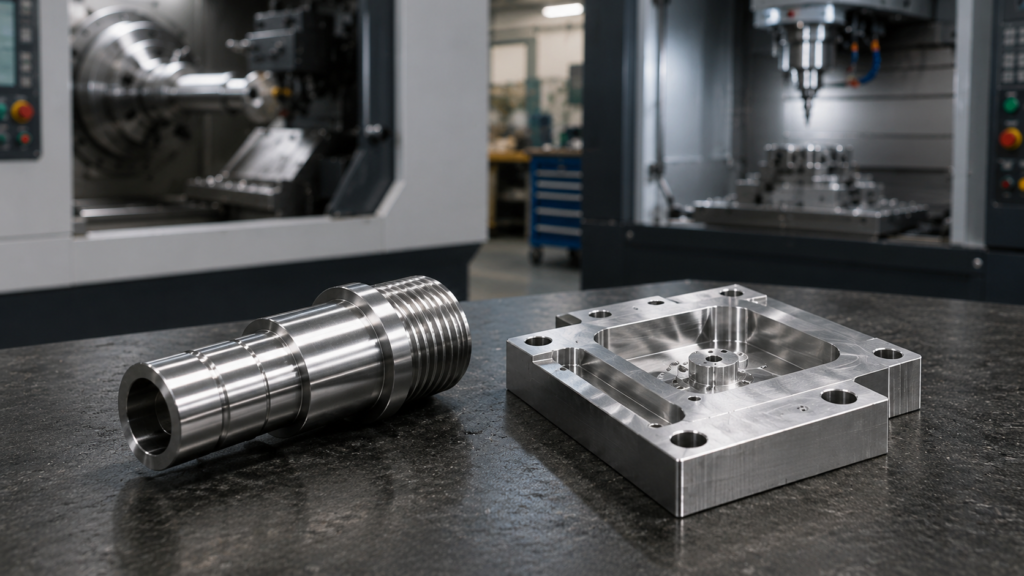
CNC turning and milling refers to the use of computer-controlled machining processes to remove material from a workpiece and create accurate custom parts. It may describe two separate processes used in one project, or a combined turning-milling process completed on one machine.
In modern manufacturing, CNC machines are programmed through digital instructions. NIST notes that industrial CNC systems are commonly connected with CAM systems and CNC command data, while newer research focuses on smarter and more integrated CAM/CNC control systems. [1]
CNC Turning Explained
CNC turning is a machining process where the workpiece rotates while a cutting tool moves along the material to remove chips. It is commonly used for parts with rotational symmetry.
Typical CNC turned parts include:
- Shafts
- Pins
- Bushings
- Sleeves
- Spacers
- Threaded parts
- Cylindrical housings
- Flanges
- Nozzles
- Connectors
Turning is efficient when the main shape is round, stepped, tapered, grooved, or threaded.
CNC Milling Explained
CNC milling uses rotating cutting tools to remove material from a workpiece. It is widely used to create flat surfaces, holes, pockets, slots, and complex 3D shapes.
Typical CNC milled parts include:
- Brackets
- Plates
- Housings
- Frames
- Fixture blocks
- Heat sinks
- Mounting parts
- Mold components
- Multi-face precision parts
Milling is more suitable when the part has flat faces, irregular shapes, square pockets, side holes, or multiple mounting features.
What CNC Turning-Milling Means
CNC turning-milling combines turning and milling operations in one machining strategy. The workpiece can be turned for round features and then milled for flats, cross holes, slots, side pockets, or complex surfaces.
For buyers, the value is simple: fewer transfers, fewer fixtures, fewer setup errors, and better consistency for complex parts.
How the Turning and Milling Process Works?
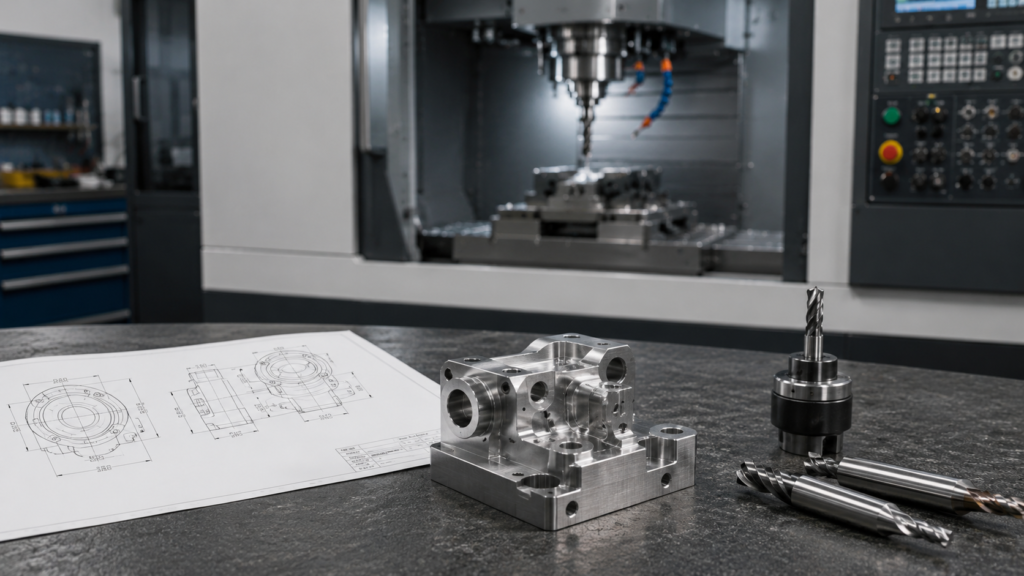
The turning and milling process usually starts from a 3D model and 2D drawing. Engineers review the geometry, tolerance, material, surface finish, and quantity before selecting the machine and machining sequence.
From CAD Drawing to Machined Part
A typical workflow includes:
- Drawing and 3D file review
- Material selection
- Process selection: turning, milling, or turning-milling
- CAM programming
- Tooling and fixture preparation
- CNC machining
- Deburring and surface finishing
- Dimensional inspection
- Packaging and delivery
MIT’s machine shop training materials describe machining as a process where machines cut, drill, face, turn, and grind material, while also warning that aggressive speed or depth of cut can cause uneven finish, tool wear, tool breakage, and safety risks. [2]
Why Setup Strategy Matters?
A setup is the way a workpiece is clamped, positioned, and machined. If a part must be moved from a lathe to a milling machine, each transfer may introduce positioning error.
Turning-milling helps reduce this risk because multiple features can be finished in one setup. This is especially useful for parts where round diameters, threaded sections, flats, holes, and side features must align accurately.
CNC Turning vs CNC Milling vs CNC Turning-Milling
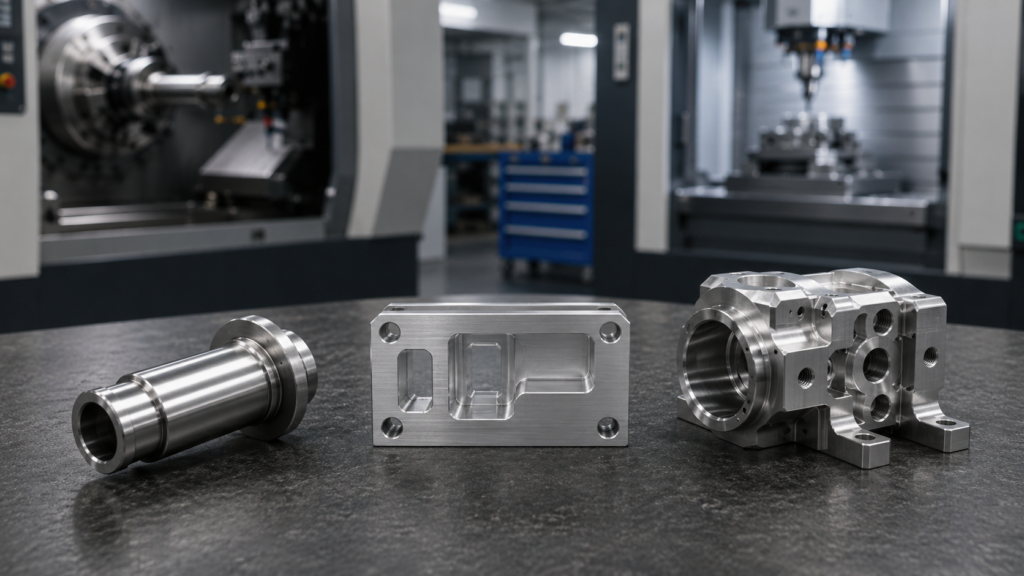
CNC turning, CNC milling, and turning-milling are not competing processes in every case. They solve different geometry problems.
Process Comparison Table
| Process | How It Cuts | Best For | Typical Parts |
| CNC turning | Workpiece rotates; tool cuts | Round and cylindrical parts | Shafts, pins, bushings, sleeves |
| CNC milling | Tool rotates; workpiece is fixed or indexed | Flat, slotted, pocketed, or complex parts | Brackets, plates, housings, frames |
| CNC turning-milling | Combines turning and milling | Round parts with side features | Connectors, valve bodies, custom fittings, complex shafts |
When to Choose Each Process?
Choose CNC turning when the part is mostly round. Choose CNC milling when the part has flat surfaces, pockets, slots, or multi-face geometry. Choose CNC turning and milling when the same part requires both rotational features and milled features.
A good example is a cylindrical connector with external threads, internal holes, side slots, and flat wrench surfaces. Turning creates the round features, while milling creates the flats and cross features.
Common Materials for Precision CNC Turning and Milling
Material selection affects tool wear, tolerance stability, surface finish, cost, and delivery time. Harder materials often require slower cutting speeds and more careful process control.
Metal Materials
Common materials for precision CNC turning and milling include:
| Material | Common Use | Key Advantage |
| Aluminum 6061 | Brackets, housings, prototypes | Good machinability and cost balance |
| Aluminum 7075 | High-strength lightweight parts | Stronger than 6061 |
| Stainless steel 304 | General corrosion-resistant parts | Stable and widely available |
| Stainless steel 316 | Medical, marine, clean environments | Better corrosion resistance |
| Brass | Connectors, fittings, decorative parts | Easy to machine |
| Copper | Electrical and thermal parts | Conductivity |
| Titanium | Medical, aerospace, high-value parts | Strength and corrosion resistance |
| Alloy steel | Wear or load-bearing parts | High strength after treatment |
Engineering Plastics
Engineering plastics are often used when parts need insulation, weight reduction, chemical resistance, or low friction.
| Plastic | Common Use | Watch Point |
| POM / Delrin | Bushings, guides, spacers | Dimensional stability is good, but temperature should be checked |
| PEEK | High-performance parts | Expensive but strong and heat resistant |
| PTFE | Low-friction parts | Soft, can deform under load |
| Nylon | Wear parts and rollers | Moisture absorption should be considered |
| ABS / PC | Covers and prototypes | Check strength and heat requirements |
Typical Applications of CNC Milling and Turning Parts
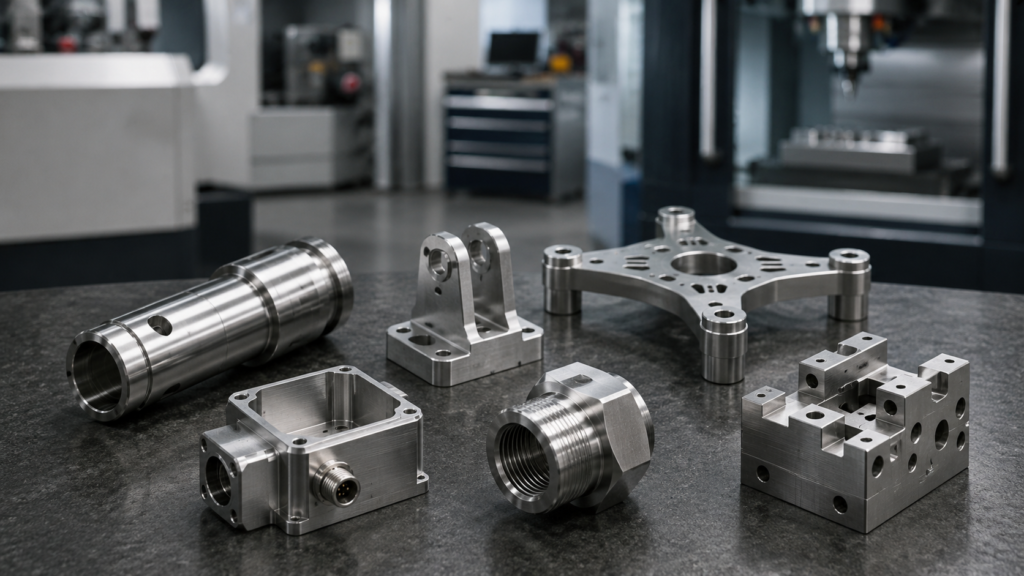
CNC milling and turning is used across industries where custom geometry, material performance, and precision assembly are more important than standard off-the-shelf parts.
Common Part Types
Common parts include:
- Motor shafts
- Sensor housings
- Medical device parts
- Robotic joints
- Optical instrument brackets
- Drone spacers and connectors
- Semiconductor fixture components
- Automotive bushings and fittings
- Threaded adapters
- Valve and pump parts
- Custom fasteners
- Precision sleeves
Industry Application Table
| Industry | Typical Parts | Main Requirement |
| Medical devices | Surgical tool parts, housings, fittings | Clean edges, stable tolerance, corrosion resistance |
| Robotics | Joints, shafts, brackets, spacers | Repeatability and strength |
| UAV and drones | Connectors, mounts, lightweight spacers | Low weight and vibration resistance |
| Semiconductor equipment | Fixture parts, alignment blocks, carriers | Precision, cleanliness, burr control |
| Automotive and motorcycle | Bushings, shafts, adapters, brackets | Durability and batch consistency |
| Optical instruments | Mounts, sleeves, focusing parts | Concentricity and surface quality |
Advantages of CNC Turning-Milling for Custom Parts
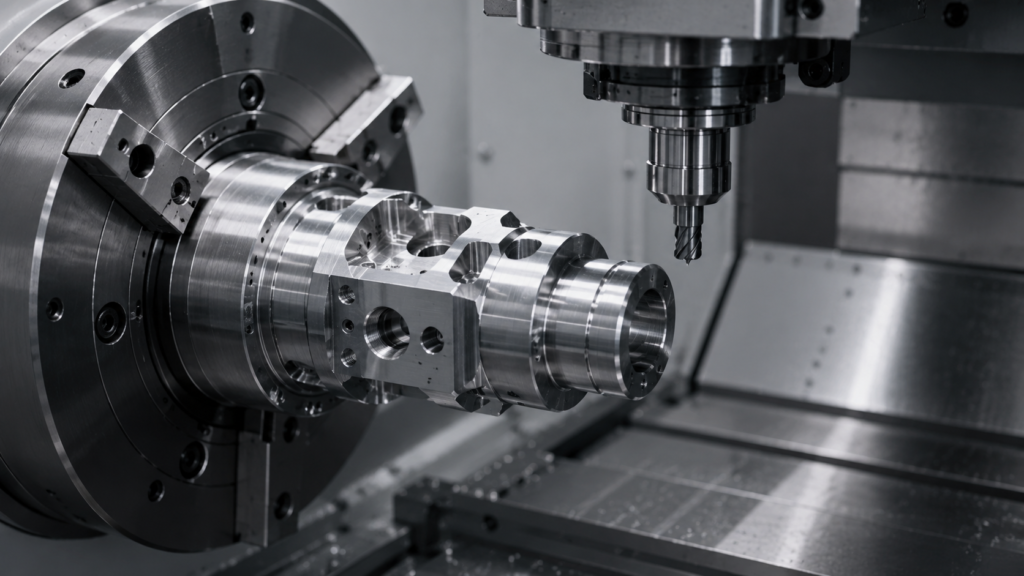
CNC turning-milling is valuable when a part is not purely round and not purely prismatic. It is designed for mixed-geometry parts.
Fewer Setups and Better Repeatability
The biggest advantage is setup reduction. When turning and milling are completed in one clamping process, the part does not need to move between multiple machines. This helps reduce tolerance stack-up and improves feature alignment.
For parts with holes, flats, slots, threads, and round diameters, this can make the final result more stable than splitting the work across different machines.
Better Support for Complex Features
Turning-milling is useful for:
- Cross holes in turned parts
- Flats on round shafts
- Side slots on cylindrical bodies
- Threaded parts with milled features
- Multi-face connectors
- Precision fittings
- Small complex components
ISO also maintains standards related to numerical control systems, turning machine test conditions, milling process data, and turning process data, showing how CNC machine accuracy and process data are treated as structured technical topics rather than simple workshop operations. [3]
Limitations of the CNC Machining Process
The CNC machining process is flexible, accurate, and widely used, but it has practical limits. Buyers should understand these limits before sending an RFQ.
Design and Cost Limitations
Common limitations include:
| Limitation | Why It Matters |
| Deep cavities | May require long tools, increasing vibration |
| Very thin walls | Can deform during cutting or finishing |
| Sharp internal corners | Cutting tools have radius limits |
| Over-tight tolerances | Increase cost and inspection time |
| Hard materials | Increase tool wear and machining time |
| Complex setup | May require special fixtures or 5-axis machining |
| Low quantity with complex features | Setup cost becomes more visible |
The best way to control cost is to define which features are truly critical and which surfaces can use standard tolerance.
Tolerance and Surface Finish Considerations
Not every feature needs tight tolerance. Not every visible surface needs a premium finish. Over-specification can increase quotation price without improving function.
A good RFQ should include:
- 3D files and 2D drawings
- Material grade
- Quantity
- Critical dimensions
- Thread requirements
- Surface roughness requirements
- Surface treatment
- Inspection needs
- Application notes
How SinoRise Supports CNC Turning and Milling Projects?
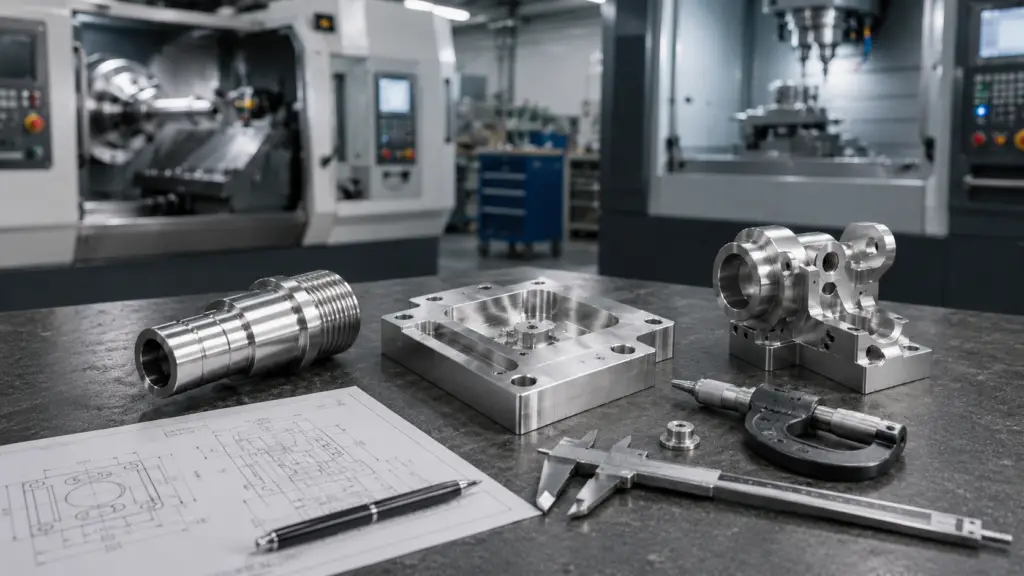
SinoRise supports CNC turning, CNC milling, and CNC turning and milling projects from prototype to small and medium-batch production. Its turning-milling service page describes the process as a combined solution that can complete turning outer diameters, internal holes, threading, milling flats, slots, drilling, and tapping in one setup. [4]
For buyers, this is useful when a part has both round and multi-face features. SinoRise can help review drawings, evaluate materials, select the right process, coordinate surface treatments, and inspect critical dimensions before delivery.
SinoRise can support:
- CNC turning
- CNC milling
- CNC turning-milling
- 3-axis, 4-axis, and 5-axis machining
- Wire cutting
- Aluminum, stainless steel, titanium, brass, copper, alloy steel, carbon steel, and engineering plastics
- Anodizing, electroplating, sandblasting, polishing, coatings, and heat treatment
- Prototype and small-batch production
- Precision inspection and process monitoring
For definition-type projects, the practical value is not only knowing what the process means. It is knowing when to choose turning, when to choose milling, and when turning-milling can reduce risk.
FAQ About CNC Turning and Milling
What Is CNC Turning and Milling?
CNC turning and milling is a machining approach that uses both turning and milling operations to create precision parts with round features, flats, slots, holes, threads, and complex surfaces.
What Is the Difference Between CNC Turning and CNC Milling?
CNC turning rotates the workpiece and uses a cutting tool to shape round parts. CNC milling uses rotating cutting tools to cut fixed or indexed workpieces into flat, slotted, pocketed, or complex shapes.
Is CNC Turning-Milling Better Than Separate Turning and Milling?
It can be better for mixed-geometry parts because it reduces setups and transfer errors. However, simple round parts may still be more cost-effective on a CNC lathe, and simple plates may be more efficient on a milling machine.
What Materials Can Be Used for CNC Turning and Milling?
Common materials include aluminum, stainless steel, brass, copper, titanium, alloy steel, carbon steel, POM, PEEK, PTFE, nylon, ABS, and PC.
What Parts Are Suitable for CNC Turning-Milling?
Suitable parts include connectors, fittings, valve parts, custom shafts, threaded adapters, sleeves with side holes, sensor housings, and precision components with both round and milled features.
What Should Be Included in a CNC Turning and Milling RFQ?
A good RFQ should include 3D files, 2D drawings, material grade, quantity, tolerance, surface finish, surface treatment, thread requirements, inspection needs, and application notes.
Can SinoRise Support Prototype CNC Turning and Milling?
Yes. SinoRise supports prototype and small-batch CNC turning and milling, including engineering review, process selection, machining, surface treatment coordination, and inspection support.
Conclusion
CNC turning and milling is one of the most useful manufacturing approaches for custom precision parts. Turning is efficient for round features. Milling is strong for flats, slots, pockets, holes, and complex shapes. Turning-milling combines both when a part needs mixed geometry.
For buyers, the best decision starts with part geometry. If the part is mostly cylindrical, choose turning. If it is mostly prismatic, choose milling. If it includes both round and milled features, CNC turning-milling may reduce setups, improve alignment, and simplify production.
SinoRise helps customers move from drawings to finished parts through CNC turning, CNC milling, turning-milling, surface treatment coordination, and inspection support. For prototypes, small batches, and complex custom components, the right machining strategy can reduce risk before production begins.
References
[1] NIST — The State of Integrated CAM/CNC Control Systems. NIST describes industrial CNC systems, CAM programming, G-code limitations, and research toward smarter integrated CAM/CNC control systems.
[2] MIT Machine Shop — Introduction to the Physics of Machining. MIT explains that machining involves cutting, drilling, facing, turning, and other material-removal actions, and notes how aggressive cutting conditions can affect finish, tool wear, and safety.
[3] ISO — Numerically Controlled Machines. ISO lists standards related to numerical control, turning machine test conditions, milling process data, turning process data, and CNC machine tool data.
[4] SinoRise — CNC Milling and Turning Precision Machining Services. SinoRise describes CNC turning-milling as a combined process that can complete turning, threading, milling flats, slots, drilling, and tapping in one setup, along with supported materials, surface treatments, and quality control.