
Quick Answer
CMM inspection uses a coordinate measuring machine to check complex dimensions, GD&T features, hole positions, flatness, and part geometry when manual inspection is not enough.
Key Takeaways
- CMM inspection is used to verify part geometry in three-dimensional space.
- It is especially valuable for high precision CNC machining, complex parts, tight tolerances, and GD&T requirements.
- Buyers usually need CMM reports for first articles, critical parts, high-value components, and supplier qualification.
- CMM inspection does not replace all manual inspection; calipers, micrometers, gauges, visual checks, and surface tests still matter.
- A good RFQ should clearly state which dimensions need CMM inspection and what report format is required.
Abstract
For procurement teams and quality engineers, CMM inspection is not just a “premium inspection option.” It is a decision about risk. If a CNC part has tight hole positions, complex geometry, critical datums, flatness, perpendicularity, or repeatability requirements, basic manual measurement may not provide enough confidence.
This guide explains what CMM inspection is, how a coordinate measuring machine works, when you need it, what it can measure, when it may not be necessary, and how SinoRise supports dimensional inspection for precision CNC parts.
What is CMM Inspection in CNC Machining?
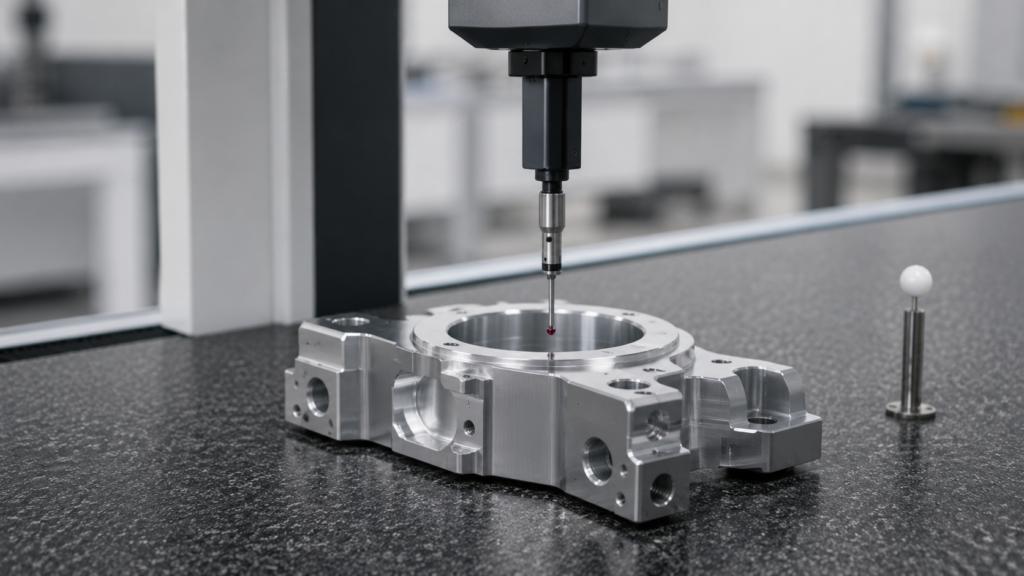
CMM inspection is a dimensional inspection method that uses a coordinate measuring machine to measure a part’s geometry in three-dimensional space. A CMM usually uses a touch probe, scanning probe, or optical sensor to collect measurement points from a part surface. The data is then compared with the drawing, CAD model, or inspection plan.
NIST describes coordinate measuring machines as tools used to precisely measure the dimensions of complex product parts, including automotive components. This makes CMM inspection especially useful when a part has geometry that cannot be checked reliably with only simple hand tools. [1]
What a Coordinate Measuring Machine Does?
A coordinate measuring machine records points along X, Y, and Z axes. Based on these points, the inspection software can evaluate holes, planes, cylinders, slots, profiles, distances, angles, and geometric relationships.
For high precision CNC machining, this is important because many parts do not fail because one length is wrong. They fail because multiple features do not relate to each other correctly.
What Makes CMM Different from Manual Inspection?
Manual tools are still useful. Calipers, micrometers, pin gauges, thread gauges, height gauges, and visual checks are fast and practical. But they are limited when the feature is complex, hidden, angled, or defined by GD&T.
CMM inspection is stronger when the question is:
- Is this hole pattern positioned correctly?
- Is this bore aligned with the datum?
- Is this surface flat enough?
- Is this profile within tolerance?
- Are multiple features consistent in 3D space?
How Coordinate Measuring Machine Inspection Works?
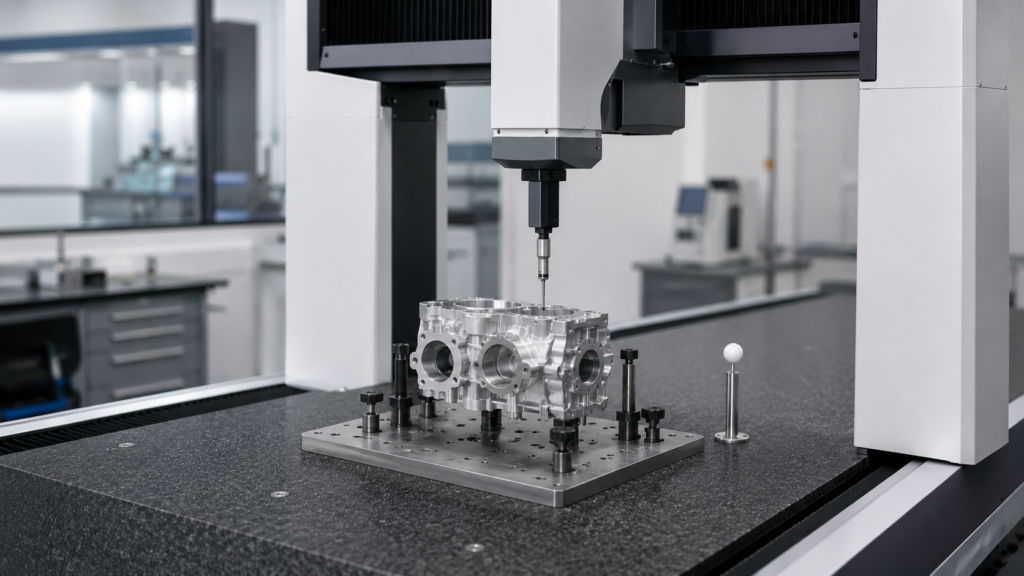
Coordinate measuring machine inspection starts with the drawing or CAD model. The inspection team reviews which dimensions are critical, which datums define the part, and which features need CMM measurement.
From Drawing Requirements to Measurement Points
A typical CMM workflow includes:
| Step | What Happens | Why It Matters |
| Drawing review | Identify datums, tolerances, and critical features | Prevents measuring the wrong areas |
| Inspection planning | Select measurement points and probe paths | Improves repeatability |
| Part fixturing | Hold the part stable during measurement | Reduces measurement variation |
| Probe measurement | Collect points from holes, surfaces, and features | Builds measurement data |
| Software evaluation | Compare measured data with drawing requirements | Confirms pass/fail status |
| Report generation | Create CMM inspection report | Supports buyer review and quality records |
ISO 10360 is the main international standard series for acceptance and reverification tests of coordinate measuring machines, which shows that CMM performance itself must be controlled and verified, not assumed. [2]
What Is Included in a CMM Inspection Report?
A CMM inspection report may include:
- Part name and drawing revision
- Material and batch information
- Measured features
- Nominal values
- Actual measured values
- Tolerance limits
- Deviation results
- Pass/fail status
- Measurement date
- Inspector or equipment information
- Notes on datums, fixtures, or special conditions
For procurement teams, this report becomes evidence that the supplier has checked the features that matter most.
When Do You Need CMM Inspection for High Precision CNC Machining?
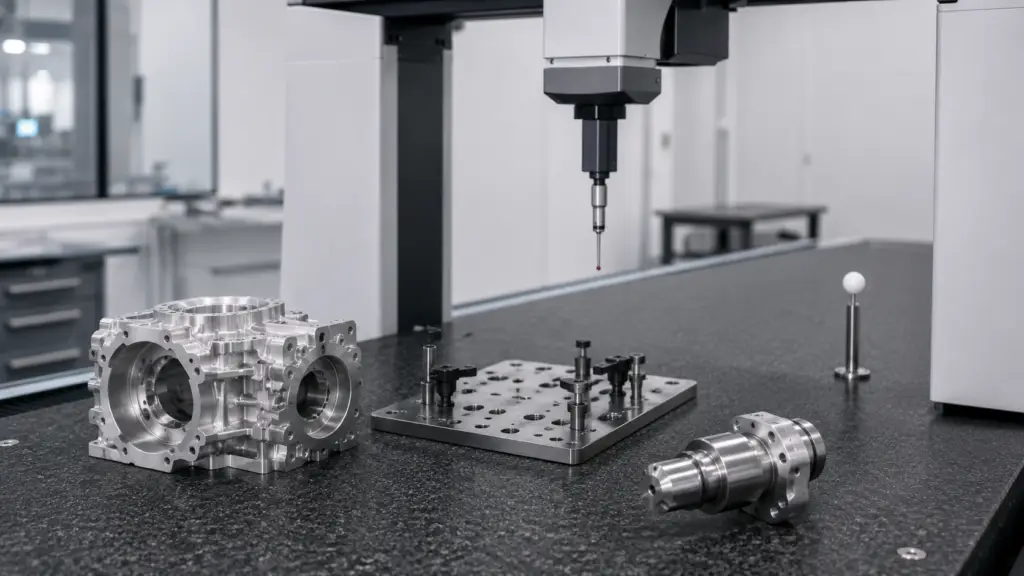
You need CMM inspection when part risk is high enough that basic inspection is not enough. In high precision CNC machining, this usually means tight tolerances, complex geometry, expensive materials, critical assemblies, or demanding industries.
Typical Use Cases for CMM Reports
CMM inspection is commonly requested for:
- First article inspection
- New supplier qualification
- Critical prototype validation
- Precision machined components
- Semiconductor fixtures
- Medical device components
- Aerospace and UAV parts
- Robotic joints and alignment parts
- Optical instrument mounts
- Automotive precision components
- Parts with GD&T requirements
- Parts with tight hole position tolerance
- Parts with flatness, parallelism, or perpendicularity requirements
ASME describes Y14.5 as the authoritative guideline for geometric dimensioning and tolerancing, which is why CMM inspection is often connected with drawings that use datums and GD&T feature control frames. [3]
Decision Table for Buyers and Quality Engineers
| Part Situation | Do You Need CMM? | Reason |
| Simple spacer with loose tolerance | Usually no | Manual tools are enough |
| Flat bracket with standard holes | Maybe | Depends on hole position requirement |
| Precision fixture plate | Yes | Hole pattern and flatness may be critical |
| Part with GD&T callouts | Usually yes | Datums and feature relationships need verification |
| First production sample | Often yes | Confirms process before batch production |
| High-value material part | Often yes | Reduces risk before delivery |
| Cosmetic cover with loose fit | Usually no | Visual and basic dimensional checks may be enough |
| Medical, optical, semiconductor, UAV component | Often yes | Assembly risk is higher |
What Can CMM Measure in a Precision Machining Service?
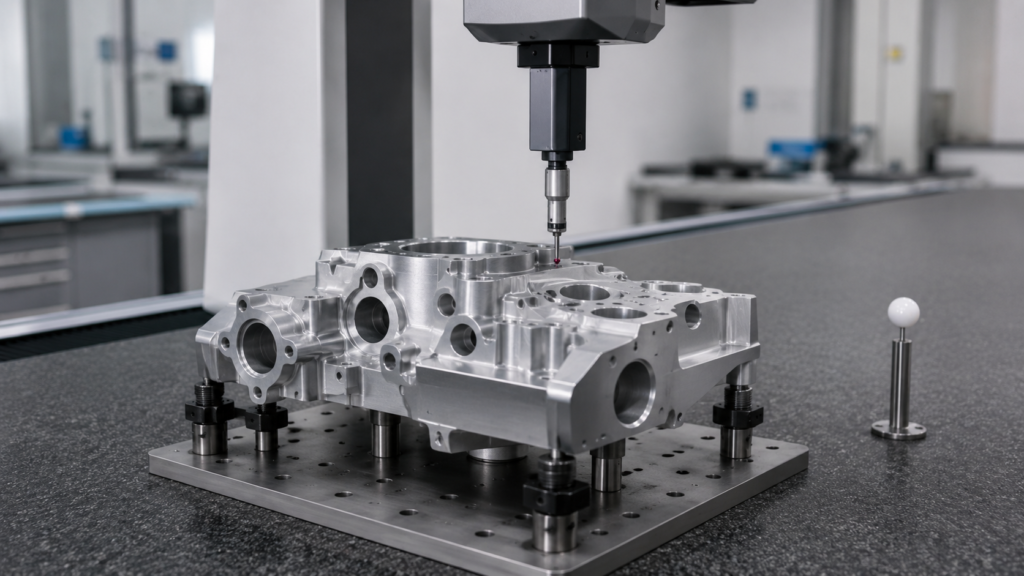
In a precision machining service, CMM inspection is mainly used to confirm whether the part can fit, align, seal, rotate, locate, or assemble as intended.
Dimensions, Positions, and GD&T Features
A CMM can help inspect:
| Feature Type | Example |
| Linear dimensions | Length, width, height, depth |
| Hole position | Bolt patterns, dowel holes, locating holes |
| Diameter | Bores, bosses, cylinders |
| Flatness | Mounting plates, sealing surfaces |
| Parallelism | Mating faces, slide surfaces |
| Perpendicularity | Upright brackets, datum faces |
| Concentricity / coaxiality | Sleeves, shafts, turned parts |
| Profile | Curved surfaces and complex contours |
| True position | GD&T-controlled holes or features |
For complex CNC parts, the most important value of CMM inspection is not measuring more numbers. It is measuring the right features in relation to the correct datum system.
CMM Inspection vs Other Inspection Methods
| Method | Best For | Limitation |
| Caliper | Quick general dimensions | Limited accuracy and 3D geometry control |
| Micrometer | Diameters and thickness | Limited feature access |
| Pin gauge | Hole size and fit | Does not verify full position relationship |
| Thread gauge | Thread pass/fail | Does not measure other geometry |
| Height gauge | Heights and step features | Needs stable setup |
| Surface roughness tester | Ra and surface texture | Does not inspect geometry |
| CMM inspection | 3D geometry, GD&T, datum relationships | Higher cost and planning time |
When CMM Inspection May Not Be Necessary?
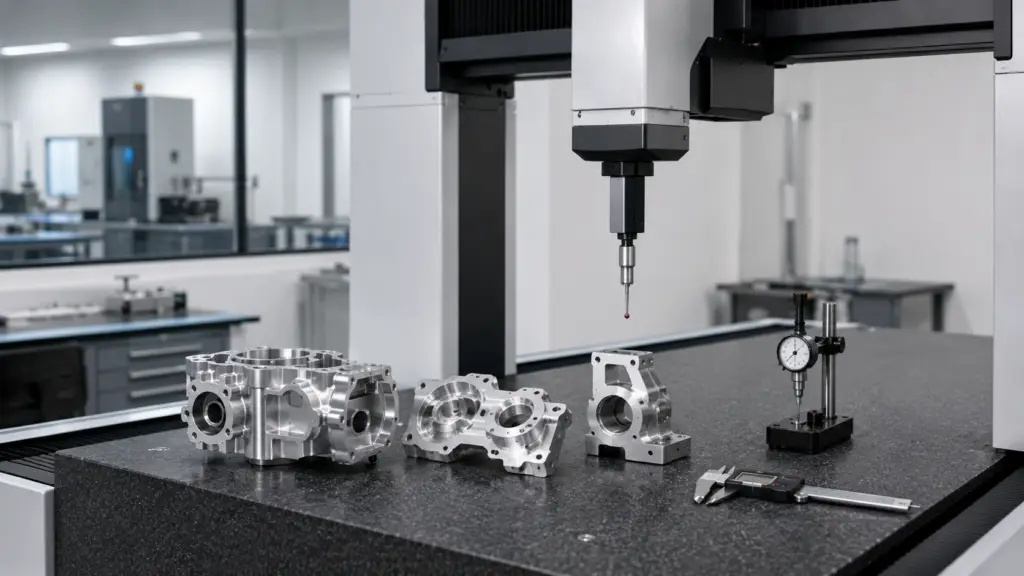
CMM inspection is powerful, but it should not be used blindly. A good supplier should help buyers decide where it creates real value.
Simple Parts and Non-Critical Dimensions
CMM may not be necessary when:
- The part has loose tolerances
- Geometry is simple
- Dimensions can be checked with gauges
- The part is non-critical
- The buyer does not require an inspection report
- The part is a rough prototype for appearance or fit only
- Cost and speed matter more than documentation
For example, a simple aluminum cover plate with clearance holes may only need caliper checks, visual inspection, and thread verification.
Cost and Lead Time Considerations
CMM inspection adds value, but it also adds cost. Programming, fixturing, probing, reporting, and review take time. The best approach is to apply CMM inspection to critical features, not every surface.
A practical RFQ should state:
- Which features require CMM inspection
- Whether a full report is needed
- Whether first article inspection is required
- Which drawing revision should be used
- Which datums are critical
- Whether the buyer has a preferred report format
Common Risks in CMM Inspection for CNC Precision Machining
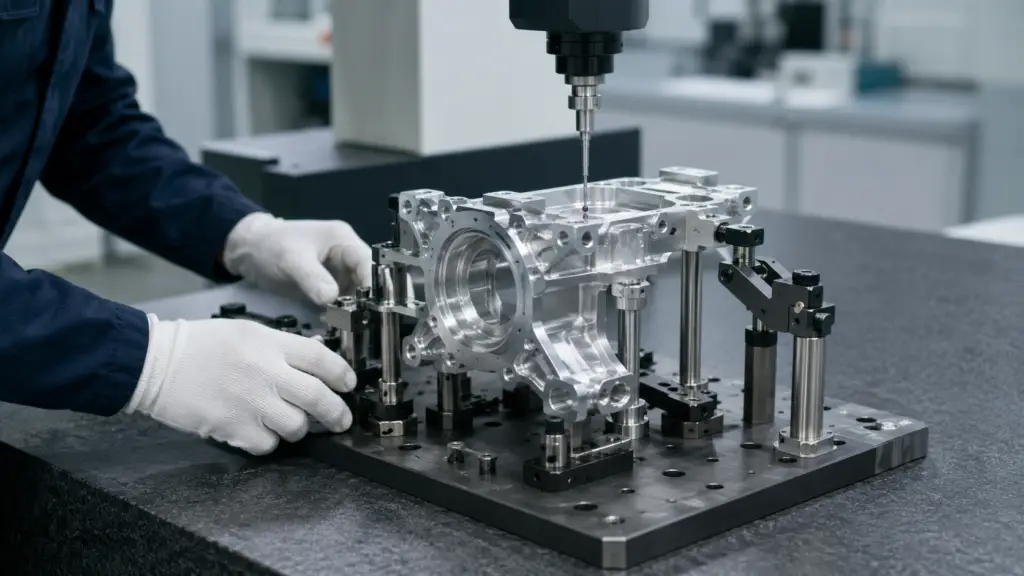
For CNC precision machining, CMM inspection can reduce risk only when the measurement plan is clear. A CMM is not a magic tool. If the drawing is unclear or the datum setup is wrong, the result may still mislead the buyer.
Unclear Datums and Drawing Ambiguity
Common issues include:
- Missing datum references
- Unclear critical dimensions
- Conflicting tolerances
- No drawing revision control
- Over-tight tolerances on non-critical features
- CAD model and 2D drawing mismatch
- No explanation of functional surfaces
When this happens, the supplier may measure what is easy instead of what is important.
Temperature, Fixturing, and Inspection Planning
CMM results can also be affected by environment and setup. NIST notes that tight temperature control helps improve the accuracy of CMM calibration services and supports research into how changing temperature affects CMM performance. [1]
Important inspection factors include:
- Stable temperature
- Clean part surfaces
- Proper fixturing
- Correct datum alignment
- Probe access
- Repeatable measurement points
- Trained inspection personnel
- Clear report review
How SinoRise Supports CNC Inspection and Quality Control?
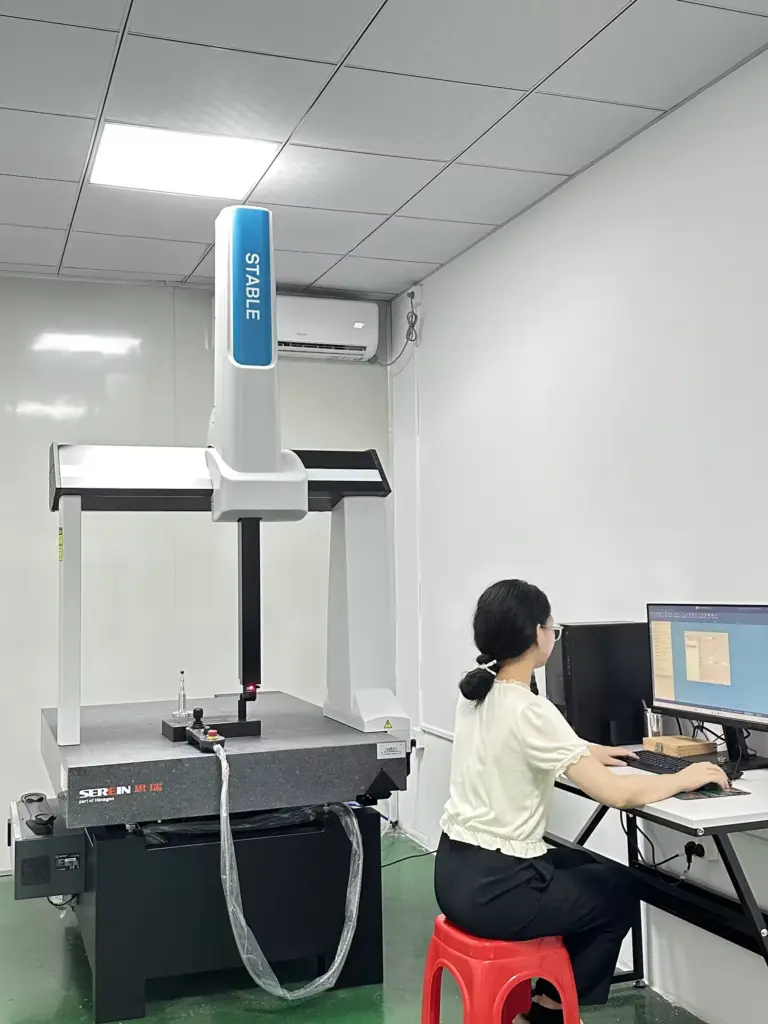
SinoRise supports CNC machining projects where inspection planning is part of the manufacturing process, not an afterthought. For precision parts, this means reviewing drawings, identifying critical features, choosing proper machining methods, coordinating surface treatments, and confirming dimensions before delivery.
SinoRise can support:
- Drawing and DFM review
- CNC milling, CNC turning, turning-milling, wire cutting, and 5-axis machining
- Precision machining for metals and engineering plastics
- Dimensional inspection for critical features
- Surface treatment coordination
- First article and batch inspection support
- Prototype to small and medium-batch production
- Inspection planning for semiconductor, medical, optical, robotic, UAV, and automotive parts
SinoRise’s published CNC content emphasizes precision machining, inspection, surface treatment, process control, and quality assurance across demanding industry applications. [4]
For buyers, the practical value is clear: the supplier should not only make the part but also help decide which features need advanced inspection and which can be checked more efficiently.
FAQ About CMM Inspection
What Does CMM Inspection Mean?
CMM inspection means using a coordinate measuring machine to measure part dimensions and geometry in three-dimensional space, then compare the measured data with the drawing or CAD model.
What Is a CMM Machine Used For?
A CMM machine is used to inspect complex dimensions, hole positions, surfaces, profiles, datums, and GD&T features on manufactured parts.
When Should I Request a CMM Report?
Request a CMM report when the part has tight tolerances, critical fit, GD&T requirements, expensive material, first article approval, or high assembly risk.
Is CMM Inspection Better Than Calipers?
CMM inspection is better for complex 3D geometry and datum-based measurement. Calipers are faster and more cost-effective for simple dimensions.
Can CMM Measure Surface Roughness?
No. CMM inspection measures geometry and dimensions. Surface roughness usually requires a surface roughness tester.
Is CMM Inspection Needed for Every CNC Part?
No. Simple parts with loose tolerances may not need CMM inspection. It is most useful for precision, complex, or high-risk parts.
What Should I Include in an RFQ If I Need CMM Inspection?
Include 3D files, 2D drawings, drawing revision, material, critical dimensions, GD&T notes, datums, inspection report requirements, batch quantity, and application background.
Conclusion
CMM inspection is not just an extra quality step. It is a way to reduce uncertainty when parts have complex geometry, tight tolerances, GD&T requirements, or high assembly risk.
For simple parts, manual inspection may be enough. For high precision CNC machining, semiconductor fixtures, medical components, optical mounts, robotic parts, UAV hardware, and automotive precision components, CMM inspection can provide the dimensional evidence needed before assembly or delivery.
SinoRise helps customers connect machining, inspection, and practical quality control. By identifying critical features early, choosing the right inspection method, and using CMM inspection where it adds value, buyers can reduce rework, avoid assembly problems, and improve confidence in precision machined parts.
References
[1] NIST — Coordinate measuring machine. NIST describes CMMs as tools used to precisely measure complex product parts and notes that temperature control affects CMM calibration and performance research.
[2] ISO 10360 — Geometrical product specifications. ISO 10360 covers acceptance and reverification tests for coordinate measuring machines and coordinate measuring systems.
[3] ASME Y14.5 — Dimensioning and Tolerancing. ASME identifies Y14.5 as an authoritative guideline for the design language of geometric dimensioning and tolerancing.
[4] SinoRise — Precision machining and CNC inspection-related content. SinoRise describes precision machining as involving process control, inspection, surface treatment, and quality assurance for demanding CNC applications.