
Small batch CNC milling is often the most practical way to produce functional metal or plastic parts without investing in molds or other hard tooling. It supports design verification, pilot production, replacement parts and stable low-volume demand. Yet buyers are often surprised when the price per part for five or ten pieces is much higher than the price for fifty.
The reason is not simply that suppliers prefer larger orders. Every new part requires engineering preparation before production begins. The supplier must review the drawing, create the CAM program, prepare workholding, set the machine, produce a first article and confirm critical dimensions. These batch-level activities exist whether the order contains five parts or fifty.
A useful way to understand small batch CNC milling cost is to separate fixed batch costs from costs that occur on every part. This also explains why repeat orders may cost less, why setup is not completely eliminated, and why ordering more is not always the best purchasing decision.
Small Batch CNC Milling Cost at a Glance
| Cost item | Cost type | Effect of higher quantity | Repeat-order potential |
| DFM and CAM programming | Mainly fixed | Spread across more parts | Reusable if the design is unchanged |
| Fixture or soft-jaw preparation | Mainly fixed | Spread across more parts | Reusable if retained |
| Machine setup | Per batch | Lower cost per part | Usually repeated |
| First article and approval | Per batch | Lower cost per part | Usually repeated |
| Raw material | Per part | Possible purchasing efficiency | Subject to market price |
| Machine cycle time | Per part | Remains significant | May be optimized |
| Surface finishing | Batch and per part | Process-dependent | Must be repeated |
| Inspection | Batch, sample or per part | Depends on the plan | Programs may be reused |
The best order quantity therefore depends on setup effort, cycle time, material, tolerance, finishing, inspection and inventory risk.
What Counts as Small Batch CNC Milling?
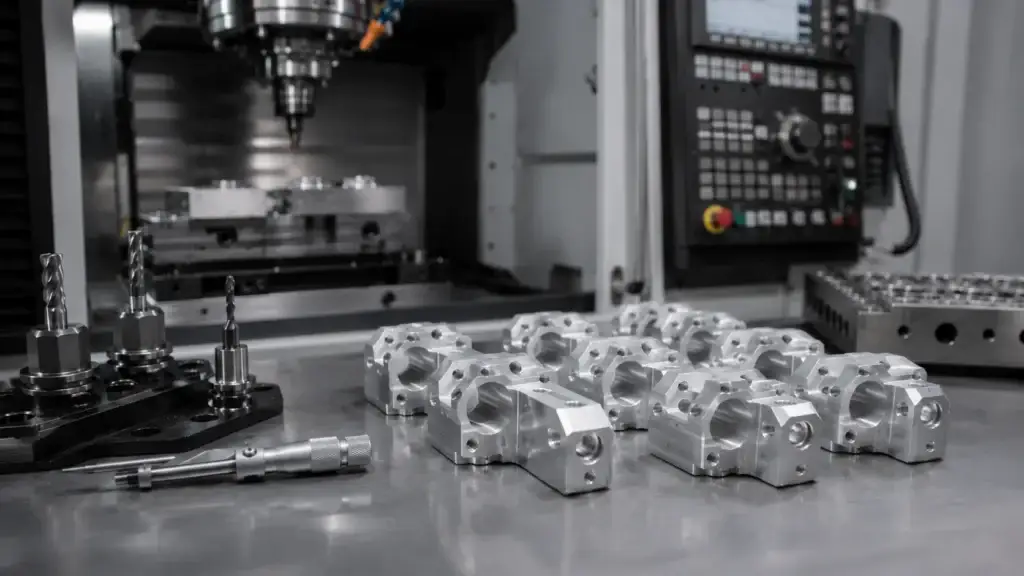
There is no single industry-wide quantity that defines small batch CNC machining. Two hundred simple aluminum plates may be a small run, while twenty large stainless steel fixtures may occupy far more production capacity.
It is more useful to define the production stage:
- Prototype: verifies geometry, fit or function.
- Engineering batch: supports testing and design refinement.
- Pilot batch: confirms the process and assembly workflow.
- Small batch production: supplies limited or variable demand.
- Repeat production: uses the same approved revision across several releases.
A supplier offering CNC machining services for low volume production should evaluate quantity in relation to setup time, cycle time and recurring demand rather than apply one fixed limit.
What Is Included in CNC Machining Setup Cost?
Drawing and DFM Review
The supplier reviews material, tolerances, datums, thin walls, deep pockets, surface finishing and inspection requirements. This identifies manufacturability risks and opportunities to simplify the part.
The review may also reveal issues that directly affect cost, such as:
- Very small internal radii
- Long-reach machining
- Tight tolerances on non-functional features
- Difficult datum transfer
- Unnecessary cosmetic requirements
- Limited inspection access
Resolving these issues before programming is usually less expensive than making changes after the first article has been produced.
CAM Programming and Process Planning
The programmer determines the machining sequence, toolpaths, cutting tools, number of setups, datum transfers and finishing operations.
A simple two-sided plate may require limited preparation. A multi-sided housing with deep pockets, angled holes and tightly related features requires more engineering even when the quantity is the same.
The program must also account for:
- Roughing and finishing allowances
- Tool reach and rigidity
- Workholding clearance
- Material movement
- Surface-finish requirements
- Inspection between operations
Fixture and Soft-Jaw Preparation
Prototypes may use standard vises and modular clamps. More complex parts may need machined soft jaws, locating plates or custom supports.
Better workholding can:
- Improve repeatability
- Reduce loading time
- Support thin features
- Protect cosmetic surfaces
- Reduce datum-transfer error
However, designing and machining the fixture adds fixed preparation cost. Whether that investment is justified depends on quantity and the likelihood of future orders.
Machine Setup and First Article
The operator installs the fixture, loads tools, establishes coordinates and verifies offsets. A first article is then machined and inspected before the rest of the batch proceeds.
For precision CNC milling, this stage confirms that the actual material, tooling and clamping method produce the required dimensions. Tool offsets or finishing passes may be adjusted before batch production begins.
Fixed Costs vs. Per-Part Costs
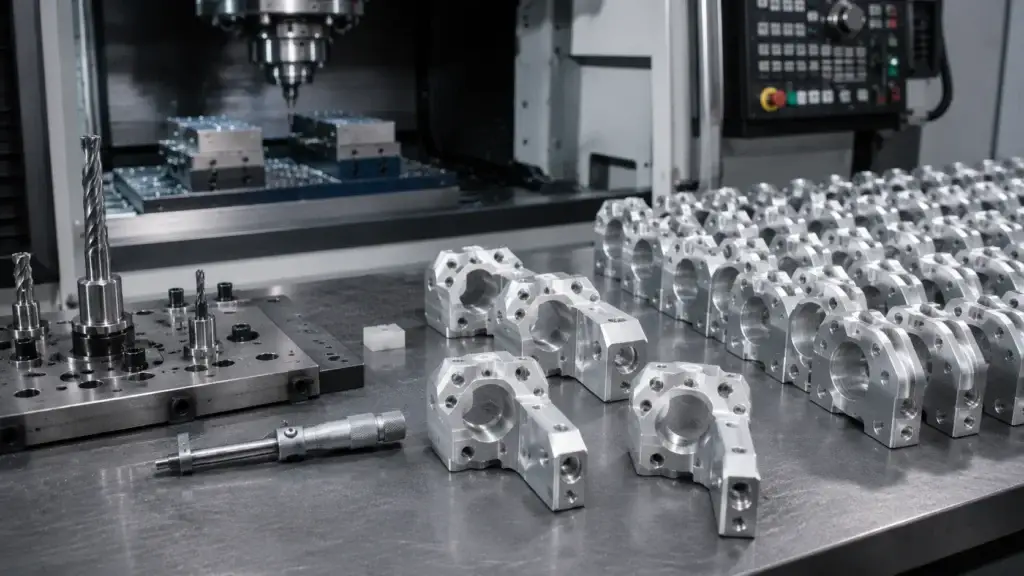
The basic relationship is:
Unit cost = Fixed batch cost ÷ Quantity + Variable cost per part
Fixed costs commonly include:
- DFM review
- CAM programming
- Process planning
- Fixture preparation
- Machine setup
- First-article confirmation
Variable costs commonly include:
- Raw material
- Machine cycle time
- Tool wear
- Part loading
- Deburring
- Surface finishing
- Inspection
- Packaging
This explains the shape of the quantity-cost curve. At low quantities, fixed costs represent a large part of each unit. As quantity increases, that portion falls. Once fixed costs are sufficiently spread out, material and recurring production work become the main cost drivers.
Doubling quantity therefore does not normally cut the unit price in half. The machine must still cut every part, and every part still requires material, handling and finishing.
How Quantity Changes CNC Milling Cost per Part?
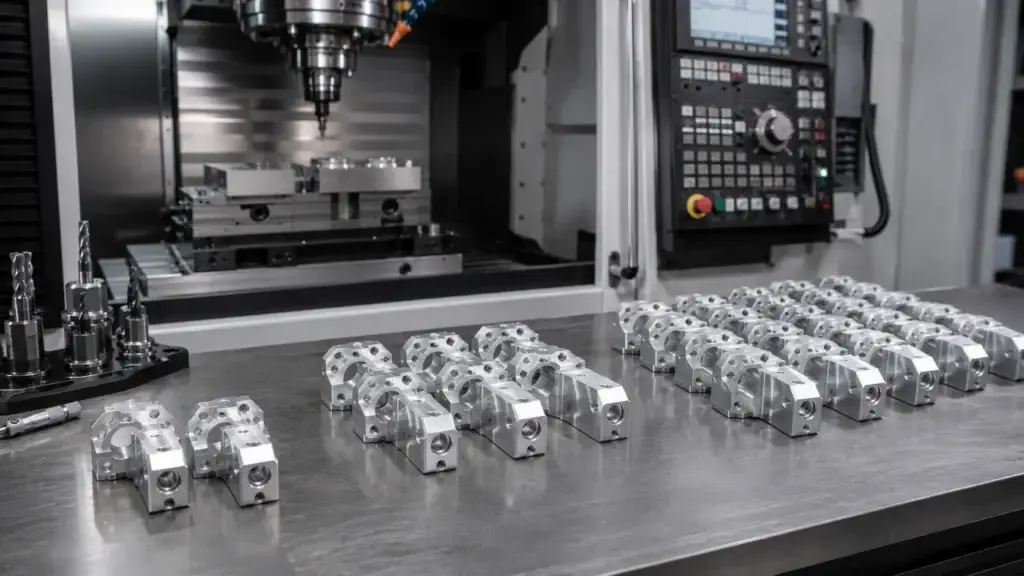
Higher quantity can reduce CNC milling cost per part in several ways:
- Programming and setup are spread across more pieces.
- Material may be purchased and cut more efficiently.
- Soft jaws or multi-part fixtures may reduce handling time.
- Toolpaths and inspection frequency can be stabilized.
- The supplier can plan tool life more effectively.
- Parts may be grouped for surface treatment or packaging.
However, the price reduction eventually slows. If every component requires significant cycle time, polishing or 100% inspection, those costs remain.
A better RFQ asks for several quantity tiers, such as:
- 10 pieces
- 25 pieces
- 50 pieces
- 100 pieces
This CNC batch pricing shows where meaningful savings occur and where the unit-cost curve begins to flatten.
It also prevents buyers from assuming that the largest quantity automatically provides the best total purchasing decision.
Why Ordering More Does Not Always Save Money?
A lower unit price does not always produce a lower total project cost. A larger order may create:
- Excess inventory
- Cash tied up in unused parts
- Storage and handling costs
- Obsolete parts after a design change
- Mixed revisions
- Corrosion or surface damage
- Uncertain demand
This matters during prototype and pilot stages.
A robotic housing may pass dimensional inspection but still require changes after cable routing, assembly or thermal testing. Ordering one hundred pieces before the design is stable can create more waste than the quantity discount saves.
A larger single order makes more sense when:
- The design is frozen.
- Demand is confirmed.
- The same revision will be used.
- Material and finish will not change.
- Inventory can be stored safely.
- The risk of obsolescence is low.
The correct purchasing target is the lowest total project cost, not simply the lowest machining price per part.
How Repeat Orders Affect CNC Milling Cost?
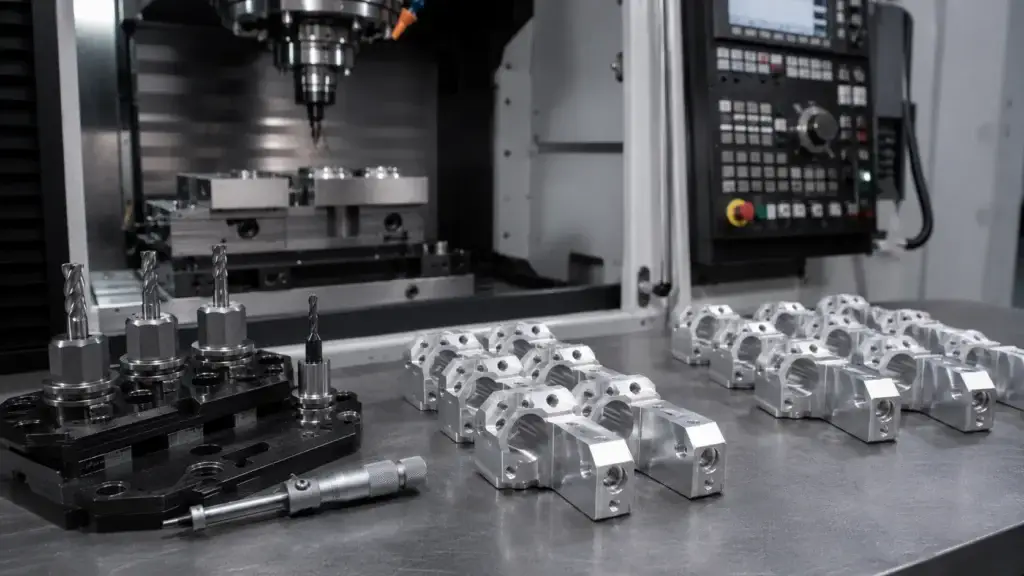
Repeat order CNC machining can be more efficient when the supplier retains a controlled manufacturing package.
Reusable information may include:
- Approved 3D model and 2D drawing
- CAM program
- Setup sheet
- Tool list
- Fixture or soft-jaw identification
- Workholding and datum strategy
- First-article report
- CMM or optical inspection program
- Surface-treatment specification
- Approved cosmetic sample
- Packaging instructions
When these records remain valid, the supplier does not need to rebuild the process from the beginning.
However, a repeat order is not setup-free. The supplier must still:
- Schedule the machine
- Install and align the fixture
- Load and verify tools
- Establish work coordinates
- Confirm offsets
- Machine and inspect the first piece
Fixtures may wear, tools may change, and a long gap between orders may require additional process verification.
The repeat-order price can also change because of:
- Material-price changes
- Finishing charges
- Different quantities
- Urgent lead times
- Revised inspection requirements
- Fixture damage or loss
- Drawing changes
Repeat orders are most predictable when the part number, revision, material, finish, quantity and quality scope remain unchanged.
When to Combine or Split Small-Batch Orders?
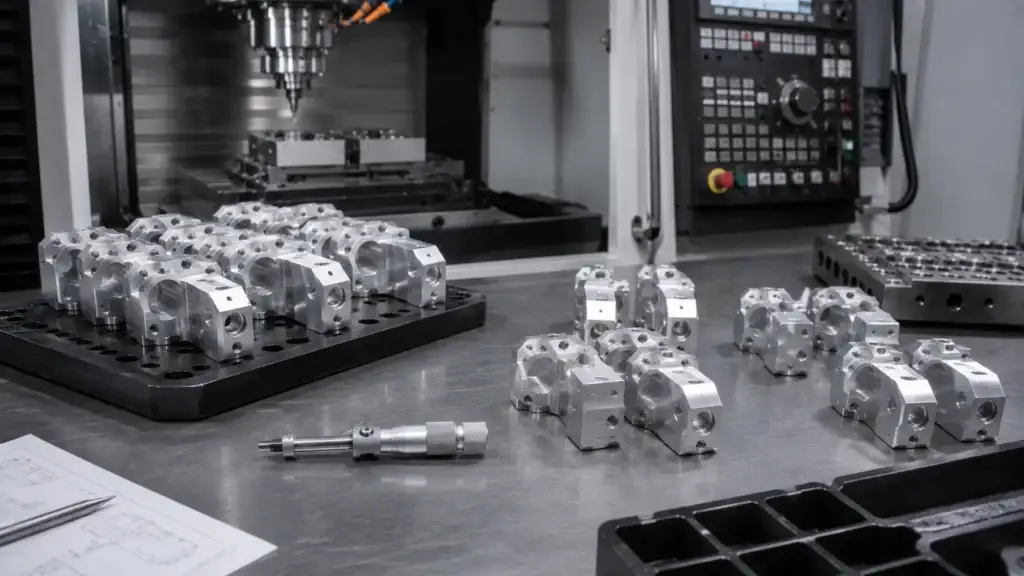
Combining demand into one order is generally more economical when:
- The design is approved.
- Demand is certain.
- The same revision will be used.
- Inventory can be stored safely.
- A later release would repeat the same setup.
- Cash-flow impact is acceptable.
Splitting the order may be safer when:
- Functional testing is incomplete.
- Customer approval is pending.
- Demand is uncertain.
- The part is expensive.
- Design changes are likely.
- The first batch is needed for assembly validation.
A practical compromise is a pilot batch followed by a planned repeat release.
The first batch validates the manufacturing and assembly process, while the buyer limits inventory risk. Providing expected annual demand and typical release quantities helps the supplier decide whether to retain fixtures or optimize the production method.
Other Factors That Change Low-Volume CNC Machining Cost
Material
Aluminum generally machines faster than stainless steel or titanium, but alloy, temper, stock size and certification also affect price.
A small order may require purchasing more stock than the finished parts consume. Uncommon material specifications may also increase procurement time and minimum purchase quantities.
Geometry
Deep pockets, thin walls, undercuts, small internal radii and multi-face features increase setup and cycle time.
Five-axis machining may have a higher hourly rate but reduce multiple setups on complex parts. The correct comparison is total manufacturing time, not machine rate alone.
Tolerances
Tight tolerances may require:
- Staged machining
- Tool compensation
- Reduced finishing feeds
- Temperature stabilization
- Additional inspection
- Re-machining after surface treatment
They should be applied only to functional features.
Surface Finishing
Anodizing, passivation, plating, bead blasting and polishing add handling, supplier coordination and minimum batch charges.
A small quantity may therefore carry a higher finishing cost per part even when the finishing process itself is unchanged.
Inspection
First-article reports, CMM reports, material certificates and 100% inspection add cost.
The inspection level should match the project risk and production stage rather than being applied equally to every feature.
Lead Time
Urgent production may require expedited material, overtime or priority scheduling. Forecasted repeat orders are easier to plan and usually provide more stable production conditions.
How to Reduce Small Batch CNC Milling Cost?
Request Quantity Tiers
Ask for multiple quantities in one RFQ. This reveals the cost curve without committing to excessive inventory.
Freeze Critical Design Details
Confirm material, revision, tolerances, finish and inspection requirements before production. Late changes can invalidate programming, fixtures and finished parts.
Use DFM Feedback
Allow the supplier to recommend larger radii, standard stock sizes, easier tool access and fewer setups where function is unaffected.
Limit Tight Tolerances
Use general tolerances for non-critical dimensions. Reserve precision requirements for locating, sealing, bearing and mating features.
Separate Cosmetic and Functional Surfaces
Do not apply fine machining, polishing or strict cosmetic standards to hidden areas that do not need them.
Standardize Materials and Hardware
Common materials, thread sizes and inserts are easier to purchase and process than unusual specifications.
Plan Repeat Orders
Share expected annual usage and release frequency. Confirm whether programs, fixtures and inspection records will be retained.
Control Revisions
Use the same approved revision across models, drawings, purchase orders and inspection documents. A new revision may require a new process review.
Three Small-Batch CNC Milling Examples
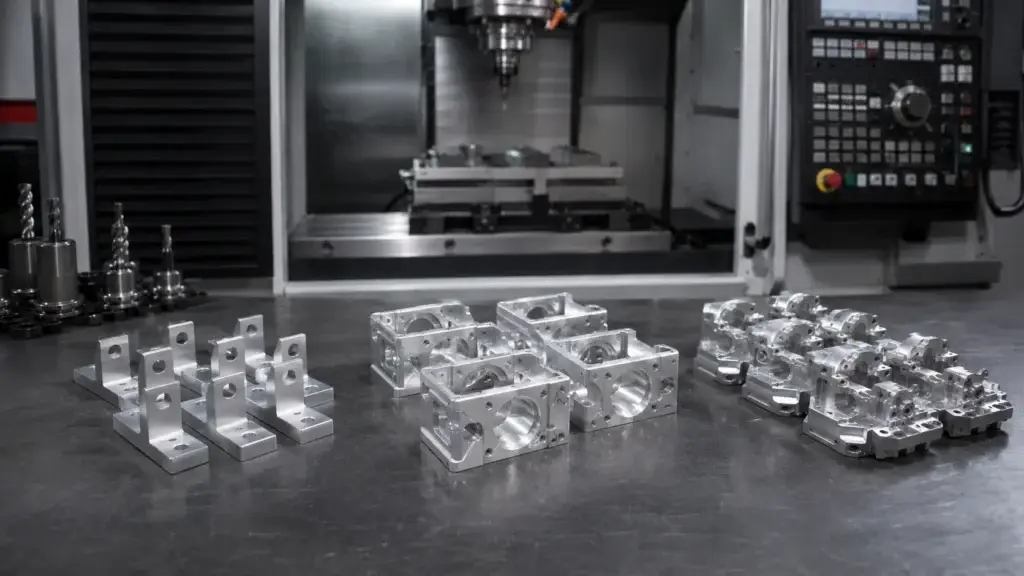
Semiconductor Fixture Plate
A fixture plate may require a large flat surface, reamed locating holes and documented position inspection. Setup and first-article measurement can represent a significant part of a small order.
After process approval, retaining the setup sheet and inspection program can make repeat releases more consistent, although each batch still requires setup and confirmation.
Robotic Housing
A robotic housing may include thin walls, deep pockets, threaded holes and anodized exterior surfaces.
During design verification, a limited pilot batch reduces the risk of obsolete inventory. Once assembly and thermal performance are confirmed, a larger repeat order may justify improved workholding and lower unit cost.
UAV Structural Bracket
A high-strength aluminum bracket may require tight hole position and anodizing.
The first batch includes process development and post-finish inspection. Later orders can reuse the validated program and inspection plan when the alloy, temper, finish and drawing revision remain unchanged.
Information Needed for an Accurate Quote
Provide:
- STEP or STP model
- 2D PDF drawing
- Part number and revision
- Exact material and temper
- Quantity tiers
- Expected annual usage
- Critical tolerances
- Surface finish and post-processing
- Inspection requirements
- Documentation requirements
- Required lead time
- Delivery destination
- Expected repeat-order schedule
A supplier can only compare production strategies when the technical scope remains consistent across all quantities.
How SinoRise Supports Small-Batch and Repeat Production?
SinoRise reviews small-batch projects from manufacturability through machining, finishing and inspection. The production route can be adjusted according to part complexity, quantity, tolerance and repeat-order potential.
SinoRise operates more than 40 precision machining machines and uses 2.5D measuring systems, digital height gauges and CMM equipment. Its ISO 9001 quality system supports projects in medical equipment, UAVs, semiconductor systems, robotics, optical instruments and automotive or motorcycle components.
For repeat projects, controlled drawings, process records and inspection requirements help maintain consistency between batches. Fixture-retention terms should be confirmed during quotation because they depend on project size, storage period and production planning.
Frequently Asked Questions
Why is small batch CNC milling expensive?
Programming, workholding, machine setup and first-article inspection are required before production. At low quantities, these costs are divided across only a few parts.
What is included in CNC setup cost?
It may include DFM review, CAM programming, fixture preparation, tool loading, coordinate setting, trial machining and first-article confirmation.
How does quantity affect CNC machining price?
Higher quantity spreads fixed costs across more parts and may improve material purchasing and production efficiency. Per-part machining and finishing costs remain.
At what quantity does CNC milling become cheaper?
There is no universal breakpoint. It depends on setup time, cycle time, material, geometry, tolerance, finish and inspection.
Should I order 10, 50 or 100 parts?
Compare quantity-tier pricing with design maturity, demand certainty, cash flow and inventory risk. The lowest unit price is not always the lowest total cost.
Are Repeat CNC Orders Cheaper?
They may be more efficient when the program, fixture and inspection method can be reused. Material, quantity and scheduling can still change the price.
Is Setup Charged Again for Repeat Orders?
Some engineering preparation may be reusable, but physical machine setup and first-piece verification are normally still required.
Can CNC Programs and Fixtures Be Reused?
Yes, when the design remains unchanged and the supplier retains them in usable condition. Retention terms should be agreed during quotation.
Why Did My Repeat-Order Price Change?
Possible reasons include material prices, finishing costs, quantity, urgent lead time, fixture condition or changes to the drawing and inspection scope.
How Can I Reduce Cost Without Ordering Too Much Inventory?
Request multiple quantity tiers, use a pilot batch, apply DFM recommendations, control revisions and plan repeat releases with the same supplier.
Request a Small-Batch CNC Milling Quote
Send SinoRise your 3D model, 2D drawing, material, quantity tiers, tolerances, finish, inspection requirements and expected repeat-order demand.
The engineering team will review setup requirements, process risks and batch strategy before providing a quote for prototype, pilot or small batch CNC machining.