
Abstract
Choosing the right material is one of the most important decisions in precision CNC machining. For tight-tolerance parts, material selection affects much more than strength or appearance. It also influences dimensional stability, machining deformation, tool wear, surface finish, inspection results, lead time, and total cost.
For procurement engineers, the right material must support stable quality, reasonable cost, repeatable production, and reliable delivery. For mechanical engineers, the material must meet functional requirements such as load, assembly fit, operating temperature, wear resistance, corrosion resistance, and long-term performance.
This guide explains how to evaluate CNC machining materials for tight-tolerance parts and how to reduce manufacturing risks before sending an RFQ.
Why Does Material Selection Matter for Tight-Tolerance Parts?
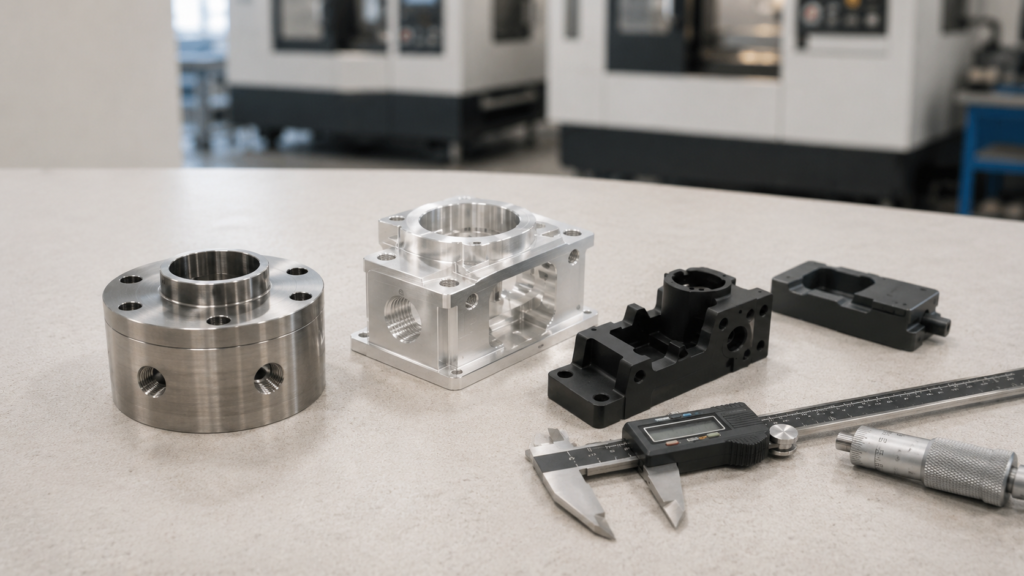
In tight-tolerance machining, material choice directly affects whether a part can meet its drawing requirements consistently. A material may look suitable based on strength data, but if it expands easily, creates burrs, wears tools quickly, or deforms after machining, the final part may fail inspection or assembly.
This is why CNC material selection should not be treated as a simple material list. It should be reviewed together with tolerance requirements, part geometry, surface finish, production volume, inspection method, and final application.
For Procurement Engineers: Cost, Lead Time, and Repeatability
Procurement engineers usually care about three practical questions:
Can the supplier machine the part consistently?
Can the price stay reasonable across batches?
Can the delivery schedule be controlled?
For tight-tolerance projects, the cheapest material does not always lead to the lowest total cost. A difficult-to-machine material may increase tool wear, cycle time, scrap rate, and inspection cost. A reliable precision machining service should help buyers compare not only raw material cost, but also processing risk and batch repeatability.
For Mechanical Engineers: Stability, Strength, and Function
Mechanical engineers focus more on part performance. The selected material must support the design load, tolerance stack-up, temperature range, surface contact, assembly requirement, and expected life cycle.
For example, aluminum may be suitable for lightweight housings and brackets. Stainless steel may be better for corrosion-resistant structural parts. Titanium may be required for high-strength or medical-related components. Engineering plastics may be useful when insulation, weight reduction, or chemical resistance is important.
Key Material Factors That Affect CNC Tolerance
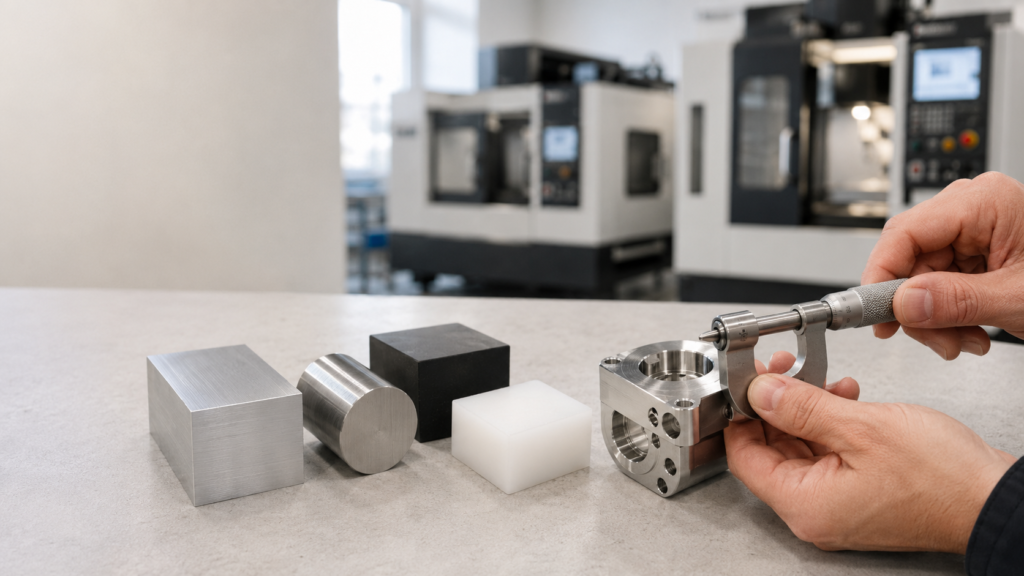
For high-precision CNC machining, material stability is often more important than strength alone. Before confirming a material, engineers and buyers should review the following factors.
Dimensional Stability and Thermal Expansion
Materials expand and contract when temperature changes. In tight-tolerance parts, even small dimensional changes can affect inspection results, assembly fit, and functional performance.
Aluminum is lightweight and easy to machine, but it has higher thermal expansion than many steels. This does not mean aluminum is unsuitable for tight-tolerance parts. It means engineers should consider part size, wall thickness, working temperature, measuring temperature, and final assembly conditions.
For larger parts, thin-wall parts, or parts with critical flatness and parallelism requirements, thermal stability should be reviewed before production.
Machinability and Tool Wear
Machinability affects dimensional consistency, surface quality, cycle time, and cost. A material with poor machinability may create unstable cutting forces, higher heat, faster tool wear, and more variation between parts.
Aluminum is generally easier to machine and suitable for fast production. Stainless steel offers strength and corrosion resistance, but it may work-harden during machining. Titanium provides excellent performance, but it requires careful heat control and rigid machining conditions. Copper is valuable for conductivity but may create burrs or tool loading. Engineering plastics may deform if clamping force, cutting heat, or tool geometry is not controlled.
Surface Finish and Burr Control
Tight tolerance is not only about dimensions. Surface finish and roughness can affect sealing, sliding, coating adhesion, optical alignment, and assembly fit.
For small holes, slots, threads, thin edges, and micro features, burr control should be discussed early. A material that machines cleanly can reduce deburring time, improve surface consistency, and lower inspection risk.
CNC Machining Materials Comparison Table
| Material | Best For | Tolerance Risk | Buyer / Engineer Tip |
| Aluminum 6061 | Housings, brackets, prototypes, UAV parts | Thermal expansion, thin-wall deformation | Good first choice for cost and speed |
| Aluminum 7075 | Lightweight structural parts | Internal stress, higher cost, finish variation | Better strength than 6061 for load-bearing parts |
| Stainless Steel 304 | General corrosion-resistant parts | Work hardening, slower machining | Good balance of strength and corrosion resistance |
| Stainless Steel 316 | Medical, marine, and chemical environments | Higher machining cost | Choose when corrosion resistance is critical |
| Titanium | Medical, aerospace, and high-load parts | Heat, tool wear, high cost | Use when performance justifies the cost |
| Brass | Bushings, connectors, fittings | Surface marking, softness | Good machinability and dimensional control |
| Copper | Conductive and thermal parts | Burrs, tool loading, softness | Use sharp tools and controlled cutting |
| PEEK / Engineering Plastics | Lightweight, insulation, medical-related parts | Deformation, heat sensitivity, moisture sensitivity | Review tolerances and inspection method carefully |
Aluminum Alloys for Lightweight Precision Parts
Aluminum is widely used for aluminum CNC machining parts because it is lightweight, cost-effective, and efficient to machine. It is often suitable for drone components, optical brackets, robotic housings, fixtures, and electronic enclosures.
For tight-tolerance aluminum parts, engineers should pay attention to thin walls, deep pockets, large flat surfaces, and temperature-related measurement differences. 6061 aluminum is often used for general-purpose precision parts, while 7075 aluminum is better when higher strength is required.
Stainless Steel for Strength and Corrosion Resistance
Stainless steel CNC parts are often selected when strength, wear resistance, and corrosion resistance matter more than weight or machining speed. 304 stainless steel is a common general-purpose option, while 316 stainless steel is preferred for harsher environments, medical-related parts, or components exposed to moisture and chemicals.
For tight tolerances, stainless steel requires stable cutting parameters, proper tool selection, and careful control of heat and work hardening.
Titanium, Brass, Copper, and Engineering Plastics
Titanium is suitable for demanding precision machining materials applications, especially when strength-to-weight ratio, fatigue resistance, and corrosion resistance are important. However, titanium is more difficult to machine and usually increases cost.
Brass is easier to machine and can hold stable dimensions in many turned parts. Copper is useful for electrical and thermal applications, but burrs and surface quality must be controlled carefully. Engineering plastics can reduce weight and provide insulation, but they require careful handling to avoid deformation during machining and inspection.
How to Match Materials with Industry Requirements?
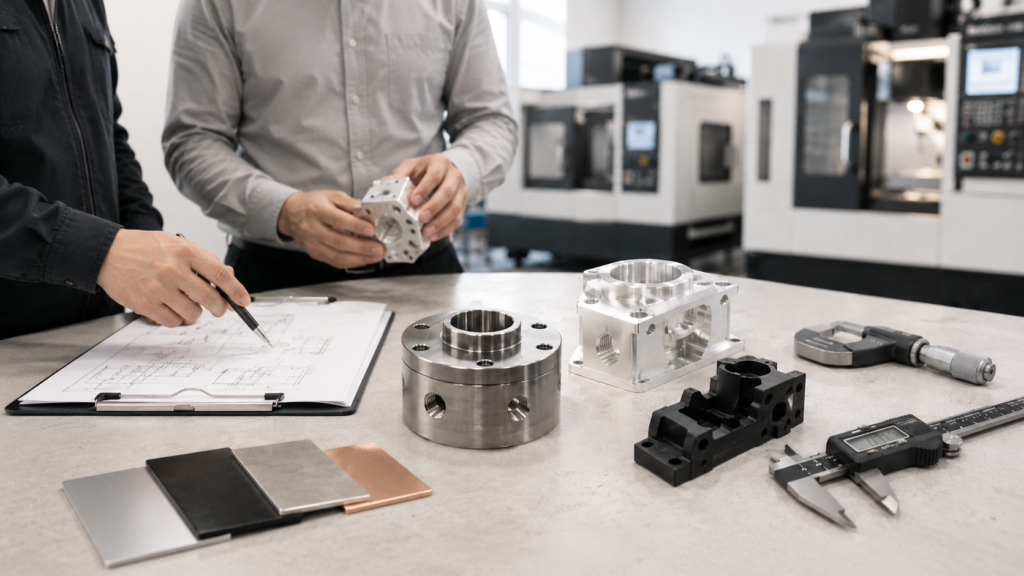
Different industries have different priorities for tight-tolerance parts. The best material should match the working environment, mechanical load, surface requirement, and inspection standard.
| Industry | Common Material Choices | Key Requirement |
| Medical devices | Titanium, stainless steel, PEEK | Precision, corrosion resistance, material reliability |
| Semiconductor equipment | Aluminum, stainless steel, copper | Stability, cleanliness, surface quality |
| Robotics | Aluminum, stainless steel, alloy steel | Weight, stiffness, wear resistance |
| Optical instruments | Aluminum, stainless steel, brass | Dimensional stability, low burrs, fine surface finish |
| UAV and drones | Aluminum 6061, aluminum 7075, titanium | Lightweight structure and strength |
| Automotive and motorcycle parts | Aluminum, stainless steel, alloy steel | Strength, vibration resistance, cost control |
Medical, Semiconductor, Robotics, Optical, and UAV Parts
Medical parts often require stainless steel, titanium, or high-performance plastics. These parts may have strict requirements for surface quality, dimensional consistency, and material reliability.
Semiconductor equipment parts may require aluminum, stainless steel, copper, or specially treated surfaces. These components often need stable dimensions, clean surfaces, and repeatable batch quality.
Robotics components often use aluminum for lightweight moving parts and steel or titanium for higher-load structures. Optical instrument parts require low burrs, stable dimensions, and controlled surface finish. UAV and drone parts often prioritize lightweight aluminum, while titanium may be used for compact high-strength components.
Automotive and Motorcycle Tight-Tolerance Components
For automotive and motorcycle parts, material choice depends on strength, vibration, heat, wear, and surface treatment. Aluminum is common for lightweight brackets, housings, and prototypes. Stainless steel is used for corrosion-resistant parts. Alloy steel may be selected for shafts, gears, and load-bearing components.
For these parts, engineers should review both machining tolerance and working conditions, including vibration, temperature, and fatigue.
Material Selection Checklist Before Sending RFQs
Before requesting a quote, procurement and engineering teams should prepare the following information:
| RFQ Item | Why It Matters |
| Material grade and acceptable alternatives | Helps suppliers evaluate cost, availability, and machining risk |
| Critical dimensions and GD&T | Identifies where tight tolerance truly matters |
| Operating temperature | Helps evaluate thermal expansion and dimensional stability |
| Surface finish requirement | Affects machining process and secondary finishing |
| Batch quantity | Influences process planning, fixture design, and cost |
| Inspection standard | Determines CMM, height gauge, visual, or functional inspection needs |
| Surface treatment | May affect final dimensions, appearance, and tolerance |
| Function of the part | Helps suppliers suggest better material or process options |
| Assembly relationship | Helps confirm fit, clearance, and tolerance stack-up |
How Sino-V-Rise Supports Tight-Tolerance CNC Material Selection?
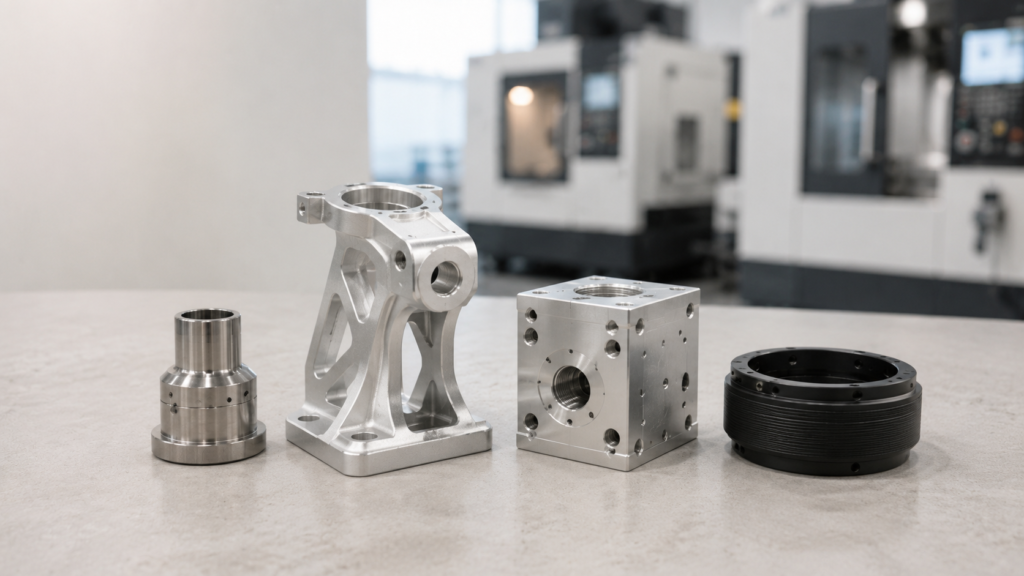
Sino-V-Rise provides precision CNC machining services for custom metal and plastic parts, including aluminum alloys, stainless steel, titanium alloys, alloy steel, carbon steel, copper, brass, and engineering plastics.
The company supports CNC milling, CNC turning, turning-milling, wire cutting, 5-axis machining, surface finishing, and inspection for prototype, small-batch, and medium-batch production. These capabilities are especially useful for tight-tolerance parts with complex geometry, thin walls, multi-surface features, or high-value materials.
For buyers comparing different CNC machining materials, Sino-V-Rise can help review drawings, evaluate material options, check tolerance feasibility, recommend suitable surface finishes, and reduce machining risks before production.
This support is valuable for industries such as medical devices, UAVs, semiconductor equipment, robotics, optical instruments, automotive parts, and motorcycle components, where precision, consistency, and delivery reliability are critical.
FAQ: CNC Materials for Tight-Tolerance Parts
What is the best material for tight-tolerance CNC machining?
There is no single best material for all tight-tolerance parts. Aluminum is good for lightweight and cost-effective parts. Stainless steel is good for strength and corrosion resistance. Titanium is better for high-performance applications. Brass, copper, and engineering plastics can also be suitable depending on the function.
What material is easiest to CNC machine?
Aluminum and brass are generally easier to machine than stainless steel or titanium. Better machinability usually means faster production, smoother surface finish, lower tool wear, and lower cost.
Why does thermal expansion matter in precision CNC machining?
Thermal expansion can change part dimensions during machining, inspection, or final use. For tight-tolerance parts, even small dimensional changes may affect assembly fit, measurement results, or functional performance.
Should I choose 6061 or 7075 aluminum for tight-tolerance parts?
Choose 6061 aluminum for general-purpose parts, good machinability, and cost control. Choose 7075 aluminum when higher strength is required, especially for lightweight structural or load-bearing parts.
Is stainless steel better than aluminum for tight tolerance?
Not always. Stainless steel is stronger and more corrosion-resistant, but aluminum is easier and faster to machine. The better choice depends on function, tolerance, weight, surface finish, corrosion resistance, and cost.
Is titanium suitable for tight-tolerance CNC parts?
Yes. Titanium is suitable for high-strength, corrosion-resistant, and high-reliability precision parts. However, it is harder to machine and more expensive than aluminum or stainless steel, so it should be selected when performance requirements justify the cost.
How can I reduce material-related CNC machining risk?
Share complete drawings, identify critical tolerances, provide application details, confirm surface finish requirements, and allow the supplier to suggest material or design improvements before production.
Conclusion
Choosing CNC machining materials for tight-tolerance parts requires more than comparing material strength or price. Engineers and buyers should evaluate dimensional stability, machinability, tool wear, thermal expansion, surface finish, inspection method, and batch repeatability.
For most projects, the best material is the one that meets the drawing requirements consistently with the lowest total risk. By working with an experienced precision CNC machining supplier such as Sino-V-Rise, procurement teams and mechanical engineers can reduce trial-and-error, improve production stability, and achieve reliable tight-tolerance components from prototype to small and medium-batch production.