
Abstract
For buyers and engineers, the question is rarely “Which process is better?” The real question is: Which process fits my part geometry, tolerance, material, and cost target? In most cases, CNC milling machining is the right choice for prismatic, multi-face, and complex parts, while CNC turning is the better option for round, concentric, and shaft-like components. If a part includes both rotational and milled features, a combined CNC milling and turning approach is often the most efficient route. Industry machining references describe the core difference this way: milling rotates the cutting tool around the workpiece, while turning rotates the workpiece against the cutting tool.
Quick Answer
Use CNC turning for cylindrical, concentric parts made from bar stock. Use CNC milling machining for blocks, plates, pockets, slots, and multi-face geometries. Use turn-mill when one part needs both.
Table of Contents
- What is CNC Milling Machining?
- What is CNC Turning?
- CNC Milling vs CNC Turning: Key Differences
- How to Choose the Right Process for Your Part
- Typical Part Examples by Industry
- When CNC Milling and Turning Works Best
What is CNC Milling Machining?
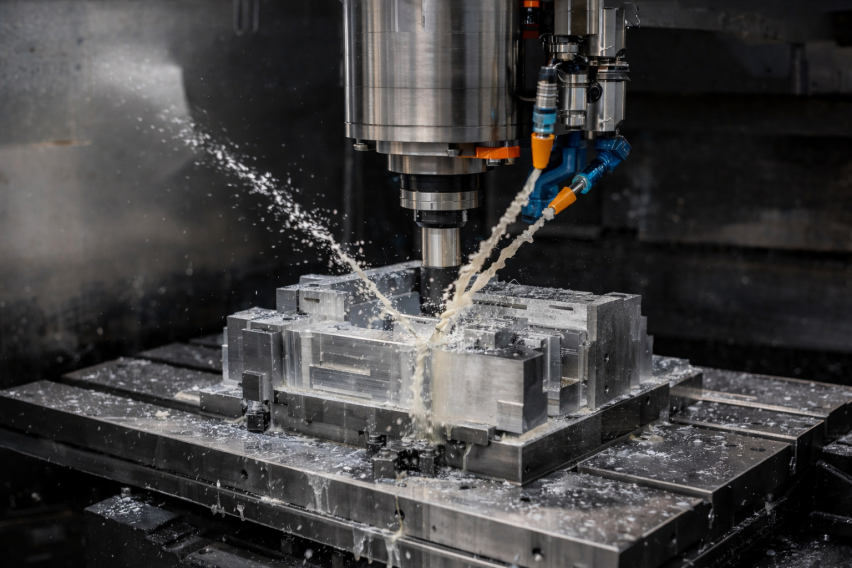
CNC milling machining removes material with a rotating cutting tool while the workpiece remains fixed or moves across programmed axes. This process is widely used for parts that need flat surfaces, pockets, slots, contours, off-center holes, and complex 3D features. Because milling can access multiple faces and generate intricate forms, it is often the preferred method for parts that are not rotationally symmetric.
Where the CNC milling process performs best?
The CNC milling process is ideal when a part starts from plate, billet, or block stock and includes:
- multiple machined faces,
- irregular outer profiles,
- internal cavities,
- threaded holes,
- or complex datums and surface relationships.
This makes precision CNC milling especially suitable for brackets, housings, optical mounts, robot frames, semiconductor blocks, and custom fixture components. Sino Rise also presents CNC milling as a strong fit for complex, custom, and precision parts across multiple industries.
What is CNC Turning?
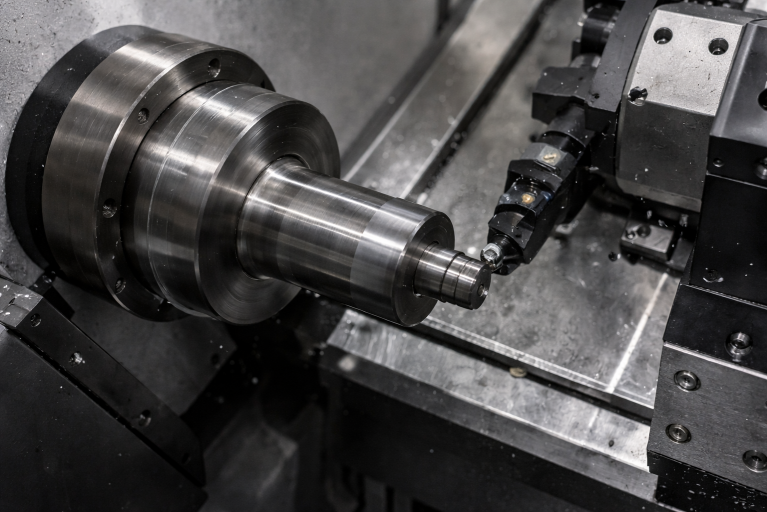
CNC turning removes material by spinning the workpiece while a cutting tool moves along its axis or profile. This is the most natural process for making round parts because the machine motion already matches the part’s rotational geometry. In practical terms, if the part is mostly cylindrical, shaft-like, or concentric, turning is usually the better starting point.
Where the CNC turning process performs best?
The CNC turning process is typically chosen for:
- outside diameters and inside bores,
- tapers, grooves, and shoulders,
- threaded round parts,
- and parts produced from bar stock.
That is why precision CNC turning and CNC turning services are commonly used for shafts, pins, collars, spacers, bushings, sleeves, nozzles, and connectors. On purely round parts, turning is often simpler and more economical than machining the same shape from a square block on a mill.
CNC Milling vs CNC Turning: Key Differences
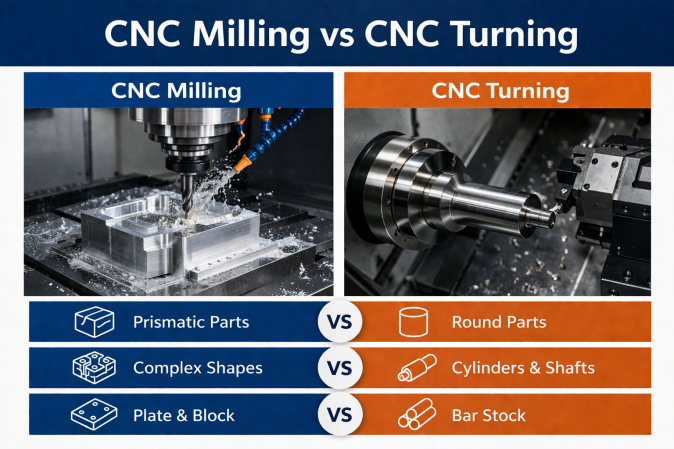
The easiest way to compare the two processes is to focus on machine motion, ideal geometry, and cost logic.
| Factor | CNC Milling Machining | CNC Turning |
| Main motion | Rotating tool cuts the workpiece | Rotating workpiece meets the tool |
| Best geometry | Prismatic, multi-face, contoured | Cylindrical, concentric, axisymmetric |
| Typical features | Pockets, slots, faces, off-axis holes | ODs, IDs, tapers, grooves, threads |
| Common parts | Housings, brackets, manifolds | Shafts, pins, bushings, sleeves |
| Common stock form | Plate, block, billet | Round bar, tube, blank |
| Cost advantage | Better for non-round complexity | Better for repeated round parts |
| Hybrid option | 4-axis / 5-axis / mill-turn | Live tooling / Y-axis / turn-mill |
This comparison aligns with guidance from major machining resources: milling is stronger for irregular and multi-face geometry, while turning is stronger for round parts and concentric surfaces.
How to Choose the Right Process for Your Part?
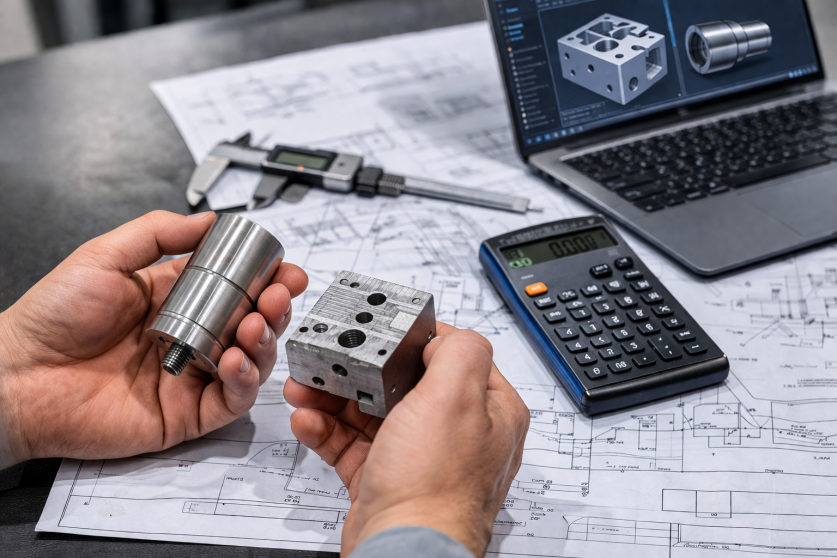
For procurement teams and engineers, the simplest rule is: start with geometry, then validate with tolerance, finish, and volume.
A quick decision path
Use CNC turning when your part is:
- primarily round,
- built around a center axis,
- made from bar stock,
- or dominated by diameters, threads, and bores.
Use CNC milling machining when your part is:
- prismatic or plate-like,
- full of pockets, slots, or side holes,
- dependent on multiple face relationships,
- or shaped by complex contours.
Use CNC milling and turning when your part has:
- turned diameters plus flats,
- cross-holes,
- milled slots,
- side features,
- or multiple operations that could be completed in one machine cycle.
Modern mill-turn platforms with live tooling and Y-axis capability blur the old line between mills and lathes, which is why hybrid process selection matters more today than a simple “mill or lathe” decision.
Cost and manufacturability checkpoints
Before placing an order, ask:
- Is the part mostly round or mostly prismatic?
- Will it start from bar stock or block stock?
- Are concentricity and runout more critical than face-to-face relationships?
- Can one setup reduce secondary operations?
- Is this a prototype, low-volume batch, or stable production part?
For example, a shaft with threads and grooves is an obvious turning job. A manifold with ports on several faces is an obvious milling job. A connector body with turned diameters plus wrench flats may be best produced through CNC turning and milling in one setup.
Typical Part Examples by Industry
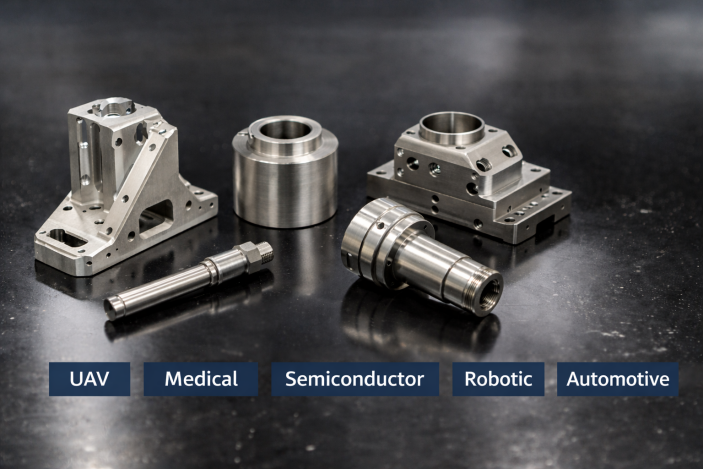
This selection logic becomes even more useful when mapped to end-use sectors. Sino Rise’s published industries include low-altitude aircraft, medical, semiconductor, robotics, optical instruments, and auto & moto parts.
Application examples
- UAV / low-altitude aircraft components: structural brackets, frames, and housings often suit CNC milling machining; motor shafts, collars, and sleeves often suit CNC turning. Keywords such as uav parts machining and drone CNC machining fit naturally here.
- Medical industry components: instrument bodies and housing parts often lean toward milling, while pins, sleeves, and small cylindrical fittings fit medical CNC turning.
- Semiconductor parts: chambers, vacuum blocks, and plates often need semiconductor CNC machining through milling; precision spacers, nozzles, and bushings often favor turning.
- Robotic components: brackets, mounts, and end-effector structures are commonly milled, while shafts, rollers, and coupling parts are often turned.
- Auto & moto parts: housings and irregular brackets are usually milled; spacers, collars, pins, and threaded round parts are commonly turned.
When CNC Milling and Turning Works Best?
Not every part fits neatly into one category. In many real projects, the most economical solution is a hybrid one. A round part may still need milled flats, face slots, cross-holes, or side drilling. A turned fitting may need a hex form or wrench surface. In these cases, CNC milling and turning in one setup can reduce transfer errors, improve repeatability, and shorten total lead time. Sino Rise specifically promotes turning-milling capability for integrated turning, drilling, milling, and tapping operations.
Conclusion
If your part is square, pocketed, multi-face, or contour-heavy, start with CNC milling machining. If it is cylindrical, concentric, and bar-stock friendly, start with CNC turning. If it combines both types of features, ask for a CNC milling and turning solution. That is the most practical way to reduce cost, improve manufacturability, and choose the right process from the start.