
Material selection affects far more than the performance of a finished CNC part. It also influences cutting speed, tool wear, dimensional stability, surface finishing, inspection requirements and total manufacturing cost.
Aluminum is often the practical starting point because it combines low weight, good machinability and moderate cost. Stainless steel is selected when corrosion resistance and durability are more important than machining speed. Titanium is justified when high strength-to-weight performance, corrosion resistance or biocompatibility is essential. Brass offers excellent machinability and clean surface quality, while engineering plastics can provide low friction, electrical insulation, chemical resistance and significant weight reduction.
This guide compares the most common CNC milling materials, including their grades, machining behavior, finishing options and best-use cases.
CNC Milling Materials Comparison
| Material | Machinability | Weight | Corrosion resistance | Relative total cost | Typical applications |
| Aluminum | Excellent | Low | Good | Low to medium | Housings, brackets, UAV and robotic parts |
| Stainless steel | Moderate to difficult | High | Very good to excellent | Medium to high | Medical, food, marine and industrial parts |
| Titanium | Difficult | Low for its strength | Excellent | High | Aerospace, medical and high-performance parts |
| Brass | Excellent | High | Good | Medium | Valves, connectors, fittings and instruments |
| Engineering plastics | Grade-dependent | Very low | Excellent against many chemicals | Low to high | Gears, insulators, guides, seals and medical parts |
There is no single best material for every project. The correct choice depends on the part’s mechanical load, operating environment, tolerance, surface requirements and production volume.
How to Choose a CNC Milling Material?
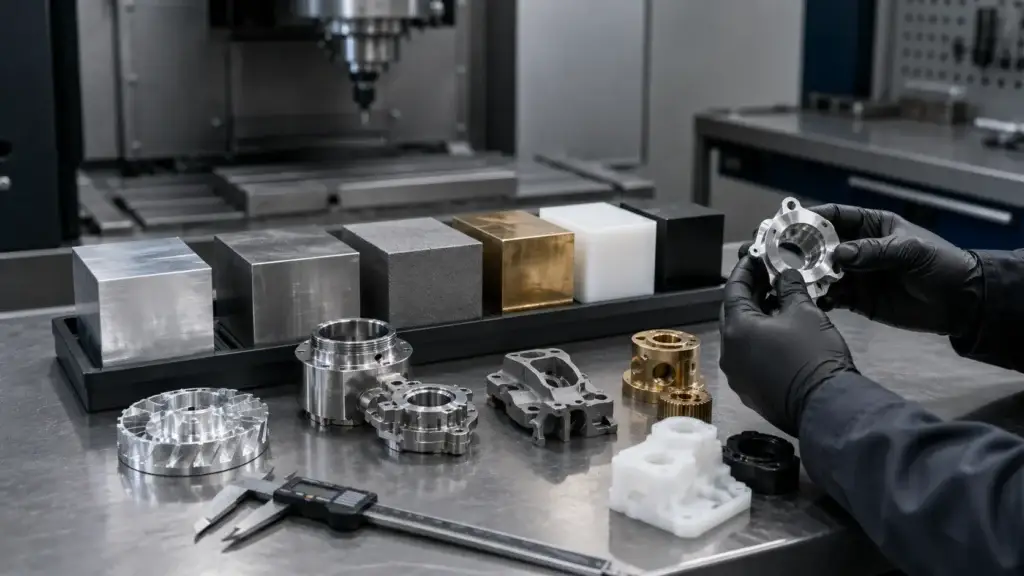
Before comparing individual grades, define the part’s actual operating requirements.
Mechanical performance
Consider whether the component must withstand:
- Static or impact loads
- Fatigue
- Wear
- Vibration
- Repeated assembly
- Thread pull-out
- Pressure or sealing forces
A protective cover may not need the same material as a load-bearing bracket. Selecting a stronger alloy than required can increase cost without improving product performance.
Weight
Weight matters in UAVs, robotics, portable devices and moving assemblies.
Aluminum provides an effective balance of weight, strength and cost. Titanium offers greater strength for its weight, but it is more expensive to purchase and machine. Engineering plastics may be suitable where loads and temperatures are moderate.
Operating environment
The material must be compatible with:
- Water and humidity
- Salt and chlorides
- Chemicals and cleaning fluids
- Fuels and oils
- Sterilization
- Outdoor exposure
- High or low temperatures
For example, 316L stainless steel may be preferred over 304 in chloride-rich environments, while PEEK may be selected when electrical insulation and chemical resistance are required.
Dimensional stability
Material behavior becomes critical when the part contains:
- Thin walls
- Large pockets
- Precision bores
- Flat sealing surfaces
- Long unsupported features
- Tight positional tolerances
Metals may release internal stress after heavy material removal. Plastics can respond to moisture, heat and clamping pressure. The selected material and machining sequence must therefore be evaluated together.
Surface finishing
The required appearance or function may influence material choice.
Common examples include:
- Anodized aluminum
- Passivated stainless steel
- Polished brass
- Electropolished medical parts
- Bead-blasted cosmetic surfaces
- Polished transparent plastics
- Low-friction machined plastic surfaces
Total manufacturing cost
Raw-material price is only one part of the finished-part cost.
A more complete comparison includes:
Material + machine time + tooling + inspection + finishing + scrap risk
Easy-to-machine aluminum or brass may produce a lower total cost than stainless steel or titanium, even when the raw-stock price difference is relatively small.
Aluminum for CNC Milling
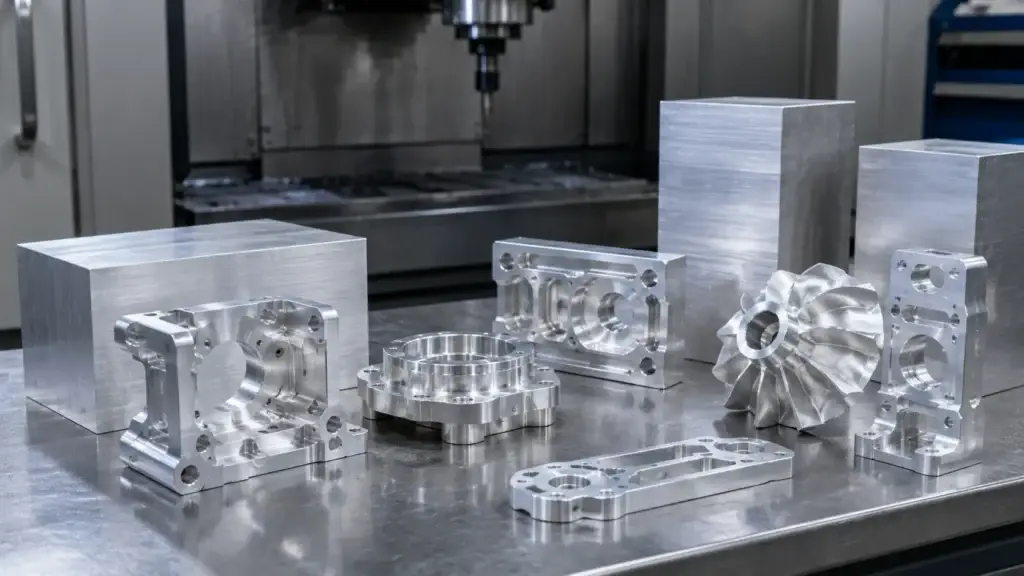
Aluminum is one of the most widely used CNC machining materials because it cuts efficiently, supports complex geometry and offers a strong strength-to-weight ratio.
It is commonly selected for:
- Electronic housings
- UAV structures
- Robotic components
- Optical mounts
- Semiconductor fixtures
- Automotive brackets
- Prototypes and small batches
Aluminum 6061-T6
6061-T6 is the standard starting point for many aluminum CNC machining parts.
Its advantages include:
- Good machinability
- Moderate strength
- Good corrosion resistance
- Wide availability
- Good anodizing response
- More practical welding than many high-strength grades
It is suitable for housings, mounting plates, frames, brackets and general mechanical parts.
6061 is often the most economical choice when the design does not require the higher strength of 7075.
Aluminum 7075-T6
7075-T6 offers significantly greater strength than 6061 and is commonly used in aerospace, UAV, robotics and high-load structures.
Choose 7075 when:
- Low weight is critical
- Structural strength is a priority
- The part carries concentrated loads
- 6061 cannot meet the mechanical requirement
However, 7075 generally costs more, offers lower corrosion resistance without protection and is less suitable for welding.
It should be selected because its strength is required, not simply because it is described as an aerospace-grade alloy.
Aluminum 2024
2024 aluminum offers high strength and good fatigue resistance. It is used in aerospace structures and load-bearing mechanical components.
Its corrosion resistance is lower than that of 6061, so protective finishing is often necessary.
Aluminum 5083
5083 provides strong corrosion resistance, especially in marine environments, and is frequently supplied in plate form.
It may be suitable for marine equipment, structural plates, enclosures and welded components.
Machining considerations for aluminum
Although aluminum is highly machinable, it can still create production challenges:
- Thin frames may distort after internal material removal
- Soft grades can form built-up edge on tools
- Poor chip evacuation can damage cosmetic surfaces
- Residual stress can affect flatness
- Anodizing can influence fits and threaded features
For precision components, material removal should be balanced where possible, and critical surfaces may require a separate finishing operation.
Stainless Steel for CNC Milling
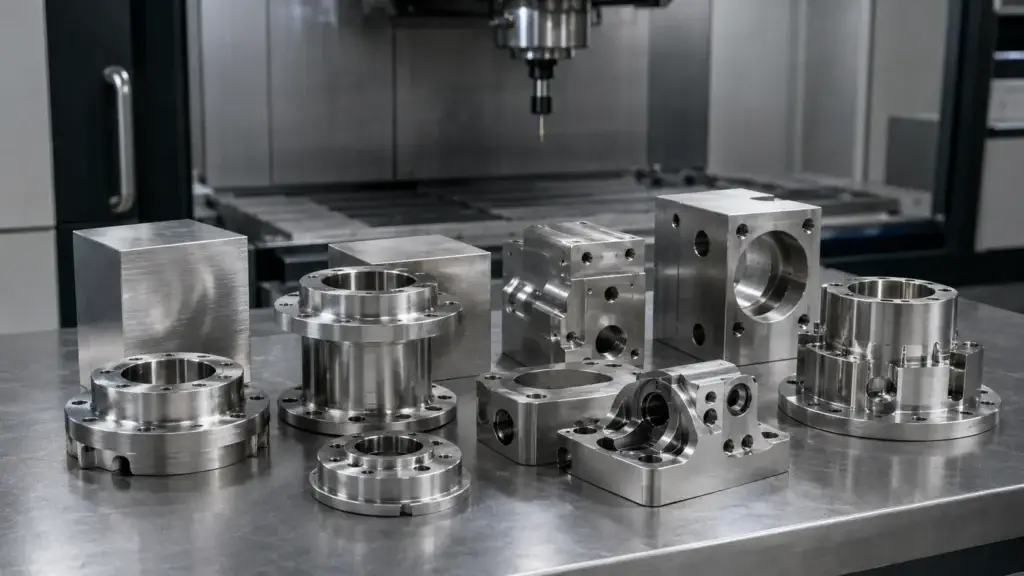
Stainless steel CNC machining is used when corrosion resistance, strength, temperature performance or hygiene requirements are more important than maximum machining speed.
Typical applications include:
- Medical equipment
- Food-processing machinery
- Marine components
- Semiconductor equipment
- Optical instruments
- Industrial valves
- Automotive systems
Stainless steel usually requires lower cutting speeds and more rigid setups than aluminum. Some grades also work-harden if the cutter rubs instead of cutting effectively.
Stainless Steel 303
303 contains additives that improve machinability compared with many other austenitic stainless steels.
It is suitable for:
- Shafts
- Fittings
- Fasteners
- Instrument parts
- Repeated precision components
Its corrosion resistance and welding performance are generally lower than those of 304 and 316.
Choose 303 when machining efficiency is important and the operating environment does not require maximum corrosion resistance.
Stainless Steel 304
304 is a general-purpose stainless steel with good corrosion resistance and broad industrial use.
Typical applications include:
- Food-processing parts
- Equipment housings
- Brackets
- Laboratory components
- General industrial parts
304 is more difficult to machine than 303 because it tends to work-harden and generate long, stringy chips. Suitable tools, stable cutting engagement and effective coolant application are important.
Stainless Steel 316L
316L provides stronger resistance to chlorides and many chemical environments.
It is commonly selected for:
- Marine equipment
- Medical components
- Pharmaceutical machinery
- Chemical-processing systems
- High-corrosion environments
316 stainless steel machining requires careful control of cutting heat and tool wear.
For a general indoor component, 304 may already be sufficient. The additional cost of 316L should be justified by the operating environment.
Stainless Steel 17-4PH
17-4PH is a precipitation-hardening stainless steel used where higher strength and hardness are required.
Applications include:
- High-load industrial components
- Valve parts
- Shafts
- Aerospace parts
- Precision mechanical assemblies
Its machinability depends on heat-treatment condition. The drawing and RFQ should clearly state the required material condition.
Key machining considerations
When producing CNC-machined stainless steel parts, process planning should address:
- Work hardening
- Cutting heat
- Tool wear
- Burr formation
- Fixture rigidity
- Passivation or electropolishing
- Material certification
The correct grade is the one that meets the environmental and mechanical requirements without introducing unnecessary machining difficulty.
Titanium for CNC Milling
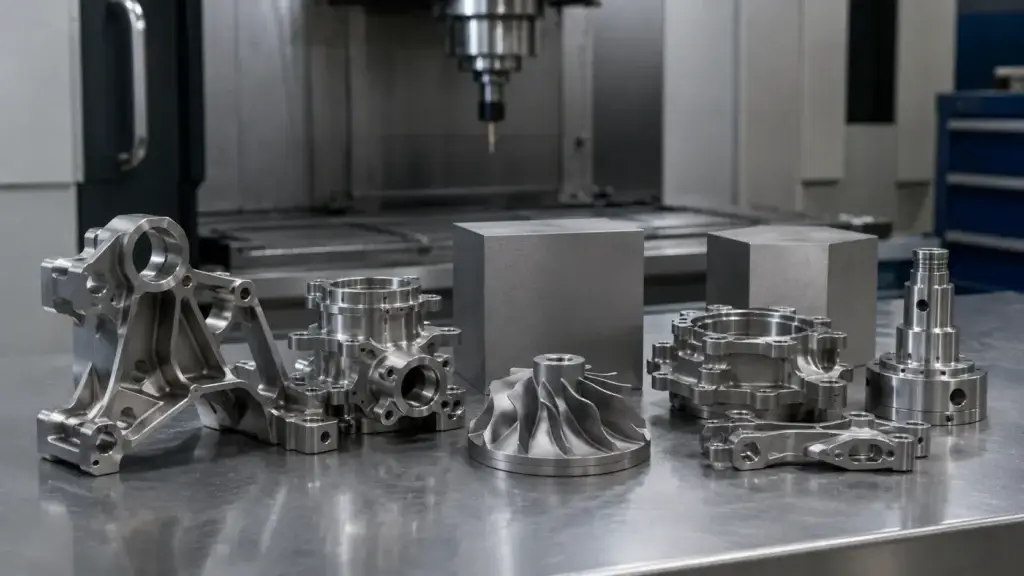
Titanium combines low density, high strength, excellent corrosion resistance and, in selected grades, good biocompatibility.
Common applications include:
- Aerospace structures
- UAV components
- Medical devices
- High-performance automotive parts
- Marine equipment
- Chemical-processing parts
However, titanium machining is more demanding than machining aluminum, brass or most stainless steels.
Titanium transfers heat poorly, so much of the cutting heat remains near the tool edge. This increases tool wear and requires controlled cutting parameters.
Titanium Grade 2
Grade 2 is commercially pure titanium. It offers excellent corrosion resistance and good formability but lower strength than Grade 5.
It may be selected for:
- Chemical-processing components
- Medical equipment
- Marine parts
- Corrosion-resistant fittings
Grade 2 is chosen primarily for corrosion performance and material compatibility.
Titanium Grade 5
Grade 5, or Ti-6Al-4V, is the most common high-strength titanium alloy used in precision manufacturing.
It is suitable for:
- Aerospace structures
- UAV components
- High-load medical parts
- Robotic systems
- Performance automotive components
Titanium CNC machining requires rigid workholding, sharp cutting tools, controlled engagement and effective coolant delivery.
When titanium is justified?
Titanium is appropriate when the component requires:
- High strength at low weight
- Excellent corrosion resistance
- Biocompatibility
- Long-term durability
- Performance in severe environments
Before specifying titanium, evaluate whether 7075 aluminum or stainless steel can meet the same requirement at a lower total cost.
Brass for CNC Milling
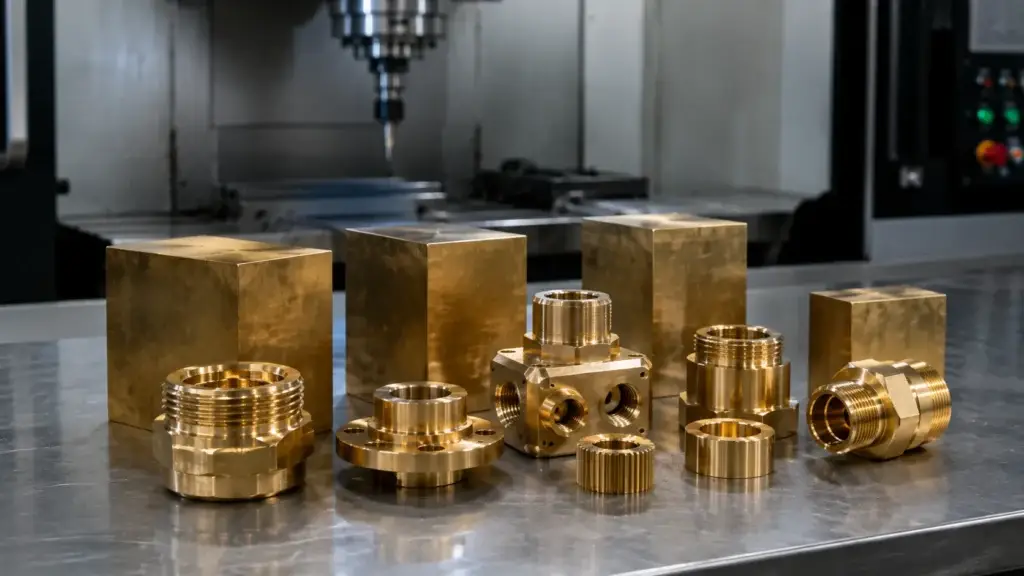
Brass CNC machining is well suited to precision parts requiring efficient cutting, clean edges, conductivity and a high-quality machined surface.
Typical applications include:
- Electrical connectors
- Valves
- Fittings
- Instrument components
- Hydraulic parts
- Decorative hardware
- Precision fasteners
C360 brass
C360 is a widely used free-machining brass grade.
Its advantages include:
- Good chip control
- High machining efficiency
- Smooth surface quality
- Stable dimensions
- Reduced tool wear
It is commonly used for connectors, threaded components, fittings and precision hardware.
Material regulations should be reviewed because the lead content in certain brass grades may limit their use in drinking-water, medical or environmentally regulated applications.
Cost and finishing
Brass stock may cost more than general aluminum, but its machining efficiency can reduce cycle time and tooling cost.
Common finishing options include:
- Polishing
- Plating
- Brushing
- Bead blasting
- Clear coating
- Machined finish
Unprotected brass may darken over time, so appearance requirements should be defined before production.
Engineering Plastics for CNC Milling
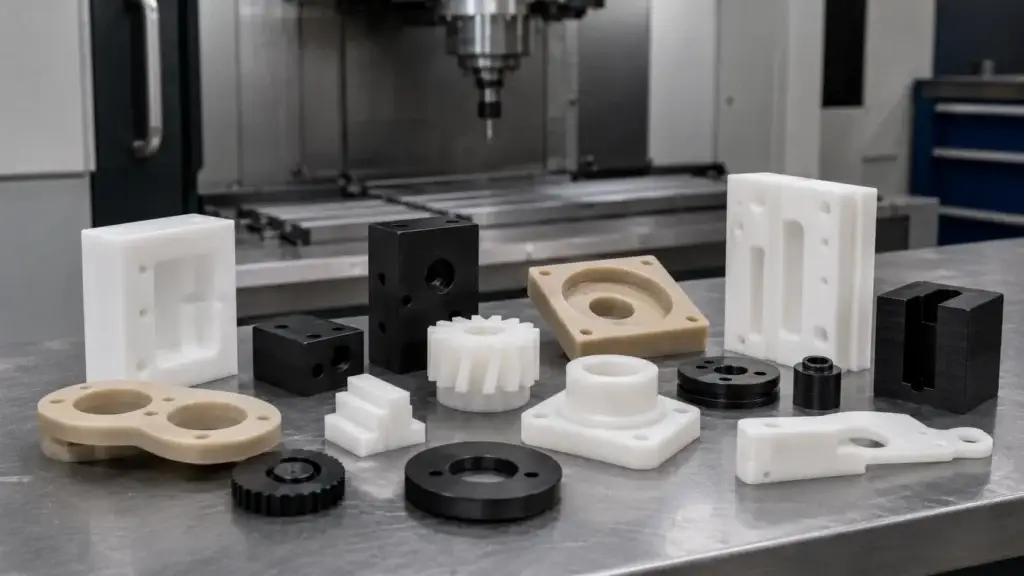
Engineering plastics are not simply low-cost substitutes for metal. In suitable applications, they can provide lower friction, electrical insulation, chemical resistance and significant weight savings.
However, CNC plastic machining requires control of heat, moisture, internal stress and clamping force.
POM or Acetal
POM, often associated with the trade name Delrin, provides:
- Good dimensional stability
- Low friction
- Good wear resistance
- Low moisture absorption
- Clean machining behavior
It is widely used for gears, guides, bushings, valve parts and precision moving components.
POM is often the first plastic considered when dimensional stability and smooth motion are important.
Nylon
Nylon offers good toughness, fatigue resistance and wear performance.
Typical uses include:
- Gears
- Rollers
- Bearings
- Wear pads
- Mechanical guides
Its primary limitation is moisture absorption. Dimensional changes caused by humidity can make nylon unsuitable for highly sensitive precision parts.
PEEK
PEEK is a high-performance thermoplastic with strong chemical resistance, mechanical performance and elevated-temperature capability.
It is used in:
- Medical equipment
- Semiconductor systems
- Aerospace parts
- Chemical-processing machinery
- Electrical insulation
PEEK can replace metal in selected applications, but its material cost is high. Grade, certification and machining stress should be reviewed carefully.
Polycarbonate
Polycarbonate combines impact resistance with optional transparency.
It is suitable for:
- Protective covers
- Transparent housings
- Inspection windows
- Electrical components
Machining heat and surface scratching must be controlled. Transparent parts may require polishing after milling.
ABS
ABS is an economical material for prototypes, housings and general components.
It is easy to source but does not provide the dimensional stability, temperature resistance or chemical performance of higher-grade engineering plastics.
Acrylic or PMMA
Acrylic provides good optical clarity and is often used for windows, light guides and display components.
It is more brittle than polycarbonate and may crack if machining or clamping stress is excessive.
PTFE
PTFE offers very low friction and strong chemical resistance.
It is commonly used for seals, insulators and chemical components. However, its softness and tendency to creep make tight dimensional control more difficult than with POM or PEEK.
Key Material Comparisons
Aluminum 6061 vs. 7075
| Factor | 6061-T6 | 7075-T6 |
| Machinability | Excellent | Very good |
| Strength | Moderate | High |
| Corrosion resistance | Good | Lower without protection |
| Welding | More practical | Generally not preferred |
| Best for | Housings, brackets and fixtures | High-load lightweight structures |
Use 6061 for general-purpose parts and 7075 when higher structural strength is necessary.
Stainless Steel 303 vs. 304 vs. 316L
| Factor | 303 | 304 | 316L |
| Machinability | Best | Moderate | More demanding |
| Corrosion resistance | Good | Very good | Excellent in chloride environments |
| Typical use | Fittings and fasteners | General industrial parts | Marine, medical and chemical parts |
POM vs. Nylon vs. PEEK
| Factor | POM | Nylon | PEEK |
| Dimensional stability | Very good | Affected by moisture | Very good |
| Wear resistance | Good | Very good | Very good |
| Temperature capability | Moderate | Moderate | High |
| Relative cost | Low to medium | Low to medium | High |
| Best for | Precision moving parts | Wear components | High-performance applications |
How Material Choice Affects CNC Milling Cost?
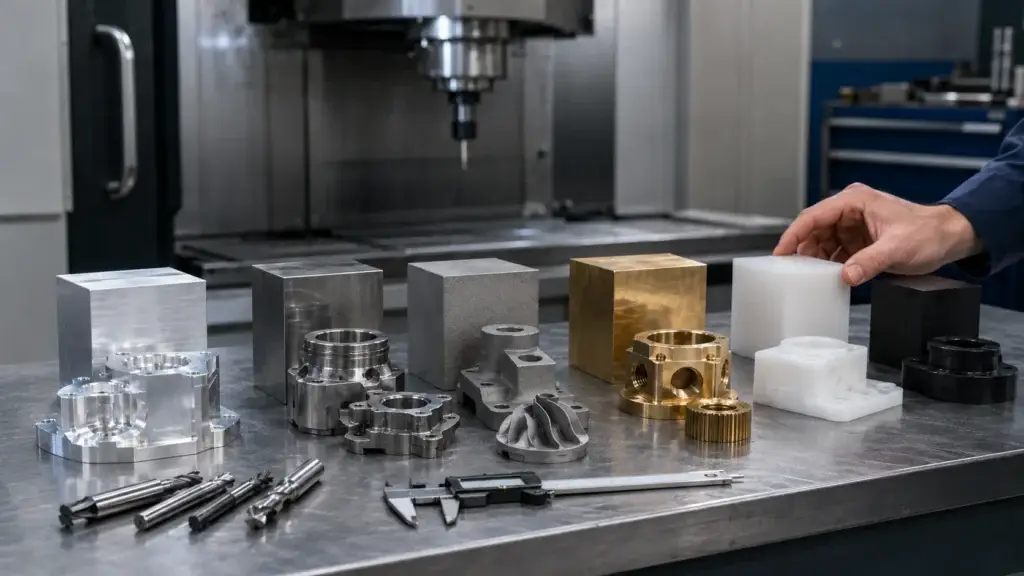
Material choice affects more than stock price.
Raw material
Titanium, PEEK and specialty stainless steels generally cost more than common aluminum or general plastics.
Availability also matters. A standard plate or bar is normally more economical than an unusual stock size.
Machining time
Aluminum and free-machining brass support relatively high cutting speeds. Stainless steel and titanium require more conservative machining.
Tool wear
Tooling cost increases with:
- Titanium
- Hardened stainless steel
- Glass-filled plastics
- Deep cavities
- Tight finish requirements
Inspection
Materials prone to movement or stress release may require additional inspection.
Thin aluminum frames may need flatness checks after unclamping, while moisture-sensitive plastic parts may require conditioning before final measurement.
Scrap risk
The cost of a rejected part includes the raw material and all machining already completed. This makes process planning especially important for titanium, PEEK and other high-value precision machining materials.
Surface Finishing by Material
| Material | Common finishing options | Main consideration |
| Aluminum | Anodizing, hard anodizing, chemical film, painting and bead blasting | Coating can affect fits and threads |
| Stainless steel | Passivation, electropolishing, polishing and bead blasting | Match the finish to corrosion and hygiene requirements |
| Titanium | Anodizing, polishing, bead blasting and coating | Surface integrity may be critical |
| Brass | Polishing, plating, brushing and clear coating | Unprotected surfaces may darken |
| Plastics | Polishing, bead blasting, dyeing or machined finish | Finishing compatibility depends on the grade |
Surface treatment should be defined before machining because coating thickness, masking and post-treatment inspection can change the production plan.
Material Selection by Application
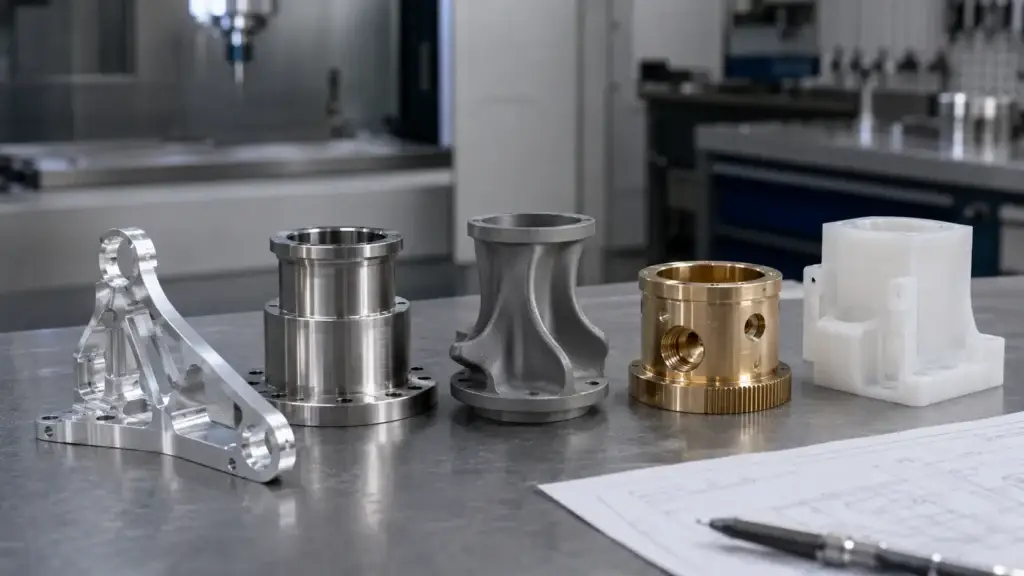
UAV bracket
6061 is suitable for moderate loads and cost-sensitive production. 7075 is preferred when higher strength is required without significant weight increase. Titanium should be reserved for demanding load or environmental conditions.
Medical component
Possible choices include 316L stainless steel, titanium and PEEK. The decision depends on sterilization, corrosion, biocompatibility, load and certification requirements.
Semiconductor fixture
Aluminum supports lightweight structures and complex machining. Stainless steel provides greater wear resistance. POM or PEEK may be selected for insulation or chemical compatibility.
Robotic housing
6061 is suitable for general housings. 7075 may be used around high-load interfaces, while stainless steel is preferred where stiffness or wear resistance is more important than weight.
Optical mount
Material selection should consider dimensional stability, thermal behavior, weight and surface finish. Aluminum is common for lightweight mounts, while stainless steel may provide greater stiffness and long-term stability.
CNC Milling Material Selection Checklist
Before releasing the drawing, confirm that:
- The exact grade and material condition are specified
- Strength matches the actual load
- The material suits the operating environment
- Weight reduction provides real value
- Dimensional behavior is acceptable
- The selected finish is compatible
- Stock is available in a suitable size
- Critical dimensions are defined before or after finishing
- Certification and traceability requirements are stated
- Lower-cost alternatives have been considered
- Total machining cost has been evaluated
How SinoRise Supports Material Selection and Machining?
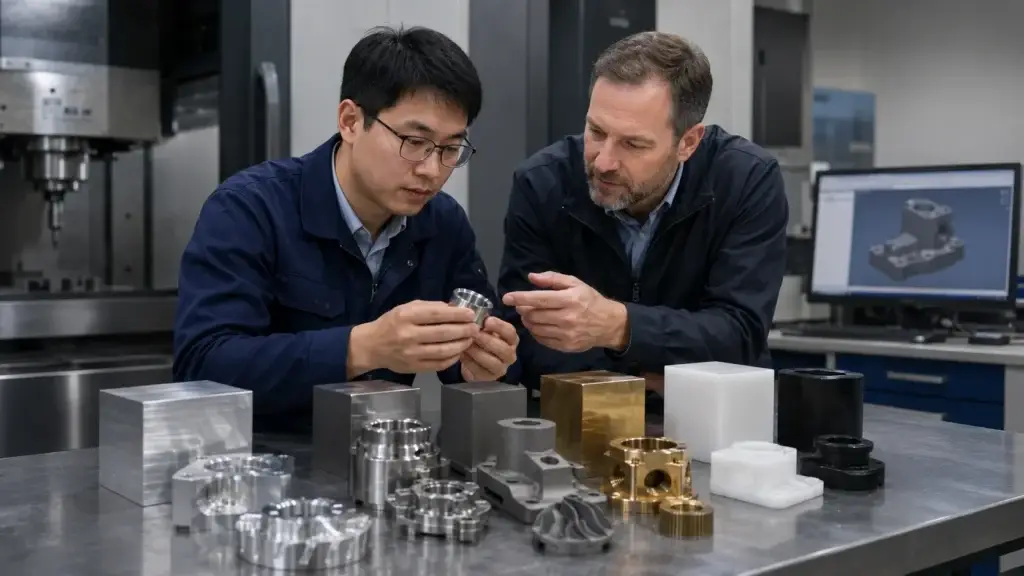
SinoRise reviews material selection together with part geometry, tolerance, surface finishing, quantity and inspection requirements.
Depending on the component, the manufacturing route may include CNC milling, CNC turning, turning-milling, wire cutting, 5-axis machining and coordinated finishing or inspection.
SinoRise operates more than 40 precision machining machines and uses 2.5D measuring systems, digital height gauges and CMM equipment. Production is managed under an ISO 9001 quality system, with a focus on parts for medical equipment, UAVs, semiconductor systems, robotics, optical instruments and automotive or motorcycle applications.
For prototype and small-batch projects, early material and DFM review can help identify:
- Over-specified material grades
- Distortion risk
- Difficult machining features
- Unnecessary finishing requirements
- More economical alternatives
- Inspection and certification needs
Frequently Asked Questions
What is the best material for CNC milling?
There is no universal best material. Aluminum 6061 is a practical starting point, while stainless steel, titanium, brass and engineering plastics are selected when different strength, corrosion, thermal or wear properties are required.
Is aluminum 6061 or 7075 better?
6061 is generally more economical and suitable for housings, fixtures and brackets. 7075 provides higher strength and is better for heavily loaded lightweight structures.
Is stainless steel harder to machine than aluminum?
Yes. Stainless steel normally requires lower cutting speeds, more rigid setups and greater tool-wear control.
When should titanium be used instead of aluminum?
Titanium is suitable when high strength, low weight, corrosion resistance or biocompatibility is required and aluminum cannot meet the application.
Is brass easy to CNC mill?
Many brass grades machine efficiently and produce good surface quality. C360 is particularly well known for machinability.
Which plastic is easiest to machine?
POM is one of the most practical plastics for precision machining because it produces clean features and offers good dimensional stability.
Can PEEK replace metal?
PEEK can replace metal in selected lightweight, insulating, chemical-resistant or high-temperature applications, but its cost and stiffness must be evaluated.
Which material holds tight tolerances best?
The result depends on grade, stock condition, geometry, internal stress, temperature and machining sequence. No material guarantees tight tolerances in every design.
What material information should be included in an RFQ?
Specify the exact grade, temper or heat-treatment condition, certification, quantity, surface finish and traceability requirements.
Request a CNC Milling Material Review
Send SinoRise your 3D model, drawing, quantity, operating conditions and current material specification.
Our engineering team will review material suitability together with machining difficulty, tolerances, finishing and inspection requirements.
Contact SinoRise for a CNC milling quotation and material manufacturability review.