
Quick Answer
For medical CNC machining, choose 316L stainless steel, titanium, or PEEK based on corrosion resistance, strength, weight, biocompatibility risk, sterilization needs, traceability, surface finish, and inspection requirements.
Key Takeaways
- Precision medical machining is not only about tight tolerance; material traceability, surface quality, burr control, and documentation are equally important.
- 316L stainless steel is commonly used for durable medical components, surgical tools, and corrosion-resistant hardware.
- Titanium is preferred when high strength-to-weight ratio, corrosion resistance, and lightweight performance matter.
- PEEK is useful for lightweight, insulating, radiolucent, and high-performance polymer components.
- Surface treatment and cleaning plans should be confirmed before machining, not treated as afterthoughts.
- Material certificates, inspection reports, and revision control help reduce sourcing risk for medical device projects.
Abstract
Medical CNC parts are judged differently from general industrial parts. A bracket, shaft, housing, or fixture may look simple, but the buyer usually needs more than a machined shape. They need the right material grade, controlled surface finish, clean edges, traceable documentation, stable inspection, and clear communication before production.
This guide explains how to choose 316L stainless steel, titanium, and PEEK for precision medical machining. It covers common part types, material selection, surface treatment, traceability, inspection methods, risks, and RFQ details. It is written for medical device OEMs, product engineers, purchasing teams, and quality engineers who need reliable CNC machined medical components.
Why Material Choice Matters in Precision Medical Machining?
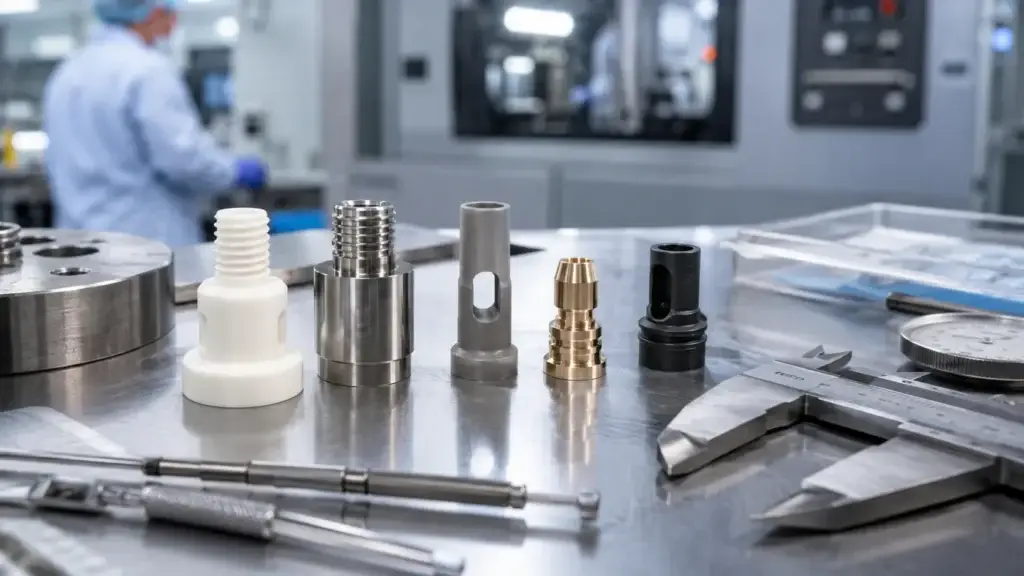
In precision medical machining, material choice affects far more than cost. It can influence corrosion resistance, mechanical strength, weight, cleaning behavior, surface finish, sterilization compatibility, wear resistance, and documentation needs.
The FDA’s guidance on ISO 10993-1 explains biological evaluation of medical devices within a risk management process for devices that come into direct or indirect contact with the human body. This is why medical material selection should be connected to intended use, contact type, duration, cleaning, and final device validation—not chosen only from a material list.
Medical Parts Are Not Selected by Strength Alone
A material that machines well may not be suitable for every medical application. A stainless steel part may provide durability, but it is heavier than titanium or PEEK. Titanium may reduce weight but increases machining cost. PEEK may provide insulation and light weight, but it requires careful toolpath and burr control.
The best choice starts with the part’s function.
Common Medical CNC Part Categories
| Part Type | Common Materials | Main Concern |
| Surgical tool components | 316L stainless steel, titanium | Strength, corrosion resistance, clean edges |
| Diagnostic equipment parts | Aluminum, stainless steel, PEEK | Stability, appearance, assembly fit |
| Medical device housings | Stainless steel, titanium, PEEK | Cleanability, weight, tolerance |
| Guide parts and fixtures | Stainless steel, PEEK, titanium | Repeatability, dimensional control |
| Shafts and pins | Stainless steel, titanium | Wear, straightness, surface finish |
| Insulating components | PEEK, PTFE, other engineering plastics | Electrical insulation, burr control |
| Prototype medical parts | Stainless steel, titanium, PEEK | Speed, function testing, documentation |
316L Stainless Steel for Medical CNC Machining
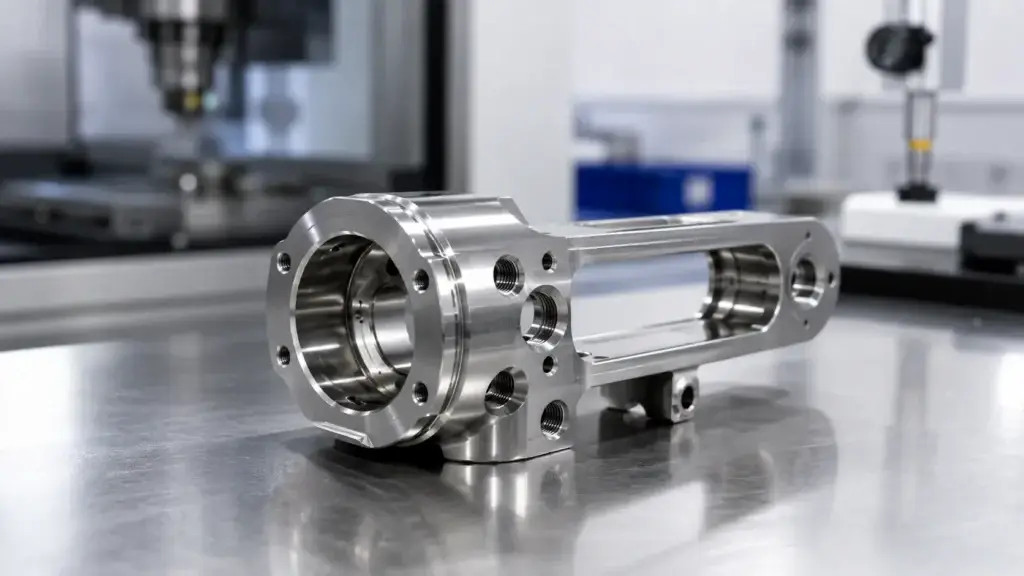
316L stainless steel is widely used in medical CNC machining because it offers good corrosion resistance, toughness, strength, and finishability. It is often selected for surgical instruments, medical hardware, diagnostic equipment parts, shafts, pins, brackets, and components that require durability.
For implant-related stainless steel, buyers should not use “316L” as a vague requirement. ASTM F138 covers wrought 18Cr-14Ni-2.5Mo stainless steel bar and wire used for surgical implants, and FDA recognizes ASTM F138-19 as relevant to medical devices.
When 316L Stainless Steel Makes Sense?
316L stainless steel is suitable when the part needs:
- Good corrosion resistance
- High mechanical durability
- Fine machined features
- Polished or passivated surfaces
- Stable threaded features
- Repeated cleaning or handling
- Strong, long-lasting hardware
Surface Treatment and Machining Notes
316L stainless steel can work-harden during machining, so tool selection, cutting parameters, coolant, and deburring are important. For medical components, passivation, polishing, and burr-free edge control are often more important than appearance alone.
Titanium for Precision Machining for Medical Devices
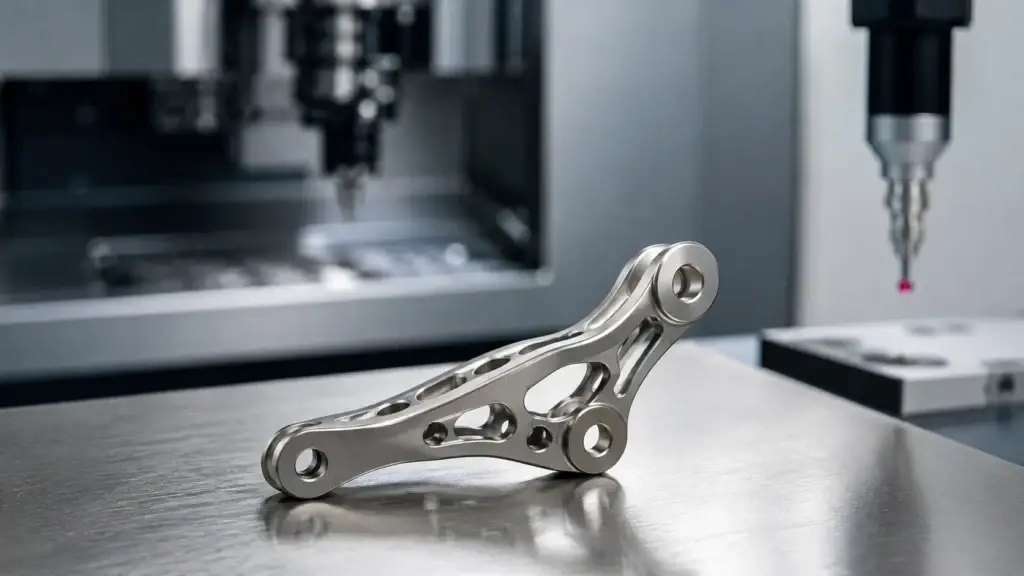
Titanium is common in precision machining for medical devices because it combines high strength-to-weight ratio, corrosion resistance, and good performance in demanding environments. It is often used for lightweight medical components, surgical instrument parts, dental-related components, orthopedic-related hardware, and high-value precision parts.
ASTM F136 covers wrought annealed Ti-6Al-4V ELI, including chemical, mechanical, and metallurgical requirements for surgical implant applications.
Why Titanium Is Used in Medical Components?
Titanium is often chosen when buyers need:
- Lower weight than stainless steel
- High strength
- Excellent corrosion resistance
- Good performance in compact components
- Premium material positioning
- Compatibility with advanced medical device designs
Titanium Machining Risks to Control
Titanium is more difficult to machine than many stainless steels and aluminum alloys. It has low thermal conductivity, which can increase tool heat. Poor cutting strategy may lead to tool wear, poor surface finish, chatter, or dimensional instability.
| Titanium Machining Risk | What to Control |
| Tool heat | Cutting speed, coolant, tool coating |
| Workpiece vibration | Fixturing and toolpath strategy |
| Burr formation | Tool sharpness and finishing pass |
| Surface damage | Handling and inspection process |
| Cost increase | Only specify titanium where function requires it |
PEEK for Medical Device CNC Machining
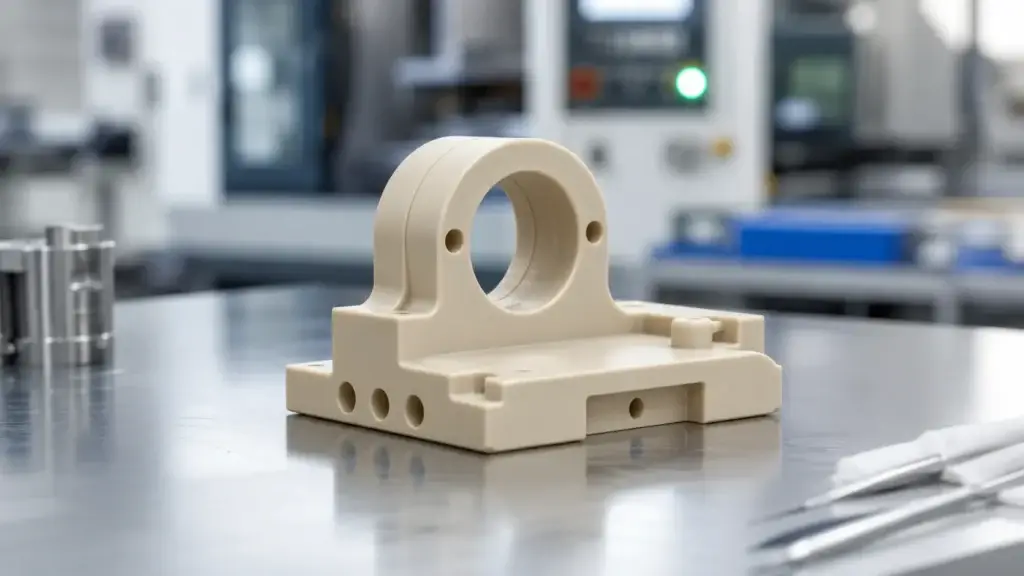
PEEK is a high-performance engineering polymer used in medical device CNC machining when the part needs light weight, chemical resistance, insulation, radiolucency, or lower metal content. It is often used for spacers, handles, fixtures, instrument components, insulating parts, and selected medical device structures.
ASTM F2026 covers PEEK polymers in virgin forms and provides requirements and test methods for thermoplastics used in intracorporeal devices such as surgical implants or components of surgical or dental devices.
When PEEK Is the Better Material?
PEEK may be suitable when the part needs:
- Lightweight structure
- Electrical insulation
- Good chemical resistance
- Lower friction than metals
- Stable performance in precision plastic components
- Non-metallic design requirements
- Complex but small medical device components
PEEK Machining and Inspection Notes
PEEK is not machined like metal. It requires sharp tools, controlled heat, stable fixturing, and careful deburring. Thin edges can deform or leave small burrs if the process is not controlled.
| PEEK Design Concern | Practical Recommendation |
| Thin walls | Avoid over-thinning unsupported areas |
| Threaded features | Confirm thread strength and engagement |
| Burrs | Define burr-free requirements clearly |
| Tight tolerance | Control temperature and fixturing |
| Surface quality | Avoid aggressive polishing unless needed |
Surface Treatment for CNC Medical Parts
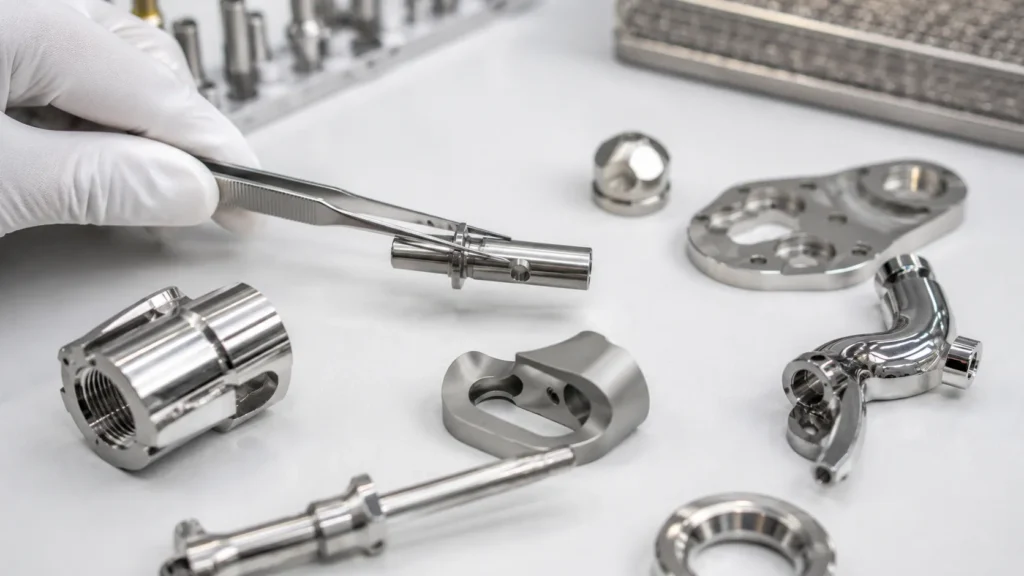
For CNC medical parts, surface treatment should be selected by function, not only appearance. The key concerns are corrosion resistance, cleanliness, edge condition, surface roughness, coating impact, and compatibility with the buyer’s downstream process.
Passivation, Polishing, Deburring, and Cleaning
Common surface requirements include:
- Passivation for stainless steel
- Mechanical polishing for selected surfaces
- Electropolishing when smoother stainless surfaces are required
- Bead blasting only when suitable for non-critical surfaces
- Deburring and edge breaking
- Ultrasonic cleaning or controlled cleaning before packaging
- No sharp burrs around holes, threads, slots, and mating faces
Finish Selection Table
| Material | Common Finish Direction | Buyer Should Confirm |
| 316L stainless steel | Passivation, polishing, electropolishing | Surface roughness, burr-free edges |
| Titanium | Polishing, bead blasting, anodizing when specified | Surface condition and handling |
| PEEK | As-machined, fine machining, careful deburring | Burrs, deformation, edge quality |
| Stainless shaft/pin | Grinding or polishing | Diameter, straightness, finish |
| Medical housing | Polishing or controlled matte finish | Cleanability and appearance |
Traceability and Inspection in Medical CNC Turning and Milling
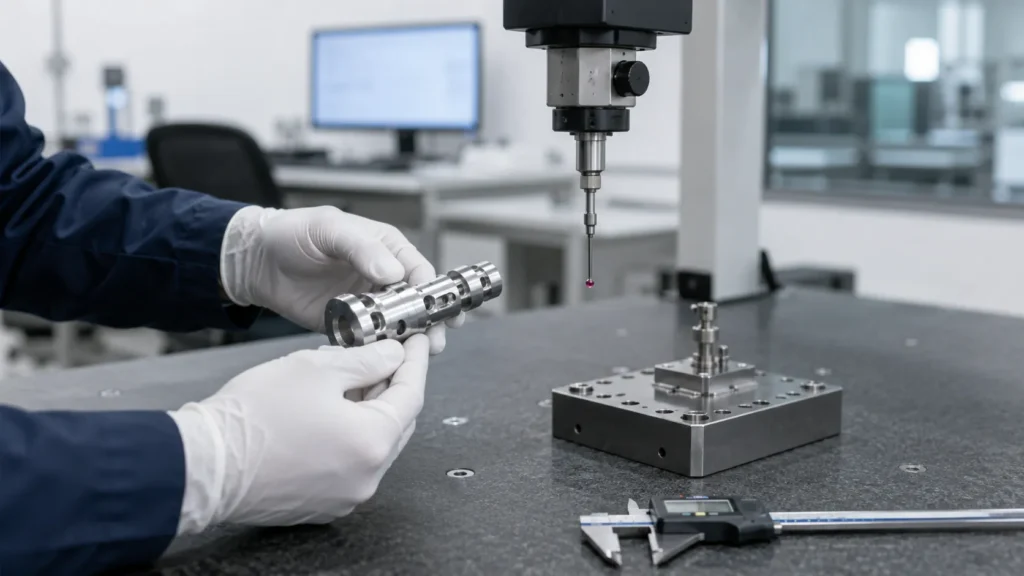
Medical CNC turning and milling projects should include documentation expectations from the beginning. Buyers often need material certificates, inspection reports, and drawing revision control for internal quality approval.
SinoRise’s official site states that it supports CNC machining from prototype to production, with precision up to ±0.005 mm, 35+ surface finishing options, 80+ metals and plastics, and inspection capability including CMM and 2.5D vision measurement.
Documentation Buyers Should Request
| Document | Why It Matters |
| Material certificate | Confirms grade and supplier source |
| Drawing revision record | Prevents old-version production |
| First article inspection report | Validates first production sample |
| Dimensional inspection report | Confirms measured results |
| CMM report | Supports complex geometry and GD&T |
| Surface finish record | Confirms treatment and roughness |
| Nonconformance record | Shows how issues are controlled |
| Packaging requirement | Protects clean and delicate parts |
Inspection Checklist for Medical CNC Parts
Critical inspection items include:
- Material grade
- Drawing revision
- Critical dimensions
- Hole position
- Thread quality
- Bore diameter
- Shaft diameter
- Flatness and perpendicularity
- Surface roughness
- Burrs and sharp edges
- Coating or passivation requirements
- Visual surface defects
- Clean packaging
Common Risks in Medical CNC Machining Materials
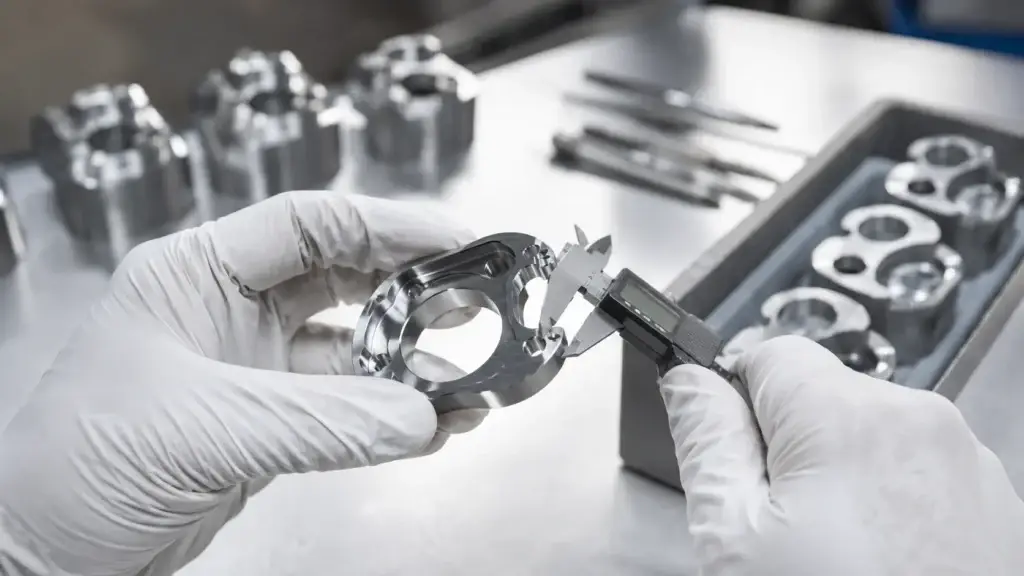
Medical CNC machining materials create risk when the RFQ is too general. “316L stainless steel part” or “PEEK part” is not enough for a serious medical component.
Material Substitution, Burrs, Surface Damage, and Unclear RFQs
| Risk | What Can Go Wrong | Prevention |
| Vague material grade | Wrong grade or non-approved material | Specify exact grade and certificate |
| No revision control | Old drawing used | Confirm drawing version in PO |
| Burrs near holes | Assembly or cleanliness issue | Define burr-free areas |
| Poor surface finish | Cleaning or fit problems | Specify Ra where required |
| PEEK deformation | Size drift or poor fit | Use stable fixturing and sharp tools |
| Titanium tool wear | Poor finish or dimension drift | Use controlled cutting strategy |
| No inspection scope | Disputes after delivery | Define report requirements early |
How to Reduce Sourcing Risk?
A strong RFQ should include:
- 3D CAD file
- 2D drawing
- Exact material grade
- Application background
- Critical dimensions
- Tolerance and GD&T requirements
- Surface finish requirement
- Cleaning or packaging requirement
- Required certificates
- Inspection report format
- Quantity and delivery target
- NDA requirement if the design is confidential
How SinoRise Supports Medical CNC Machining Projects?

(图片alt:How SinoRise Supports Medical CNC Machining Projects)
SinoRise supports precision medical machining projects from prototype to small and medium-batch production. For medical buyers, the value is not only machining a part, but helping clarify material, tolerance, finish, inspection, and documentation before production begins.
SinoRise can support:
- CNC milling, turning, turning-milling, wire cutting, and 5-axis machining
- Stainless steel, titanium, PEEK, aluminum, copper, brass, and engineering plastics
- Medical device housings, brackets, shafts, pins, fixtures, and precision components
- Surface treatment coordination
- First article inspection when needed
- CMM and dimensional inspection
- Prototype-to-batch production support
- Global delivery and protective packaging
Final device validation, regulatory approval, and biocompatibility qualification remain the responsibility of the medical device manufacturer. A machining supplier’s role is to provide controlled manufacturing, traceable materials, accurate parts, and clear quality documentation.
FAQ About Medical CNC Machining Materials
What Materials Are Commonly Used in Medical CNC Machining?
Common materials include 316L stainless steel, titanium, PEEK, aluminum, PTFE, POM, and other engineering plastics. For higher-risk applications, exact grade and certification requirements should be confirmed by the buyer.
Is 316L Stainless Steel Suitable for Medical Parts?
Yes, 316L stainless steel is commonly used for durable medical components, tools, shafts, pins, and hardware. For implant-related applications, buyers should specify recognized medical material standards and require certificates.
Why Is Titanium Used in Medical CNC Machining?
Titanium is used when parts need high strength, low weight, corrosion resistance, and premium performance. It is common in high-value medical components, but machining cost and tool wear must be controlled.
Is PEEK Easy to CNC Machine?
PEEK is machinable, but it requires sharp tools, heat control, stable fixturing, and careful deburring. It should not be treated like aluminum or stainless steel.
What Surface Finish Is Needed for CNC Medical Parts?
It depends on function. Stainless steel may need passivation or polishing. Titanium may need controlled polishing or finishing. PEEK often needs fine machining and careful deburring. Critical surfaces should include clear Ra or finish notes.
What Should I Include in a Medical CNC Machining RFQ?
Send 3D files, 2D drawings, exact material grade, surface finish, critical dimensions, inspection requirements, material certificate needs, packaging requirements, quantity, delivery target, and any NDA requirements.
Conclusion
Medical CNC machining materials should be chosen with the final application, surface condition, traceability, and inspection needs in mind. 316L stainless steel, titanium, and PEEK each solve different problems. Stainless steel offers durability and corrosion resistance. Titanium reduces weight while maintaining strength. PEEK supports lightweight, insulating, and high-performance polymer designs.
For precision medical machining, the safest approach is to define the part function first, then confirm the material grade, machining process, surface treatment, inspection scope, and documentation requirements. SinoRise supports medical CNC machining projects with precision machining, material options, surface finishing coordination, inspection support, and prototype-to-batch production workflows.