
Quick Answer
The best finish for optical instrument parts depends on light control, dimensional stability, surface roughness, coating thickness, cleanliness, corrosion resistance, and inspection requirements.
Key Takeaways
- Optical parts are not judged only by appearance; surface finish can affect reflection, stray light, assembly accuracy, cleanliness, and long-term stability.
- Optical instrument parts often require different finishes on different surfaces: black anodizing inside, precision machining on datums, and polishing on contact or visible areas.
- Surface roughness should be selected by function, not simply made as low as possible.
- Aluminum is commonly used for lightweight optical housings, lens barrels, and brackets, while stainless steel, brass, copper, PEEK, and black engineering plastics may suit specific needs.
- Surface treatment should be reviewed before machining is finalized because coating thickness, masking, polishing, and blasting can all affect fit.
- A reliable supplier should support material review, CNC machining, finishing, masking, cleaning, and inspection as one connected workflow.
Abstract
Optical component manufacturing is sensitive to small details. A lens barrel may need a matte black internal surface to reduce unwanted reflection. A camera bracket may need stable flatness to hold an optical axis. A sensor housing may need anodizing for corrosion resistance but also controlled masking around datum faces. A mirror mount may require low burrs, clean edges, and consistent surface texture.
This guide explains the best surface finishing options for optical instrument parts from a CNC machining and purchasing perspective. It covers common optical part types, key performance indicators, recommended materials, surface treatments, machining processes, inspection methods, and common risks. It also shows how SinoRise supports optical component projects through precision machining, surface finishing coordination, and quality inspection.
What Buyers Care About in Optical Instrument Parts?
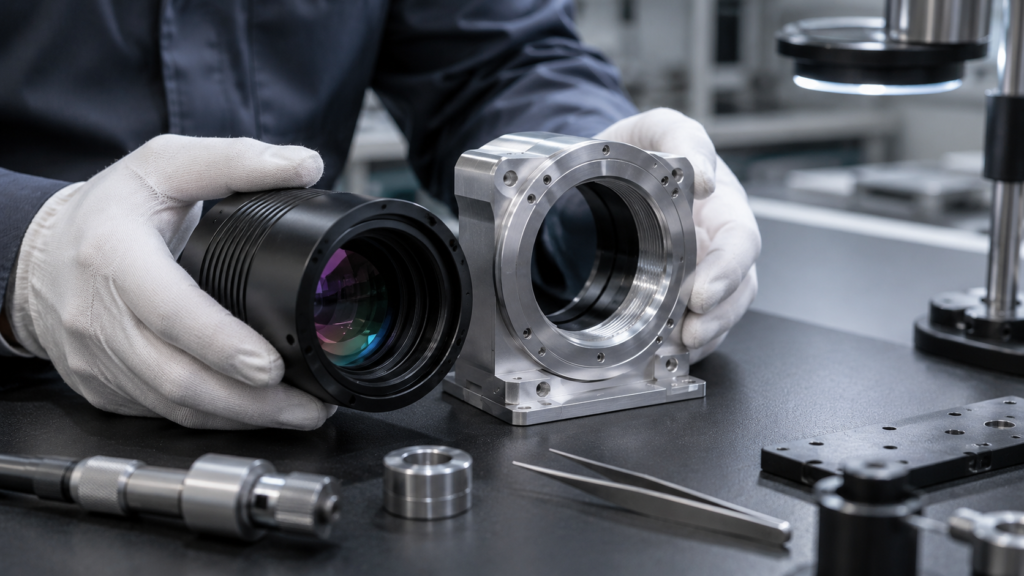
For optical instrument parts, the surface finish is not just cosmetic. It can influence how the part reflects light, fits with lenses or sensors, holds alignment, resists corrosion, and performs after repeated assembly.
Optical buyers often care about the part’s function more than the finish name. A “black surface” may not be enough if it reflects too much light inside a lens barrel. A “smooth surface” may not be enough if a datum face is polished unevenly and loses flatness. A “nice anodized finish” may still fail if coating buildup changes a precision bore.
Surface Finish Is Part of Optical Performance
Optical drawings and specifications often use standards to define surface quality, texture, and coating requirements. ISO 10110 is widely used for optical drawings, including surface texture and surface imperfections, while ISO 9211 describes optical coatings and their specification framework. [1][2]
For CNC machined optical structures, the main challenge is practical: the supplier must understand which surfaces affect light, which surfaces affect assembly, and which surfaces only need standard protection.
Key Requirements for Optical CNC Parts
| Requirement | Why It Matters |
| Low reflection | Reduces stray light inside optical assemblies |
| Stable datums | Maintains lens, sensor, or mirror alignment |
| Controlled roughness | Supports contact quality, coating adhesion, or reflection control |
| Burr-free edges | Prevents scratches, particles, and assembly interference |
| Coating thickness control | Protects fit, thread quality, and bore dimensions |
| Cleanliness | Reduces contamination in optical assemblies |
| Corrosion resistance | Improves reliability in lab, outdoor, or medical environments |
| Repeatability | Keeps optical alignment consistent across batches |
Common Optical Components That Need Surface Finishing
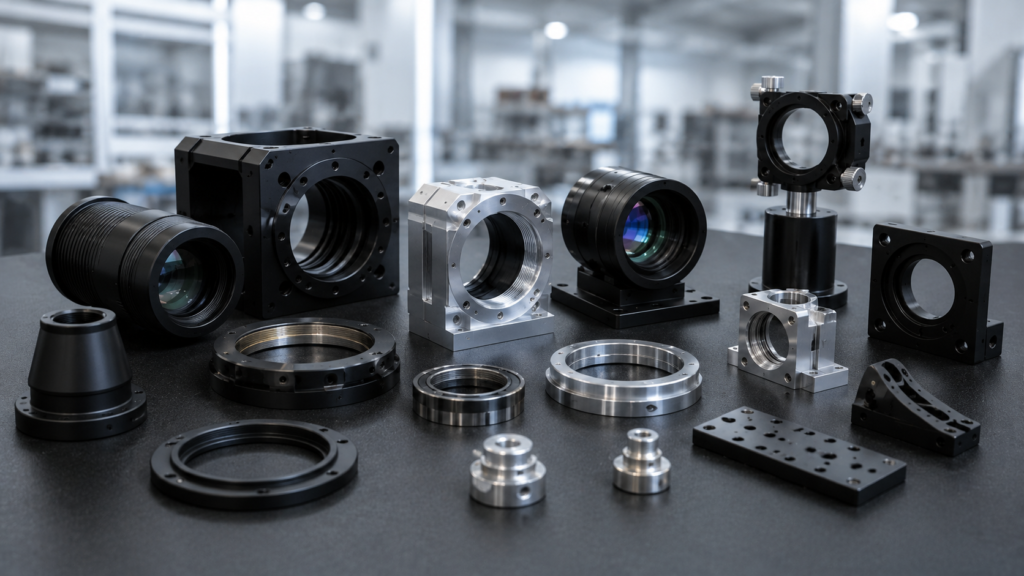
Many optical components are not lenses themselves. They are mechanical structures that hold, protect, align, and support optical elements. Their surface treatment can directly affect the performance of the optical system.
Lens Barrels, Mounts, Housings, Brackets, and Fixtures
Common CNC machined optical parts include:
- Lens barrels
- Camera housings
- Optical sensor housings
- Mirror mounts
- Prism holders
- Optical brackets
- Focusing sleeves
- Adapter rings
- Filter holders
- Laser module housings
- Alignment blocks
- Inspection fixtures
- Optical instrument frames
- Telescope or microscope structural parts
These parts often combine precision bores, fine threads, flat datum surfaces, thin walls, and treated internal surfaces.
Optical Part Category Table
| Part Type | Main Function | Key Surface Concern |
| Lens barrel | Holds lens elements | Internal reflection, bore fit, thread quality |
| Camera housing | Protects sensor and optical module | Black finish, sealing, appearance |
| Mirror mount | Holds reflective element | Flatness, stability, burr control |
| Sensor bracket | Controls position | Datum accuracy, vibration resistance |
| Focusing sleeve | Rotating or sliding motion | Smoothness, wear, concentricity |
| Filter holder | Supports replaceable filter | Edge quality, coating, clean handling |
| Optical fixture | Inspection or alignment support | Precision, repeatability, clean surface |
Best Surface Finishing Services for Optical Components
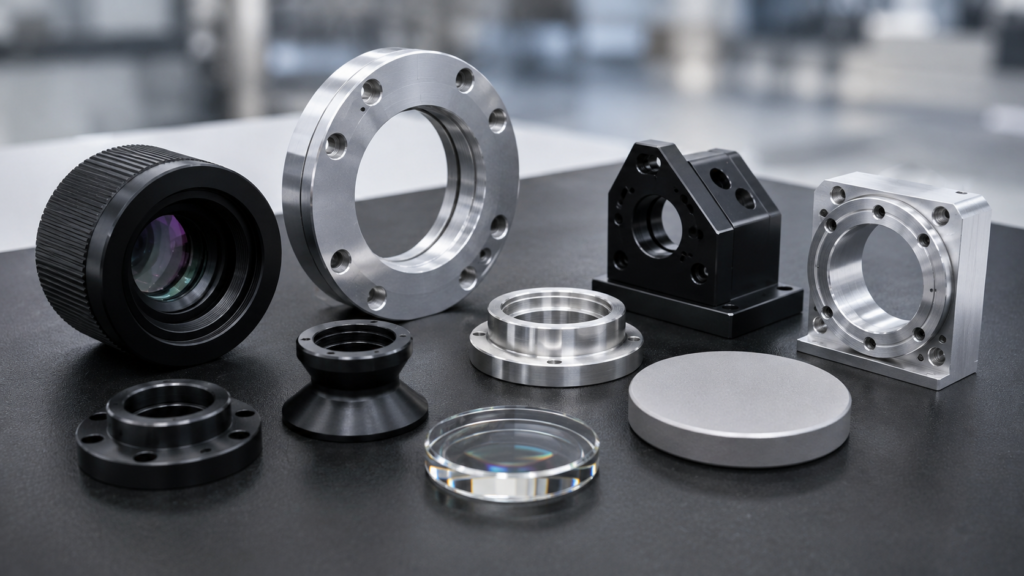
The best surface finishing services for optical parts depend on the surface function. One part may need several different finishes or masking strategies.
Anodizing, Blackening, Polishing, Passivation, and Coating
Common finishing options include:
| Finish Option | Best For | Main Benefit |
| Black anodizing | Aluminum optical housings and lens barrels | Corrosion resistance and reduced reflection |
| Hard anodizing | Wear areas, sliding surfaces, repeated assembly parts | Better surface durability |
| Matte black coating | Internal optical cavities or anti-reflection areas | Better light control when specified correctly |
| Sandblasting before anodizing | Visible aluminum parts | Uniform matte texture |
| Polishing | Contact surfaces or visible precision areas | Smoother surface and improved appearance |
| Passivation | Stainless steel optical hardware | Corrosion resistance |
| Electropolishing | Stainless clean parts | Smoother and cleaner surface |
| Nickel plating | Brass, steel, or copper parts | Wear, conductivity, corrosion protection |
| As-machined finish | Internal prototypes or non-critical parts | Faster and lower cost |
Finish Selection Table by Function
| Functional Need | Recommended Finish Direction | RFQ Note |
| Reduce stray light | Matte black anodizing or black coating | Specify internal surfaces and reflectivity expectation if needed |
| Protect aluminum housing | Anodizing | Confirm color, masking, and coating thickness |
| Improve wear resistance | Hard anodizing or plating | Check fit after coating |
| Keep datum accuracy | Masking or post-machining datum surfaces | Do not polish or blast critical datums blindly |
| Improve stainless corrosion resistance | Passivation or electropolishing | Confirm cleaning requirement |
| Improve visual consistency | Sandblast + anodizing | Use samples for appearance-critical parts |
| Prototype quickly | As-machined or simple anodizing | Suitable before final finish approval |
Managing Surface Finish and Roughness in Optical Parts
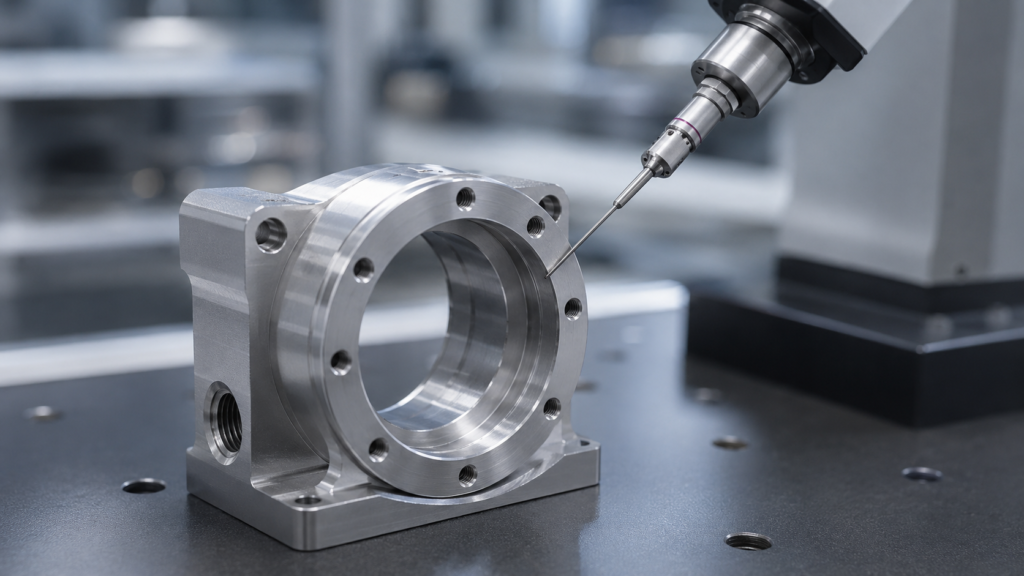
Surface finish and roughness are critical because rough surfaces can scatter light, affect coating behavior, and change how parts contact or slide against mating components. NIST surface metrology materials also describe optical methods for measuring surface roughness, showing that roughness measurement is a serious metrology topic rather than a simple appearance judgment. [3]
Roughness, Reflection, Scatter, and Contact Surfaces
For optical mechanical parts, not every surface should be polished. Internal surfaces may need controlled matte texture to absorb or diffuse light. Datum faces may need controlled machining rather than aggressive polishing. Sliding sleeves may need smoother surfaces for motion, while external covers may prioritize uniform appearance.
This is why RFQs should separate surfaces by function:
- Optical internal surfaces
- Datum and mounting faces
- Sliding or rotating surfaces
- Threaded areas
- Cosmetic external surfaces
- Masked areas
- Non-critical surfaces
Ra Selection for Machined Optical Structures
| Surface Type | Typical Surface Direction | Practical Note |
| Datum face | Controlled machined finish | Protect flatness and perpendicularity |
| Internal light-control surface | Matte black finish or textured coating | Avoid glossy reflection |
| Sliding sleeve | Lower Ra and wear-resistant finish | Confirm motion and fit |
| External housing | Sandblast + anodizing | Good visual consistency |
| Precision bore | Fine machining, masking if coated | Control fit after finishing |
| Prototype surface | As-machined | Fast and cost-effective |
The best surface is not always the smoothest. It is the surface that supports optical function.
Recommended Materials for Precision CNC Machining of Optical Parts
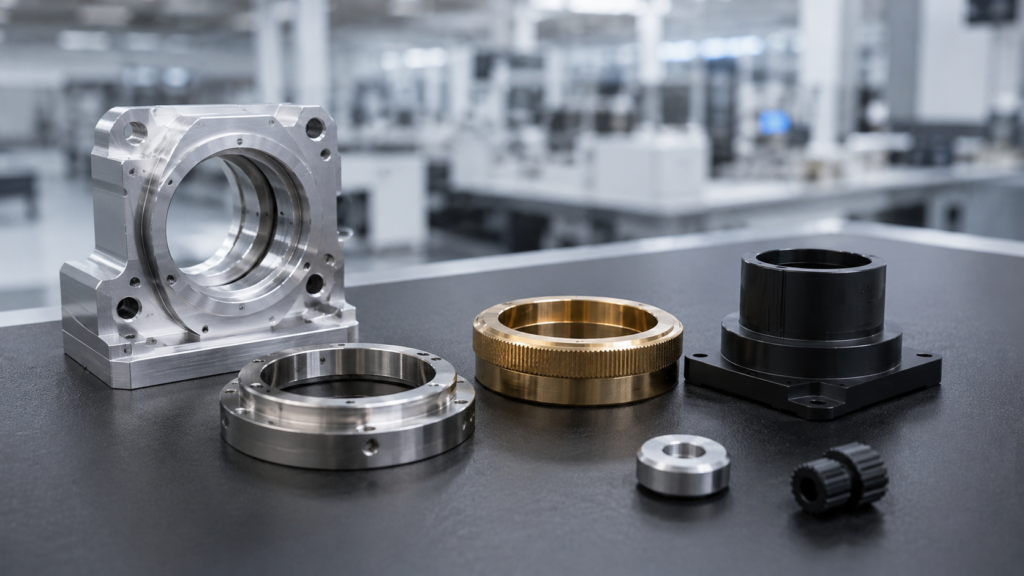
Material choice affects machinability, finish quality, thermal stability, weight, corrosion resistance, and cost. For precision CNC machining, the finish plan should be reviewed together with the material.
Aluminum, Stainless Steel, Brass, Copper, and Engineering Plastics
Aluminum 6061 is commonly used for optical housings, brackets, and frames because it machines well and accepts anodizing. Aluminum 7075 can be used when higher strength and stiffness are needed.
Stainless steel is suitable for corrosion-resistant hardware, clean components, and stable fixtures. Brass and copper are useful for parts requiring conductivity, thermal behavior, or stable machining. Engineering plastics such as PEEK, POM, PTFE, and black acetal can reduce weight, add insulation, or support low-friction movement.
Material Selection Table by Optical Application
| Material | Best For | Surface Finish Direction |
| Aluminum 6061 | Lens barrels, housings, brackets | Black anodizing, sandblast + anodizing |
| Aluminum 7075 | High-stiffness mounts | Hard anodizing or controlled anodizing |
| Stainless steel 304/316 | Clean hardware, fixtures, mounts | Passivation, polishing, electropolishing |
| Brass | Rings, adapters, small precision parts | Nickel plating, polishing |
| Copper | Thermal or conductive parts | Plating or controlled bare surface |
| PEEK | High-performance insulating parts | Machined finish, deburring |
| POM / Acetal | Sleeves, spacers, low-friction parts | Fine machining, clean edges |
| Black engineering plastics | Non-reflective structural parts | Machined finish, burr control |
Recommended Processes for Metal Surface Treatment and Machining
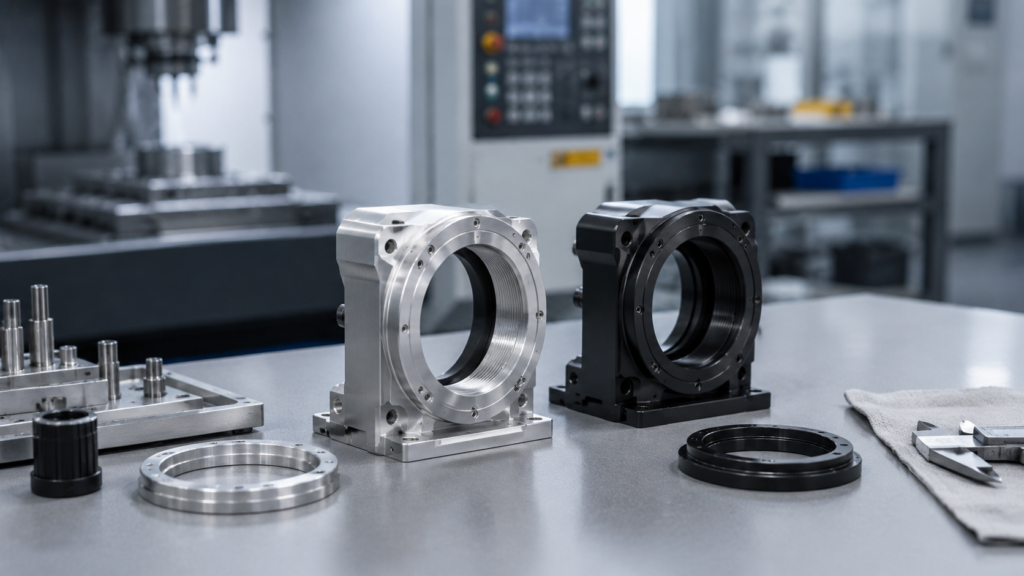
Metal surface treatment must be planned before machining is complete. If the supplier treats finishing as a final cosmetic step, optical parts may suffer from tolerance shifts, blocked threads, coating buildup, or damaged datum faces.
CNC Milling, Turning, Turning-Milling, and 5-Axis Machining
| Process | Typical Optical Parts | Why It Fits |
| CNC turning | Lens barrels, sleeves, rings | Good for concentric round parts |
| CNC milling | Brackets, housings, frames, mounts | Good for flats, pockets, holes, and datum faces |
| Turning-milling | Barrels with flats, side holes, threads | Reduces setup error |
| 5-axis machining | Complex optical mounts and angled structures | Improves access and feature alignment |
| Wire EDM | Thin plates, precise profiles | Useful for accurate flat shapes |
| Polishing / lapping | Selected contact or optical-adjacent surfaces | Used only where function requires it |
Masking and Process Planning Before Finishing
Masking is often necessary for:
- Precision bores
- Threaded holes
- Datum faces
- Bearing seats
- Sliding fits
- Electrical contact areas
- Areas that must remain uncoated
The finishing plan should be discussed before production, not after parts are machined.
Inspection Methods for Metal Finishes on Optical Components
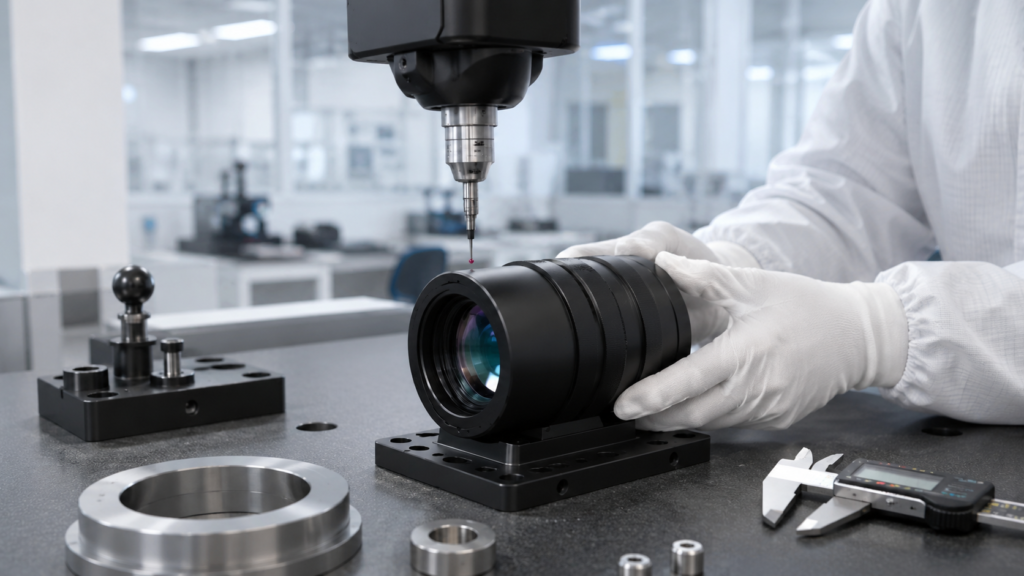
Metal finishes for optical parts should be inspected both dimensionally and visually. A finish may look acceptable but still affect function if it changes a bore, reflects too much light, or damages a mating surface.
Dimensional, Visual, Surface, and Coating Inspection
Recommended checks include:
| Inspection Method | What It Checks |
| CMM inspection | Datum relationships, hole position, geometry |
| Calipers / micrometers | Basic dimensions, thickness, diameters |
| Pin gauges | Bore and hole fit |
| Thread gauges | Thread quality after finishing |
| Surface roughness tester | Ra on critical surfaces |
| Coating thickness gauge | Anodizing, plating, or coating buildup |
| Visual inspection | Scratches, dents, gloss, color, stains |
| Assembly test | Fit with lenses, sensors, rings, or mating parts |
Optical Component Inspection Checklist
Before approval, buyers should confirm:
- Correct drawing revision
- Correct material grade
- Finish type and color
- Masking requirements
- Coating thickness impact
- Thread fit after treatment
- Burr-free edges
- Reflective internal surfaces
- Surface roughness on functional faces
- Clean packaging for optical assembly
Common Risks in Finishing Optical CNC Parts
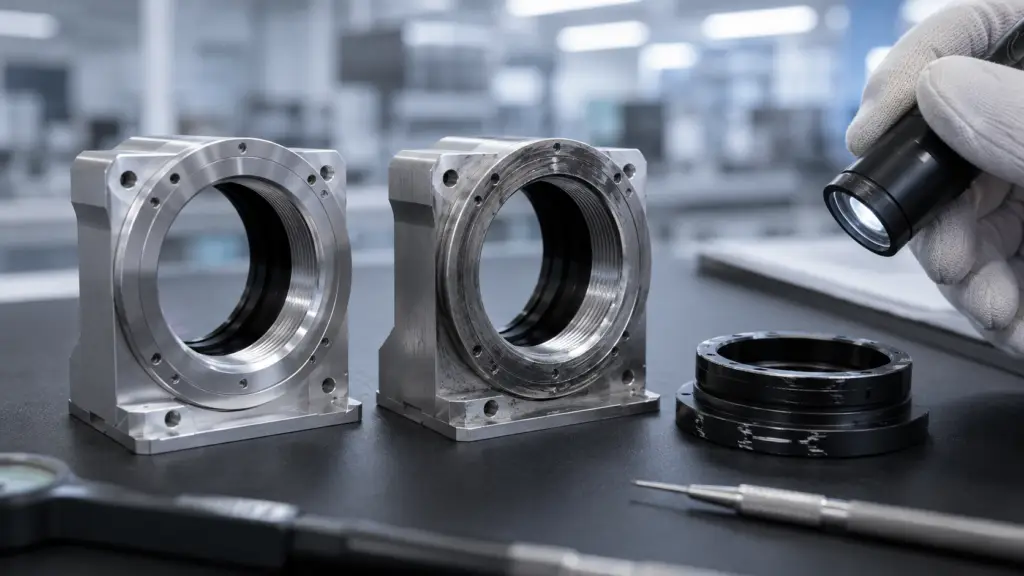
Optical parts often fail because finishing requirements are not connected to the part’s real function. A finish that works for general industrial parts may not work inside an optical assembly.
Reflection, Coating Buildup, Burrs, and Datum Damage
| Risk | What Can Go Wrong | Prevention |
| Glossy internal surface | Stray light or image interference | Specify matte black or controlled internal finish |
| Coating buildup in bores | Lens or sleeve does not fit | Mask or compensate dimensions |
| Blasted datum face | Loss of flatness or positioning accuracy | Mask datum surfaces |
| Polishing edges | Dimensional change or rounded edges | Limit polishing to selected areas |
| Burrs near lens seat | Scratches or particles | Define burr-free requirements |
| Inconsistent anodizing | Appearance variation | Confirm sample or finish standard |
| Unclear RFQ | Supplier chooses wrong finish | Separate surfaces by function |
How to Reduce Sourcing Risk Before Production?
A strong RFQ should include:
- 3D file and 2D drawing
- Material grade
- Surface finish requirement
- Internal vs external surface notes
- Masking areas
- Coating thickness requirement
- Critical dimensions
- Surface roughness values
- Inspection requirements
- Sample approval needs
For optical projects, one sentence such as “black anodized finish” is usually not enough.
How SinoRise Supports Optical Component Surface Finishing?
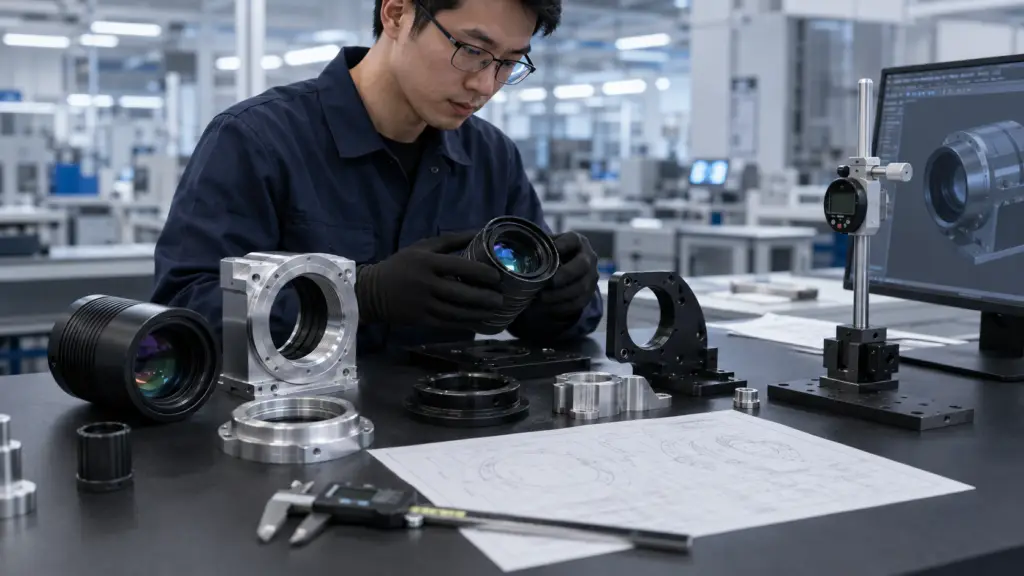
SinoRise supports custom CNC machining and surface finishing coordination for precision optical structures, including housings, lens barrels, brackets, mounts, frames, adapters, and inspection fixtures.
SinoRise’s surface finishing service page highlights one-stop support from CNC machining to heat treatment coordination, surface finishing, inspection, assembly, and packaging. It also lists experience across optics, medical, robotics, UAVs, semiconductor, and automotive applications, with precision capability and multiple finishing options. [4]
For optical component buyers, SinoRise can support:
- Drawing and DFM review
- Material selection
- CNC milling, turning, turning-milling, wire cutting, and 5-axis machining
- Black anodizing, hard anodizing, polishing, passivation, plating, sandblasting, and coating coordination
- Masking review for bores, threads, datums, and sliding surfaces
- Dimensional and surface inspection
- Prototype to small and medium-batch production
- Packaging support for clean precision parts
The practical value is not only making the part. It is helping buyers match finish, function, tolerance, and inspection before production begins.
FAQ About Surface Finishing for Optical Components
What Is the Best Finish for Optical Instrument Parts?
The best finish depends on function. Internal optical surfaces often need matte black or low-reflection treatment. Datum faces may need controlled machining. External housings often use sandblast + anodizing for appearance and corrosion resistance.
Is Black Anodizing Good for Optical Components?
Black anodizing is commonly used for aluminum optical components, especially housings and lens barrels. However, internal reflection, gloss level, coating thickness, and masking should be reviewed for optical performance.
Why Is Surface Roughness Important in Optical Parts?
Surface roughness can affect light scatter, contact quality, coating behavior, and motion in sliding parts. It should be specified only where function requires it.
Should Optical Parts Be Polished?
Only selected surfaces should be polished. Polishing can improve smoothness and appearance, but it may change dimensions, round edges, or affect datum accuracy if used incorrectly.
What Materials Are Common for CNC Machined Optical Components?
Aluminum 6061, aluminum 7075, stainless steel, brass, copper, PEEK, POM, PTFE, and black engineering plastics are commonly used depending on strength, weight, finish, corrosion resistance, and light-control needs.
What Should Be Included in an Optical Component RFQ?
Include 3D files, 2D drawings, material grade, surface finish, color, coating thickness, masking areas, critical dimensions, surface roughness, inspection needs, and the optical function of important surfaces.
Conclusion
The best surface finishing option for optical components is not a universal finish. It depends on what each surface must do: reduce stray light, hold a lens, protect a housing, control sliding motion, resist corrosion, or maintain precise alignment.
For optical instrument parts, the safest sourcing strategy is to define surface function before choosing the finish. Internal light-control surfaces, datum faces, threaded holes, precision bores, and visible housing surfaces should not be treated the same way.
SinoRise supports optical component manufacturing through CNC machining, surface finishing coordination, masking review, inspection, and prototype-to-batch production support. For optical housings, lens barrels, mounts, brackets, frames, and fixtures, the right finishing plan helps reduce assembly risk and improve final product reliability.
References
[1] ISO 10110-7 — Optics and photonics: preparation of drawings for optical elements and systems; surface imperfections. This standard specifies the indication of acceptability levels for surface imperfections on optical elements.
[2] ISO 9211-4:2022 — Optical coatings. ISO states that ISO 9211 describes surface treatments of components and substrates by applying optical coatings and provides a standard form for specification.
[3] NIST — Surface finish metrology tutorial and optical roughness measurement materials. NIST references methods for measuring effective surface roughness of optical components, including optical measurement approaches.
[4] SinoRise — Surface-Finishing service page. SinoRise describes integrated support from CNC machining to surface finishing, inspection, assembly, and packaging, with experience across optics and other demanding industries.