
Quick Answer
Lightweight UAV parts should reduce mass without sacrificing stiffness, thread strength, vibration resistance, surface protection, or repeatable assembly accuracy.
Key Takeaways
- UAV parts machining is not only about making parts lighter; it is about balancing weight, strength, stiffness, and reliability.
- Common machined drone parts include frames, arms, housings, motor mounts, brackets, spacers, payload plates, and thermal components.
- Aluminum 6061 and 7075 are common choices, while titanium, stainless steel, magnesium, PEEK, and POM fit more specific requirements.
- CNC milling, turning, turning-milling, wire cutting, and 5-axis machining can be selected according to part geometry.
- Surface treatment should be chosen by function: corrosion resistance, wear resistance, reflection control, conductivity, or outdoor durability.
- Inspection should focus on weight, hole position, threads, flatness, burrs, coating thickness, and real assembly fit.
Abstract
Drone and UAV systems are becoming more demanding. Industrial inspection drones, mapping UAVs, agricultural drones, delivery platforms, and low-altitude aircraft systems all require lighter structures, better payload support, longer operating time, and more reliable field performance.
For machined parts, this means a simple “lightweight” requirement is not enough. Buyers need to consider material strength, vibration, wall thickness, surface treatment, tolerance, and assembly accuracy at the same time. This guide explains how to design and source lightweight machined parts for drone and UAV systems, including common part types, material choices, CNC processes, surface finishes, inspection methods, risks, and how SinoRise supports custom UAV component projects.
What Buyers Care About in UAV Parts Machining?
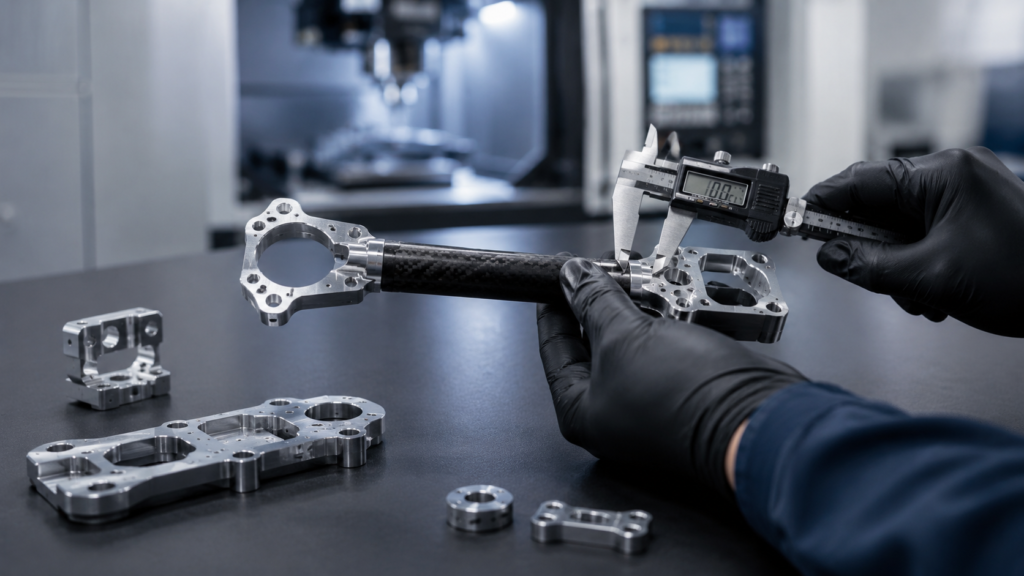
In UAV parts machining, buyers care about whether the part can help the aircraft fly longer, carry the payload safely, and remain stable under vibration. Weight matters, but it is only one part of the decision.
This is especially important for commercial small unmanned aircraft systems. Under U.S. small UAS regulations, a small unmanned aircraft is defined as an unmanned aircraft weighing less than 55 pounds on takeoff, including everything on board or attached to it. This makes weight control a practical design factor for many commercial drone platforms. [1]
Weight Reduction Must Protect Structure
A lighter part is not always a better part. If a drone arm becomes too thin, the motor mount may vibrate. If a housing is too aggressively pocketed, it may deform after assembly. If the thread engagement is too short, fasteners may loosen during repeated flights.
The better question is not “How much weight can we remove?” but “Where can we remove material without weakening the load path?” In long-endurance UAV development, lighter and more compact structures are often connected with longer operating time and better mission flexibility, which is why weight control should be treated as an engineering decision rather than a simple cost-cutting step. [2]
Key Performance Indicators for UAV Parts
| Requirement | Why It Matters |
| Low weight | Improves endurance and payload capacity |
| High stiffness | Reduces vibration and deformation |
| Strength-to-weight ratio | Supports load-bearing parts without excess mass |
| Fatigue resistance | Handles repeated takeoff, landing, and vibration |
| Accurate hole position | Keeps motors, sensors, arms, and housings aligned |
| Thread quality | Prevents loose fasteners and field assembly problems |
| Surface protection | Resists moisture, oxidation, and outdoor exposure |
| Batch repeatability | Keeps prototype and production parts consistent |
Common Parts in Drone CNC Machining
Drone CNC machining is useful when parts need accurate holes, strong threads, clean edges, tight fitting, and better material performance than many standard printed or molded parts.
Structural, Payload, Housing, and Motion Parts
Common CNC machined drone and UAV parts include:
- Drone frames and center plates
- Arms and arm connectors
- Motor mounts
- Gimbal and camera brackets
- Payload mounting plates
- Sensor brackets
- Battery trays and holders
- Heat sinks and thermal plates
- GPS or antenna mounts
- Landing gear connectors
- Spacers, bushings, shafts, and pins
- Lightweight housings and covers
- Prototype fixtures and test parts
For industrial UAVs, these parts often sit in critical areas where poor alignment, weak threads, or excess vibration may affect the whole system.
UAV Part Category Table
| Part Category | Typical Examples | Main Concern |
| Structural parts | Frames, arms, center plates | Weight, stiffness, fatigue resistance |
| Power system parts | Motor mounts, heat sinks, battery holders | Heat, vibration, thread strength |
| Payload parts | Camera mounts, gimbal brackets, sensor plates | Alignment, flatness, vibration control |
| Enclosure parts | Housings, covers, antenna shells | Weight, protection, appearance |
| Motion parts | Spacers, bushings, shafts, pins | Concentricity, fit, wear resistance |
| Prototype parts | Test frames, trial brackets | Fast iteration and design flexibility |
Recommended Materials for Lightweight CNC Machined Drone Parts
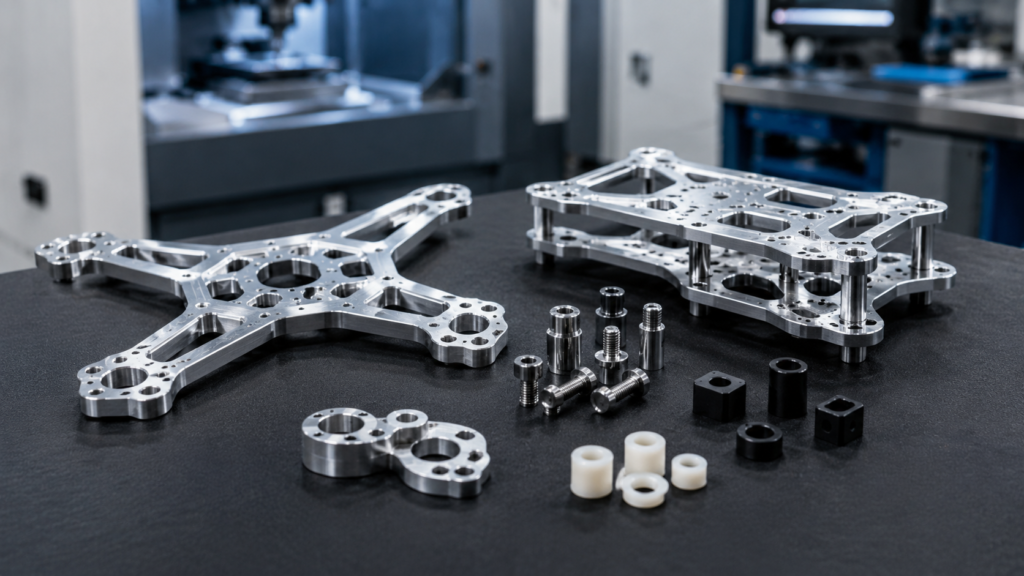
Material selection for lightweight CNC machined drone parts should balance density, strength, machinability, corrosion resistance, cost, surface treatment, and delivery time.
Aluminum, Titanium, Magnesium, and Engineering Plastics
Aluminum 6061 is often the most practical starting point for UAV brackets, housings, covers, and general structural parts. It machines well, supports anodizing, and offers a strong cost-performance balance.
Aluminum 7075 is suitable for higher-load frames, arms, and mounting structures where strength-to-weight ratio matters more. Titanium is used when compact parts need high strength and corrosion resistance. Magnesium can reduce weight further, but corrosion protection and handling should be reviewed carefully.
Engineering plastics such as PEEK, POM, and nylon can reduce weight, provide insulation, and support low-friction or non-metallic contact areas.
Material Selection Table
| Material | Best For | Advantage | Watch Point |
| Aluminum 6061 | Brackets, covers, housings | Balanced cost and machinability | Lower strength than 7075 |
| Aluminum 7075 | Frames, arms, high-load mounts | High strength-to-weight ratio | Higher cost, finishing control needed |
| Titanium | Compact premium load-bearing parts | Strong, corrosion resistant | Higher machining cost |
| Magnesium | Ultra-lightweight structures | Very low density | Corrosion and handling concerns |
| Stainless steel | Pins, shafts, wear parts | Strength and durability | Heavier than aluminum |
| PEEK | Insulating or high-performance parts | Heat and chemical resistance | Higher material cost |
| POM / Nylon | Spacers, guides, bushings | Lightweight and low friction | Check moisture and temperature limits |
Recommended Processes for Drone Frame Machining
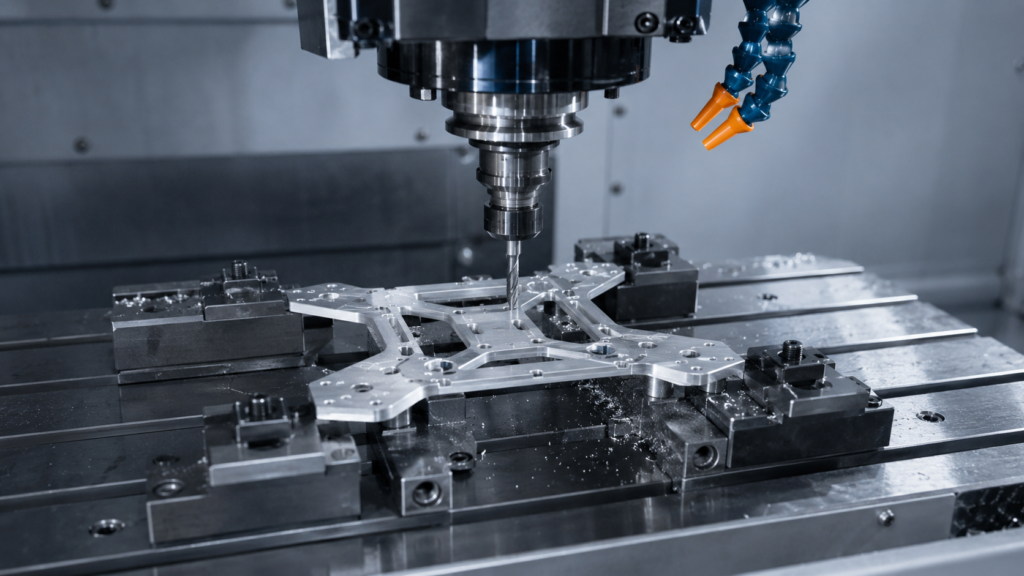
Drone frame machining often involves thin walls, pockets, slots, hole arrays, threaded features, and multi-side structures. The CNC process should be selected according to geometry, tolerance, material, and quantity.
CNC Milling, Turning, Wire Cutting, and 5-Axis Machining
| CNC Process | Suitable UAV Parts | Why It Fits |
| CNC milling | Frames, brackets, housings, plates | Good for pockets, holes, slots, and flat surfaces |
| CNC turning | Spacers, shafts, bushings, sleeves | Good for round and concentric parts |
| Turning-milling | Round parts with holes or flats | Reduces secondary setups |
| 5-axis machining | Complex brackets, angled mounts | Improves access and reduces setup error |
| Wire cutting | Thin plates and accurate profiles | Useful for precise flat shapes |
| Sheet metal + CNC | Covers, trays, lightweight panels | Efficient for formed structures |
5-axis machining is especially helpful when UAV parts include angled faces, multi-side mounting features, or lightweight pockets that are difficult to machine accurately in multiple setups.
Process Selection by Geometry
| Part Geometry | Recommended Process |
| Flat frame plate with holes | CNC milling or wire cutting |
| Lightweight bracket with angled faces | 5-axis machining |
| Round spacer or bushing | CNC turning |
| Motor mount with pockets and threads | CNC milling |
| Complex housing with multi-side features | CNC milling or 5-axis machining |
| Shaft with side holes | Turning-milling |
Surface Finishes for Drone Housing Machining
For drone housing machining, surface finish is not only cosmetic. UAV parts may face outdoor moisture, dust, sunlight, temperature changes, handling wear, and repeated assembly.
Surface Treatment Options
| Surface Treatment | Suitable Material | Main Purpose |
| Anodizing | Aluminum | Corrosion resistance, color, surface durability |
| Hard anodizing | Aluminum | Wear resistance and stronger surface protection |
| Sandblasting | Aluminum, stainless steel | Uniform matte texture |
| Polishing | Aluminum, stainless steel, brass | Smooth or visible surface improvement |
| Passivation | Stainless steel | Corrosion resistance |
| Nickel plating | Steel, brass, copper | Wear resistance, conductivity, corrosion protection |
| Black oxide | Steel | Dark appearance and mild protection |
| Powder coating | Aluminum, steel | Durable color and outdoor protection |
Finish Selection by Working Condition
| UAV Requirement | Suggested Finish |
| Outdoor use | Anodizing, hard anodizing, powder coating |
| Visible housing | Sandblast + anodizing |
| High-wear mounting area | Hard anodizing or stronger material |
| Stainless small hardware | Passivation |
| Conductive component | Plating or controlled bare metal surface |
| Camera or optical bracket | Matte black anodizing |
| Prototype testing | As-machined or simple anodizing |
Surface treatment should be confirmed before production because coating thickness can affect tight holes, threads, bearing fits, and assembly clearance.
Inspection Methods for CNC Machining Aerospace Parts Used in UAVs
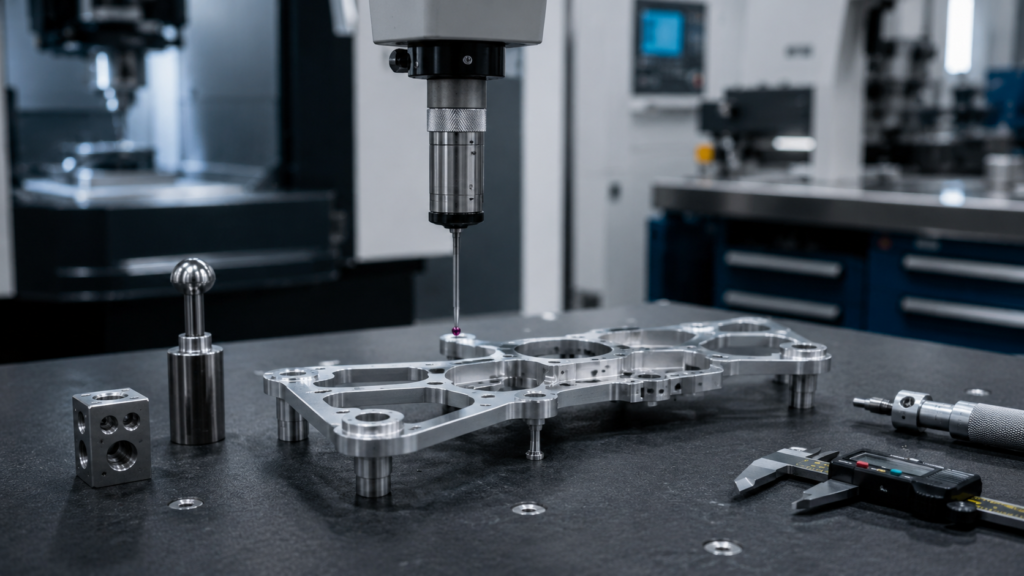
Many UAV buyers use aerospace-style thinking even when the drone part is not formally aerospace-certified. For cnc machining aerospace parts used in UAV systems, inspection should focus on whether the part can assemble correctly and perform reliably.
What to Inspect Before Assembly?
Important inspection points include:
- Overall weight
- Mounting hole position
- Flatness of assembly surfaces
- Thread depth and quality
- Shaft and bushing diameters
- Critical outer dimensions
- Surface roughness where needed
- Burrs and sharp edges
- Coating thickness
- Fit with mating parts
- Visual finish consistency
UAV Machining Inspection Checklist
| Inspection Method | What It Checks |
| Calipers and micrometers | General size, thickness, diameter |
| Height gauge | Step height and flatness-related checks |
| CMM inspection | Hole position and datum relationship |
| Thread gauge | Internal and external thread quality |
| Pin gauge | Hole fit and size |
| Surface roughness tester | Functional contact surfaces |
| Coating thickness gauge | Anodizing, plating, or coating buildup |
| Visual inspection | Burrs, scratches, dents, finish defects |
| Assembly fit check | Compatibility with mating parts |
Common Risks in Custom UAV Component Machining
Custom UAV component machining often fails when weight reduction is treated as the only goal. A part may look optimized in CAD but still perform poorly after machining, coating, and assembly.
Over-Lightweighting and Vibration Risks
| Risk | Possible Result | Prevention |
| Thin walls without support | Deformation during machining or flight | Add ribs, radii, or thicker mounting zones |
| Too many pockets | Reduced stiffness | Keep material around load paths |
| Weak thread depth | Fastener loosening | Use proper engagement or inserts |
| Sharp internal corners | Stress concentration | Add internal radii |
| Poor datum design | Assembly mismatch | Define functional datum surfaces |
| Ignored vibration | Sensor instability | Review stiffness and mounting strategy |
Burr, Coating, and Assembly Risks
Other common risks include burrs around cross holes, anodizing buildup in threads, scratches on visible housings, tool marks on sealing faces, inconsistent batch appearance, and part deformation after aggressive material removal.
Regulation is also pushing drone hardware toward better traceability and reliable system integration. FAA Remote ID rules require compliant drones or broadcast modules to transmit identification and location information, while drones without Remote ID are limited to FAA-Recognized Identification Areas. [3]
How SinoRise Supports UAV CNC Machining Projects?
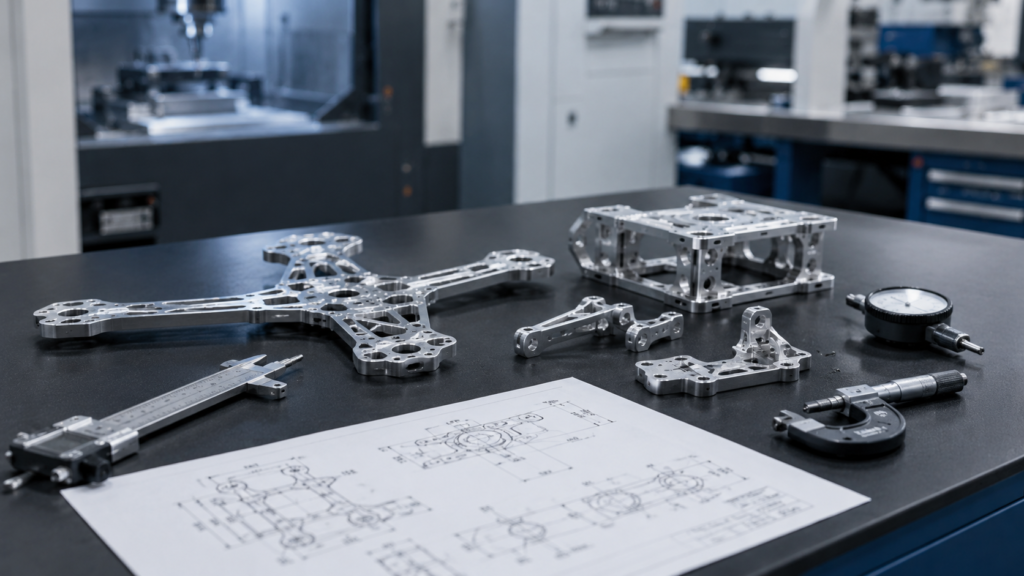
SinoRise supports custom UAV parts machining from prototype to small and medium-batch production. For drone and UAV system buyers, the value is not only cutting the part, but helping review the design, material, tolerance, finish, and inspection plan before production starts.
SinoRise highlights prototype-to-production CNC machining support, precision machining capability up to ±0.005mm, 35+ surface finishing options, and 80+ metals and plastics available. These capabilities are useful for UAV projects where material, tolerance, surface finish, and delivery need to be reviewed together. [4]
SinoRise can support:
- Drawing and DFM review
- Material selection for lightweight drone parts
- CNC milling, CNC turning, turning-milling, wire cutting, and 5-axis machining
- Aluminum 6061, 7075, titanium, stainless steel, magnesium, PEEK, POM, and other materials
- Surface treatment coordination
- Critical dimension inspection
- Prototype iteration
- Small and medium-batch delivery
- One-stop support for frames, brackets, housings, spacers, mounts, and precision parts
For weight-sensitive components, SinoRise can help buyers identify which features should remain tightly controlled and which areas can be optimized for cost, weight, and manufacturability.
FAQ About UAV Parts Machining
What Is UAV Parts Machining?
UAV parts machining refers to CNC manufacturing of custom parts used in drones and unmanned aerial systems, including frames, arms, housings, brackets, mounts, spacers, shafts, and payload-related components.
What Materials Are Best for Lightweight Drone Parts?
Aluminum 6061 is a balanced choice for many drone parts. Aluminum 7075 is better for high-strength lightweight structures. Titanium, magnesium, PEEK, POM, and stainless steel may be used when strength, insulation, wear resistance, or corrosion resistance is more important.
Is CNC Machining Suitable for Drone Frames?
Yes. CNC machining is suitable for drone frames when the design needs accurate holes, lightweight pockets, strong threads, stiff mounting areas, and repeatable production quality.
What Is the Best Surface Finish for Aluminum Drone Parts?
Anodizing is commonly used for aluminum drone parts because it improves corrosion resistance, appearance, and surface durability. Hard anodizing is better for wear areas, while sandblast + anodizing is often used for visible housings.
How Can Drone Parts Be Made Lighter Without Losing Strength?
Use proper material selection, remove weight only from non-critical areas, keep material around load paths, add ribs or radii, avoid weak thread zones, and confirm stiffness through design review and testing.
What Should Be Included in a Drone CNC Machining RFQ?
A strong RFQ should include 3D files, 2D drawings, material requirements, tolerances, surface treatment, weight target, critical dimensions, batch quantity, application environment, and inspection requirements.
Can SinoRise Support Prototype and Small-Batch UAV Parts?
Yes. SinoRise supports custom UAV and drone parts from prototype to small and medium-batch production, including CNC milling, turning, turning-milling, 5-axis machining, surface treatment coordination, and inspection support.
Conclusion
Lightweight machined parts for drone and UAV systems require more than removing material. The best parts balance low weight, stiffness, strength, vibration resistance, precision assembly, surface protection, and repeatable inspection.
For buyers, the most effective sourcing approach is to define the part’s role first: structural, payload, power system, housing, thermal, or assembly function. Then choose the material, CNC process, surface finish, and inspection plan around that function.
SinoRise can support UAV parts machining projects with engineering review, multi-process CNC manufacturing, material selection, surface treatment, and inspection planning. For drone frames, housings, brackets, motor mounts, spacers, and lightweight precision components, the right manufacturing partner can help turn a weight-sensitive design into a reliable flight-ready part.
References
[1] eCFR — 14 CFR Part 107, Small Unmanned Aircraft Systems. The definition section states that a small unmanned aircraft weighs less than 55 pounds on takeoff, including everything on board or attached.
[2] NASA Technology Transfer Program — New UAV designs and long-endurance UAV development, including a vertical takeoff UAV concept capable of 24-hour flight.
[3] Federal Aviation Administration — Remote Identification of Drones. FAA explains that Standard Remote ID drones or broadcast modules transmit identification and location information, while non-Remote-ID drones are limited to FAA-Recognized Identification Areas.
[4] SinoRise official website — CNC machining services from prototype to production, including precision capability, 5-axis capabilities, surface finishing options, and available metals and plastics.