
Quick Answer
Semiconductor CNC machining requires stable materials, tight tolerances, clean surfaces, reliable inspection, and fixture designs that control positioning, particles, thermal change, and repeatability.
Key Takeaways
- Semiconductor fixtures are used to hold, align, support, transfer, or test sensitive parts during production and assembly.
- Buyers care most about precision, cleanliness, stability, repeatability, burr control, and material compatibility.
- Common materials include aluminum alloys, stainless steel, PEEK, POM, PTFE, copper, and engineering plastics.
- Precision CNC machining is often combined with anodizing, passivation, polishing, electropolishing, or cleaning requirements.
- Inspection should focus on critical dimensions, flatness, hole position, surface roughness, burrs, and functional fitting.
- A good supplier should review drawings, material choice, surface treatment, tolerances, and application risks before quoting.
Abstract
Semiconductor equipment and fixture parts are not ordinary machined components. They are often used around wafer handling, inspection, automation, testing, packaging, and clean manufacturing environments. In these applications, a small dimensional error, burr, unstable material, or unsuitable surface finish may affect assembly accuracy, product yield, or equipment reliability.
This guide explains the main design and material considerations for semiconductor cnc machining fixtures. It covers common fixture part types, key performance indicators, recommended materials, CNC machining processes, surface treatment options, inspection methods, and common risks. It also shows how Sino-V-Rise can support buyers with semiconductor CNC precision machining, engineering review, multi-process production, surface finishing, and quality inspection.
Why Semiconductor CNC Machining Fixtures Need Higher Control?
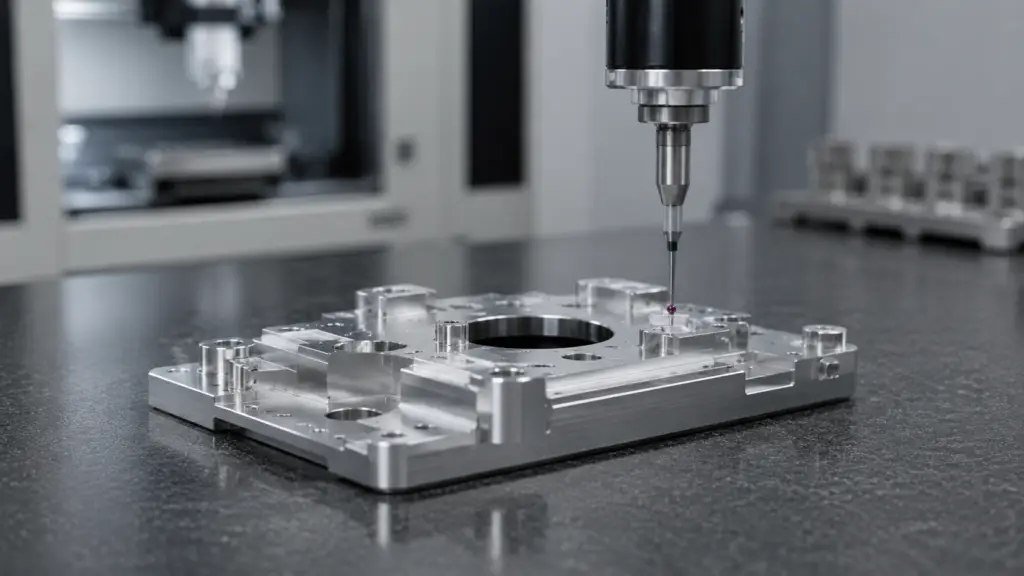
Semiconductor CNC machining fixtures need higher control because they often work in precision equipment, automated systems, clean environments, or testing processes. These parts may not be the final chip product, but they help keep semiconductor manufacturing and inspection processes stable.
A fixture may hold a wafer-related component, position a test module, guide a sensor, support a vacuum plate, or align a precision assembly. If the fixture is not stable, accurate, or clean enough, the problem may appear later as poor alignment, assembly deviation, extra particles, test inconsistency, or repeated adjustment.
What Semiconductor Buyers Care About Most?
When semiconductor equipment buyers purchase CNC machined fixtures, they usually care about more than price. The main concerns are:
| Buyer Concern | Why It Matters |
| Dimensional accuracy | Helps ensure stable assembly and positioning |
| Repeatability | Reduces variation between batches and replacement parts |
| Flatness and parallelism | Important for plates, carriers, bases, and contact surfaces |
| Clean surface | Reduces particle and contamination risk |
| Burr control | Prevents scratches, assembly interference, and loose particles |
| Material stability | Reduces deformation, corrosion, outgassing, or wear |
| Surface treatment compatibility | Protects parts without affecting tolerance or cleanliness |
| Inspection documentation | Helps verify critical dimensions before installation |
For this reason, semiconductor fixture sourcing should begin with function, not just drawing size.
How AI and Advanced Packaging Increase Fixture Requirements?
AI chips, advanced packaging, and high-density electronic devices are pushing semiconductor equipment toward higher precision and more complex processes. This increases demand for reliable machine parts semiconductor manufacturing suppliers that can support small-batch, high-mix, and precision fixture production.
For CNC buyers, this means fixtures need better design review, stable production repeatability, controlled surface quality, and clearer inspection requirements.
Common Machine Parts for Semiconductor Manufacturing
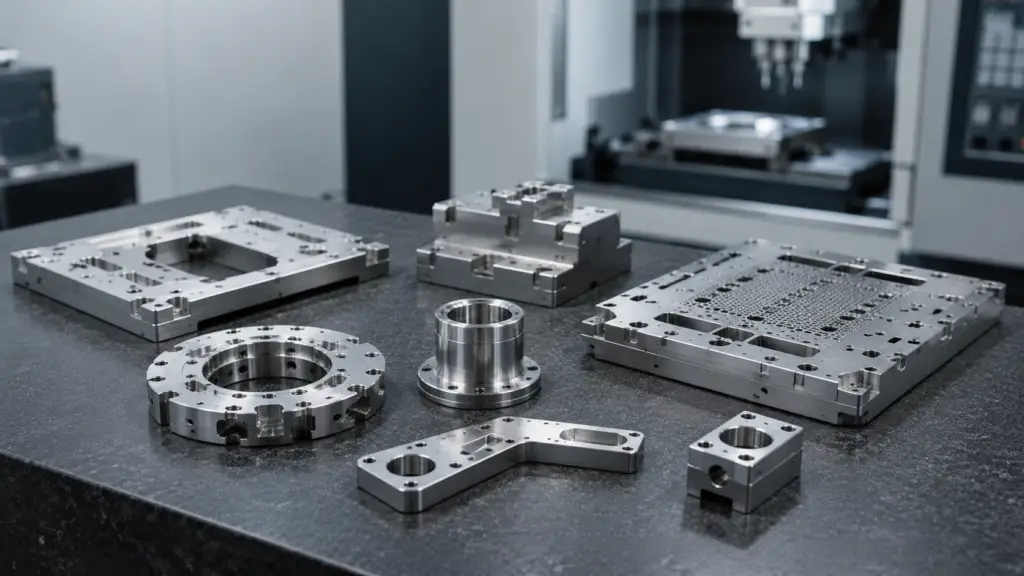
Machine parts semiconductor manufacturing projects often include fixtures, plates, brackets, carriers, housings, positioning blocks, and test tooling. These parts are usually customized according to the equipment structure, assembly method, and process environment.
Typical Semiconductor Fixture and Tooling Parts
Common CNC machined semiconductor fixture parts include:
Wafer handling fixture components
Test fixture plates
Vacuum fixture plates
Sensor mounting brackets
Precision alignment blocks
Inspection tooling plates
Automation transfer parts
Module support frames
Probe or test station components
Clean equipment hardware
Positioning pins, bushings, and spacers
Custom aluminum or stainless steel plates
These parts may look simple, but their real value lies in accuracy, stability, and reliable repeat use.
Fixture Function Table by Application
| Fixture Type | Main Function | Key Machining Requirement |
| Tooling plate | Supports and locates modules | Flatness, hole position, surface finish |
| Vacuum plate | Holds parts by suction | Sealing surface, hole quality, flatness |
| Alignment block | Controls positioning | Tight tolerance, datum accuracy |
| Sensor bracket | Holds optical or inspection parts | Stability, hole position, vibration control |
| Test fixture | Supports electrical or functional testing | Repeatability, insulating or conductive material choice |
| Carrier component | Transfers or supports parts | Lightweight, wear resistance, clean edges |
This application-based view helps buyers match fixture design with real working needs.
Key Design Considerations for Semiconductor CNC Precision Machining
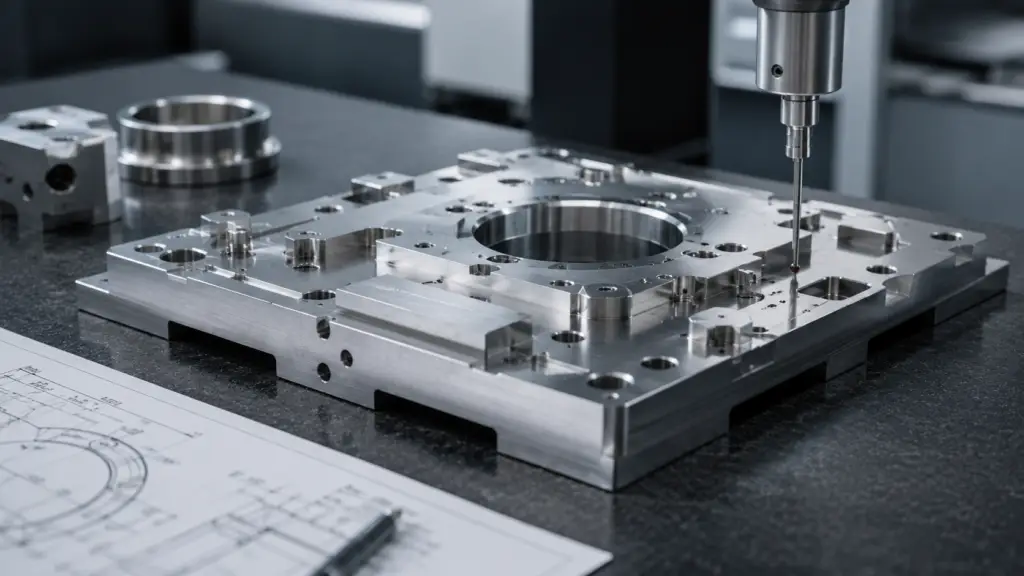
Semiconductor cnc precision machining should consider tolerance, flatness, datum design, burr control, surface quality, and material behavior at the same time. If these factors are handled separately, the final part may meet one requirement but fail in assembly.
Tolerance, Flatness, and Datum Control
For semiconductor fixtures, not every dimension needs extreme tolerance. The most important areas are usually locating holes, mounting faces, sealing surfaces, sensor positions, and datum references.
A better drawing should clearly define:
Critical-to-function dimensions
Datum surfaces
Hole position tolerance
Flatness and parallelism requirements
Threaded hole depth
Surface roughness for sealing or contact areas
Areas that require masking before surface treatment
This avoids unnecessary cost while keeping the truly important surfaces under control.
Burr Control, Chamfers, Holes, and Clean Edges
Burrs are a major risk in semiconductor fixture parts. A small burr may interfere with assembly, scratch a contact surface, or become a loose particle.
Important design notes include:
Add proper chamfers or edge breaks
Avoid deep blind holes when cleaning is difficult
Define burr-free requirements for critical edges
Avoid sharp internal corners when possible
Confirm whether threaded holes require plug protection during finishing
Mark areas where no blasting media or coating residue is allowed
For clean manufacturing environments, “deburring” should not be treated as a simple cosmetic step. It is part of functional quality control.
Recommended Materials for CNC Machined Semiconductor Fixtures
Material selection for CNC machined semiconductor fixtures should balance strength, machinability, stability, corrosion resistance, weight, insulation, conductivity, and cleanability.
Metal Material Selection
| Material | Main Advantages | Typical Use |
| Aluminum 6061 | Good machinability, lightweight, cost-effective | Plates, brackets, housings, general fixtures |
| Aluminum 7075 | Higher strength and rigidity | High-load lightweight fixtures |
| Stainless steel 304 | Corrosion resistance, stable structure | Clean hardware, brackets, support parts |
| Stainless steel 316 | Better corrosion resistance | More demanding clean or chemical environments |
| Copper | Good electrical and thermal conductivity | Conductive parts, heat-related components |
| Tool steel | Wear resistance after treatment | Positioning or repeated-contact components |
Aluminum is often used when weight and machinability matter. Stainless steel is better when corrosion resistance and durability are more important. Copper is selected when conductivity or heat transfer is required.
Engineering Plastic Selection
| Material | Main Advantages | Typical Use |
| PEEK | High temperature resistance, strength, chemical resistance | High-performance insulating fixtures |
| POM / Delrin | Good machinability, low friction | Positioning parts, guide blocks |
| PTFE | Low friction, chemical resistance | Non-stick or isolation parts |
| Nylon | Tough and wear-resistant | General non-metallic components |
| PC | Transparent and impact-resistant | Covers, inspection-related parts |
Engineering plastics can reduce weight, provide insulation, or protect delicate parts. However, buyers should confirm dimensional stability, moisture absorption, and temperature conditions before selection.
Recommended CNC Processes and Surface Treatments
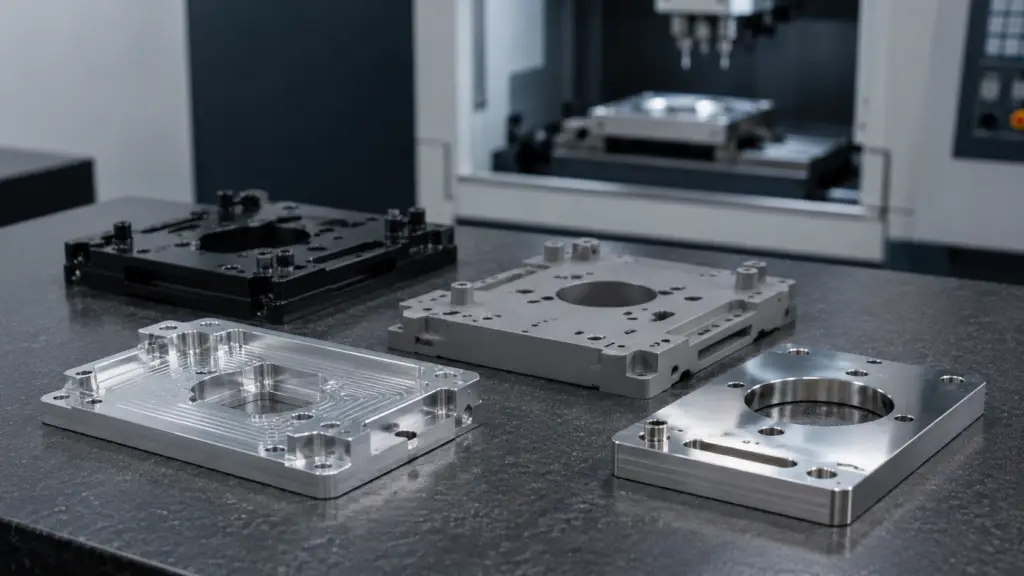
The recommended process depends on part geometry, tolerance, material, surface requirement, and batch size. For many semiconductor fixtures, several processes may be combined.
CNC Milling, Turning, Turning-Milling, and 5-Axis Machining
| Process | Best For | Fixture Application |
| CNC milling | Plates, pockets, slots, flat surfaces | Tooling plates, brackets, fixture bases |
| CNC turning | Round parts, pins, bushings, spacers | Positioning pins, sleeves, shafts |
| CNC turning-milling | Complex round parts with holes or flats | Custom connectors, combined-axis components |
| 5-axis CNC machining | Complex angles and multi-face machining | Complex brackets, high-precision fixture parts |
| Wire cutting | Sharp profiles and precise shapes | Thin plates, special profiles, tooling inserts |
For fixture parts with many holes, pockets, and mounting features, CNC milling is usually the main process. For complex multi-angle parts, 5-axis CNC machining may reduce setups and improve positional consistency.
Surface Finish and Treatment Selection
| Surface Treatment | Purpose | Notes |
| As-machined | Fast, cost-effective | Suitable for non-visible or internal parts |
| Anodizing | Corrosion resistance and surface protection | Common for aluminum fixtures |
| Hard anodizing | Wear resistance | Useful for repeated-contact aluminum parts |
| Passivation | Corrosion resistance | Common for stainless steel |
| Electropolishing | Smooth and cleaner surface | Useful for stainless steel clean parts |
| Polishing | Smoother contact or visible surface | May affect dimensions if overused |
| Sandblasting | Uniform matte texture | Avoid unprotected precision holes or sealing surfaces |
Surface treatment should be selected together with tolerance. Coating thickness, masking, polishing removal, and surface texture may all affect final assembly.
Recommended Inspection Methods for Precision CNC Machining
For precision CNC machining, inspection should focus on whether the fixture can perform its intended function, not only whether it looks good.
Dimensional and Geometric Inspection
Recommended inspection methods include:
| Inspection Method | What It Checks |
| CMM inspection | Hole position, datum relationship, complex geometry |
| 2.5D optical measurement | Profiles, holes, edges, small features |
| Height gauge | Flatness-related height checks and step dimensions |
| Surface roughness tester | Ra values on sealing or contact surfaces |
| Thread gauge | Thread quality and fit |
| Pin gauge | Hole size and fit |
| Visual inspection | Burrs, scratches, coating defects, surface consistency |
Critical dimensions should be marked on the drawing so the supplier knows which features require detailed inspection records.
Surface, Burr, and Assembly Inspection
For semiconductor fixtures, final inspection should also include:
Burr-free edge check
Coating and color consistency
Masking area confirmation
Clean hole and thread check
Flatness of contact surfaces
Trial assembly if mating parts are available
Packaging protection for precision surfaces
A good inspection plan reduces risk before the part reaches the equipment assembly stage.
Common Risks in Semiconductor Fixture Machining
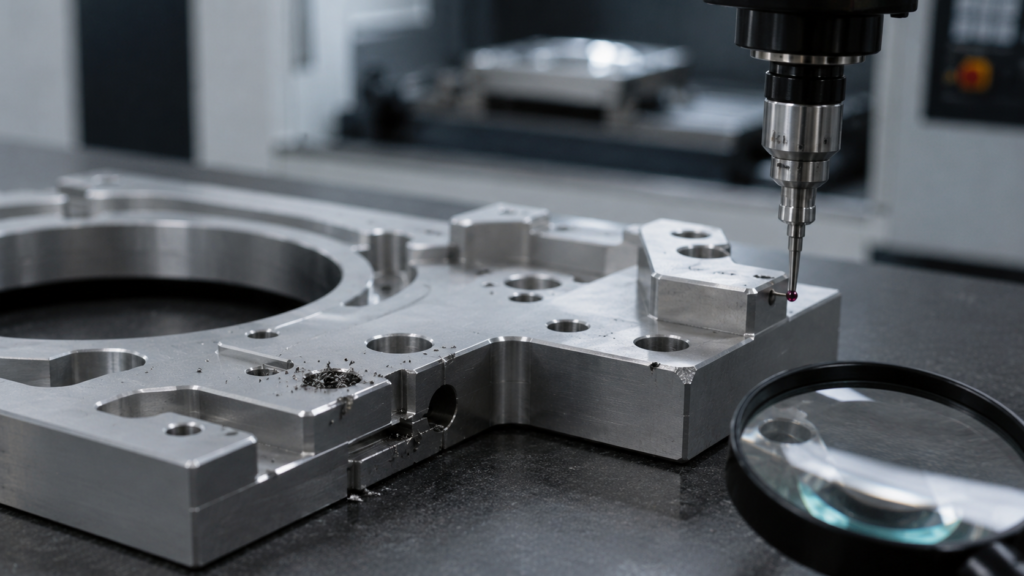
Semiconductor fixture projects often fail not because CNC machining is impossible, but because design, material, finishing, and inspection requirements are not aligned early enough.
Over-Specification and Hidden Cost
Over-specification happens when every surface is assigned tight tolerance, low Ra, or premium finishing even when only a few surfaces are functional. This can increase cost and lead time without improving performance.
A better approach is to separate the following:
Critical surfaces
Assembly surfaces
Cosmetic surfaces
Non-critical surfaces
This helps the supplier control the right features and keep the project practical.
Material, Coating, and Cleaning Risks
Common risks include:
Aluminum deformation during thin-wall machining
Stainless steel work hardening
Plastic dimensional change due to moisture or temperature
Coating buildup in holes
Blasting media trapped in small features
Burrs inside cross holes
Polishing that changes sharp edges or flatness
Packaging damage during shipping
These risks should be reviewed before production, especially for small-batch semiconductor fixture projects with tight delivery schedules.
How Sino-V-Rise Supports Semiconductor Fixture Projects?
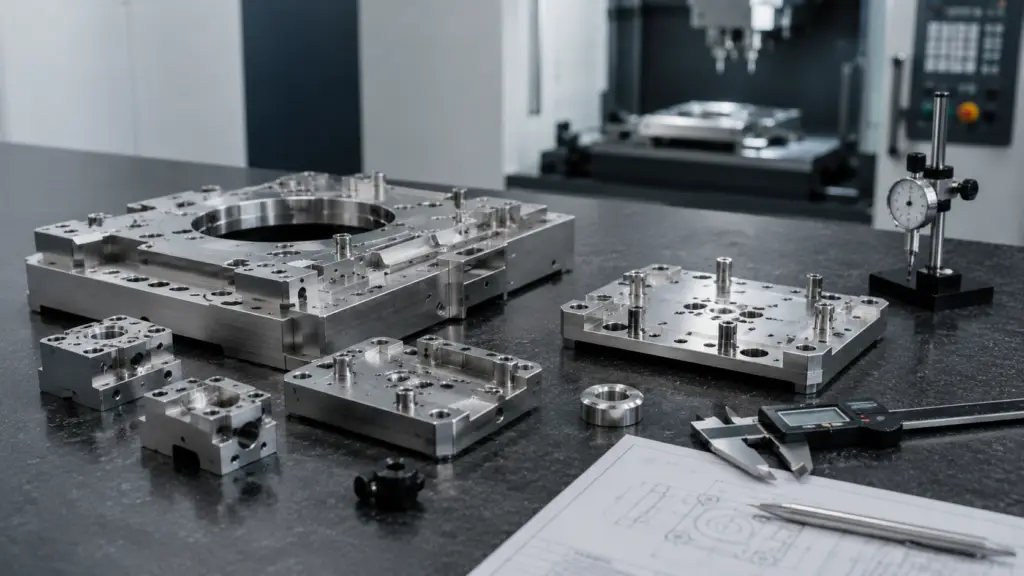
(图片alt:How Sino-V-Rise Supports Semiconductor Fixture Projects)
Sino-V-Rise supports custom semiconductor cnc machining projects from drawing review to machining, finishing, inspection, and delivery. For semiconductor fixtures, the focus is not only producing the part, but also helping buyers reduce uncertainty before production.
Sino-V-Rise can support buyers with:
Drawing and DFM review
Material selection suggestions
CNC milling, CNC turning, turning-milling, wire cutting, and 5-axis machining
Aluminum, stainless steel, copper, PEEK, POM, PTFE, and other material options
Surface treatment coordination
Critical dimension inspection
Small and medium-batch production support
Prototype-to-production manufacturing
For buyers in semiconductor equipment, automation, optical inspection, robotics, and precision instruments, this one-stop support helps turn technical drawings into reliable machined parts.
FAQ About Semiconductor CNC Machining Fixtures
What Is Semiconductor CNC Machining?
Semiconductor CNC machining refers to the production of precision components used in semiconductor equipment, testing, automation, inspection, packaging, and related manufacturing processes.
What Parts Are Commonly CNC Machined for Semiconductor Equipment?
Common parts include fixture plates, vacuum plates, brackets, carriers, alignment blocks, sensor mounts, test fixtures, positioning pins, spacers, housings, and tooling components.
What Materials Are Best for Semiconductor Fixtures?
Aluminum 6061, aluminum 7075, stainless steel 304/316, copper, PEEK, POM, PTFE, and other engineering plastics are commonly used. The best choice depends on weight, strength, conductivity, insulation, cleanliness, and working temperature.
Is Aluminum Suitable for Semiconductor Fixture Parts?
Yes. Aluminum is lightweight, easy to machine, and suitable for many fixture plates, brackets, and housings. It is often combined with anodizing or hard anodizing for better surface protection.
When Should Stainless Steel Be Used?
Stainless steel is suitable when the part needs better corrosion resistance, higher durability, cleaner surfaces, or stronger mechanical performance in demanding environments.
Why Is Burr Control Important in Semiconductor Fixtures?
Burrs may cause assembly interference, scratches, loose particles, or unstable positioning. For semiconductor applications, burr-free edges and clean holes are important quality requirements.
What Surface Finish Is Recommended for Semiconductor CNC Parts?
It depends on function. As-machined finish may be enough for non-critical parts. Anodizing, hard anodizing, passivation, polishing, or electropolishing may be used when corrosion resistance, cleanliness, wear resistance, or smoother surfaces are required.
What Should Be Included in an RFQ for Semiconductor Fixtures?
A good RFQ should include drawings, material requirements, critical dimensions, surface finish, surface treatment, tolerance notes, clean or burr-free requirements, quantity, application environment, and inspection needs.
Conclusion
Semiconductor CNC machining fixtures require more than accurate cutting. They require the right material, stable design, controlled tolerance, clean edges, suitable surface treatment, and reliable inspection.
For semiconductor buyers, the best sourcing strategy is to define how the fixture will be used first. Then choose materials, CNC processes, surface finishes, and inspection methods based on function. This helps avoid over-specification, reduce production risk, and improve repeatability.
Sino-V-Rise helps customers produce custom semiconductor fixtures and precision machined parts through multi-process CNC machining, engineering review, surface treatment coordination, and quality inspection support. For projects involving fixtures, tooling plates, brackets, vacuum plates, carriers, or test components, Sino-V-Rise can provide practical manufacturing support from prototype to small and medium-batch production.