
Quick Answer
Choose 6061 for balanced CNC aluminum machining, corrosion resistance, cost, and anodized appearance. Choose 7075 for high-stress, lightweight parts where strength outweighs price and corrosion trade-offs with engineering support first.
Key Takeaways
- 6061 aluminum is usually the safer default for balanced CNC machining aluminum projects.
- 7075 aluminum offers much higher strength but requires closer control of cost, corrosion protection, and finishing.
- For cosmetic anodizing, outdoor exposure, welded structures, or budget-sensitive parts, 6061 is often preferred.
- For drone frames, robotic arms, aerospace-style brackets, and high-load fixtures, 7075 can be worth the premium.
- Final selection should consider load, environment, tolerance, finish, batch size, and inspection requirements.
Abstract
6061 and 7075 are two of the most common alloys for aluminum cnc machining parts, but they solve different engineering problems. 6061 belongs to the 6xxx aluminum family, which The Aluminum Association describes as versatile, heat-treatable, formable, weldable, and corrosion-resistant; 7075 belongs to the 7xxx family, where zinc-based alloys are known for very high strength and aircraft-industry use.
For CNC buyers, the practical rule is simple: choose 6061 when you need balanced performance, easier machining, better corrosion resistance, and cleaner anodized appearance. Choose 7075 when strength-to-weight ratio, fatigue resistance, or structural load capacity matters more than price and corrosion simplicity.
6061 vs. 7075 Aluminum at a Glance: CNC Machining Aluminum
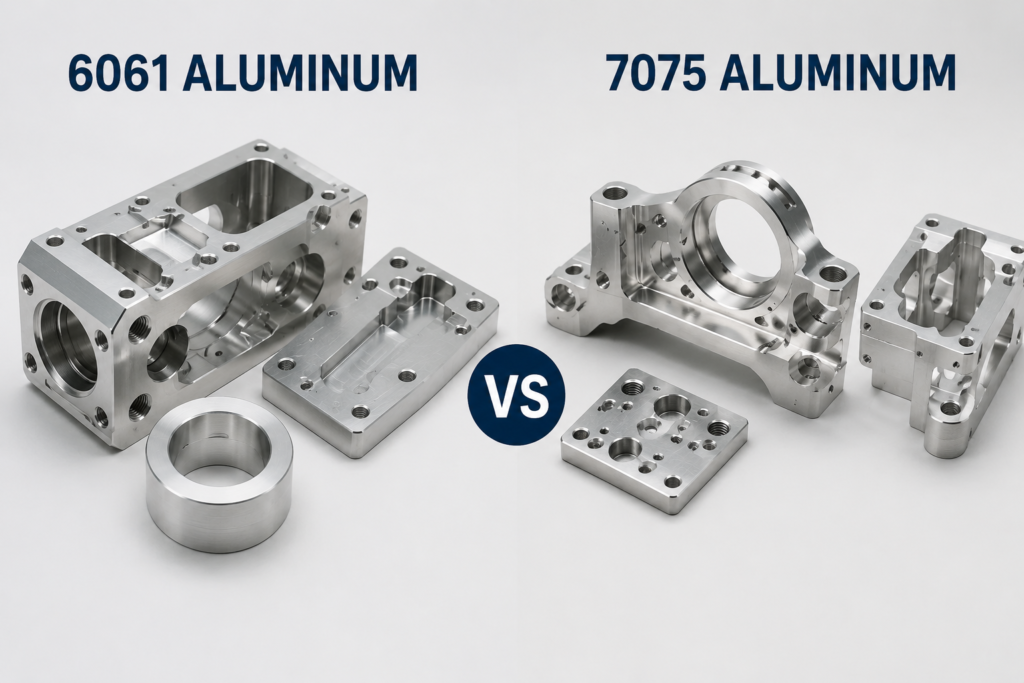
| Factor | 6061-T6 Aluminum | 7075-T6 Aluminum | CNC Machining Meaning |
| Tensile strength | About 310 MPa | About 572 MPa | 7075 is much stronger for loaded parts. |
| Yield strength | About 276 MPa | About 503 MPa | 7075 resists permanent deformation better. |
| Corrosion resistance | Better | Lower, especially without protection | 6061 is safer for outdoor or humid use. |
| Machinability | Good and widely used | Good, but harder and more demanding | 7075 may need closer toolpath and fixturing control. |
| Forming/welding | Better | Poorer | 6061 fits welded or formed assemblies better. |
| Anodizing appearance | More consistent | Can be less uniform | 6061 is often better for cosmetic finishes. |
| Cost | Lower | Higher | 6061 is better for budget-sensitive parts. |
ASM/MatWeb lists typical 6061-T6 tensile yield strength at 276 MPa and ultimate tensile strength at 310 MPa, while 7075-T6 is listed around 503 MPa yield and 572 MPa ultimate tensile strength.
Selection Table: Budget, Strength, Corrosion, and Anodizing aluminum cnc machining parts
| Priority | Recommended Alloy | Why It Fits | Typical CNC Parts |
| Budget priority | 6061 | Lower material cost, easier sourcing, efficient machining | Housings, brackets, covers, fixtures |
| Strength priority | 7075 | Much higher yield and tensile strength | Drone frames, robotic arms, load-bearing plates |
| Corrosion priority | 6061 | Better natural corrosion resistance and coating acceptance | Outdoor parts, marine-adjacent hardware, equipment covers |
| Anodized appearance priority | 6061 | More stable cosmetic anodizing and color consistency | Consumer-facing housings, panels, optical instrument parts |
| Lightweight high-load priority | 7075 | Strong strength-to-weight ratio | UAV structures, motorsport parts, aerospace-style components |
| Welded or formed assembly | 6061 | Better weldability and formability | Frames, welded brackets, machine guards |
Why 6061 Is More Balanced for CNC Aluminum Machining: Machining 6061-T6 Aluminum
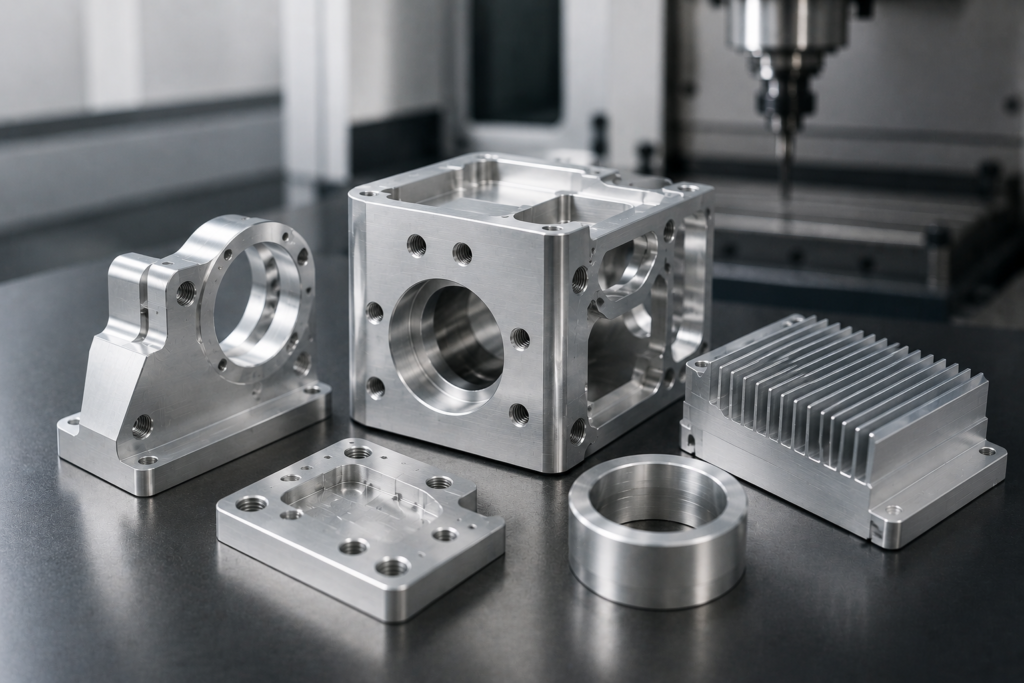
6061 is often the first choice when engineers want predictable CNC results without overpaying for strength they may not need. It machines well, supports milling and turning, accepts many surface finishes, and performs reliably in general mechanical environments. MatWeb describes 6061 as combining relatively high strength, good workability, high corrosion resistance, and good acceptance of coatings.
Best for cost-controlled CNC machining services cnc machining services
For prototypes, low-volume production, and general custom parts, 6061 usually gives the best performance-to-cost ratio. It is especially suitable for precision CNC machining when the part needs tight tolerances, smooth surfaces, light weight, and dependable delivery.
Better for corrosion resistance and coating
If the part will face moisture, outdoor use, handling, or general industrial exposure, 6061 is usually easier to manage. It naturally forms a protective oxide layer and responds well to anodizing, painting, and other surface treatments. This makes it a strong choice for equipment housings, medical device fixtures, optical instrument parts, and automation components.
Better for anodized appearance
For clear or colored anodizing, 6061 is generally more predictable. 7075 can be anodized, but its zinc and copper content may make appearance control more complex. If the customer cares about a consistent black, clear, red, blue, or natural anodized finish, 6061 is often the lower-risk option.
When 7075 Aluminum Is Worth the Extra Cost machining 7075 aluminum
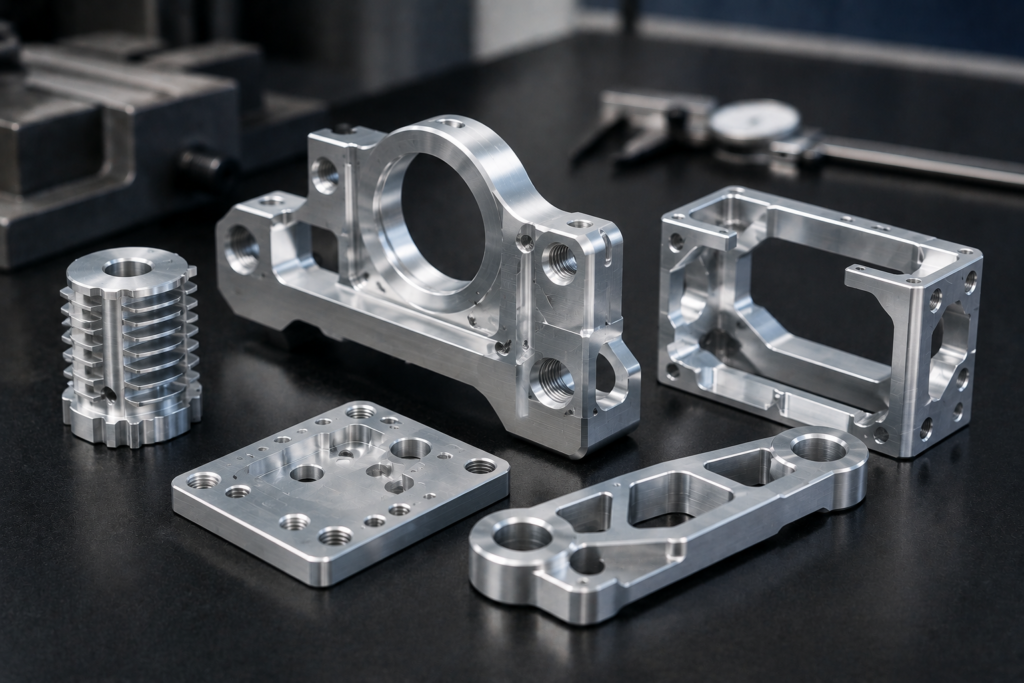
7075 is not simply “better aluminum.” It is a high-strength engineering alloy for parts where load, stiffness, vibration, fatigue, or weight reduction justify the premium. MatWeb describes 7075 as a very high-strength material used for highly stressed structural parts, with certain tempers improving stress-corrosion cracking resistance.
Choose 7075 for high-stress lightweight parts
7075 is a strong candidate for drone frames, robotic joints, aerospace-style brackets, high-load fixtures, motorsport parts, and performance hardware. If reducing section thickness without losing strength matters, 7075 may help designers save weight while maintaining structural performance.
Consider the corrosion and finishing trade-off
The higher strength of 7075 comes with trade-offs. It is less corrosion-friendly than 6061 and often needs anodizing, painting, conversion coating, or careful environmental control. For harsh environments, engineering teams should confirm temper, coating, and inspection requirements before production.
Confirm if the strength is actually needed
Many buyers specify 7075 because it looks stronger on paper. In reality, 6061 may be enough for covers, light-duty brackets, panels, adapters, and many machine components. A practical RFQ should include load conditions, tolerance requirements, finishing expectations, and operating environment before choosing 7075.
Industry Applications: Drone, Medical, Robotics, and Semiconductor Parts drone CNC machining
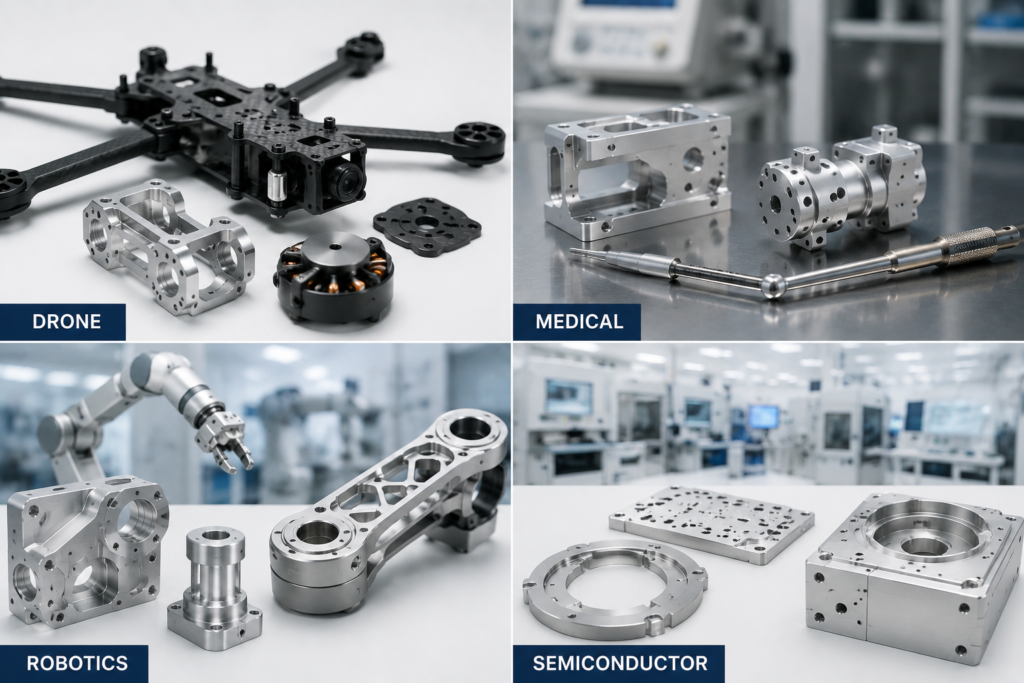
Material selection is becoming more important as lightweight, high-precision equipment grows across automation, semiconductor, and low-altitude aircraft applications. IFR reported that 542,000 industrial robots were installed globally in 2024, while SEMI reported worldwide semiconductor manufacturing equipment sales increased to $135.1 billion in 2025.
| Industry | Better Starting Alloy | Why |
| Drone / UAV parts | 7075 for frames; 6061 for housings | 7075 for high strength; 6061 for cost and finish |
| Medical device fixtures | 6061 | Good corrosion resistance, finish options, stable machining |
| Robotics components | 6061 or 7075 | 6061 for housings; 7075 for joints and load-bearing arms |
| Semiconductor equipment parts | 6061 | Good machinability, surface finish, and dimensional stability |
| Optical instrument parts | 6061 | Better cosmetic finish and corrosion resistance |
| Auto & moto parts | 6061 or 7075 | Depends on load, impact, fatigue, and coating requirements |
How Sino-V-Rise Supports CNC Aluminum Projects Precision CNC Machining
Sino-V-Rise positions itself around custom CNC machining from prototype to production, with 5-axis capabilities, CNC milling, CNC turning, turning-milling, precision machining, and surface treatment support. Its website highlights precision up to ±0.005 mm, 35+ surface finishes, and 80+ metals and plastics, which fits aluminum alloy selection projects where tolerance, finish, and material performance must be reviewed together.
Engineering review before production 5-axis cnc machining services
For a 6061 vs 7075 decision, the best workflow is not only quoting by material name. Sino-V-Rise’s process includes drawing submission, engineer review, quotation, sample production, mass production, packaging, and delivery, which helps buyers confirm alloy, tolerance, surface finish, and inspection requirements before batch production.
Practical RFQ checklist
Before requesting a quote, prepare:
- Alloy preference: 6061-T6, 7075-T6, or “supplier recommendation”
- Drawing format: STEP, IGES, CAD, or 2D PDF
- Critical dimensions and tolerances
- Surface finish: as-machined, anodized, bead blasted, painted, or coated
- Application environment: indoor, outdoor, humid, high load, vibration
- Batch size and delivery target
- Inspection requirements: CMM, material certificate, surface roughness report
FAQ: People Also Ask aluminum cnc machining parts
Is 6061 or 7075 better for CNC machining?
6061 is better for most general CNC machining projects because it is more balanced, cost-effective, corrosion-resistant, and finish-friendly. 7075 is better when high strength and lightweight structural performance are the main priorities.
Is 7075 aluminum stronger than 6061?
Yes. In T6 temper, 7075 has much higher yield and tensile strength than 6061. Typical MatWeb values show 7075-T6 at about 503 MPa yield strength, compared with about 276 MPa for 6061-T6.
Which aluminum is better for anodizing?
6061 is usually better for cosmetic anodizing because it tends to produce more consistent results. 7075 can be anodized, but color uniformity and corrosion protection should be reviewed carefully.
Which aluminum is better for corrosion resistance?
6061 is generally better for corrosion resistance. For outdoor, humid, or frequently handled parts, 6061 with proper surface treatment is often the safer choice.
Should I choose 7075 for drone CNC machining?
Choose 7075 for drone frames, arms, and structural parts where high strength and low weight are critical. Choose 6061 for drone housings, covers, fixtures, and cost-sensitive parts where balanced machinability and finish matter more.
Conclusion: CNC Machining Aluminum
For most cnc machining aluminum projects, 6061 is the more balanced alloy: easier to machine, more corrosion-resistant, more finish-friendly, and usually more cost-effective. For high-stress, lightweight, or fatigue-sensitive components, 7075 can be the better engineering choice, but it requires more careful planning around cost, corrosion protection, and surface finishing.
The best answer is not “6061 or 7075” in isolation. It is the alloy that matches load, environment, tolerance, finish, quantity, and inspection requirements. For custom aluminum cnc machining parts, Sino-V-Rise can review drawings, recommend suitable materials, and support CNC milling, turning, 5-axis machining, and surface finishing from prototype to small and medium-batch production.