
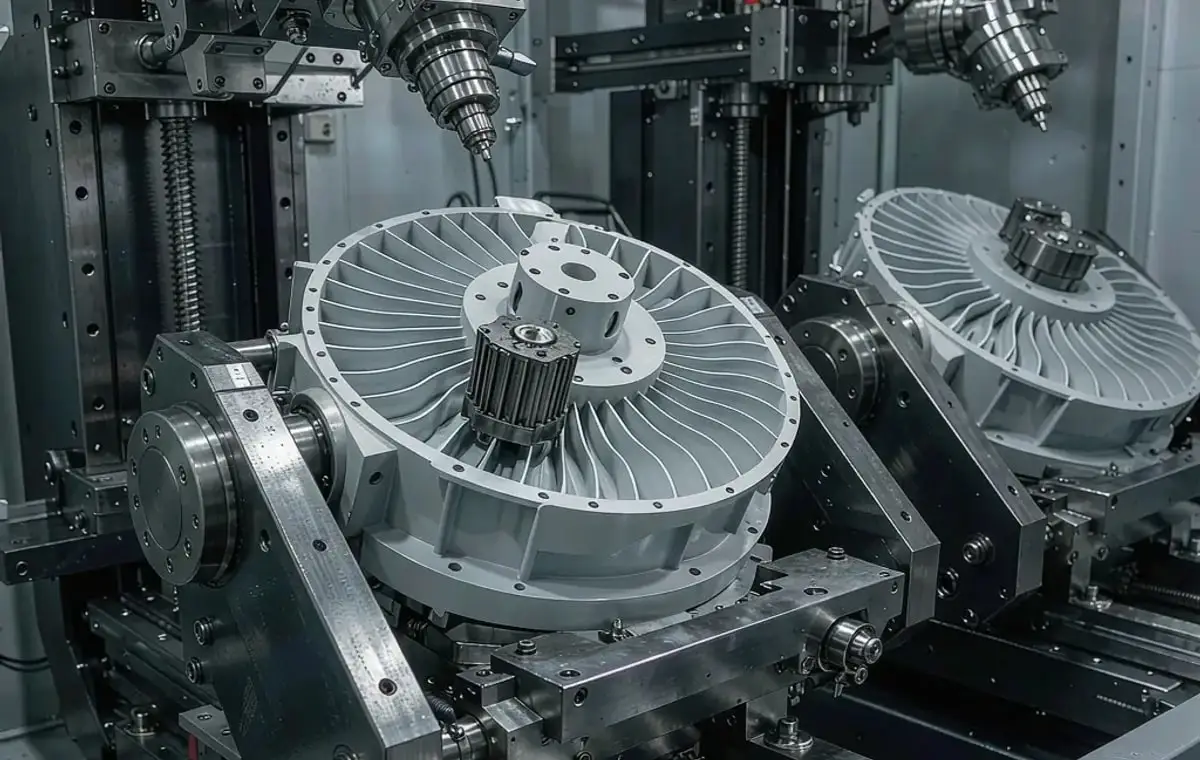


Five-Axis CNC Milled 316L Stainless Steel Mixing Impeller
Custom five-axis CNC milled 316L stainless steel mixing impellers for agitators, reactors and inline mixers. Blades are cut from a single billet with the tool kept normal to the surface, so the pitch holds to ±0.5° and the hub bore stays concentric to the blade set.
- Five-Axis Blade Machining
- 316L for Aggressive Media
- Polished to Ra 0.8
- Balanced to G6.3
*Send the vessel, the fluid and the duty speed, because the blade pitch, the diameter and the balance grade all follow from the mixing duty rather than from the shaft size.
316L Mixing Impeller Overview
A mixing impeller turns shaft power into flow and shear, and the split between the two is set by the blade pitch and the blade area. Get the pitch wrong and the impeller either stirs without moving the batch or moves it without mixing it.
The impeller is milled from a 316L billet on five axes, with the blade surfaces cut normal to the tool so the profile follows the model from root to tip. The hub is bored after the blades are cut, so the running fit is referenced to the blade set rather than to the billet.
17-4PH / 316L Stainless
17-4PH is specified when the housing has to hold a thread or a press fit under load. After ageing it reaches roughly 1,000 MPa and still machines to a fine bore. 316L is the alternative when chloride exposure is the concern and strength is secondary.
304L Stainless Steel Bar
304L is chosen for housings and fittings that see coolant, washdown or outdoor service. It welds without carbide precipitation, machines to a fine finish on the sealing faces, and needs no coating, so a scratch does not become a corrosion point.
316L covers most chemical duty. 904L is specified for chloride and acid service, and 316Ti is used where the impeller sees elevated temperature without a post-weld anneal.
316L Mixing Impeller Specifications
Machining and finishing data for mixing impellers, agreed against the vessel, the fluid and the duty speed.
| Specification | Machining Data | Specification | Machining Data |
|---|---|---|---|
| Product | Mixing Impeller / Agitator Blade | Machining Process | 5-Axis Simultaneous CNC Milling |
| Material | 316L / 316Ti / 904L Stainless Steel | Typical Tolerance | ±0.05 mm on Blade Profile |
| Impeller Diameter | 80 – 500 mm | Blade Angle Tolerance | ±0.5° |
| Blade Count | 2 – 6 Blades, Pitched or Flat | Balance Grade | G6.3 at Service Speed |
| Hub Bore | 15 – 100 mm, H7 | Surface Finish | Ra 0.8 µm on Product Contact |
| Wall Thickness | Minimum 2 mm at Blade Tip | Concentricity | 0.02 mm Bore to Blade Set |
| Features | Pitched Blades, Hub Keyway, Set Screw, Polished Surfaces | Drawing Format | STEP, STP, IGES, X_T, DWG, DXF, PDF |
| Customization | Blade Pitch, Diameter, Hub Interface, Polish Level | Lead Time | 10 – 16 Days (Prototype), 20 – 30 Days (Batch) |
| Inspection | CMM Blade Scan, Bore Gauge, Balance Report | Packing | Foam Cradled, Blade Protected, Crate |
Key Features of Our CNC Milled Mixing Impellers
A blade set that matches the duty, and a surface the product does not stick to.
Five-Axis Blade Cutting
Blades are milled with the tool normal to the surface, so the profile follows the CAD model from root fillet to tip and the pitch does not drift along the span.
Hub Bored After the Blades
The hub bore is cut after the blade set, so concentricity to the blades is 0.02 mm and the impeller runs true on the shaft without a balancing correction.
Polished Product Contact
Product contact surfaces are polished to Ra 0.8 and electropolished where the process is hygienic, which reduces both retention and corrosion initiation.
Balanced at Service Speed
Each impeller is balanced to G6.3 at its duty speed, and the balance report ships with the part so the agitator does not need a site balance.
Mixing a batch that will not blend?
Surface Finishes for 316L Mixing Impellers
For a hygienic impeller the finish is a process requirement, so it is specified on the product contact surfaces only.
| Finish | Main Purpose | Finish | Main Purpose |
|---|---|---|---|
| As Machined | Bare blade where the process is not hygienic | Mechanical Polishing | Ra 0.8 or better on product contact surfaces |
| Electropolishing | Passive, low-retention surface for pharma and food | Passivation | Removes free iron after machining and polishing |
| Bead Blasting | Uniform matte finish before polishing | Pickling | Removes heat tint where blades are welded |
*Polishing removes material and changes the balance. Where both polishing and balancing are specified, the impeller is balanced after the final polish, not before.
Put your CNC milling parts into production today
All information and uploads are secure and confidential.
Trusted for Precision CNC Machined Components
Supporting OEM projects with accurate machining, flexible production, and reliable component quality.
Trusted for Precision CNC Milling.
CNC Machining Process for 316L Mixing Impellers
Blades are cut on five axes from a single billet, so the pitch and the hub stay in one datum.
01. Duty Review
Check the vessel geometry, the fluid properties and the duty speed, then fix the blade pitch, the diameter and the balance grade before the model is released.
02. Billet Preparation
Select 316L billet with enough stock for the hub and the blade roots, face both ends and mark the datum that the five-axis operations are programmed from.
03. Five-Axis Milling
Rough the blade channels, semi-finish the flanks, then finish with a ball-nose cutter kept normal to the surface. The hub and the keyway are cut in the same set-up.
04. Polishing and Passivation
Polish the product contact surfaces to Ra 0.8, electropolish where specified, then passivate and rinse before any handling without gloves.
05. Balance and Inspection
Balance at the service speed, scan the blades on a CMM against the model, gauge the bore and issue both reports with the impeller.
Need an impeller that mixes to spec on the first run? Send the vessel, fluid and duty speed, and we will quote the blade set.
Five-Axis CNC Milled Mixing Impeller FAQs
A machined impeller holds the blade profile to ±0.05 mm and the pitch to ±0.5°, which a casting cannot without hand finishing. For small batches and high-shear duties the machined blade gives predictable mixing from the first unit.
Yes. Product contact surfaces are polished to Ra 0.8 and electropolished where the process requires it, then passivated. The impeller is balanced after the final polish because polishing removes material.
316L covers most duties. 904L is used where chlorides or acids attack 316L, and 316Ti is chosen for elevated temperature service where a welded impeller cannot be annealed afterwards.
The hub is bored after the blades are cut, from the same datum, so concentricity to the blade set is 0.02 mm. That is what lets the impeller run true without a balancing correction on site.
The impeller is supplied to the shaft interface you specify. Shafts and couplings can be quoted as an assembly where the agitator is supplied complete.
Ten to sixteen days for a single impeller including five-axis programming, machining, polishing, balancing and inspection. Small batches of five to twenty run twenty to thirty days.
Other CNC Machined Mechanical Components
Explore additional precision CNC machined components manufactured for OEM applications and customized production needs.
Custom CNC machined aluminium mounting brackets for robots, automation and equipment mounting.
Custom CNC machined aluminium brake booster check valve bodies for motorcycles and automotive systems.
Custom CNC machined aluminum hollow sleeve connectors for robot arm segments and linear modules.
Get high‑quality machined parts in as fast as 4 days with our expanded automated CNC milling!



