
Quick Answer
Semiconductor CNC machined parts require flatness, cleanliness, thermal stability, burr control, tight tolerance, and reliable inspection because small mechanical errors can affect equipment performance.
Key Takeaways
- Semiconductor CNC machining is different from general industrial machining because parts often work near wafers, sensors, vacuum systems, heat sources, or precision motion assemblies.
- Vacuum plates, cooling fins, and sensor brackets each have different machining priorities.
- Buyers should not only ask whether a supplier can machine the part, but whether they can control flatness, burrs, surface finish, material, inspection, and packaging.
- Aluminum, stainless steel, copper, and engineering plastics are common choices, but material selection must match the part’s function.
- Surface treatment and cleaning should be planned before production, especially for vacuum-contact, heat-transfer, or sensor-positioning parts.
- SinoRise can support semiconductor CNC parts through drawing review, CNC milling, 5-axis machining, surface finishing, inspection, and small-to-medium batch production.
Abstract
Semiconductor equipment depends on many precision mechanical parts that are not always visible in the final chip. Vacuum plates hold or support components under controlled pressure. Cooling fins and thermal parts help manage heat. Sensor brackets keep cameras, probes, optical sensors, or detection modules aligned. These parts may look like ordinary machined components, but their real requirements are often stricter: flatness, cleanliness, burr control, dimensional consistency, thermal behavior, surface treatment, and inspection documentation.
This guide explains how to evaluate semiconductor CNC machined parts from a manufacturing and purchasing perspective. It focuses on vacuum plates, cooling fins, and sensor brackets, then connects part function to material choice, machining process, surface finish, inspection, risks, and RFQ preparation.
Why Semiconductor CNC Machining Parts Require More Than Tolerance?
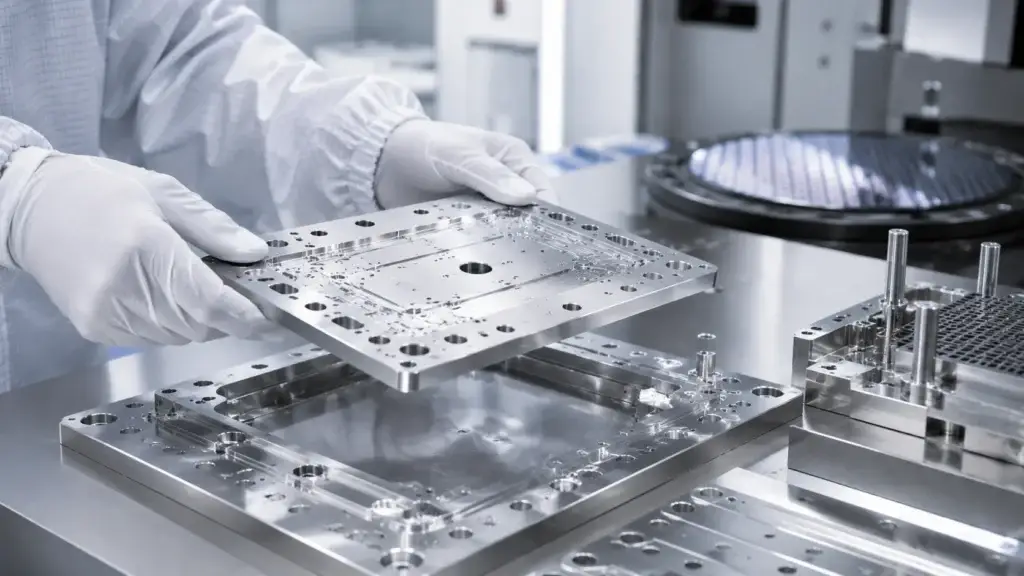
Semiconductor CNC machining is not only about making a part match a drawing. In semiconductor equipment, a machined component may affect vacuum stability, heat transfer, sensor alignment, wafer handling, optical accuracy, or machine repeatability.
This is increasingly important because semiconductor equipment demand continues to grow. SEMI forecasts global semiconductor equipment sales to reach a record $156 billion in 2027, with foundry and logic equipment spending supported by advanced nodes, AI accelerators, high-performance computing, and premium mobile processors.
Semiconductor Equipment Demand Is Rising
As fabs and equipment makers scale production, custom machined parts must support both precision and repeatability. A supplier may produce a good first sample, but semiconductor buyers usually care about whether that quality can continue across small batches, repeat orders, and revised designs.
What Buyers Really Care About?
| Buyer Concern | Why It Matters |
| Flatness | Affects sealing, mounting, and alignment |
| Burr control | Prevents particles and assembly damage |
| Clean surface | Reduces contamination risk |
| Thermal stability | Supports temperature-sensitive processes |
| Hole position | Controls sensor, fixture, or vacuum layout |
| Surface finish | Affects sealing, cleaning, friction, and coating |
| Inspection data | Supports internal quality approval |
| Packaging | Protects precision surfaces before assembly |
Common Semiconductor CNC Machined Parts in Equipment
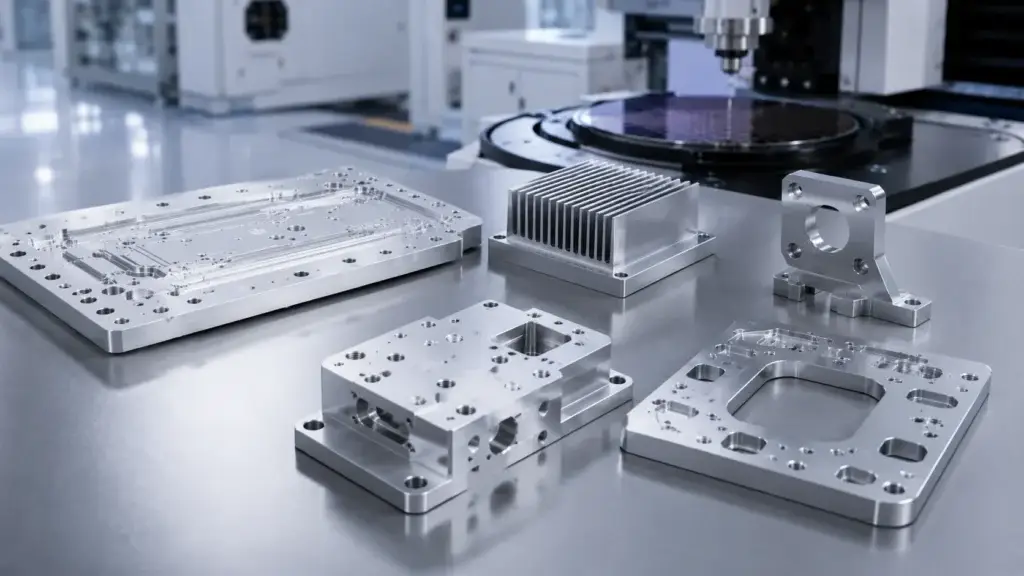
Semiconductor CNC machined parts include vacuum plates, cooling plates, heat sinks, sensor brackets, optical mounts, fixture plates, guide blocks, alignment parts, gas-path components, chamber-related brackets, and test equipment parts.
Vacuum Plates, Cooling Fins, Sensor Brackets, and Related Components
The three part types in this article represent common semiconductor machining needs:
- Vacuum plates: flatness, hole patterns, sealing surfaces, and cleanliness
- Cooling fins: thermal performance, thin-wall machining, and deformation control
- Sensor brackets: positioning accuracy, stiffness, and vibration stability
Part Category Table
| Part Type | Main Function | Key Machining Requirement |
| Vacuum plate | Support or hold parts under vacuum | Flatness, sealing surface, hole accuracy |
| Cooling fin / heat sink | Remove or spread heat | Thin-fin control, material choice, surface area |
| Sensor bracket | Hold sensor or optical module | Position accuracy, stiffness, repeatability |
| Fixture plate | Support process or assembly tooling | Flatness, hole position, datum control |
| Alignment block | Locate critical components | Tight tolerance and stable material |
| Chamber-related part | Support equipment structure | Clean finish, corrosion resistance |
Vacuum Plates in Semiconductor CNC Precision Machining
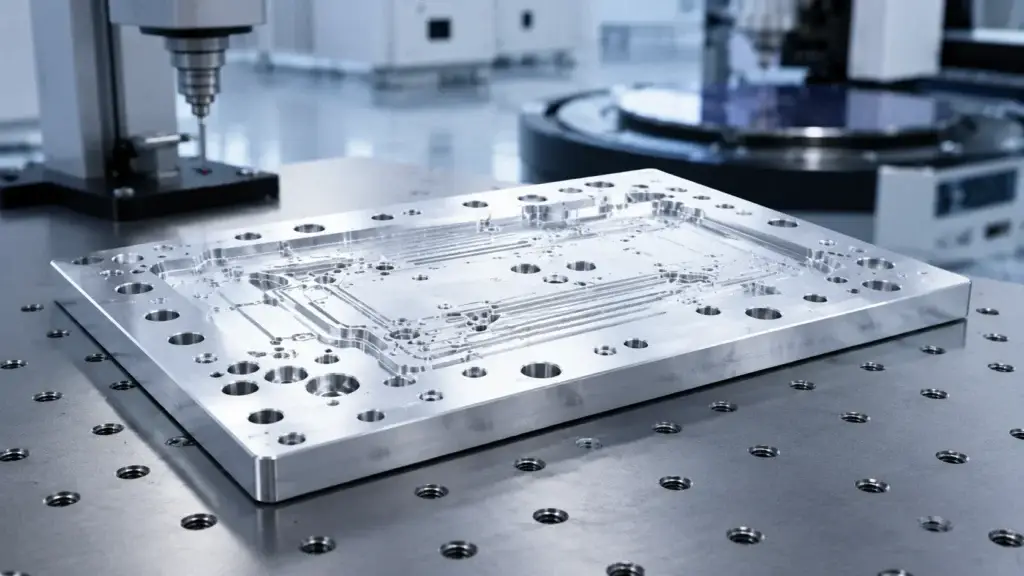
In semiconductor CNC precision machining, vacuum plates require more than a flat-looking surface. A small flatness error, scratch, burr, or blocked channel may affect holding force or sealing reliability.
Flatness, Hole Patterns, Sealing, and Surface Quality
Important vacuum plate features include:
- Flat datum surfaces
- Vacuum channels or grooves
- Hole patterns
- Threaded inserts or threaded holes
- Sealing areas
- Edge quality
- Surface roughness
- Burr-free internal passages
- Masked or protected finishing areas
Vacuum Plate Machining Checklist
| Requirement | What to Confirm |
| Flatness | Inspect after machining and finishing |
| Hole position | Use CMM or suitable fixture measurement |
| Vacuum channels | Check burrs and blockage |
| Surface roughness | Match sealing or contact requirement |
| Coating | Confirm thickness and masking |
| Cleaning | Remove chips, oil, and loose particles |
| Packaging | Protect flat surfaces and channels |
Cooling Fins and Thermal Parts for Machine Parts Semiconductor Manufacturing
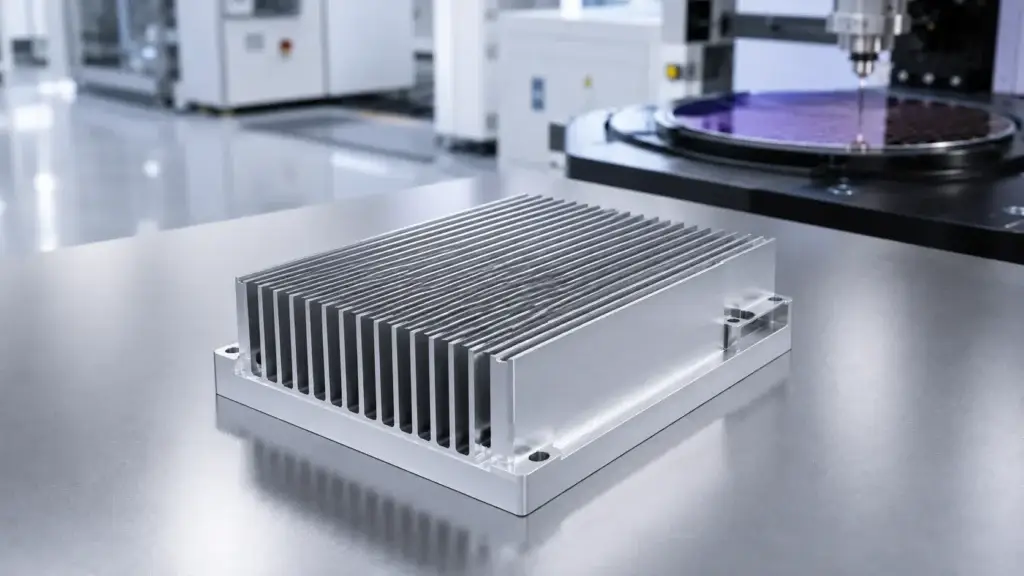
For machine parts semiconductor manufacturing, cooling fins and thermal components help manage temperature around equipment modules, electronics, sensors, or process-related assemblies.
Heat Transfer, Material Choice, and Thin-Fin Machining
Cooling parts are often made from aluminum or copper. Aluminum is lightweight, machinable, and finish-friendly. Copper improves thermal conductivity but is softer, heavier, and may need more careful machining.
Thin fins are challenging because they can vibrate, bend, or burr during machining. The process should control tool sharpness, cutting force, chip evacuation, and fixture support.
Cooling Component Risk Table
| Risk | What Can Go Wrong | Prevention |
| Thin fins deform | Reduced thermal and assembly performance | Use staged machining and support |
| Burrs between fins | Particles or airflow blockage | Define deburring and cleaning |
| Poor surface contact | Weak heat transfer | Control flatness and roughness |
| Wrong material | Poor thermal performance | Confirm aluminum or copper grade |
| Coating buildup | Fit or thermal interface issue | Review finish and masking |
Sensor Brackets for CNC Machining for Semiconductor Equipment
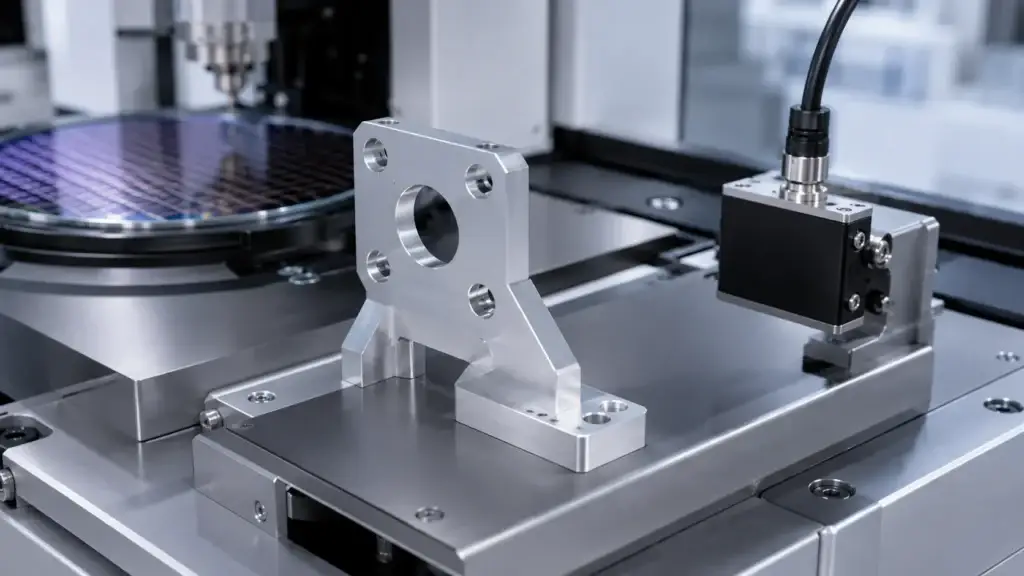
CNC machining for semiconductor equipment often includes sensor brackets used for optical sensors, position sensors, cameras, probes, or monitoring modules.
Positioning Accuracy, Stability, and Vibration Control
A sensor bracket may seem like a simple support part, but its function depends on stability. If it bends, vibrates, or shifts after assembly, the sensor may lose alignment.
Sensor Bracket Design Considerations
| Design Point | Why It Matters |
| Datum surface | Controls sensor position |
| Hole position | Affects assembly repeatability |
| Wall thickness | Prevents vibration and deformation |
| Material stiffness | Maintains alignment |
| Surface finish | Reduces glare, corrosion, or contamination |
| Edge quality | Prevents cable damage and particle generation |
Materials for Precision CNC Machining of Semiconductor Parts
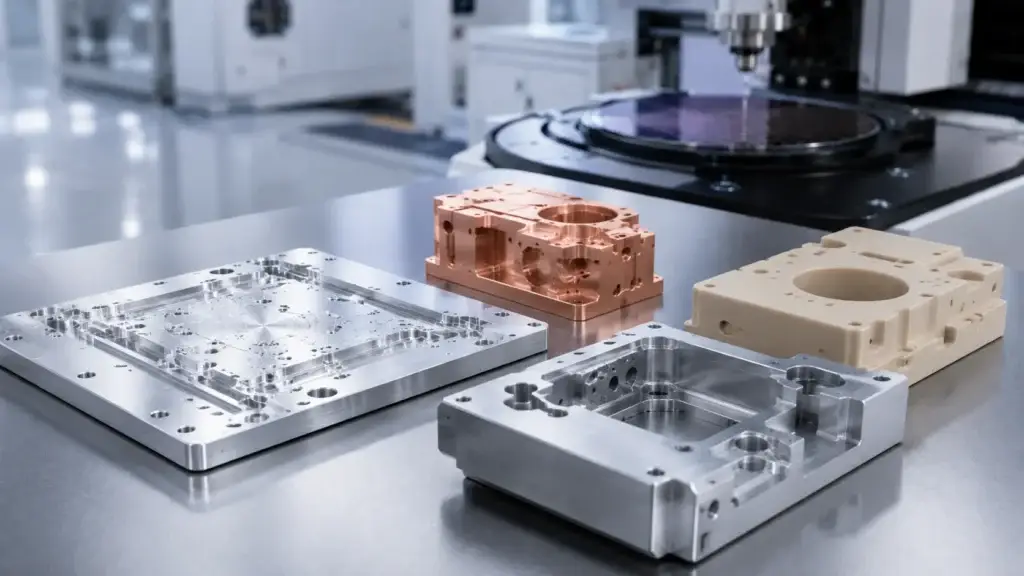
Material selection in precision CNC machining should follow part function. The right material for a cooling fin may not be right for a vacuum plate or sensor bracket.
Aluminum, Stainless Steel, Copper, and Engineering Plastics
| Material | Best For | Key Advantage |
| Aluminum 6061 / 7075 | Vacuum plates, brackets, housings, cooling parts | Lightweight, machinable, finish-compatible |
| Stainless steel 304 / 316 | Clean hardware, corrosion-resistant parts | Strength and corrosion resistance |
| Copper | Thermal parts, conductive components | High thermal and electrical conductivity |
| Brass | Small fittings or stable machined parts | Good machinability |
| PEEK | Insulating or high-performance polymer parts | Lightweight, chemical resistance |
| POM / PTFE | Low-friction or insulating parts | Sliding or non-metallic support |
Material Selection Table
For vacuum plates, aluminum is often practical when weight and machinability matter. For cooling fins, aluminum and copper are common choices. For sensor brackets, aluminum, stainless steel, or black engineering plastics may be selected depending on stiffness, weight, reflection, and environment.
Surface Treatment and Cleanliness for Semiconductor CNC Parts
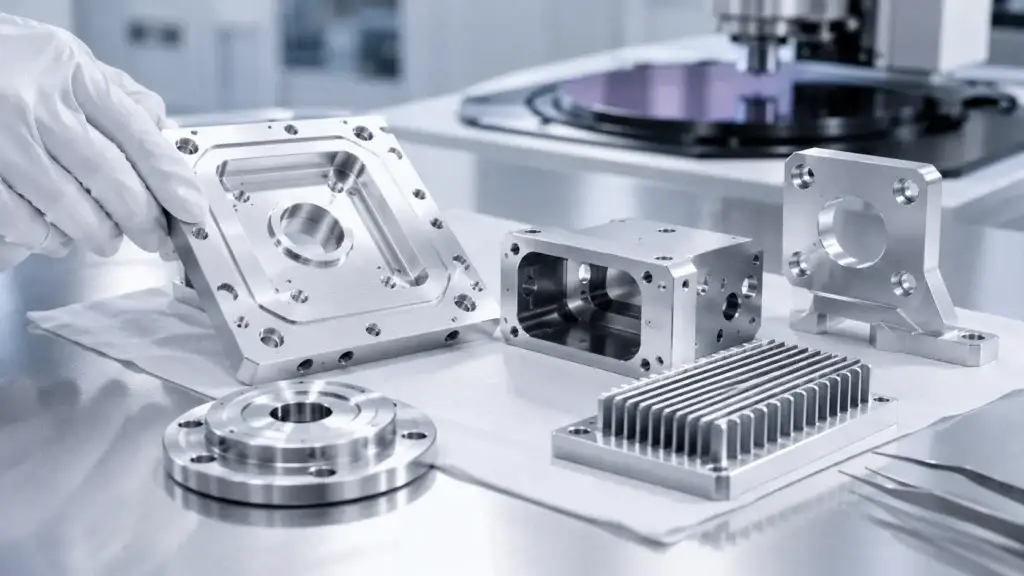
Surface treatment for semiconductor parts should be planned before machining is completed. ISO 14644-1 specifies cleanroom air cleanliness classification by airborne particle concentration, which shows why contamination control is a serious issue in semiconductor-related environments.
Anodizing, Passivation, Polishing, and Cleaning
| Finish / Process | Suitable Parts | Main Purpose |
| Anodizing | Aluminum plates, brackets, housings | Protection and appearance |
| Hard anodizing | Wear areas | Durability |
| Black anodizing | Sensor or optical-adjacent brackets | Low reflection |
| Passivation | Stainless steel parts | Corrosion resistance |
| Polishing | Selected contact or visible surfaces | Smoothness |
| Bead blasting | Non-critical visible surfaces | Uniform matte texture |
| Cleaning | All sensitive parts | Removes particles and residues |
Finish Selection Table
Do not apply one finish everywhere. Vacuum surfaces, sealing areas, threaded holes, sensor datums, and thermal contact faces may need masking or special treatment.
Inspection Methods for Semiconductor CNC Machined Parts
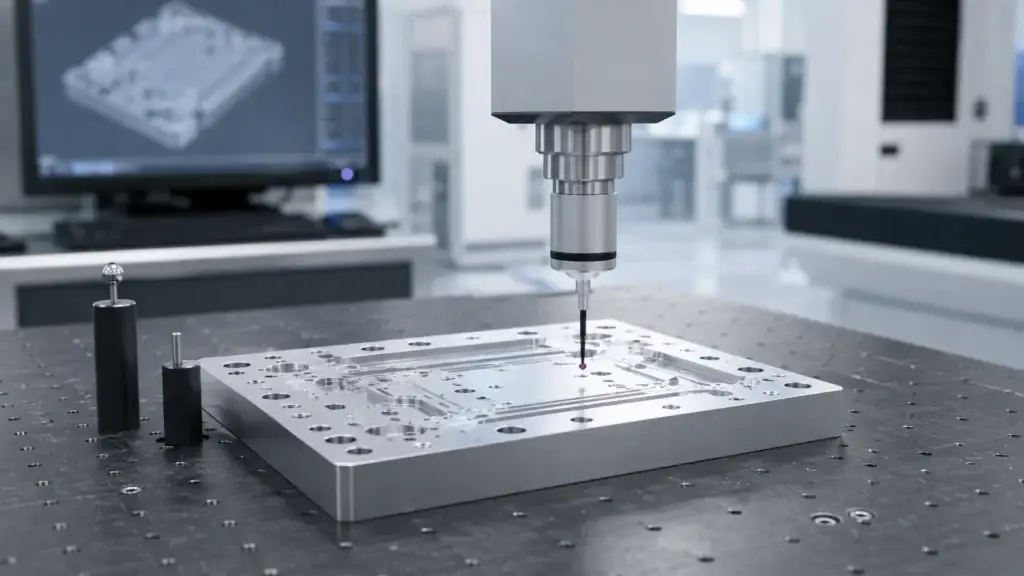
Inspection should match function. For semiconductor parts, the most important features are often flatness, hole position, surface roughness, burrs, thread quality, and coating thickness.
CMM, Flatness, Roughness, Burr, and Coating Checks
ASME Y14.5 is widely used as a reference for geometric dimensioning and tolerancing, which is useful when semiconductor drawings need clear datums, flatness, true position, profile, and perpendicularity control.
Inspection Checklist
| Inspection Item | Suitable Method |
| Hole position | CMM or vision measurement |
| Flatness | CMM, height gauge, surface plate |
| Bore diameter | Pin gauge, bore gauge, CMM |
| Thread quality | Thread gauge |
| Surface roughness | Roughness tester |
| Coating thickness | Coating thickness gauge |
| Burrs and edges | Visual and microscope inspection |
| Cleanliness | Visual check and agreed cleaning process |
Common Risks in Semiconductor CNC Machining Projects
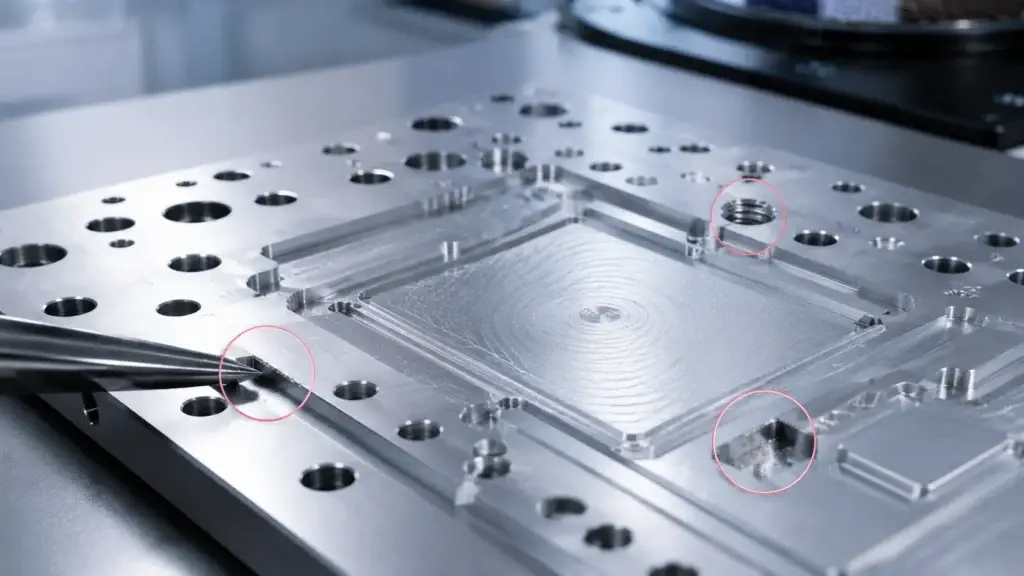
Burrs, Particles, Coating Buildup, Deformation, and Unclear RFQs
Common risks include:
| Risk | Result | Prevention |
| Burrs in channels | Particle generation or blockage | Define burr-free areas |
| Coating buildup | Holes or threads become too tight | Mask or adjust tolerance |
| Warped plate | Vacuum or mounting failure | Control flatness after finishing |
| Thin fin deformation | Poor cooling or assembly issue | Optimize machining process |
| Vague material callout | Wrong grade or performance | Specify exact material grade |
| No inspection scope | Disputes after delivery | Confirm report requirements |
How SinoRise Supports Semiconductor CNC Machining Projects?
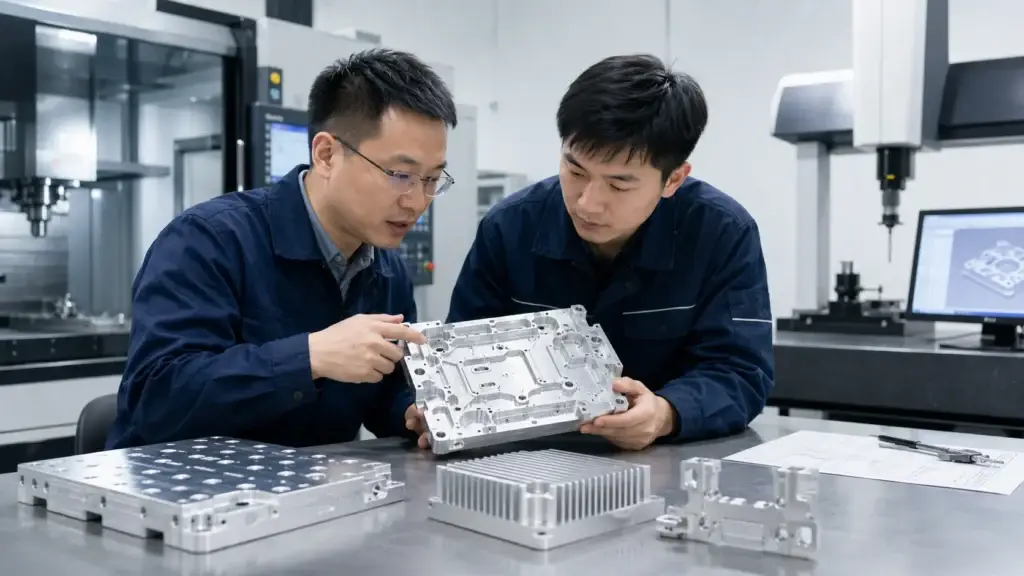
SinoRise supports custom CNC machining from prototype to production, including precision up to ±0.005 mm, 5-axis machining, metals and plastics, surface finishing options, and inspection capability. Its official website also highlights semiconductor parts as an application area requiring ultra-clean and wear-resistant machining support.
For semiconductor CNC machining projects, SinoRise can support:
- Drawing and DFM review
- CNC milling, turning, turning-milling, wire cutting, and 5-axis machining
- Vacuum plates, cooling fins, heat sinks, sensor brackets, fixture plates, and housings
- Aluminum, stainless steel, copper, brass, PEEK, POM, and other engineering plastics
- Anodizing, hard anodizing, passivation, polishing, bead blasting, and coating coordination
- CMM, 2.5D, height gauge, thread gauge, roughness, and dimensional inspection
- Prototype, first article, small-batch, and repeat production
- Protective packaging for precision machined surfaces
FAQ About Semiconductor CNC Machined Parts
What Are Semiconductor CNC Machined Parts?
They are precision machined components used in semiconductor equipment, including vacuum plates, cooling fins, heat sinks, sensor brackets, fixture plates, alignment parts, housings, and chamber-related components.
Why Are Vacuum Plates Difficult to Machine?
Vacuum plates require controlled flatness, clean channels, accurate hole patterns, sealing surfaces, and burr-free features. Surface treatment and cleaning can also affect final function.
What Materials Are Used for Semiconductor CNC Parts?
Common materials include aluminum 6061/7075, stainless steel 304/316, copper, brass, PEEK, POM, PTFE, and other engineering plastics.
Why Are Cooling Fins Hard to CNC Machine?
Cooling fins are often thin and easy to deform or burr. Toolpath strategy, fixture support, sharp tooling, and careful deburring are important.
What Should Be Included in a Semiconductor CNC Machining RFQ?
Include 3D files, 2D drawings, material grade, tolerance, flatness, surface finish, cleanliness expectations, critical dimensions, inspection requirements, quantity, and packaging needs.
Can SinoRise Support Semiconductor CNC Machining?
Yes. SinoRise supports semiconductor-related CNC parts including vacuum plates, cooling fins, sensor brackets, fixtures, housings, and precision components with machining, finishing, and inspection support.
Conclusion
Semiconductor CNC machined parts are not ordinary metal blocks. Vacuum plates need flatness, sealing quality, clean channels, and burr-free surfaces. Cooling fins need thermal performance, thin-fin control, and careful deburring. Sensor brackets need stiffness, positioning accuracy, and stable alignment.
The best sourcing strategy is to connect part function with material, machining process, surface treatment, inspection, and packaging from the beginning. For buyers, that means sending clear drawings, defining critical features, confirming finish and cleanliness expectations, and asking for suitable inspection reports.
SinoRise supports semiconductor CNC machining projects by combining engineering review, precision CNC machining, surface finishing coordination, and dimensional inspection into one practical workflow for semiconductor equipment parts.
References
[1] SEMI — Global semiconductor equipment sales forecast, including growth driven by advanced nodes, AI accelerators, HPC, and related capacity expansion.
[2] ISO 14644-1:2015 — Cleanroom air cleanliness classification by airborne particle concentration.
[3] SinoRise — CNC machining services and semiconductor application information.
[4] SinoRise — Supplier evaluation and CNC machining support overview, including engineering review, inspection, surface finishing, and delivery support.