
Abstract
CNC turning is a subtractive manufacturing process used to produce accurate round, cylindrical, conical, and threaded parts from metal or plastic materials. In CNC turning, the workpiece rotates while a cutting tool removes material according to a programmed toolpath. This makes the process especially suitable for shafts, pins, bushings, sleeves, spacers, connectors, knobs, threaded parts, and other rotational components.
As a definition-style guide, this article explains what CNC turning is, how the CNC turning process works, common turning operations, suitable materials, typical applications, advantages, limitations, and when buyers should consider CNC turning services for custom precision parts.
What Is CNC Turning?
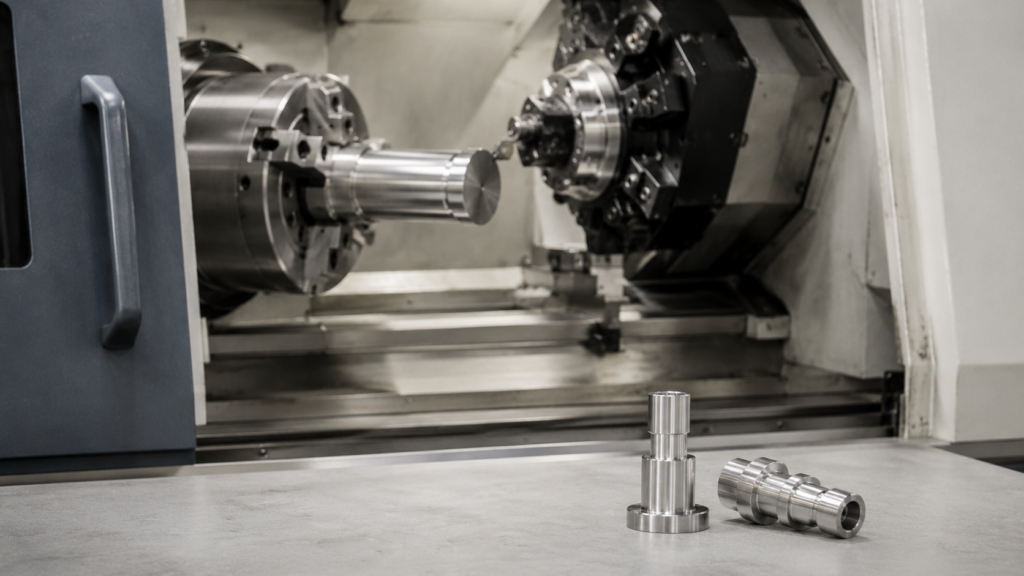
CNC turning is a computer-controlled machining process in which a workpiece rotates on a spindle while a cutting tool removes material to create the required shape. The process is usually performed on a CNC lathe or CNC turning center.
In simple terms, CNC turning machining creates parts by rotating the material instead of rotating the main cutting tool. This is different from CNC milling, where the cutting tool rotates and the workpiece is usually fixed.
CNC turning is best for parts with rotational features, such as outer diameters, inner diameters, grooves, threads, tapers, shoulders, and end faces.
CNC Turning Definition
CNC turning uses computer instructions to control spindle speed, tool movement, feed rate, depth of cut, and machining sequence. The machine removes material from a rotating workpiece until the final shape meets the drawing requirements.
Because the process is controlled by a CNC program, it can produce consistent dimensions across prototypes, small batches, and repeat production.
CNC Turning vs Manual Turning
Manual turning depends heavily on operator skill. CNC turning uses programmed toolpaths and controlled machining parameters to reduce human variation.
This improves repeatability, dimensional consistency, and production efficiency. For parts with tight diameters, threads, grooves, or concentricity requirements, precision CNC turning is usually a better option than manual turning.
How Does the CNC Turning Process Work?
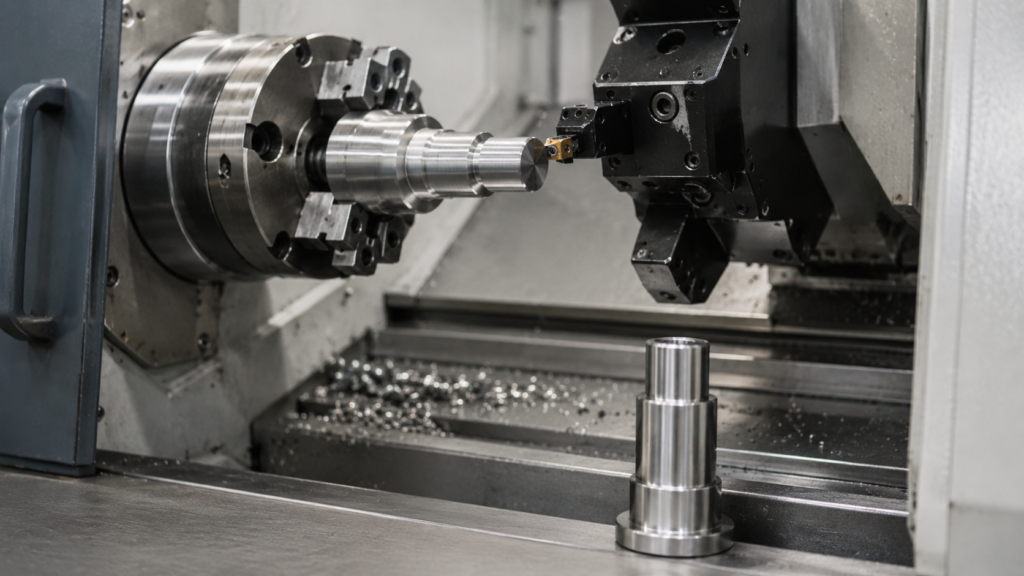
The CNC turning process begins with a digital part design and ends with an inspected machined component. The exact workflow depends on geometry, material, tolerance, surface finish, and production quantity.
| Step | What Happens | Why It Matters |
| CAD design | The part geometry is created or reviewed | Confirms dimensions and features |
| CAM programming | Toolpaths and machining steps are generated | Controls cutting sequence and efficiency |
| Material preparation | Bar stock or blanks are selected | Affects cost, stability, and lead time |
| Machine setup | Tools, chuck, fixture, and program are prepared | Reduces runout and setup error |
| Machining | The part is turned, drilled, grooved, or threaded | Produces the required features |
| Inspection | Dimensions, threads, and surface finish are checked | Confirms drawing compliance |
From CAD Model to CNC Program
A CNC turned part usually starts with a 2D drawing or 3D model. Engineers review the geometry, tolerance, material, and surface finish requirements. Then the machining team creates a CNC program that defines the toolpath, cutting sequence, spindle speed, feed rate, and tool selection.
For custom parts, this review stage is important because it helps identify potential machining risks, such as thin walls, deep grooves, difficult threads, long slender shapes, or tight concentricity requirements.
Main Turning Steps on a CNC Lathe
During CNC turning machining, the raw material is clamped in the spindle or chuck. The machine rotates the workpiece, and the cutting tool moves along one or more axes to remove material.
Coolant may be used to control heat, improve surface quality, and extend tool life. For complex parts, a CNC turning center may include live tooling, sub-spindles, or multi-axis capability. This allows turning, drilling, milling, and tapping to be completed with fewer setups.
Key Features of CNC Turning
CNC turning is not suitable for every shape, but it is highly efficient when the part is designed around rotational geometry.
| Feature | Why It Matters |
| Rotating workpiece | Ideal for round and cylindrical parts |
| Controlled tool movement | Supports repeatable dimensions |
| Strong diameter accuracy | Suitable for shafts, pins, sleeves, and bushings |
| Threading capability | Useful for connectors, fittings, and fasteners |
| Batch repeatability | Good for prototypes and small-to-medium production |
| Material flexibility | Works with metals and engineering plastics |
Best for Round, Cylindrical, and Threaded Parts
CNC turning is commonly used for components with circular or rotational features.
| Part Feature | Examples |
| Outer diameters | Shafts, pins, rollers, spacers |
| Inner diameters | Bushings, sleeves, nozzles |
| Threads | Connectors, fasteners, medical instrument parts |
| Grooves | O-ring grooves, retaining ring grooves |
| Tapers | Conical pins, fittings, valve components |
| Face features | End faces, shoulders, chamfers |
This is why buyers often look for a CNC turned parts manufacturer when they need accurate circular parts with stable dimensions.
Repeatability for Prototype and Batch Production
CNC turning services can reduce manual variation and improve batch consistency. Once the program, tools, and setup are validated, the same process can be repeated for future production runs.
This makes CNC turning suitable for custom prototypes, low-volume production, and medium-batch manufacturing where repeatable quality is important.
Common Types of CNC Turning Operations
The CNC turning process includes more than one cutting action. A single part may require several turning operations to complete all features.
| Operation | Purpose | Common Part Feature |
| Facing | Creates a flat end surface | End faces, shoulders |
| OD turning | Reduces or shapes the outside diameter | Shafts, pins, sleeves |
| Boring | Enlarges or finishes an internal diameter | Bushings, tubes, housings |
| Drilling | Creates holes along the part axis | Connectors, fluid parts |
| Grooving | Cuts narrow channels | O-ring grooves, snap-ring grooves |
| Threading | Produces internal or external threads | Screws, adapters, fittings |
| Parting | Separates the finished part from bar stock | Small turned components |
| Knurling | Creates textured grip surfaces | Handles, knobs, instrument parts |
Facing, Turning, Boring, Grooving, Threading, and Parting
Facing creates a clean flat surface at the end of the part. Turning shapes the outside diameter. Boring finishes internal diameters. Grooving creates channels for seals or retaining rings. Threading produces screw features. Parting separates the finished component from the bar stock.
For high precision CNC turning, stable workholding, correct cutting parameters, tool wear control, and suitable inspection methods are essential.
Common CNC Turning Materials
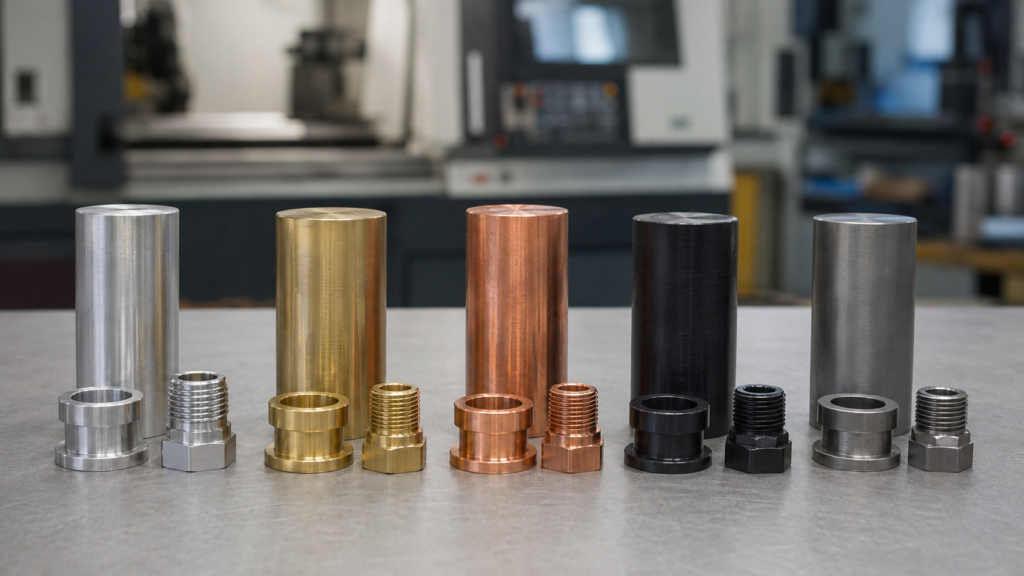
One advantage of CNC turning is that it supports a wide range of CNC machining materials. Material choice affects machinability, strength, surface finish, corrosion resistance, weight, and cost.
| Material | Typical Use | Turning Consideration |
| Aluminum 6061 / 7075 | Lightweight shafts, spacers, housings | Easy to machine, good for fast production |
| Stainless Steel 304 / 316 | Corrosion-resistant parts, medical and industrial components | Slower machining, good durability |
| Brass | Fittings, bushings, connectors | Excellent machinability |
| Copper | Conductive components, thermal parts | Burr and surface control needed |
| Titanium | Medical, aerospace, high-strength parts | More difficult to machine |
| Engineering Plastics | Insulating, lightweight, low-friction parts | Clamping and heat control are important |
Aluminum CNC Turned Parts
Aluminum CNC turned parts are often used when weight, cost, and delivery speed matter. Aluminum is easy to machine, supports good surface quality, and is suitable for prototypes, fixtures, housings, spacers, and lightweight mechanical parts.
Stainless Steel CNC Turned Parts
Stainless steel CNC turned parts are selected when strength, wear resistance, and corrosion resistance are important. Stainless steel is common in medical equipment, industrial machinery, automotive parts, and corrosion-sensitive assemblies.
Brass CNC Turned Parts
Brass CNC turned parts are widely used for fittings, bushings, connectors, inserts, and threaded components. Brass machines cleanly, holds fine details well, and is suitable for many small precision turned parts.
CNC Turning Applications by Industry
(图片alt:CNC Turning Applications by Industry)
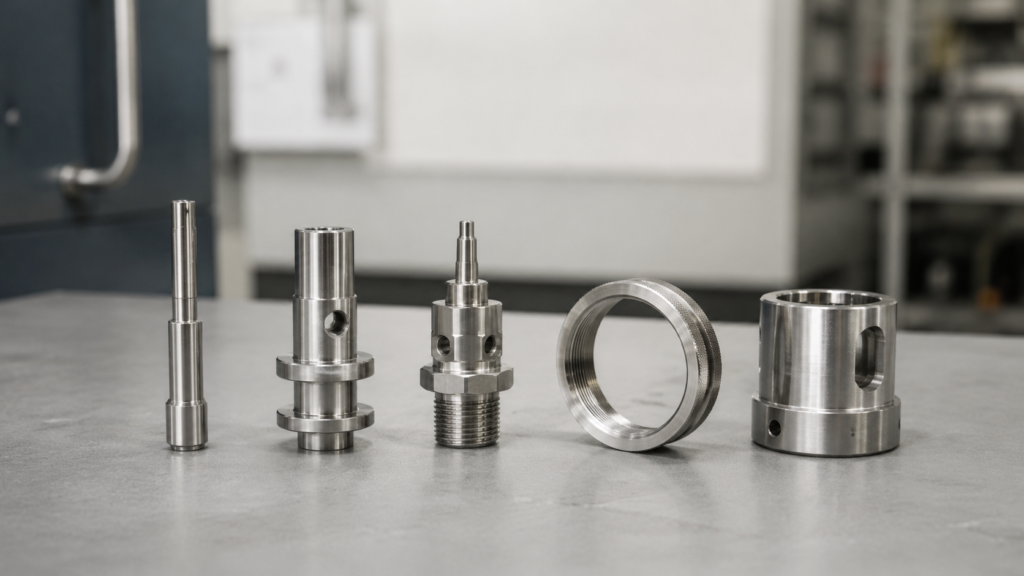
CNC turning is used across many industries because round parts appear in almost every mechanical assembly.
| Industry | Common CNC Turned Parts |
| Medical devices | Pins, sleeves, instrument parts, connectors |
| Robotics | Shafts, bushings, spacers, transmission parts |
| Semiconductor equipment | Precision pins, nozzles, fixtures, connectors |
| Optical instruments | Lens barrel parts, adjustment rings, threaded parts |
| Automotive and motorcycle | Axle spacers, bushings, adapters, shafts |
| Aerospace and low-altitude aircraft | Lightweight fittings, threaded parts, precision sleeves |
Medical, Robotics, Semiconductor, Optical, Auto, and Moto Parts
In medical devices, CNC turning is used for pins, sleeves, connectors, and instrument components. In robotics, it is used for shafts, spacers, bushings, and moving assemblies. Semiconductor equipment may require precision pins, nozzles, and connectors. Optical instruments often use turned rings, threaded sleeves, and alignment parts.
For automotive and motorcycle components, CNC turning is commonly used for shafts, bushings, spacers, adapters, and fittings. These parts often require stable dimensions, reliable threads, and good surface quality.
Advantages and Limitations of CNC Turning
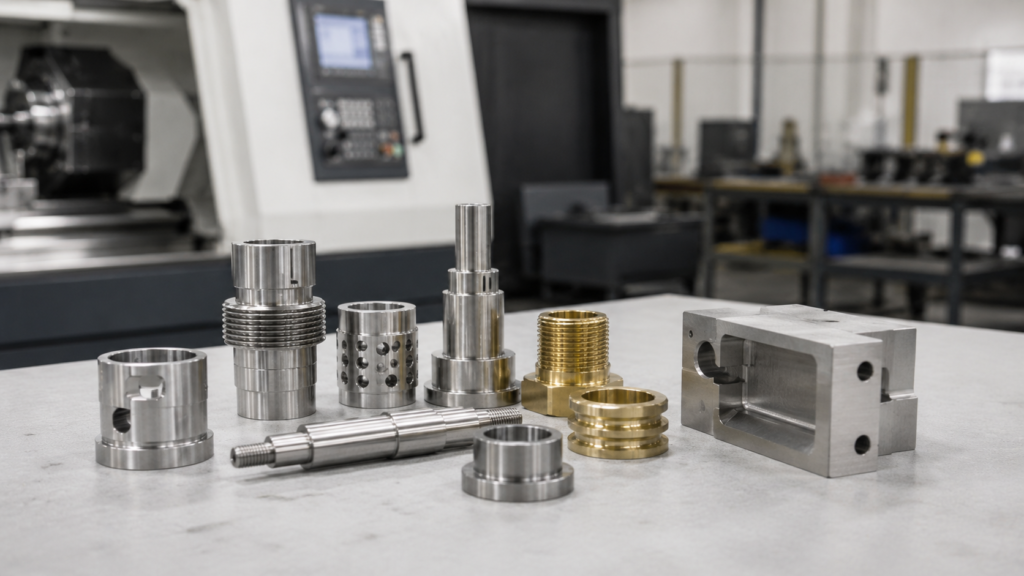
CNC turning offers strong advantages for rotational parts, but it also has limitations.
| Advantage | Why It Matters |
| High repeatability | Suitable for batches and repeat orders |
| Strong accuracy for round parts | Ideal for diameters, threads, and concentric features |
| Good production efficiency | Faster than many manual methods for cylindrical parts |
| Wide material compatibility | Supports metals and engineering plastics |
| Lower variation | CNC control reduces operator-dependent differences |
| Good surface quality | Proper tools and parameters can produce smooth finishes |
Advantages of CNC Turning
CNC turning is efficient, repeatable, and suitable for tight diameter control. It can produce smooth surfaces, accurate threads, and consistent round features. It is also flexible enough for prototypes, small batches, and medium-volume production.
For buyers, CNC turning can reduce production variation and improve repeat order consistency.
Limitations of CNC Turning
CNC turning is less suitable for parts that are mainly square, flat, pocketed, or highly irregular. Those parts usually require CNC milling or multi-axis machining.
Other limitations include material waste from bar stock, setup cost for very low quantities, tool access limits for deep internal features, and possible vibration on long slender parts.
When to Choose CNC Milling and Turning Instead
If a component has both round features and milled flats, slots, cross-holes, or angled surfaces, CNC milling and turning may be a better option.
Turning-milling can combine several processes in one setup, helping reduce handling, improve alignment, and lower accumulated tolerance errors. This is especially useful for complex connectors, medical components, robotic parts, and precision mechanical assemblies.
How Sino-V-Rise Supports CNC Turning Projects?
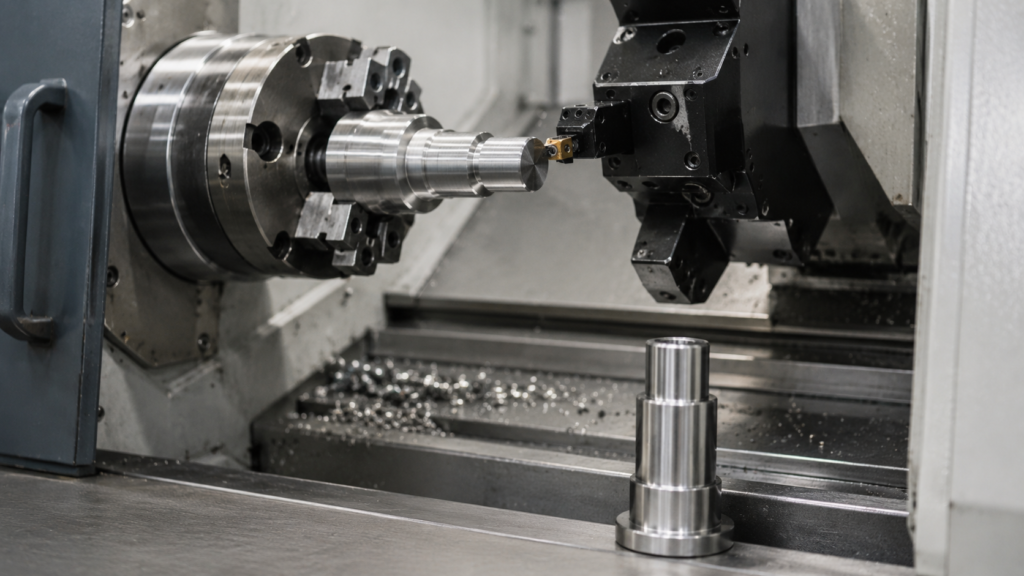
Sino-V-Rise provides custom CNC turning services as part of its broader precision machining capabilities. The company supports CNC turning, CNC milling, turning-milling, wire cutting, 5-axis machining, surface finishing, and inspection for custom metal and plastic parts.
For CNC turning projects, Sino-V-Rise can support drawing review, material selection, process planning, surface treatment recommendations, inspection reporting, and prototype to small-and-medium batch production.
The company works with industries such as medical devices, robotics, semiconductor equipment, optical instruments, automotive parts, motorcycle components, and low-altitude aircraft components. This makes Sino-V-Rise suitable for engineers and procurement teams that need precision turned parts with stable quality, flexible batch support, and reliable delivery.
Recommended Internal Links
| Internal Link Target | Suggested Anchor Text |
| CNC Turning Service Page | CNC turning services |
| CNC Turning-Milling Service Page | CNC milling and turning |
| Precision Machining Page | precision CNC machining |
| Materials Page | CNC machining materials |
| Surface Treatment Page | surface finishing services |
| Medical Industry Page | medical CNC turned parts |
| Auto & Moto Parts Page | automotive CNC turning parts |
| Robotics Components Page | robotic precision turned parts |
FAQ About CNC Turning
What is CNC turning?
CNC turning is a computer-controlled machining process where the workpiece rotates and a cutting tool removes material to create round, cylindrical, threaded, or tapered parts.
What is CNC turning used for?
CNC turning is used for shafts, pins, sleeves, bushings, spacers, connectors, nozzles, threaded parts, fittings, and other components with rotational features.
What is the difference between CNC turning and CNC milling?
In CNC turning, the workpiece rotates and the cutting tool removes material. In CNC milling, the cutting tool rotates and cuts a fixed or indexed workpiece. Turning is better for round parts, while milling is better for flat surfaces, pockets, slots, and complex profiles.
What materials can be used for CNC turning?
Common materials include aluminum, stainless steel, brass, copper, titanium, carbon steel, alloy steel, and engineering plastics.
Is CNC turning suitable for tight tolerances?
Yes. Precision CNC turning is suitable for tight diameters, threads, concentricity, and smooth surface requirements. Actual tolerance depends on material, part geometry, machine capability, tooling, and inspection method.
When should I choose CNC turning instead of milling?
Choose CNC turning when the part is mainly round, cylindrical, threaded, or symmetrical around an axis. Choose milling or turning-milling when the part also needs flats, slots, pockets, cross-holes, or complex surfaces.
Is CNC turning good for small-batch production?
Yes. CNC turning is suitable for prototypes, small batches, and repeat production, especially when stable dimensions and repeatability are required.
Conclusion
CNC turning is one of the most important processes in precision manufacturing. It is ideal for producing round, cylindrical, threaded, and concentric parts with high repeatability and good surface quality. By understanding the CNC turning process, common operations, suitable materials, applications, advantages, and limitations, buyers can choose the right manufacturing method more confidently.
For custom turned components, Sino-V-Rise can support material selection, CNC turning, CNC turning-milling, surface treatment, inspection, and small-to-medium batch production across industries such as medical devices, robotics, semiconductor equipment, optical instruments, automotive, motorcycle, and low-altitude aircraft components.