
Quick Answer
Choose 304 stainless steel for general CNC parts in mild environments. Choose 316 stainless steel when parts face chlorides, saltwater, chemicals, humidity, or long-term corrosion risk.
Key Takeaways
- 304 stainless steel machining is usually more cost-effective for general industrial CNC parts.
- 316 stainless steel machining is better for chloride, marine, medical, chemical, and high-humidity environments.
- The key advantage of 316 is not much higher strength, but stronger resistance to pitting and crevice corrosion.
- For stainless steel CNC machining, the working environment should guide material selection before price.
- Both 304 and 316 require proper tooling, coolant, chip control, and inspection to achieve stable CNC results.
Abstract
304 and 316 stainless steel are two of the most common materials used for CNC machined parts. Both offer good strength, corrosion resistance, clean appearance, and wide industrial use. However, they are not equal in every environment. 304 stainless steel is a practical choice for many indoor and general-purpose parts, while 316 stainless steel is often the safer option when parts are exposed to salt, chlorides, cleaning chemicals, moisture, or aggressive fluids.
This guide explains how to compare 304 vs 316 stainless steel from the perspective of CNC part design, machining performance, corrosion risk, cost, and real application needs.
Start with the Working Environment, Not the Material Price
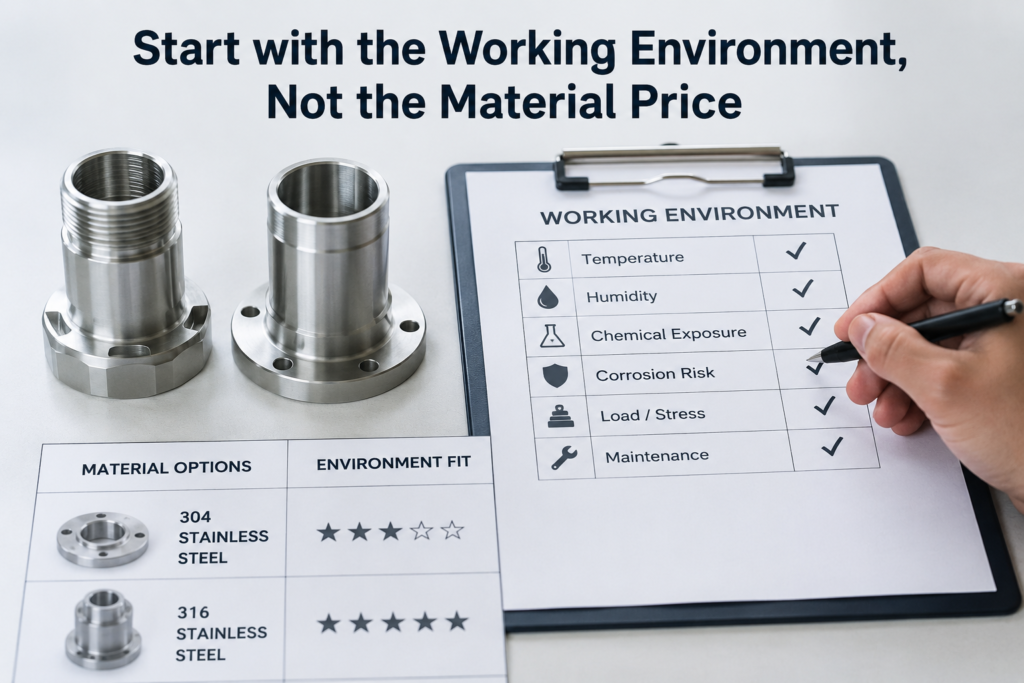
When comparing 304 vs 316 stainless steel for CNC parts, many buyers first look at material cost. That is understandable, but it is not always the best starting point.
The more important question is: where will the part work?
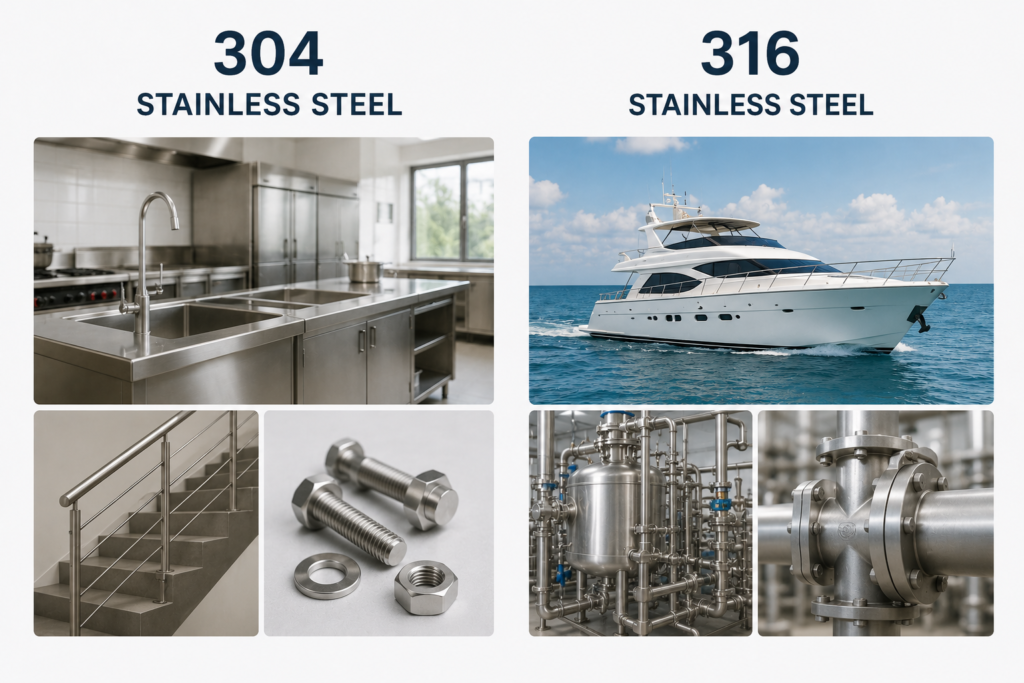
If the part is used indoors, in dry air, or in a mild industrial environment, 304 stainless steel is often enough. It provides good corrosion resistance, stable mechanical performance, and a relatively lower material cost.
If the part will face saltwater, coastal air, chloride-based cleaning agents, chemical fluids, repeated sterilization, or high humidity, 316 stainless steel is usually the better choice. The reason is simple: 316 contains molybdenum, which improves resistance to chloride-related pitting and crevice corrosion. Material references commonly identify this as the main performance difference between 304 and 316 stainless steel.
Why chloride exposure matters for CNC parts?
Stainless steel protects itself with a passive surface film. In many normal environments, this film helps prevent corrosion. However, chloride exposure can damage the passive layer and cause small pits or localized corrosion.
This is especially important for cnc machined stainless steel parts used in:
| Environment | Material Risk |
| Marine or coastal air | Chloride pitting and staining |
| Medical cleaning | Repeated exposure to disinfectants or cleaning agents |
| Chemical processing | Localized corrosion around holes, slots, or threads |
| Outdoor equipment | Moisture and contaminant buildup |
| Road-salt exposure | Corrosion around fasteners and hidden surfaces |
For this reason, 316 stainless steel is often selected when corrosion failure would be expensive, unsafe, or difficult to repair.
What Is 304 Stainless Steel Best For?
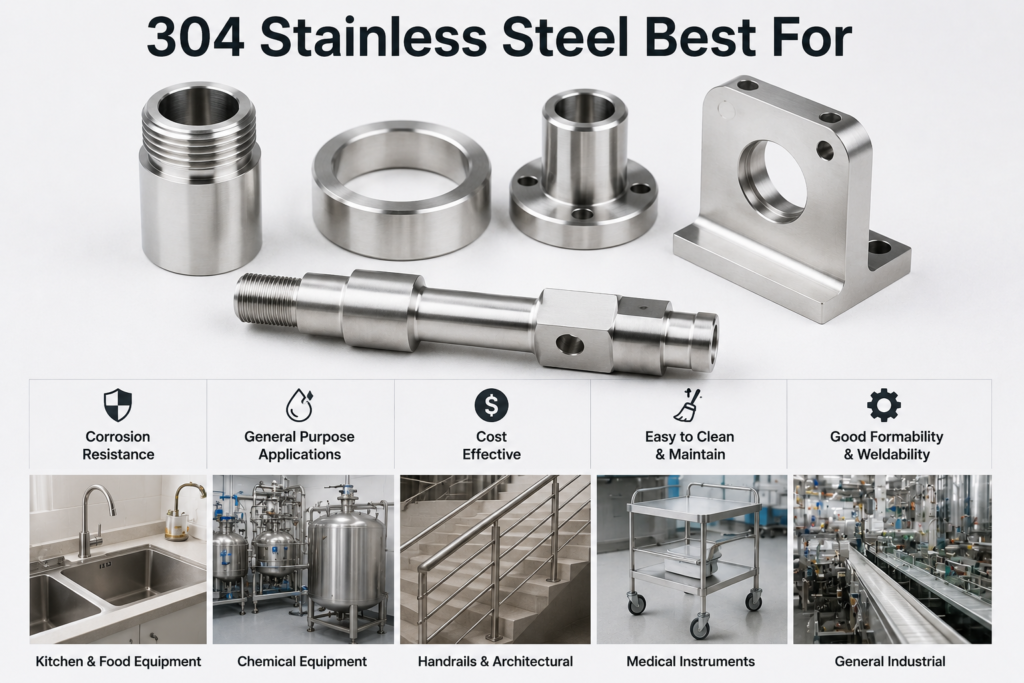
304 stainless steel is one of the most widely used stainless steel grades. It offers a strong balance of corrosion resistance, formability, strength, appearance, and cost.
For 304 stainless steel machining, it is commonly used when the CNC part does not need high chloride resistance. It is a practical option for brackets, housings, plates, covers, fixtures, shafts, pins, and general industrial components.
Good applications for 304 stainless steel CNC parts
304 stainless steel is usually suitable for:
- Indoor machine parts
- General industrial brackets and fixtures
- Food equipment components in mild conditions
- Automation equipment parts
- Prototype stainless steel parts
- Clean-looking external covers or housings
- Cost-sensitive custom stainless steel parts
304 is not a “low-quality” material. In the right environment, it can provide excellent service life. The main point is that it should not be treated as the best choice for every corrosive environment.
What Makes 316 Stainless Steel Different?
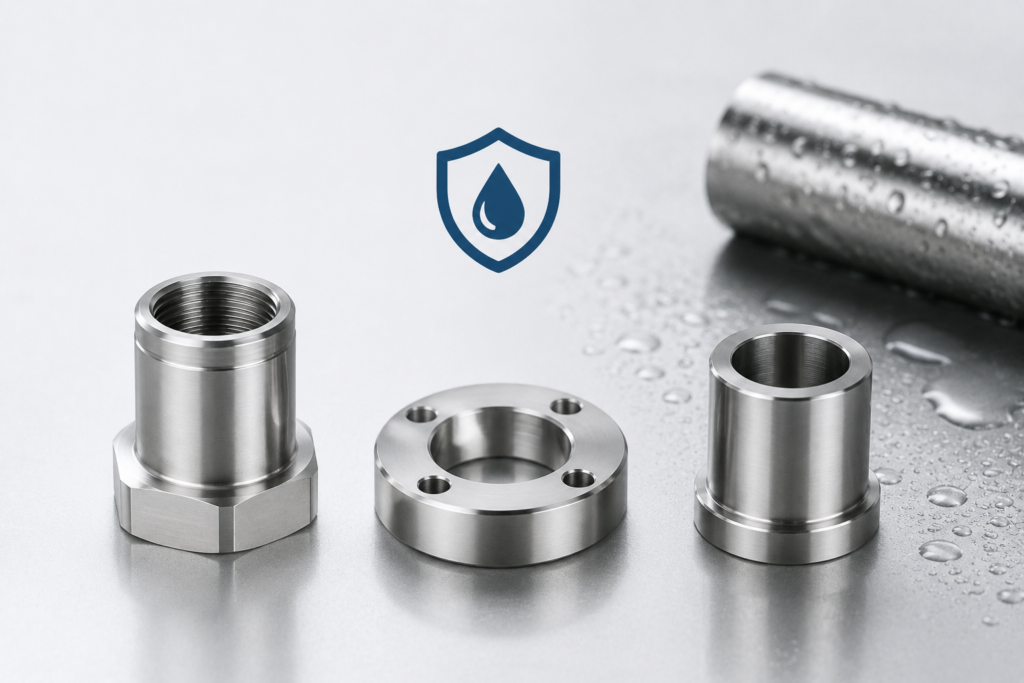
316 stainless steel is similar to 304 in many ways, but it contains molybdenum. This small alloying difference gives 316 better resistance to pitting and crevice corrosion, especially in chloride environments.
That is why 316 stainless steel machining is common for parts used in marine equipment, medical devices, chemical systems, outdoor hardware, semiconductor equipment, and other demanding applications.
When 316 stainless steel is worth the higher cost?
316 stainless steel is usually worth considering when:
- The part works near seawater or coastal air
- The part contacts chloride-based cleaners
- The part is used in medical or laboratory equipment
- The part must resist staining or corrosion over a long service life
- The part has threads, grooves, holes, or crevices where moisture can stay
- Failure or corrosion would increase maintenance cost
For precision CNC projects, 316 is not always selected because it is stronger. It is selected because it reduces corrosion risk in more aggressive environments.
304 vs 316 Stainless Steel CNC Parts Comparison Table
| Factor | 304 Stainless Steel | 316 Stainless Steel |
| Main advantage | Cost-effective and widely available | Better corrosion resistance |
| Best environment | Indoor, dry, mild industrial use | Marine, chemical, humid, chloride exposure |
| Chloride resistance | Moderate | Better |
| Material cost | Lower | Higher |
| CNC machinability | Moderate; work-hardens | Moderate; can be slightly tougher |
| Typical CNC parts | Brackets, covers, fixtures, shafts | Medical parts, marine parts, chemical-use parts |
| Best keyword match | 304 stainless steel machining | 316 stainless steel machining |
| Best choice when | Price and general corrosion resistance matter | Long-term corrosion resistance matters more |
Simple selection guide
| Your Part Condition | Recommended Grade |
| Indoor mechanical part | 304 |
| General industrial fixture | 304 |
| Food equipment in mild conditions | 304 or 316 |
| Coastal or marine exposure | 316 |
| Medical cleaning environment | 316 |
| Chemical contact | 316 |
| Outdoor part with hidden crevices | 316 |
| Cost-sensitive prototype | 304, unless corrosion testing is needed |
CNC Machining Considerations for 304 and 316 Stainless Steel
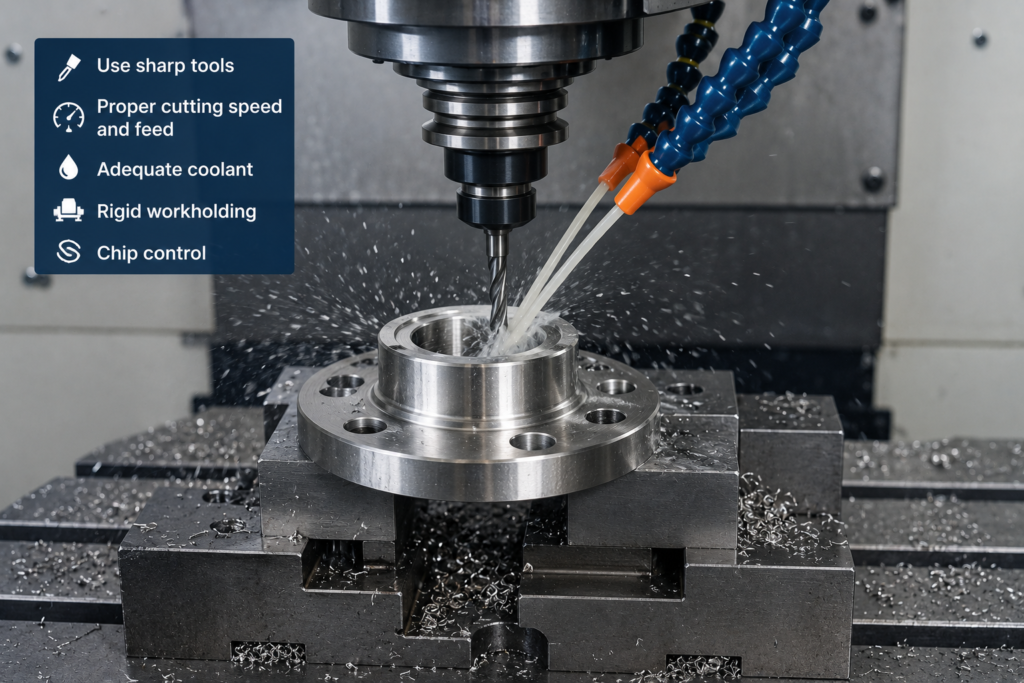
Both 304 and 316 belong to austenitic stainless steels. In stainless steel CNC machining, they can be more difficult to machine than aluminum or free-machining steel because they tend to work-harden and generate heat.
If the cutting tool rubs instead of cutting cleanly, the surface can harden quickly. This may increase tool wear, reduce surface quality, and affect dimensional accuracy.
Key machining risks
Common machining challenges include:
- Work hardening
- Tool wear
- Heat buildup
- Long or stringy chips
- Burr formation
- Thread galling
- Surface finish variation
- Dimensional movement on thin-wall parts
How to improve stainless steel CNC machining quality?
A reliable machining plan should consider:
| Machining Factor | Recommended Control |
| Cutting tools | Use sharp tools with suitable coating |
| Feed rate | Avoid rubbing; maintain stable cutting |
| Coolant | Use enough coolant for heat and chip control |
| Tool path | Reduce vibration and sudden load changes |
| Clamping | Ensure rigid and stable workholding |
| Deburring | Plan edge finishing early |
| Inspection | Check critical dimensions, threads, and surface finish |
For stainless steel CNC-turned parts, extra attention should be given to thread quality, concentricity, shaft diameter, surface roughness, and burr control.
Which Industries Should Choose 304 or 316 Stainless Steel?
Different industries have different priorities. A low-cost material may be acceptable for one product but risky for another.
Sino-V-Rise supports CNC machining projects across medical devices, drone and UAV parts, semiconductor equipment, robotics, optical instruments, automotive components, and motorcycle parts. In these fields, stainless steel selection is often connected to service environment, precision, appearance, and reliability.
Industry-based selection table
| Industry | 304 May Fit When… | 316 May Fit When… |
| Medical devices | The part is a non-fluid-contact fixture or housing | The part faces cleaning, moisture, or corrosion risk |
| Semiconductor equipment | The part works in a controlled dry area | The part is near chemicals or process fluids |
| Robotics | The robot works indoors in a clean environment | The robot works in washdown or humid conditions |
| Drone/UAV parts | Weight and corrosion demand are moderate | Outdoor, coastal, or high-humidity use is expected |
| Optical instruments | Clean appearance and stability are needed | Staining or corrosion would affect long-term use |
| Automotive/motorcycle parts | Indoor or protected components | Road salt, moisture, or outdoor exposure is likely |
| Marine equipment | Rarely recommended | Usually preferred |
This makes the material decision more practical. The question is not simply “Is 316 better than 304?” The better question is “Which material fits the real environment of this CNC part?”
How Sino-V-Rise Supports Stainless Steel CNC Machining Projects?
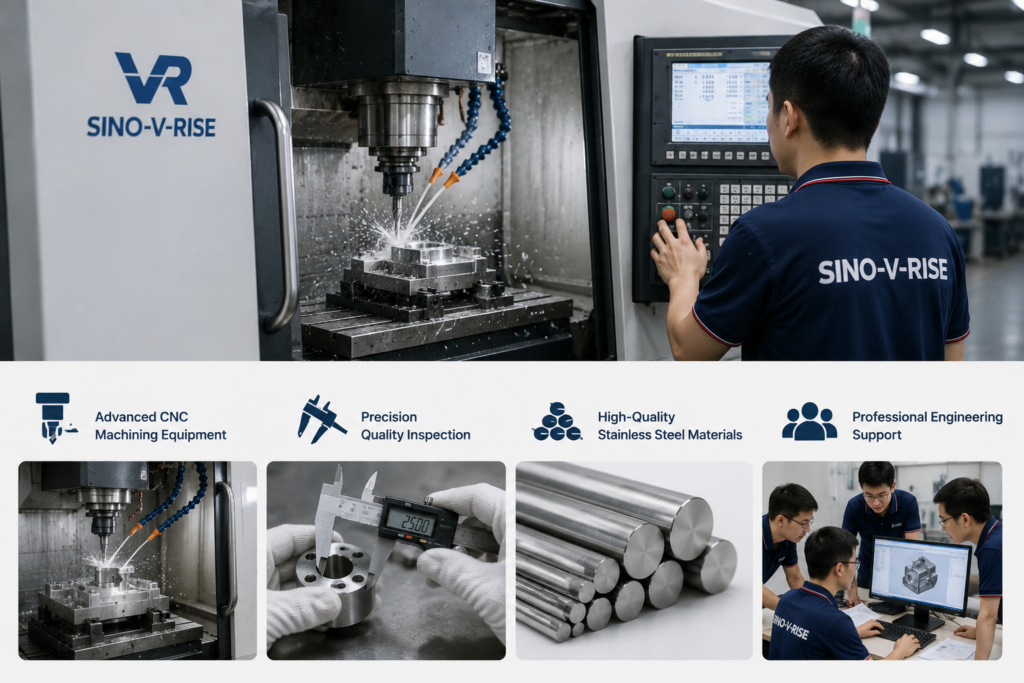
Choosing between 304 and 316 stainless steel is only one part of a successful CNC project. The final result also depends on DFM review, machine selection, process planning, surface finishing, inspection, and delivery control.
Sino-V-Rise provides custom CNC machining for prototype, small-batch, and medium-batch precision parts. For stainless steel projects, the team can support CNC milling, CNC turning, turning-milling, 5-axis machining, surface treatment coordination, and dimensional inspection.
This is especially useful when buyers are not only looking for a material answer, but also need a manufacturable solution for custom stainless steel parts.
What to include in your stainless steel CNC RFQ?
To receive a more accurate quote and material recommendation, prepare:
| RFQ Information | Why It Matters |
| 3D CAD file | Confirms geometry and machinability |
| 2D drawing | Defines tolerance, threads, roughness, and inspection points |
| Material requirement | Confirms 304, 316, 316L, or alternative grade |
| Working environment | Helps verify corrosion risk |
| Quantity | Affects process planning and unit cost |
| Surface finish | Influences machining and post-processing |
| Critical dimensions | Helps plan inspection and quality control |
| Application industry | Helps identify risk factors early |
If the part will be used in a chloride, marine, medical, or chemical environment, it is better to mention this before production. This helps the engineering team evaluate whether 304 is enough or whether 316 is the safer choice.
FAQ: 304 vs 316 Stainless Steel for CNC Parts
Is 316 stainless steel stronger than 304?
Not significantly for most CNC part decisions. Their mechanical properties are often similar. The main reason to choose 316 is better corrosion resistance, especially in chloride or chemical environments.
Is 304 stainless steel good for CNC machining?
Yes. 304 stainless steel machining is widely used for general CNC parts. It is strong, corrosion-resistant, and cost-effective, but it requires proper cutting tools, coolant, and machining parameters.
Is 316 stainless steel harder to machine than 304?
316 can be slightly more challenging because it may feel tougher during cutting and can generate more tool wear. However, with the right setup, 316 stainless steel machining can achieve accurate and stable results.
Which stainless steel is better for marine CNC parts?
316 stainless steel is usually the better choice for marine or coastal CNC parts because it has stronger resistance to chloride-related corrosion.
Should I always choose 316 for stainless steel CNC parts?
No. If the part works in a mild indoor environment, 304 may be the better value. Choose 316 when the environment, cleaning conditions, or lifecycle risk justify the higher material cost.
What is the best stainless steel for precision CNC machining?
There is no single best grade for every project. For precision stainless steel machining, 304 is often suitable for general use, while 316 is better for corrosion-sensitive applications. The best choice depends on environment, tolerance, surface finish, and cost target.
Conclusion
For stainless steel CNC machining, both 304 and 316 are reliable materials, but they serve different needs. 304 stainless steel is a practical and cost-effective choice for general CNC parts in mild environments. 316 stainless steel is the better option when parts face chlorides, saltwater, chemicals, cleaning agents, humidity, or long-term corrosion risk.
The best material is not always the more expensive one. It is the material that matches the real working environment, part geometry, tolerance requirements, surface finish, and service life expectations.
For buyers developing CNC-machined stainless steel parts, the safest approach is to share the drawing, application environment, tolerance needs, and expected quantity with the machining supplier before production. That allows the engineering team to recommend the right material and process before cost, quality, or corrosion problems appear.