
Quick Answer
Surface treatment of metals modifies a part’s outer layer to improve corrosion resistance, wear resistance, hardness, appearance, roughness, cleanliness, or functional performance after machining.
Key Takeaways
- Surface treatment improves how metal parts perform, look, and survive in real operating environments.
- Common metal finishes include anodizing, plating, polishing, sandblasting, passivation, powder coating, and heat-related surface processes.
- The right metal surface treatment depends on material, tolerance, roughness, corrosion risk, wear, appearance, and industry requirements.
- CNC parts for medical, semiconductor, robotics, optical, low-altitude aircraft, and automotive applications often need finishing after machining.
- A good finishing plan should be confirmed before production, not after parts are already machined.
Abstract
Surface treatment of metals is a post-processing or surface-engineering method used to modify the outer surface or near-surface layer of a metal component. It can protect the base material, improve wear behavior, reduce corrosion, refine texture, improve cosmetic appearance, or prepare the part for assembly. ASM International describes surface engineering as covering surface treatments and coatings used to improve performance against corrosion and wear.
For CNC machined parts, surface finishing services are not only cosmetic. They affect function, dimensional fit, cleanliness, friction, coating adhesion, and long-term reliability. This guide explains what metal surface treatment means, how it works, common treatment types, suitable materials, applications, benefits, limitations, and how to choose the right finish for precision machined components.
What is Surface Treatment of Metals?
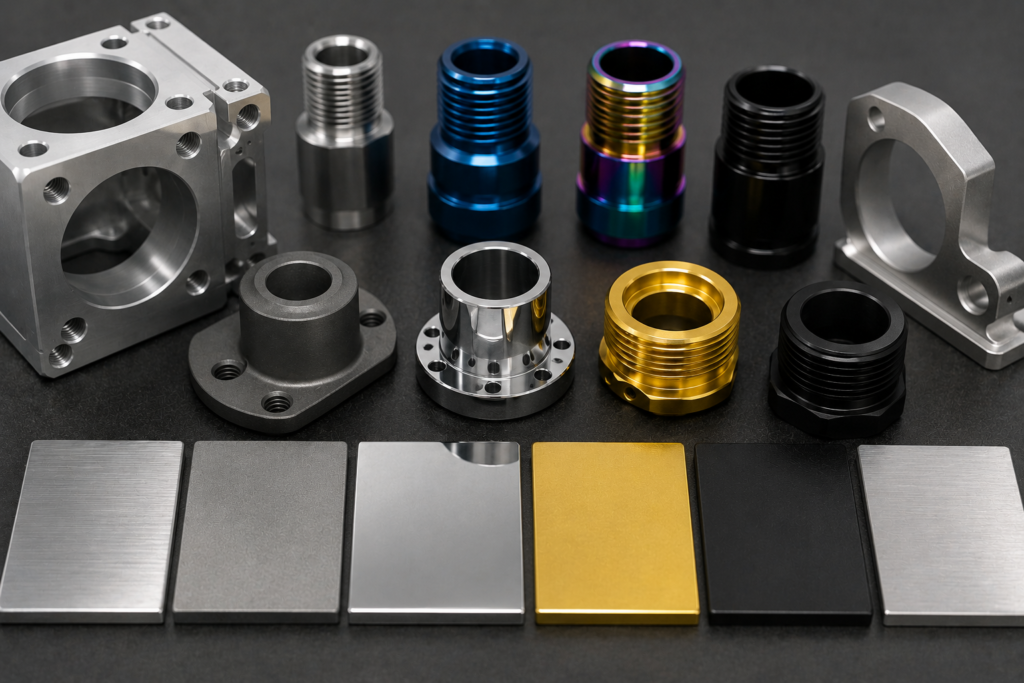
Surface treatment of metals is the process of changing the surface condition of a metal part without necessarily changing the entire bulk material. The goal is to make the part more suitable for its final use.
In CNC machining, a part may leave the machine with tool marks, burrs, machining lines, sharp edges, or a raw metallic surface. A finishing step can then be added to improve corrosion resistance, wear resistance, surface texture, color, conductivity, hardness, or cleanliness.
A simple way to define it:
Surface treatment is the controlled modification of a metal part’s surface to improve performance, appearance, protection, or manufacturability.
This makes it different from basic machining. Machining creates the geometry; finishing improves the surface.
How Metal Surface Treatment Works ?
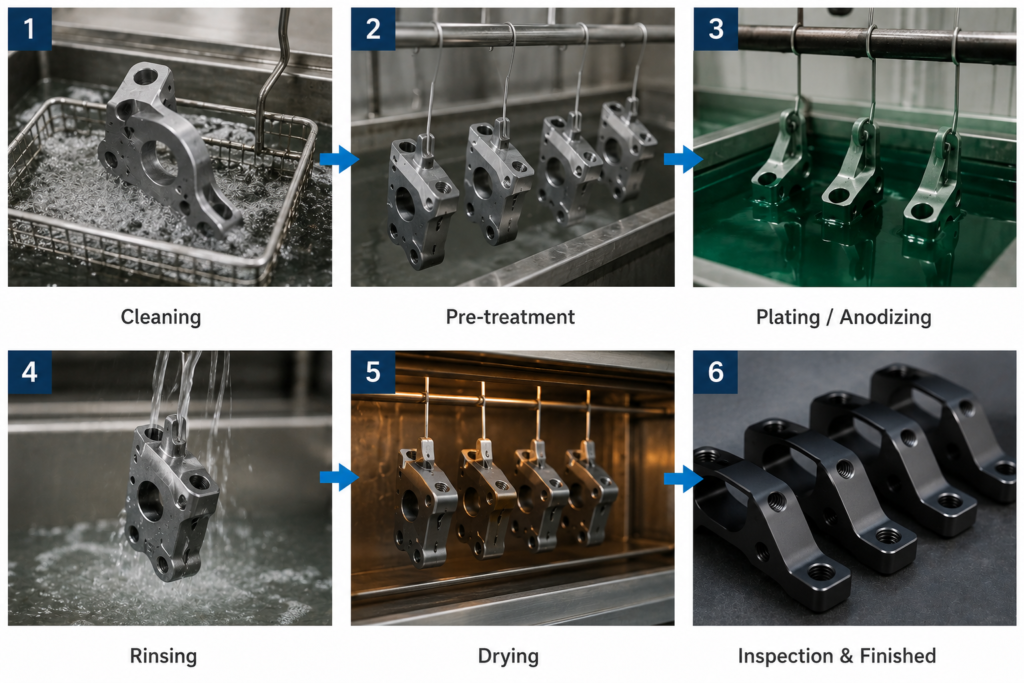
Metal surface treatment works by removing material, adding material, converting the surface chemically, or altering the surface layer physically.
Surface removal
Processes such as polishing, grinding, deburring, and blasting remove high spots, burrs, oxide, or machining marks. They are often used to improve surface finish and roughness before anodizing, plating, or assembly.
Surface addition
Coatings and plating add a new layer on top of the metal. AMPP explains that protective coatings isolate the substrate from its environment and can protect through barrier, inhibitive, sacrificial, or combined mechanisms.
Surface conversion
Some treatments chemically convert the outer layer. Anodizing, passivation, black oxide, and conversion coatings do not simply paint the surface; they create or enhance a protective layer.
Surface property modification
Heat treatment, hardening, shot peening, or specialized coatings can change hardness, fatigue resistance, friction, or wear behavior. These are selected when appearance alone is not enough.
Common Types of Metal Finishes
| Type of Finish | Best For | Main Purpose | Common Materials |
| Anodizing | Aluminum parts | Corrosion resistance, color, surface protection | Aluminum |
| Hard anodizing | Wear-resistant aluminum parts | Hardness and abrasion resistance | Aluminum |
| Sandblasting | Matte texture | Cleaning and uniform appearance | Aluminum, steel, stainless steel |
| Polishing | Smooth visible surfaces | Lower roughness and better appearance | Stainless steel, aluminum, brass |
| Electroplating | Conductive or decorative parts | Wear, corrosion, conductivity, appearance | Steel, brass, copper |
| Passivation | Stainless steel | Corrosion resistance | Stainless steel |
| Powder coating | Structural parts | Durable color and protection | Steel, aluminum |
| Black oxide | Steel parts | Dark appearance and mild protection | Steel |
| Electropolishing | Clean precision parts | Smoothness and corrosion resistance | Stainless steel |
| Brushing | Decorative panels | Linear texture | Aluminum, stainless steel |
Sino-V-Rise’s CNC machining guidance also lists anodizing, sandblasting, polishing, electroplating, and powder coating as common options for CNC machined parts, with different finishes serving corrosion, appearance, wear, or functional goals.
Surface Treatment Comparison Table
| Selection Priority | Recommended Treatment | Why It Fits |
| Budget priority | As-machined, deburring, sandblasting | Lower cost and shorter lead time |
| Corrosion resistance | Anodizing, passivation, plating, powder coating | Protects exposed metal surface |
| Cosmetic appearance | Anodizing, polishing, brushing, painting | Improves visual quality |
| Wear resistance | Hard anodizing, hard plating, heat-related treatments | Supports sliding or contact surfaces |
| Cleanliness | Electropolishing, passivation, precision cleaning | Useful for medical and semiconductor parts |
| Matte finish | Sandblasting, bead blasting | Creates uniform texture |
| Conductivity | Nickel, gold, silver, or copper plating | Supports electrical applications |
Common Materials for Surface Treatment: Aluminum Surface Treatment
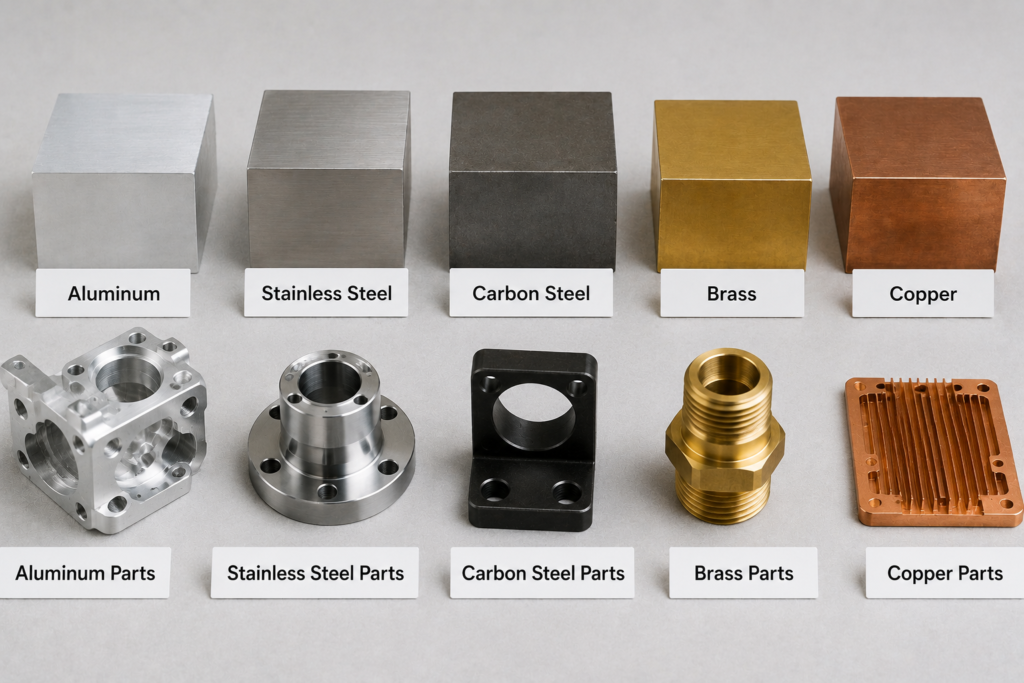
Different metals respond differently to finishing. That is why material choice and surface treatment should be planned together.
Aluminum surface treatment
Aluminum surface treatment often includes anodizing, hard anodizing, sandblasting, polishing, brushing, and powder coating. Aluminum is widely used for CNC housings, frames, brackets, robotics parts, drone components, and optical fixtures because it is lightweight and easy to machine.
Stainless steel surface treatment
Stainless steel is often passivated, polished, electropolished, bead blasted, or coated. For medical, food-contact, semiconductor, and clean equipment components, smoothness and corrosion resistance are usually more important than color.
Steel and alloy steel surface treatment
Steel parts may require black oxide, zinc plating, nickel plating, phosphate coating, painting, powder coating, or hardening. These treatments help control rust, friction, hardness, and wear.
Brass and copper surface treatment
Brass and copper can be polished, plated, brushed, or protected with clear coatings. They are often used when conductivity, appearance, or machinability matters.
Titanium surface treatment
Titanium may be polished, passivated, bead blasted, anodized, or coated depending on the application. In medical and aerospace-style parts, surface condition can affect cleanliness, appearance, and compatibility.
Applications in CNC Machined Parts precision machining
Surface treatment is especially important in precision CNC machining because many parts are not judged by dimensions alone. They must also meet surface, durability, and assembly requirements.
| Industry | Surface Treatment Focus | Typical CNC Parts |
| Medical | Smoothness, cleanliness, corrosion resistance | Surgical tool parts, housings, connectors |
| Semiconductor | Clean surface, low particles, stability | Fixtures, carriers, mounting plates |
| Robotics | Wear resistance, lightweight structure, appearance | Robot joints, arms, brackets |
| Optical instruments | Fine finish, stability, matte or anti-reflective surfaces | Mounts, rings, housings |
| Low-altitude aircraft / UAV | Lightweight protection, corrosion resistance | Frames, housings, brackets |
| Auto & moto | Wear, corrosion, durability, appearance | Custom brackets, shafts, performance parts |
The need for finishing is growing as precision industries expand. IFR reported 542,000 industrial robots installed globally in 2024, while SEMI reported that semiconductor manufacturing equipment sales reached $135.1 billion in 2025, driven by AI-related logic, memory, and advanced packaging demand.
Benefits and Limitations of Surface Treatment, Surface Finish, and Roughness
Main benefits
Good surface treatment can improve:
- Corrosion resistance
- Wear resistance
- Surface hardness
- Cosmetic appearance
- Color consistency
- Cleanliness
- Friction and sliding behavior
- Electrical conductivity
- Coating adhesion
- Product life
Main limitations
Surface treatment also has trade-offs. It can add cost, change dimensions slightly, affect tolerances, introduce color variation, increase lead time, or require special masking. Some finishes are also restricted by material type. For example, anodizing is mainly used for aluminum, while passivation is mainly used for stainless steel.
Surface roughness must also be specified clearly. DIN EN ISO 21920 provides terminology and methods for describing and measuring surface texture, including parameters such as Ra and Rz, so drawing requirements can be communicated consistently between buyer and supplier.
How to Choose Surface Finishing Services ?
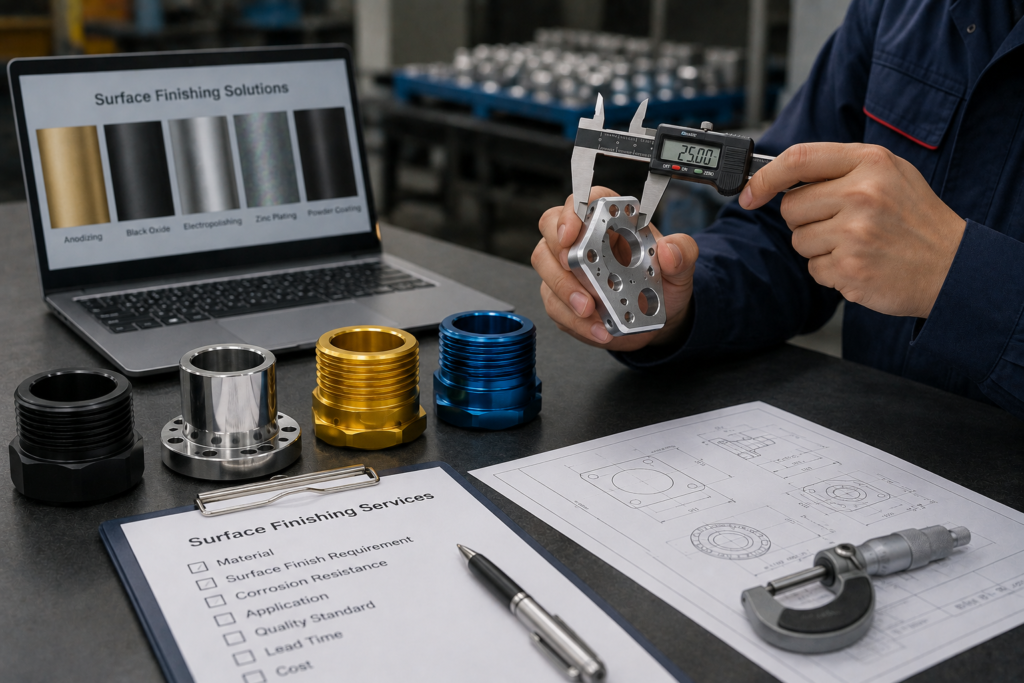
Choosing surface finishing services should start with the part’s function, not only appearance.
Step 1: Confirm the base material
Aluminum, stainless steel, brass, copper, titanium, and steel all have different finishing options. Some finishes are impossible or inefficient for certain materials.
Step 2: Define the working environment
Will the part face humidity, outdoor exposure, chemicals, heat, friction, or frequent handling? Corrosion and wear requirements should guide the finish.
Step 3: Specify the appearance level
For visible parts, define color, gloss, texture, and acceptable variation. For internal parts, a simple functional finish may be enough.
Step 4: Control tolerance and masking
Some finishes add thickness, remove material, or require masking. This is critical for threaded holes, bearing seats, sealing surfaces, and precision fits.
Step 5: Match inspection methods
Use visual inspection for appearance, roughness testing for Ra/Rz, coating thickness measurement for plating or anodizing, and CMM inspection for critical dimensions.
Sino-V-Rise is positioned for custom CNC machining from prototype to small and medium-batch production, with precision machining, surface treatment, and quality inspection support. Its website highlights ±0.005 mm precision, 35+ surface finishes, and 80+ metals and plastics for custom parts production. The uploaded company profile also emphasizes multi-process CNC precision parts, small-to-medium batch delivery, ISO9001 quality systems, and focus industries including medical, drones, semiconductor, robotics, optical instruments, and auto/moto parts.
FAQ
What is surface treatment of metals?
Surface treatment of metals is the process of modifying a metal part’s surface to improve protection, roughness, appearance, hardness, wear resistance, corrosion resistance, or functional performance.
Why is surface treatment important after CNC machining?
CNC machining creates accurate geometry, but the surface may still have tool marks, burrs, or insufficient corrosion protection. Finishing improves the final part’s function and appearance.
What are the most common metal finishes?
Common metal finishes include anodizing, polishing, sandblasting, electroplating, passivation, powder coating, painting, brushing, black oxide, and electropolishing.
What is the difference between surface finish and surface treatment?
Surface finish usually describes the texture or roughness of a surface, such as Ra or Rz. Surface treatment is the process used to create or improve that surface condition.
Which surface treatment is best for aluminum?
For aluminum CNC parts, anodizing is often the first choice for corrosion resistance and appearance. Hard anodizing is better for wear resistance, while sandblasting and polishing improve texture and appearance.
Does surface treatment affect tolerance?
Yes. Plating, anodizing, powder coating, polishing, and blasting can affect dimensions or surface texture. Critical surfaces should be masked or tolerance-compensated during design and process planning.
Conclusion: Surface Treatment
Surface treatment of metals is a key step between CNC machining and final part performance. It helps parts resist corrosion, reduce wear, improve appearance, meet roughness requirements, and perform better in demanding industries.
For a definition-type pillar article, the most important message is simple: machining creates the part shape, while metal surface treatment helps the part survive, function, and look right in its actual environment. For precision CNC projects, the best finish should be selected early based on material, tolerance, roughness, application, cost, and inspection requirements.
Sino-V-Rise can support this workflow through CNC milling, CNC turning, 5-axis machining, material selection, surface finishing services, and quality inspection for custom precision parts.