All uploads are secure and confidential.

Why Choose Sino Rise for Precision CNC Machining

Leading Technology and Extensive Experience to Provide Efficient and Precise Solutions
Advanced Equipment and Technology
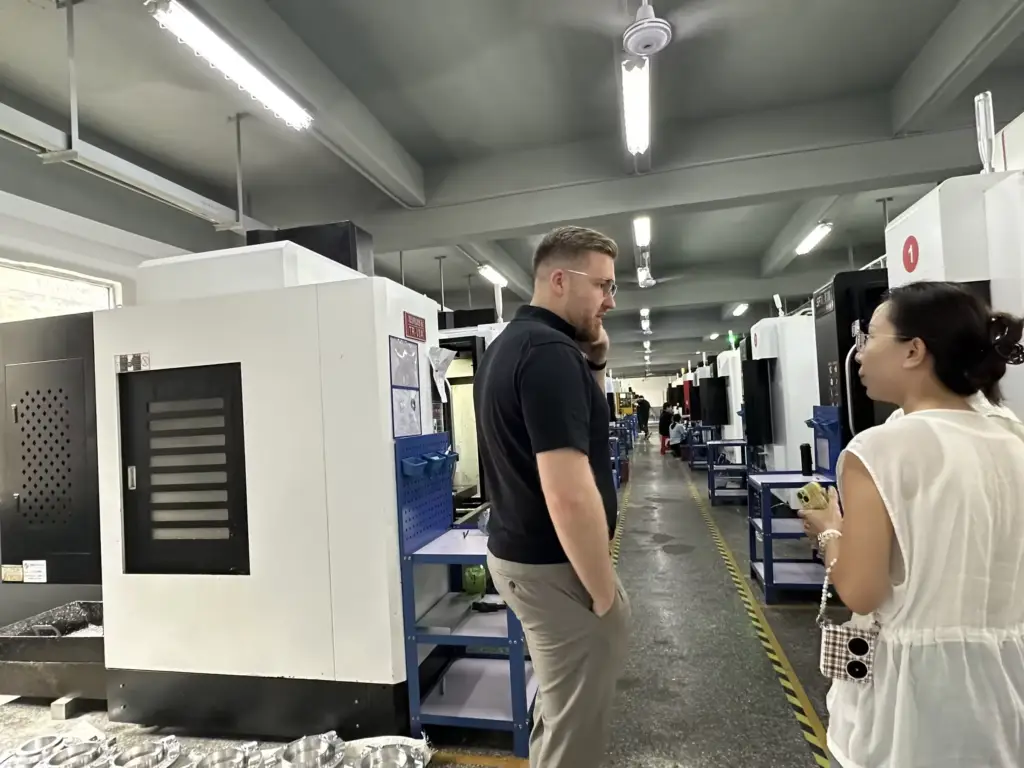
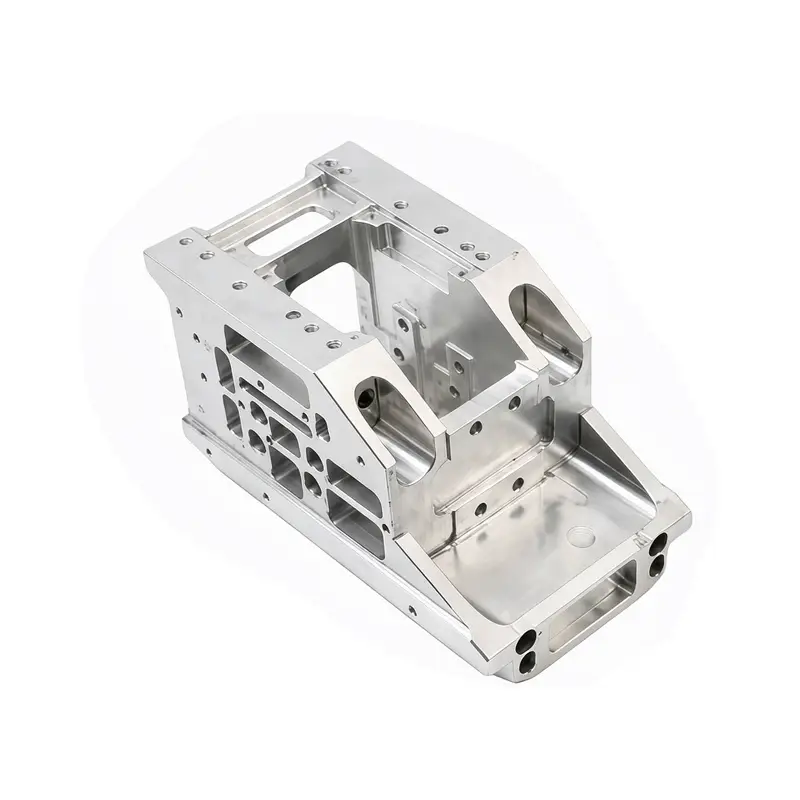
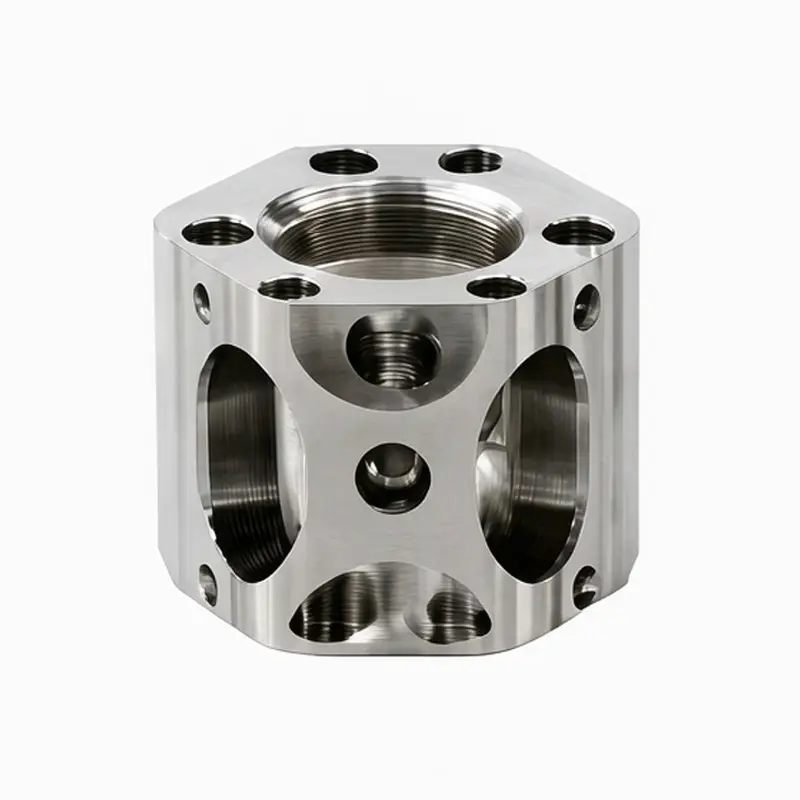
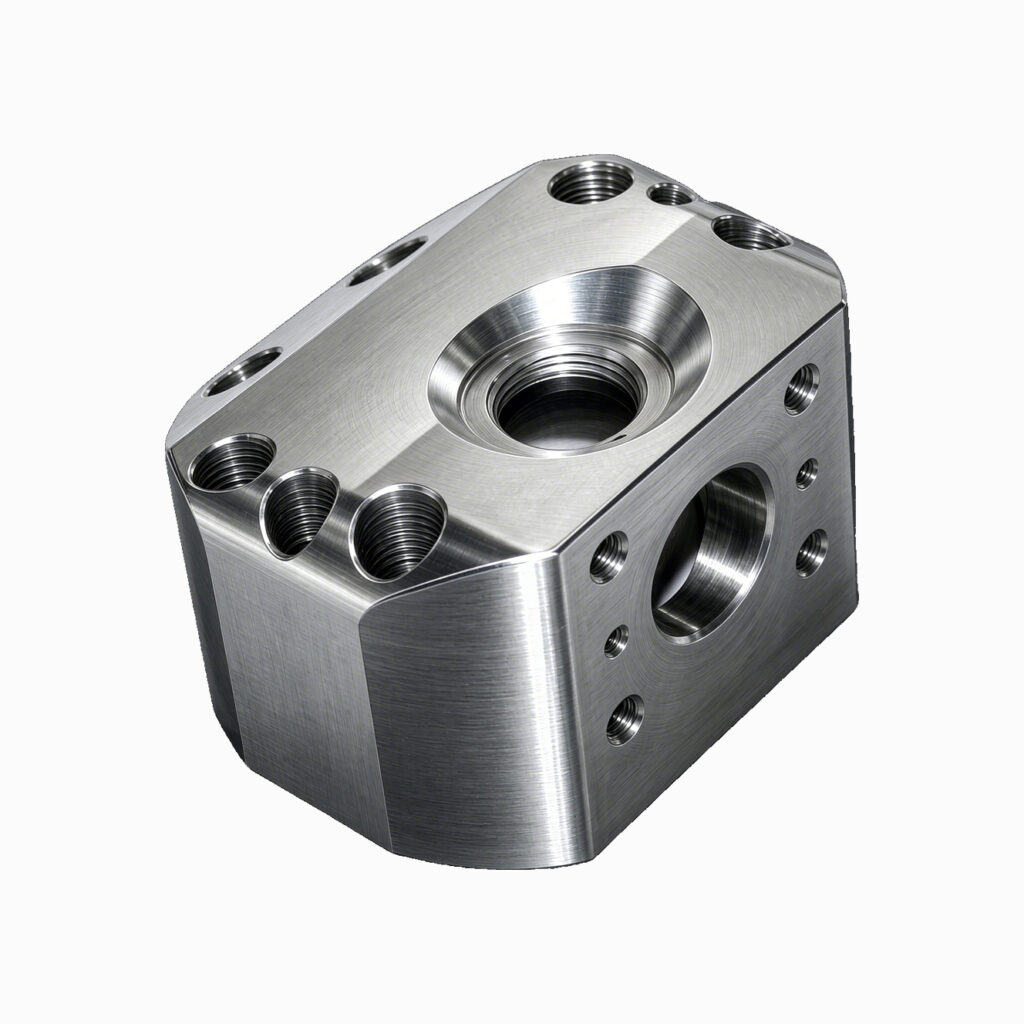
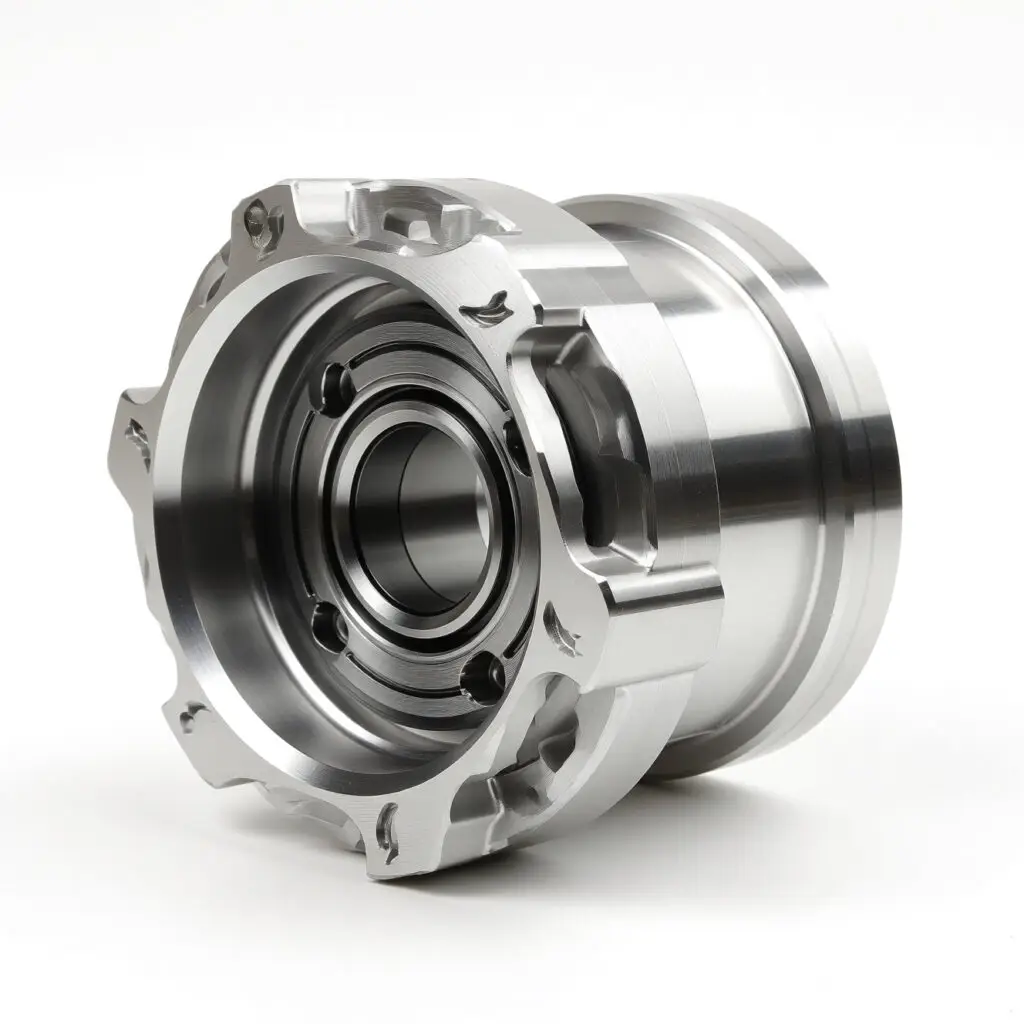
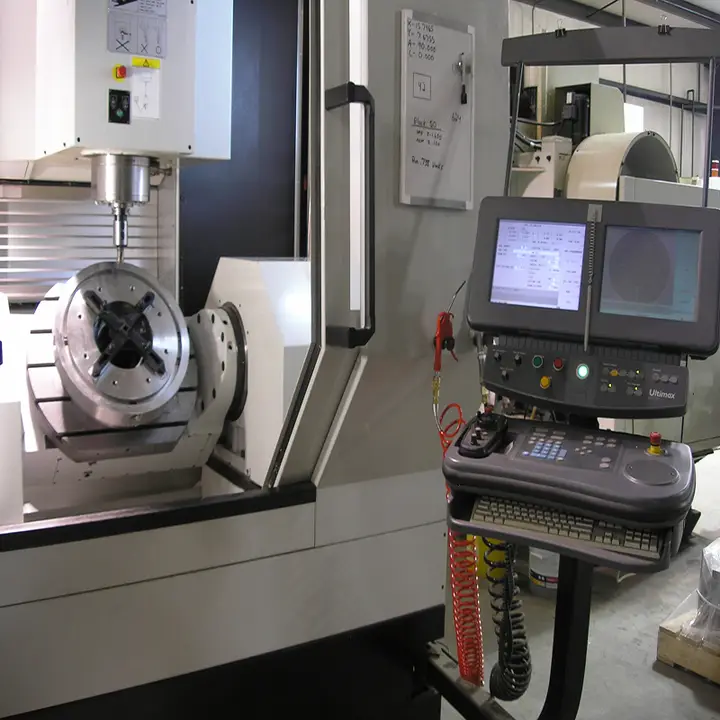
With over 17 years of precision machining experience, we have multiple advanced 5-axis CNC machines, ensuring high precision and efficiency while maintaining stable processing quality and delivery schedules.
One-on-One Engineer Service
Each project is managed by our experienced engineering team, from blueprint review and DFM optimization to processing execution, ensuring every part meets your specific requirements.
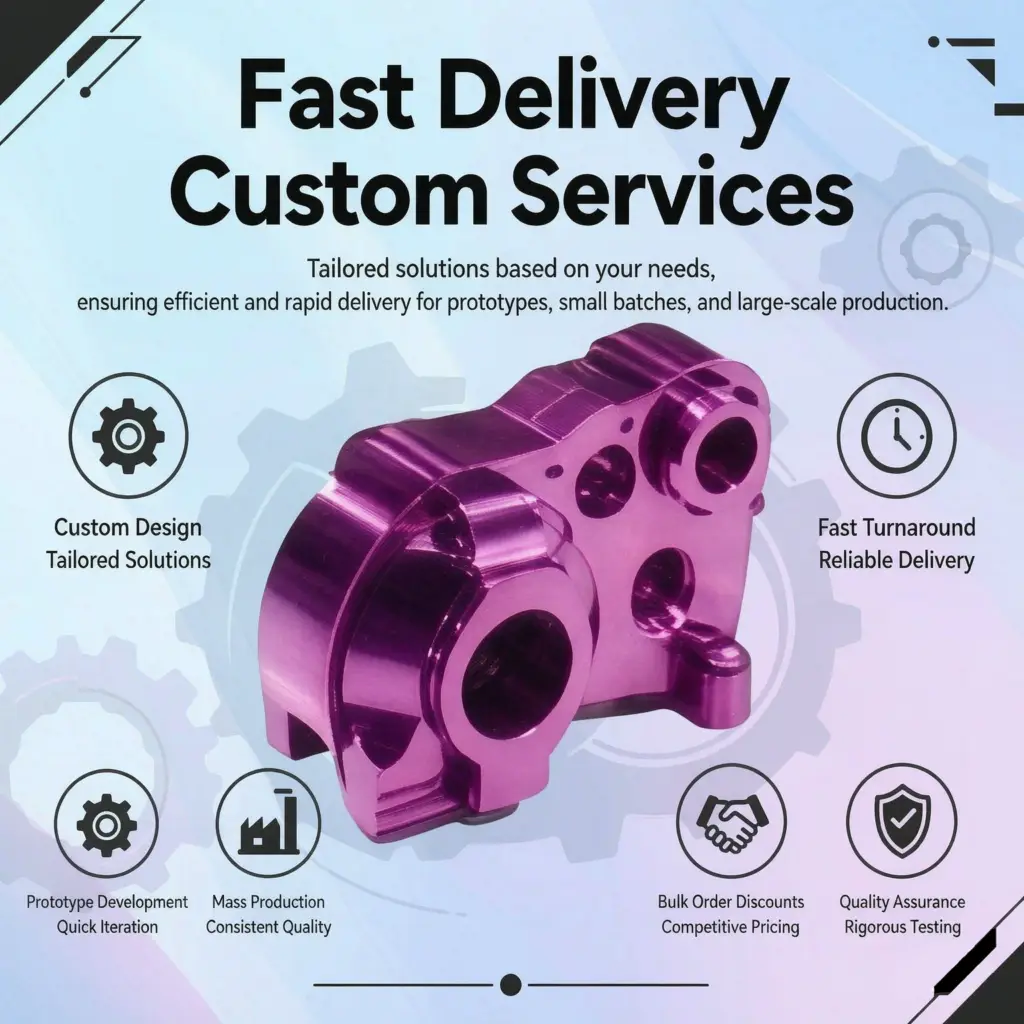
Fast Delivery and Custom Services
We offer tailored solutions based on your needs, ensuring efficient and rapid delivery for prototypes, small batches, and large-scale production.

Ready to Start Your 5-Axis CNC Machining Project?

Upload your CAD files and receive a fast, accurate machining quote.

Upload

Review

Quote

Production

Simultaneous 5 Axis Machining vs. 3+2 Machining: How to Choose

Simultaneous 5-axis CNC machining and 3+2 machining use the same five machine axes, but they differ in how those axes move during cutting and which parts they are best suited for.

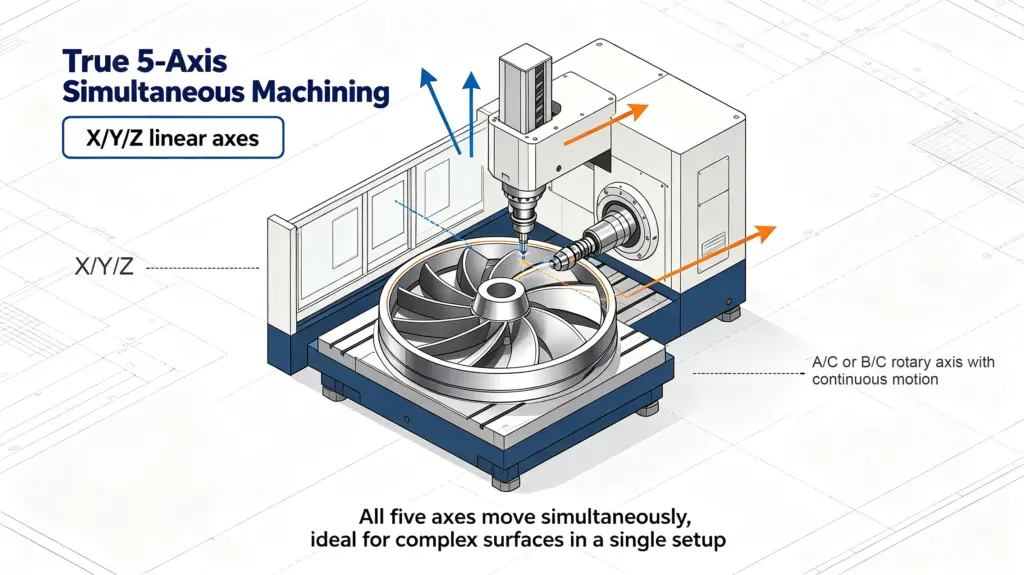
Simultaneous 5-Axis Machining

Simultaneous 5-Axis Machining

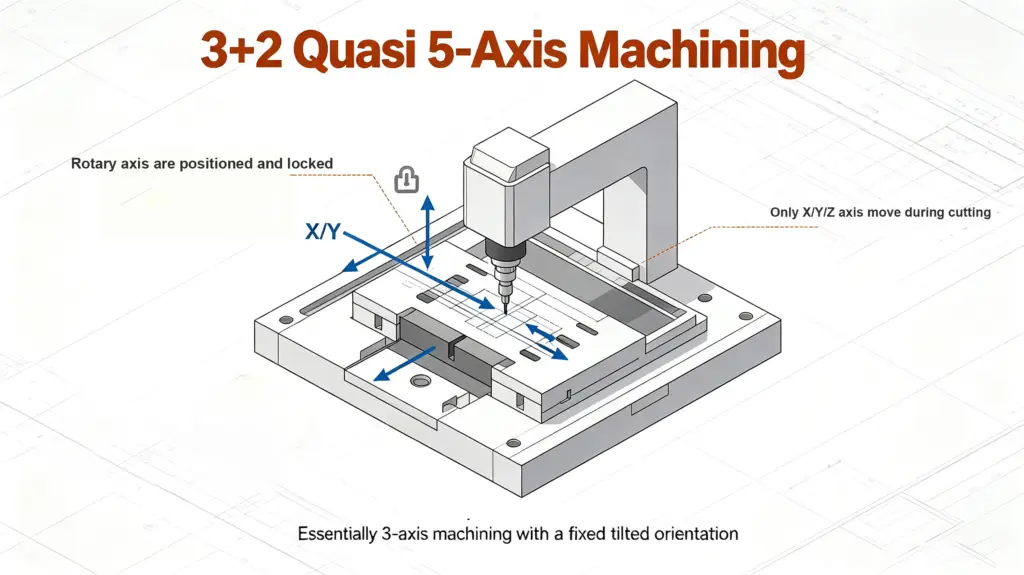
3+2 Axis Machining

3+2 Axis Machining

Axis Motion

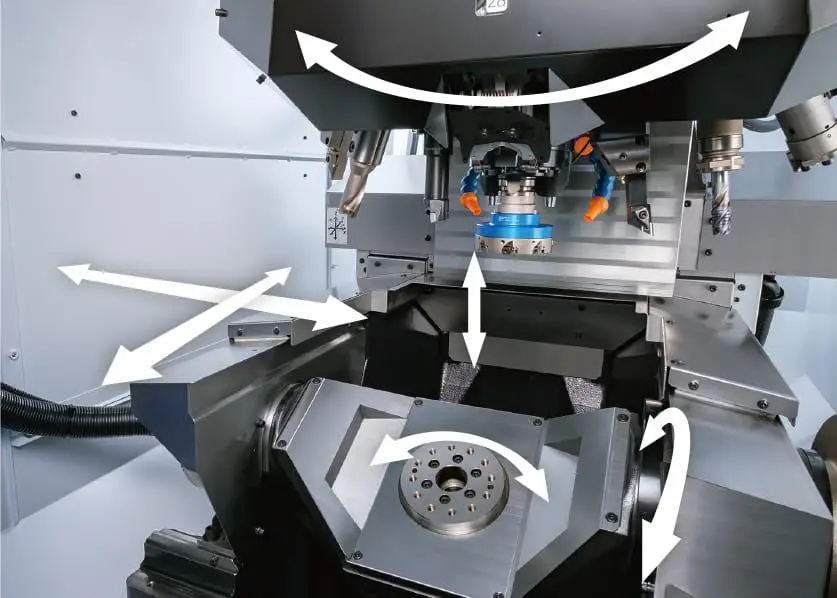
All five axes can move together during machining. As the tool follows the programmed path, the rotary and linear axes continuously coordinate to change the cutting position and orientation. This allows the machine to follow complex surfaces and contours without repeatedly stopping to reposition the workpiece.

Three linear axes perform the cutting from a fixed indexed angle. The two rotary axes first rotate the part or tool into the required position and then remain stationary during the cut. When another side or angle needs to be machined, the rotary axes index to a new position before cutting continues.

Part Geometry

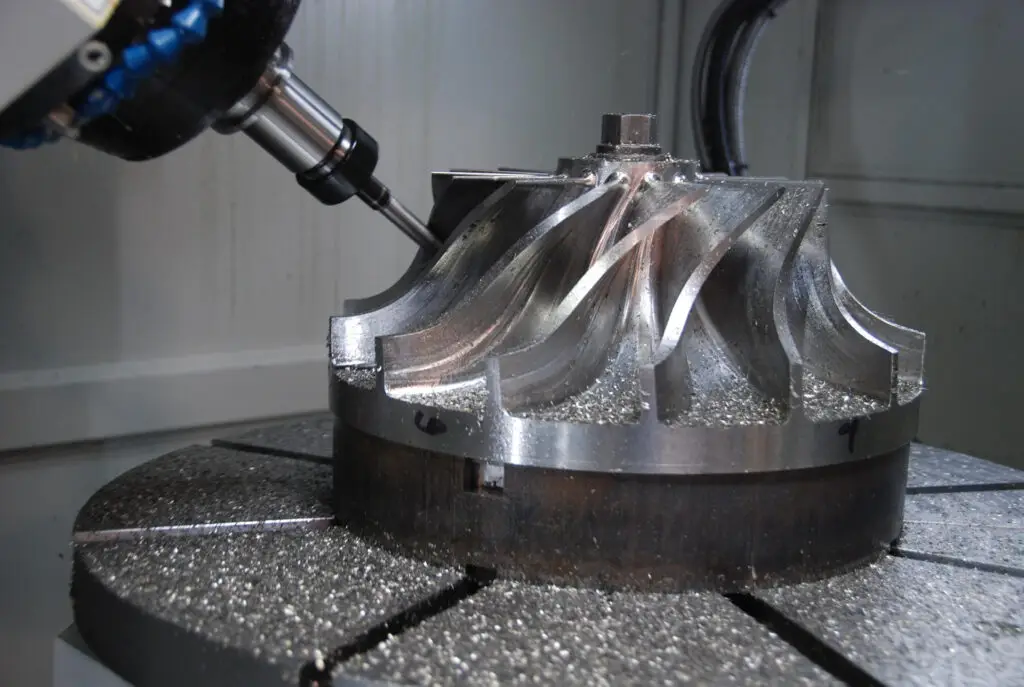
Best suited for complex contours, deep cavities, impellers, and freeform surfaces that require continuous multi-axis tool movement.

Well suited for multi-face parts, angled holes, pockets, and features that can be machined from several indexed positions.

Setup Requirements

More features can often be completed in a single setup, reducing repositioning and helping maintain consistency between machined features.

Several indexed positions may be required to complete the part, depending on the number and orientation of features.

Surface Finish

Continuous tool motion is better suited to smooth transitions and complex curved surfaces with fewer visible tool marks.

Suitable for standard machined surfaces, but complex contours may require additional finishing or repositioning.

Best For

Ideal for high-complexity parts where geometry, surface continuity, and fewer setups are priorities.

A practical choice for multi-angle parts that do not require continuous five-axis motion.

Types of 5 Axis CNC Machine Configurations

5-axis CNC machines use different rotary-axis configurations depending on part size, geometry, tool access, and machining requirements. Two common designs are trunnion-style and swivel-head configurations.

Trunnion-Style 5-Axis Machine

Trunnion-Style 5-Axis Machine

Swivel-Rotate-Style 5-Axis Machine

Swivel-Rotate-Style 5-Axis Machine

Workpiece Movement

Rotary table tilts and rotates the workpiece during positioning and machining.

Workpiece remains more stable while the spindle tilts or rotates around the part.

Axis Configuration

Typically combines tilting and rotary table axes.

Typically combines a tilting spindle head with a rotary axis.

Tool Access

Strong access to multiple sides of small and medium-sized parts.

Greater flexibility around large, deep, or irregular components.

Tool Length

Longer tools may be required for some deep or restricted features.

Flexible spindle orientation can allow shorter and more rigid cutting tools.

Part Type

Best for small to medium complex precision parts and freeform surfaces.

Better for larger, heavier, or irregularly shaped parts and housings.

Typical Applications

Medical, aerospace, mold making, precision components.

Aerospace structures, automotive, energy equipment, large housings.

5 Axis Machining Parts and Applications

Explore how 5-axis CNC machining supports complex, high-precision parts across automotive, aerospace, medical, robotics, semiconductor, and optical applications.

Automotive

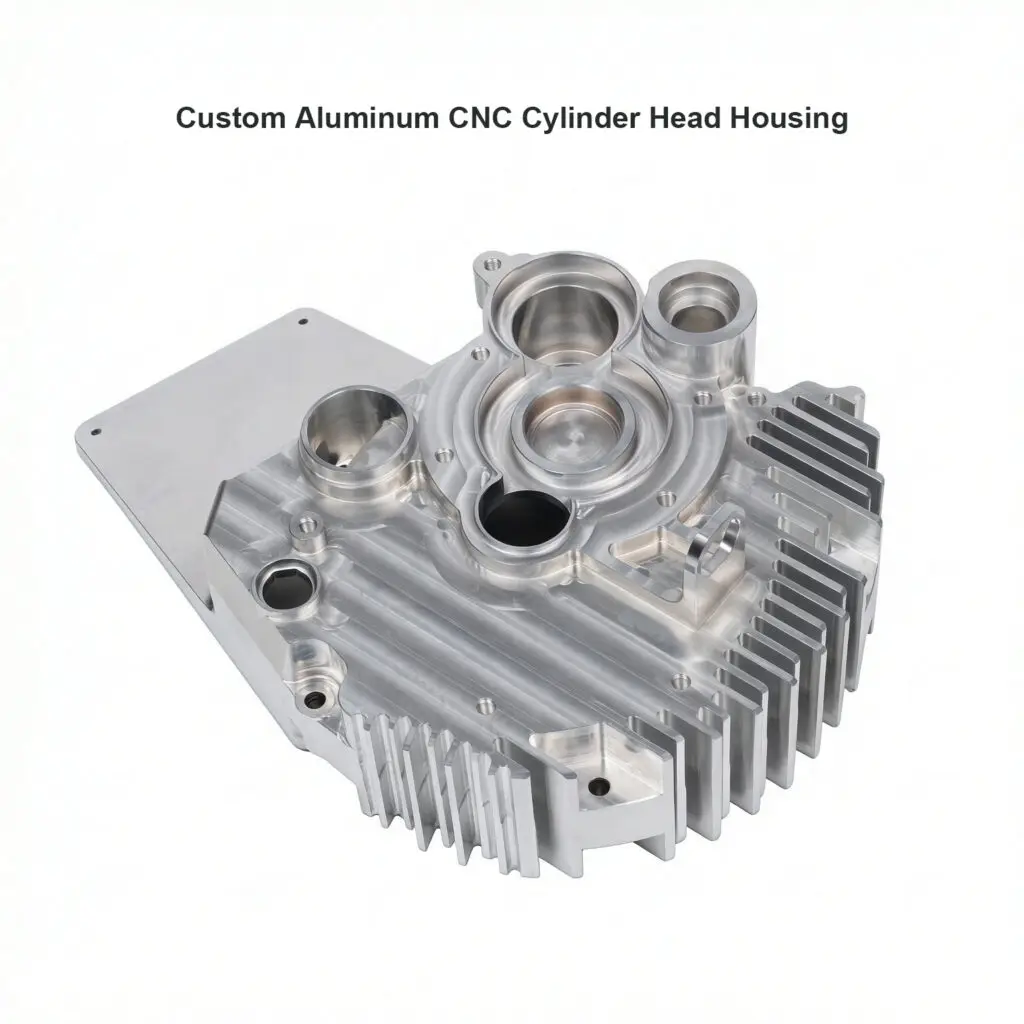
5-axis CNC machining is suitable for complex automotive components that require multi-angle machining, tight tolerances, and consistent dimensional accuracy.

汽摩配件 定制铝合金CNC气缸盖壳体

Aerospace

5-axis CNC machining enables the production of lightweight aerospace components with complex geometries, tight tolerances, and excellent surface finishes for demanding flight applications.

Aerospace

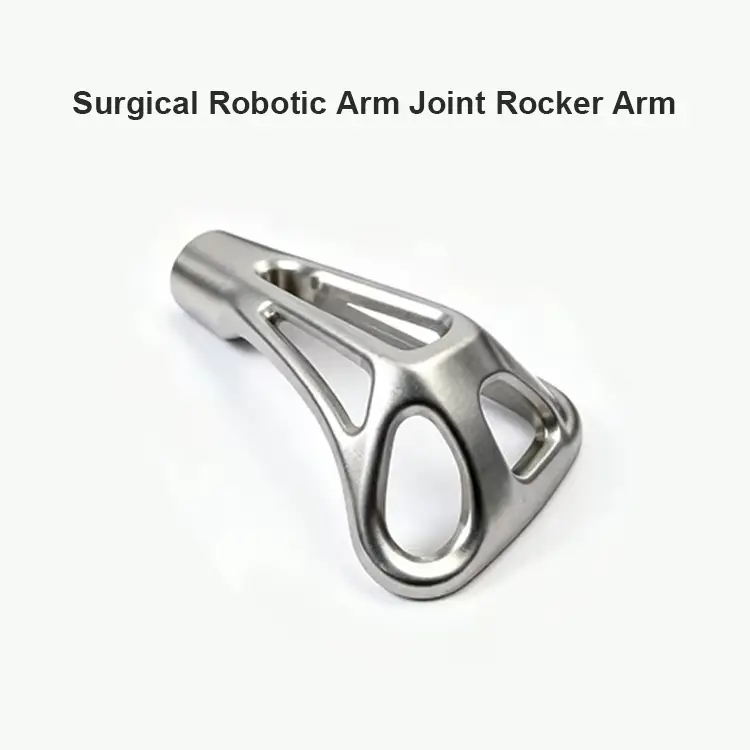
Medical

5-axis CNC machining supports precision medical components with complex geometries, small features, and tight tolerance requirements.

Medical

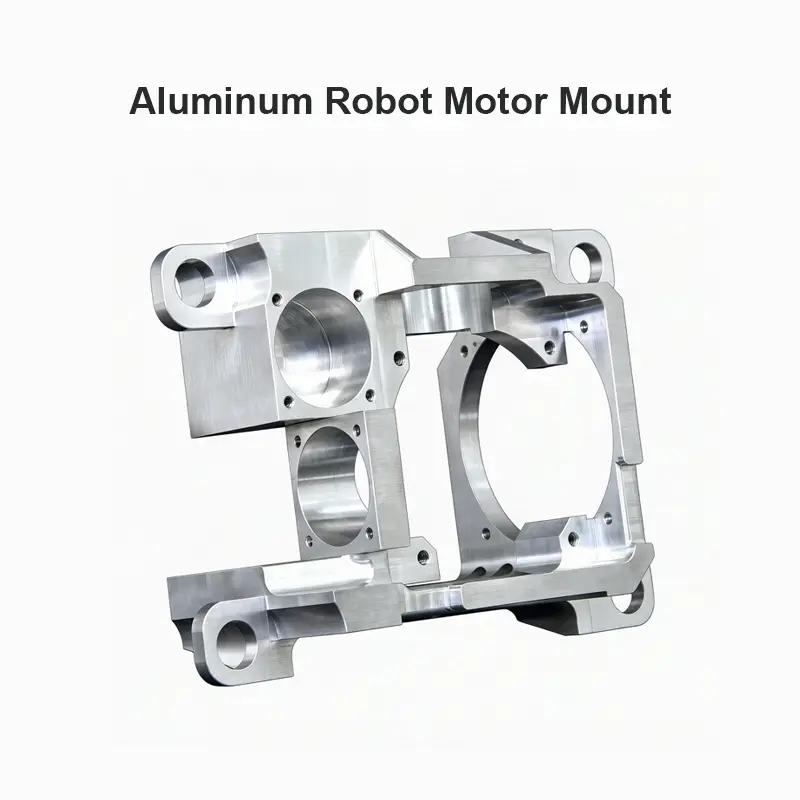
Robotics

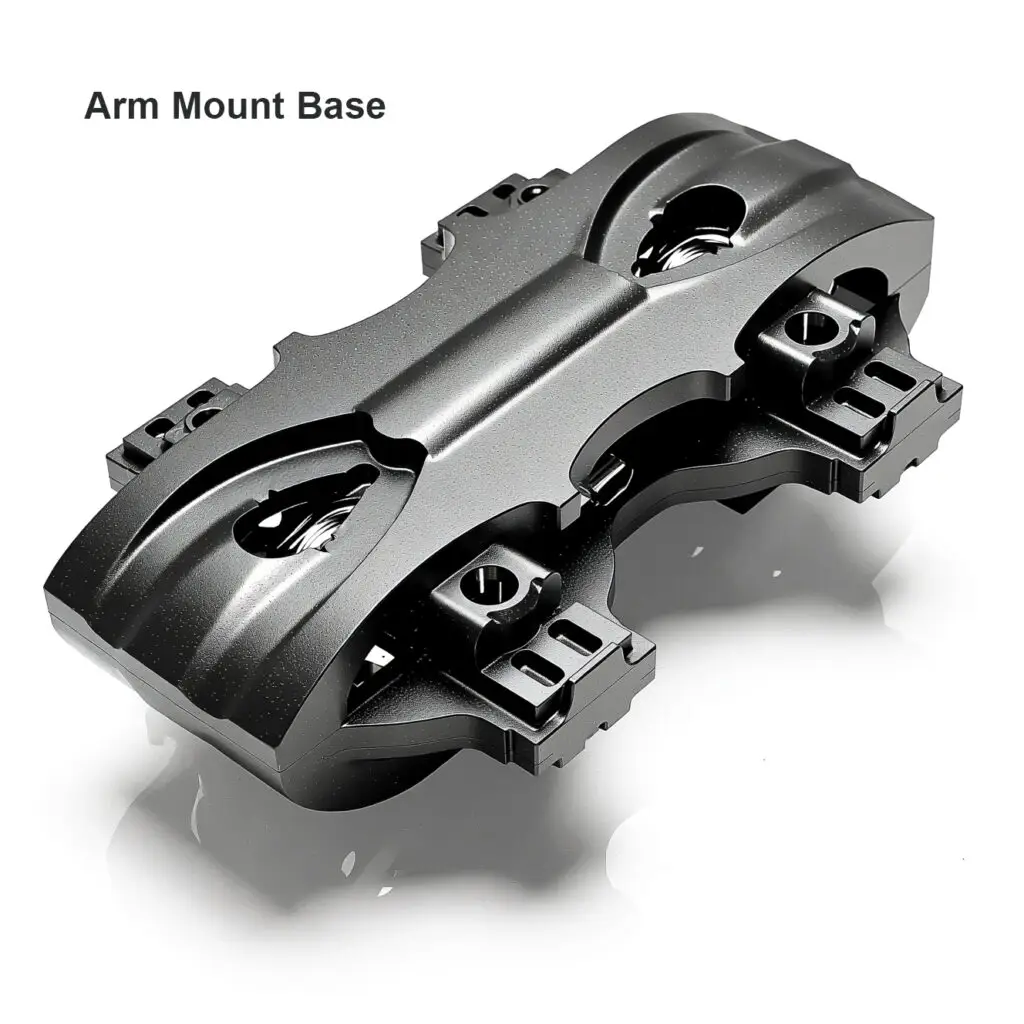
5-axis CNC machining enables complex robotic components to be produced with fewer setups and accurate multi-surface machining.

Robotics

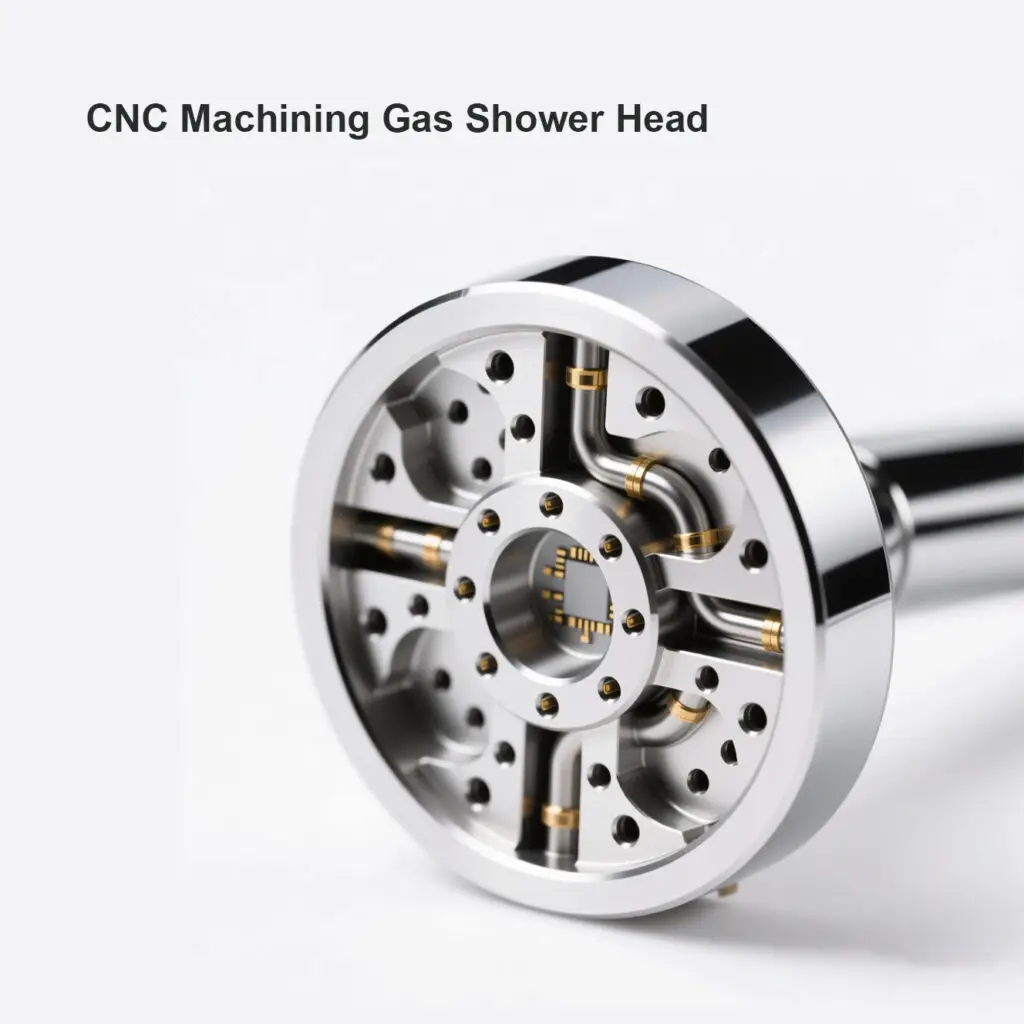
Semiconductor

5-axis CNC machining is suitable for semiconductor equipment parts that require precise hole positions, flatness, complex features, and stable dimensional control.

Semiconductor

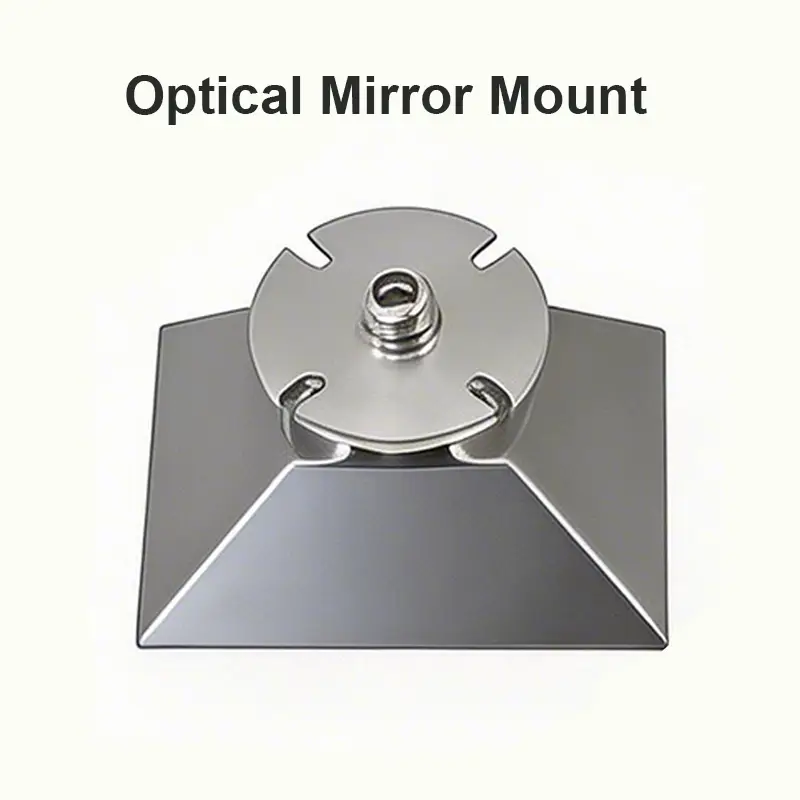
Optical

5-axis CNC machining supports optical equipment components with complex surfaces, precise mounting features, and high dimensional consistency.

Optical

Materials Used for 5 Axis CNC Milling

Explore commonly used metals and engineering plastics for 5-axis CNC machining, selected to meet different requirements for strength, weight, machinability, corrosion resistance, and part performance.

Alum

Aluminum

Aluminum is widely used in 5-axis CNC machining because of its low weight, good machinability, and suitability for complex precision parts.

Common Grades

6061, 7075, 2024

Machinability

Excellent

Strength-to-Weight Ratio

High

Corrosion Resistance

Good

Available Finishes

As machined, anodizing, bead blasting, polishing

SS

Stainless Steel

Stainless steel is suitable for precision components that require high strength, corrosion resistance, wear resistance, and reliable performance in demanding environments.

Common Grades

304, 316, 303, 17-4 PH

Machinability

Moderate

Strength

High

Corrosion Resistance

Excellent

Available Finishes

As machined, polishing, passivation, bead blasting

Steel

Steel

Steel is widely used in 5-axis CNC machining for components that require high strength, rigidity, wear resistance, and reliable mechanical performance.

Common Grades

1018, 1045, 4140, D2

Machinability

Good to Moderate

Strength

High

Wear Resistance

High

Available Finishes

As machined, black oxide, plating, heat treatment

Ti

Titanium

Titanium is suitable for 5-axis CNC machining of high-performance components that require high strength, low weight, corrosion resistance, and complex precision features.

Common Grades

Grade 2, Grade 5 (Ti-6Al-4V)

Machinability

 Difficult

Strength-to-Weight Ratio

Excellent

Corrosion Resistance

Excellent

Available Finishes

As machined, polishing, bead blasting, anodizing

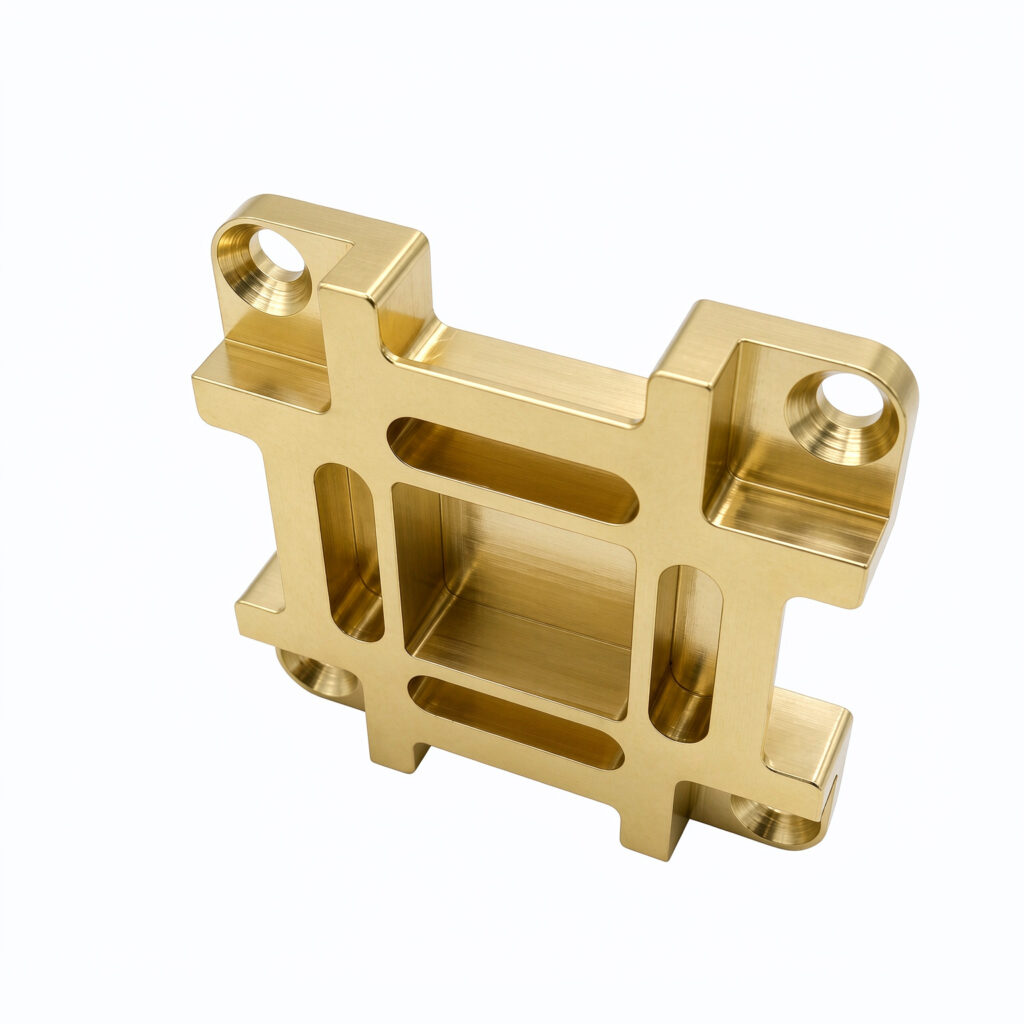
Brass

Brass

Brass is well suited for precision CNC machining because of its excellent machinability, dimensional stability, corrosion resistance, and attractive surface finish.

Common Grades

C360, C260

Machinability

Excellent

Corrosion Resistance

Good

Electrical Conductivity

Good

Available Finishes

As machined, polishing, plating, brushing

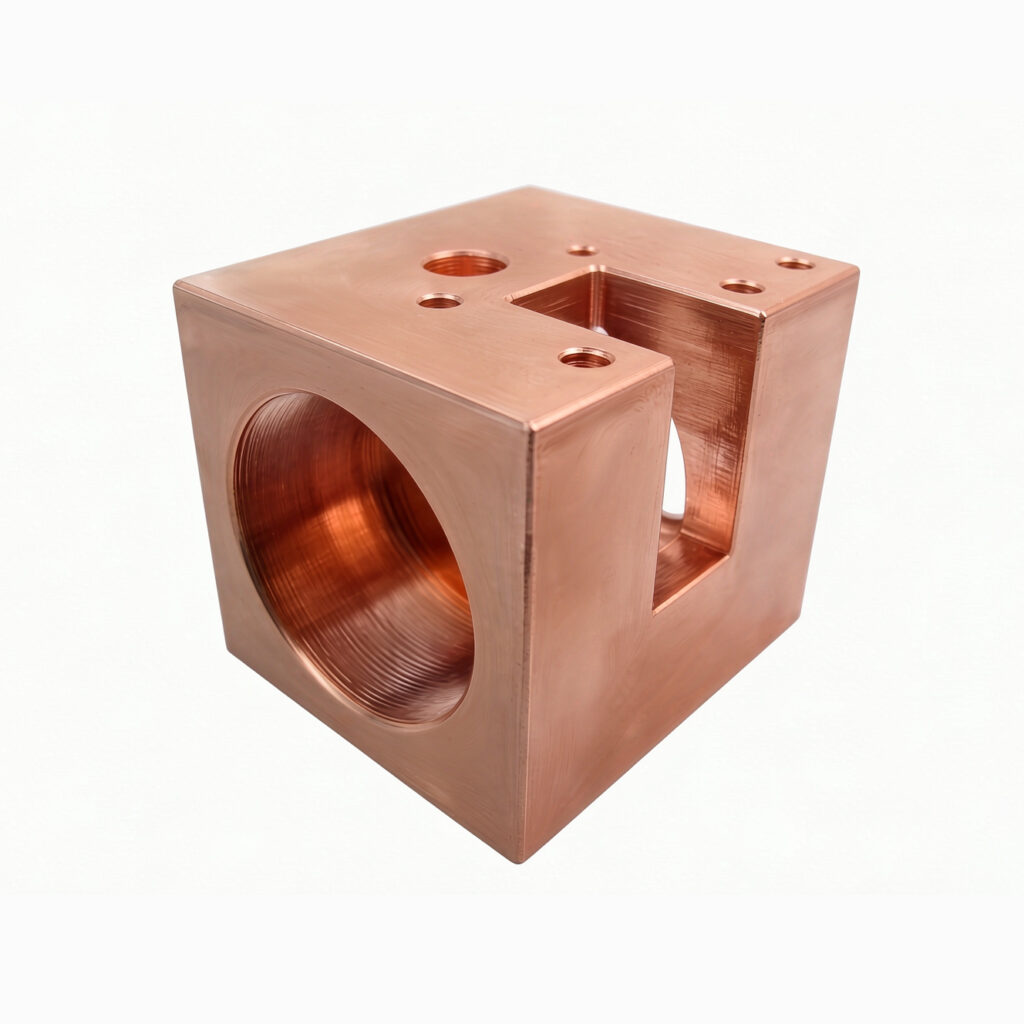
Copper

Copper

Copper is commonly used for precision machined components that require excellent electrical conductivity, thermal conductivity, and reliable dimensional accuracy.

Common Grades

C110, C101

Machinability

 Moderate

Electrical Conductivity

Excellent

Thermal Conductivity

Excellent

Available Finishes

As machined, polishing, plating, brushing

5 Axis Machining Design Guidelines for Complex Parts

Follow these practical design guidelines to improve machinability, reduce unnecessary machining complexity, and support more efficient 5-axis CNC production.

Feature
Guideline

Minimum Hole Diameter

≥ 0.5 mm (0.02 in)

Minimum Slot Width

≥ 0.5 mm (0.02 in)

Minimum Wall Thickness

Metals: ≥ 0.8 mm (0.031 in); Plastics: ≥ 1.0 mm (0.039 in)

Fillets and Corners

Use radii/fillets on internal corners to reduce stress and improve machinability

Deep Pockets

Avoid where possible; increase corner radius and reduce depth for better results

Material Suggestions

Aluminum (6061/7075), Stainless Steel, Titanium, PEEK

Common Five Axis Machining FAQs

A: 5-axis CNC machining is an advanced machining process that uses three linear axes (X, Y, and Z) combined with two rotary axes to control the cutting tool or workpiece position. Unlike traditional 3-axis machining, it allows the tool to approach parts from multiple angles, reducing the need for repeated setups. This makes it suitable for producing complex components with curved surfaces, angled features, deep cavities, and tight precision requirements.

A: 5-axis CNC machining works by coordinating five controlled movements simultaneously or positioning two rotary axes before cutting to achieve the required machining angle. The X, Y, and Z axes control linear movement, while the additional A, B, or C rotary axes adjust tool orientation or workpiece rotation. This enables better tool access, shorter setups, and more efficient machining of complex geometries.

A: The main difference between 5-axis and 3-axis machining is the number of controlled movements available during cutting. A 3-axis CNC machine moves along the X, Y, and Z axes, making it suitable for standard parts with flat surfaces, holes, and pockets. A 5-axis machine adds two rotary axes, allowing machining from multiple angles and improving efficiency for complex parts with advanced geometries.

A: The difference between simultaneous 5-axis and 3+2 machining is how the rotary axes move during the cutting process. Simultaneous 5-axis machining allows all five axes to move continuously together, making it ideal for complex contours, freeform surfaces, and highly detailed components. In 3+2 machining, the rotary axes position the part at a fixed angle before cutting, which is often more suitable for angled features and multi-sided machining.

A: 5-axis machining is suitable for complex precision parts that require multiple machining directions, curved surfaces, or difficult-to-reach features. Common applications include aerospace components, medical devices, automotive parts, semiconductor components, impellers, molds, and precision housings. By reducing setups and improving tool accessibility, 5-axis machining helps maintain accuracy while manufacturing complex geometries. 

A:5-axis CNC machining can process a wide range of metals and engineering plastics, including aluminum, stainless steel, titanium, brass, copper, PEEK, and other machinable materials. Material selection depends on the required strength, weight, corrosion resistance, thermal performance, and application requirements. With proper tooling and process planning, 5-axis machining can produce precision components across industries such as aerospace, medical, automotive, and industrial equipment.

Start Your Custom 5-Axis CNC Machining Project

Scroll to Top